
Year-End Tax Statements for Landlords: The Complete 2026 Preparation Checklist

The annual tax scramble isn't an inevitable cost of real estate investing; it's the direct result of treating reconciliation as an emergency rather than a routine process. If you manage rental properties across fragmented accounts, compiling complete year-end tax statements for landlords while distinguishing routine repairs from capital improvements is both frustrating and risky. You know the anxiety that comes with misplaced receipts, Schedule E audit triggers, and the persistent concern that overlooked deductions are silently reducing your net operating income.
You shouldn't have to waste entire weekends on manual data entry just to confirm your compliance before the spring deadlines. This guide provides a structured preparation checklist covering every essential financial statement, deduction record, and safe harbor threshold you need for a seamless filing season. From reconciling your general ledger to preparing an audit-resistant package for your CPA, here is how to eliminate reporting discrepancies and master your 2026 rental property taxes.
Key Takeaways
- Master the four core financial summaries, including the profit and loss ledger and balance sheet, that establish the numeric base for IRS Form 1040 Schedule E.
- Follow an operational document checklist to compile all year-end tax statements for landlords, covering non-refundable fees, vendor forms, and local tax records.
- Differentiate routine operational repairs from capital improvements to optimize depreciation recovery periods and apply safe harbor thresholds accurately.
- Maintain clean audit trails by isolating tenant security deposits on the balance sheet and avoiding personal bank account commingling.
- Compare spreadsheet accounting with structured property management reporting to streamline your annual CPA filing handoff.
Essential Year-End Tax Statements Every Landlord Must Compile
Compiling year-end tax statements for landlords isn't merely an administrative chore for the spring filing window. It creates the objective quantitative record of your asset performance. These consolidated statements summarize total gross receipts, operational disbursements, capital outlays, and net cash flow across every property in your portfolio. Precision matters here. Discrepancies between your internal ledgers and reported figures invite regulatory scrutiny, complicate debt-to-income verification for portfolio refinancing, and cause tax preparers to bill extra hours for basic cleanup.
IRS Form 1040 Schedule E and Supporting Records
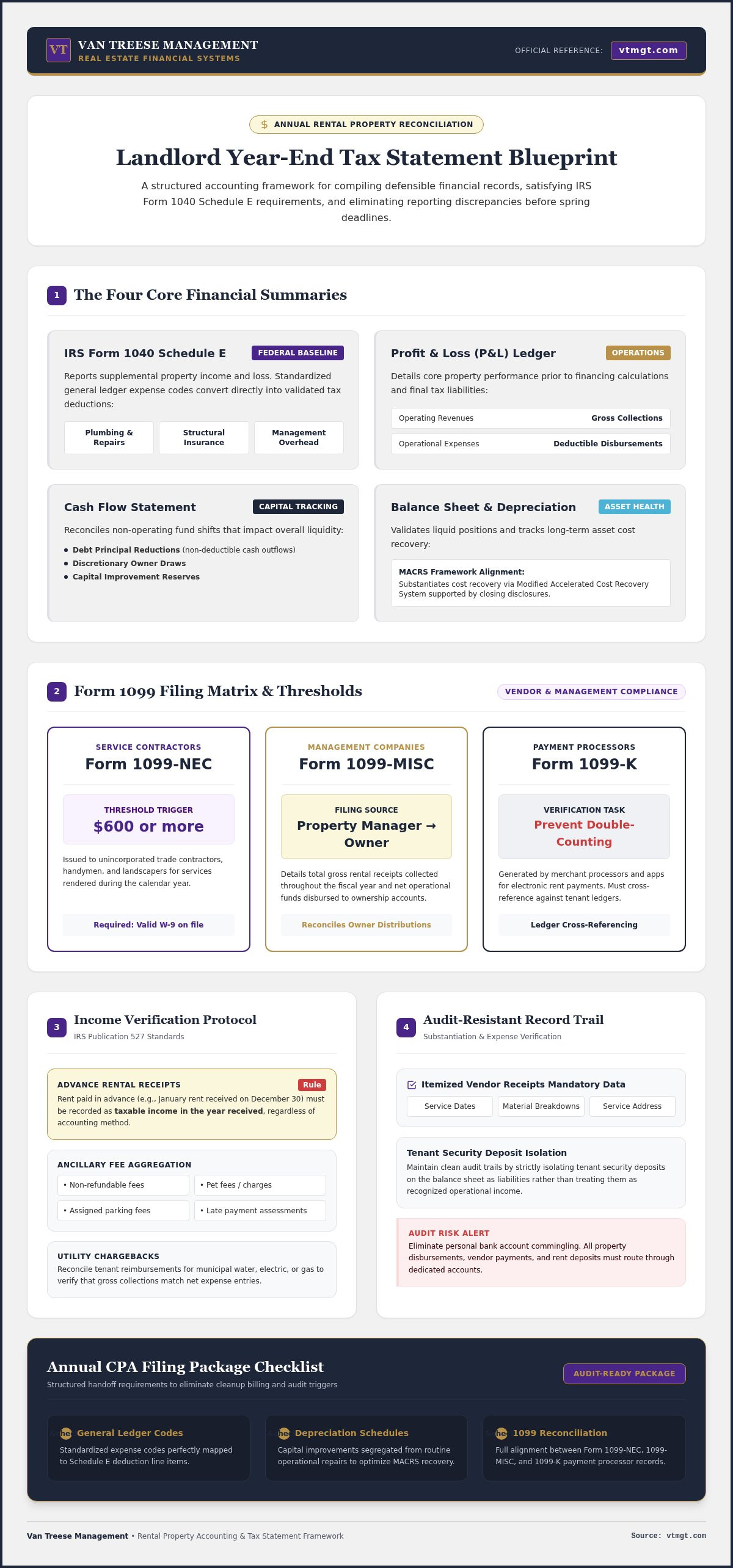
Schedule E serves as the federal baseline for reporting supplemental property income and loss. Standardized general ledger expense codes correspond directly to specific Schedule E line items, transforming operational transactions like plumbing repairs, structural insurance, and management overhead into verified tax deductions. Beyond the form itself, you must maintain matching bank records, digital receipts, and closing disclosures to validate every deduction against prospective IRS audits. These records substantiate cost recovery calculated through the Modified Accelerated Cost Recovery System (MACRS) across your assets.
1099-MISC, 1099-NEC, and 1099-K Reporting Requirements
Information returns ensure compliance across external contractor networks and property management relationships. Landlords must track payments systematically throughout the fiscal year to satisfy these distinct reporting requirements:
- Form 1099-NEC: Issue this statement to unincorporated trade contractors, landscapers, and handymen paid $600 or more for services rendered during the calendar year.
- Form 1099-MISC: Professional property management companies issue this form to property owners to detail gross rental receipts collected and net funds disbursed to ownership accounts.
- Form 1099-K: Merchant processors and payment applications generate this form for electronic payments; cross-reference these totals against tenant ledgers to prevent accidental double-counting of rental revenue.
Annual Profit and Loss (P&L) and Cash Flow Summaries
The annual Profit and Loss (P&L) statement reflects the core operational performance of each property, detailing operating revenues alongside deductible operational expenses before financing charges and tax calculations. A cash flow statement expands on this by tracking non-operating movements, including debt principal reductions, discretionary owner draws, and capital improvement reserves. Certified Public Accountants need both year-end tax statements for landlords to reconcile true taxable net income with actual liquid balance sheet positions, guaranteeing that your filings remain defensible and comprehensive.
The Comprehensive Year-End Tax Statement Checklist for Rental Properties
Executing an organized tax filing requires moving systematically from raw receipts to categorized records. Rather than sifting through disordered banking portals in March, investors rely on an operational checklist to verify every income stream and deductible disbursement. This sequential workflow guarantees that all year-end tax statements for landlords align with federal documentation standards before submittal to your CPA.
Income Verification and Advance Payment Accounting
Reconciling gross revenue requires examining more than base contractual rents. You must account for every auxiliary charge collected across the twelve-month operating cycle:
- Advance Rental Receipts: Under federal rules detailed in IRS Publication 527, rent paid in advance (such as January rent received on December 30) must be recorded as taxable income in the year received, regardless of accounting method.
- Ancillary Fee Ledgers: Aggregate non-refundable fees, pet charges, assigned parking fees, and late payment assessments into separate income lines.
- Utility Chargebacks: Reconcile tenant reimbursements for municipal water, electric, or gas services to ensure gross collections match net expense entries.
Operating Expense and Vendor Payment Records
Every operational deduction requires an audit-resistant paper trail. Maintain itemized vendor receipts displaying service dates, material breakdowns, and service addresses rather than relying on unitemized credit card summaries. Tracking ongoing repairs through structured property accounting ensures routine maintenance isn't misclassified. For regional operational strategies, study our guide to rental property maintenance in Northern Michigan to handle seasonal winter utility costs and service invoices efficiently. Collect all legal fees, tenant screening invoices, and management administration records to claim full operational offsets.
Financing, Taxes, and Insurance Documentation
Securing external statements ensures non-operating carrying costs match state and institutional ledgers. Gather Form 1098 from your mortgage servicers to isolate deductible mortgage interest and points from escrow balances. You must also compile local municipal property tax receipts, split between summer and winter assessments, alongside proof of comprehensive liability and hazard insurance payments made throughout the year. As your portfolio expands, adopting professional property management in Petoskey, MI delivers structured financial systems that keep these statements synchronized month after month.
To establish full audit readiness across your assets, exploring professional financial reporting and accounting helps maintain clean general ledgers without manual end-of-year administrative strain.
Reconciling Security Deposits, Repairs, and Capital Depreciation
Reconciling operational disbursements against long-term capital assets requires technical accounting discipline. Mischaracterizing routine maintenance as a capital upgrade or booking tenant escrow liabilities as current revenue creates discrepancies during an IRS compliance review. Clean reconciliation in your year-end tax statements for landlords establishes distinct boundaries between immediately deductible operating costs, escrow liabilities, and multi-year cost recovery schedules.
Security Deposit Accounting and Escrow Compliance
Tenant security deposits are balance sheet liabilities, not earned revenue. They remain tenant property held in escrow until lease conclusion. If a tenant defaults or inflicts unit damage exceeding normal wear and tear, the retained funds convert into taxable income for that tax year. You then offset this income dollar-for-dollar against the deductible repair invoices paid. Review our summary of Michigan landlord laws to maintain strict escrow separation and follow state-mandated itemized deduction notices upon lease termination.
Repairs vs. Improvements: Applying the De Minimis Safe Harbor
The IRS separates property maintenance into operational repairs and capital improvements. Routine repairs keep a rental unit in its ordinary operating condition without extending its lifespan. Capital improvements, by contrast, involve material betterments, structural restorations, or adaptations to new uses. Under IRS Publication 527, these improvements require multi-year depreciation. However, property owners can leverage the De Minimis Safe Harbor election to immediately expense qualifying tangible property or equipment costing up to $2,500 per invoice or item, keeping minor upgrades out of complex depreciation schedules.
Tracking Depreciation and Form 4562 Assets
Substantial capital outlays exceeding the safe harbor threshold must be capitalized and depreciated over prescribed statutory timeframes. Residential rental structures depreciate over a 27.5-year straight-line recovery schedule, whereas commercial properties follow a 39-year timeline. Landlords report these non-cash deductions on IRS Form 4562. Maintaining an ongoing fixed-asset ledger documenting in-service dates, physical asset descriptions, and cost basis allocations ensures your tax preparer applies applicable recovery periods and permanent bonus depreciation rules accurately.
Common Pitfalls in Year-End Landlord Reporting and Michigan Specifics
Operational oversights during the fiscal year inevitably surface during reconciliation, compromising the integrity of your filings. When preparing year-end tax statements for landlords, minor accounting discrepancies can trigger extended reviews from the IRS or the Michigan Department of Treasury. Maintaining clear audit trails and understanding regional expense variations prevents unexpected assessments and protects your investment yield.
Commingled Funds and Inadequate Documentation Trails
Maintaining mixed personal and business banking accounts remains the fastest way to compromise legal entity protection and invite tax scrutiny. Operating individual commercial checking accounts for every property or holding company establishes transparent income and expense boundaries. Missing vendor receipts represent the primary audit vulnerability during state or federal tax reviews. Every general ledger line item must correspond to an itemized invoice detailing materials, service labor, vendor tax identification numbers, and exact property locations.
Northern Michigan Seasonal Maintenance and Property Taxes
Operating rental assets in northern climates introduces regional accounting complexities that generic national tax guides overlook. The state assesses income at a flat 4.0% rate on net rental earnings, making accurate operational deduction tracking essential. Investors must properly classify substantial seasonal invoices:
- Winter Maintenance Outlays: Snow plowing, roof shoveling, mechanical freeze prevention, and emergency ice dam remediation require timely classification as routine operational repairs.
- Bifurcated Property Tax Levies: Michigan municipalities bill real estate taxes in two separate cycles: summer and winter. Reconcile both statements based on the calendar payment dates to ensure cash basis ledgers match county records.
- Assessment Adjustments: Verify millage rates and taxable value adjustments across Emmet, Charlevoix, and Grand Traverse counties to account for annual property valuation changes accurately.
Audit-Proof Record Retention Standards
Tax preparation extends beyond generating annual totals; you must also preserve historical proof. Maintain digital repositories with redundant cloud encryption containing bank statements, cleared checks, executed leases, and vendor invoices for a rolling seven-year window. Permanent asset records, including initial closing disclosures, land-to-building value allocations, and capital improvement receipts, must be kept for the entire duration of property ownership plus seven years past asset disposition.
To eliminate compliance risks across your Northern Michigan portfolio, request property management services from our local team to establish structured financial reporting systems.
Streamlining Year-End Tax Reporting: DIY Systems vs. Professional Management
Every landlord reaches a point where manual financial tracking creates friction. While spreadsheets offer total operational control, they introduce severe calculation liabilities and administrative drag as property counts grow. Dedicated landlord software automates rent processing, yet still demands manual transaction coding and receipt reconciliation. For owners seeking complete accuracy, outsourcing property operations to professional management transforms the annual tax scramble into a predictable, hands-off reporting delivery.
The True Cost of Self-Managed Tax Bookkeeping
Self-managing rental records carries substantial hidden costs beyond simple software subscriptions:
- Administrative Time Drain: Tracking individual vendor receipts, distributing Form 1099-NECs, and manually reconciling bank statements consumes dozens of hours every January.
- Overlooked Operational Deductions: Manual data entry frequently misses legitimate deductible items like travel mileage, software tools, advertising costs, and minor repair charges.
- Costly Filing Corrections: Ledger errors trigger filing delays, amended tax returns, and elevated billable hours from your CPA to reclassify transactions properly.
Standardized Financial Reporting Packages from Management
Full-service property management replaces ad-hoc recordkeeping with structured, institutional-grade accounting. Owners receive standardized monthly statements detailing gross receipts, itemized disbursements, and attached vendor repair invoices. At calendar year-end, management issues a consolidated financial packet containing a pre-reconciled annual profit and loss ledger, balance sheet summary, and Form 1099 statements. When your CPA receives pre-categorized year-end tax statements for landlords, tax preparation moves faster, requires fewer revisions, and significantly lowers professional accounting fees.
Optimizing Your Portfolio for Next Tax Season
Systematic tax readiness begins long before December arrives. Aligning lease agreements to clearly delineate tenant utility obligations prevents mid-year accounting disputes. Setting up automated digital rent collection and electronic invoice archives ensures complete data capture from the day a tenant moves in. If you are actively investing in rental property in Northern Michigan, partnering with Van Treese Management gives your portfolio the direct accounting support and financial reporting required to protect operational profits and streamline every future tax cycle.
Transform Your Rental Property Tax Preparation for 2026
Tax preparation doesn't need to disrupt your operations every spring. Treating recordkeeping as an ongoing operational standard protects your bottom line. By isolating escrow liabilities on your balance sheet, categorizing repairs under safe harbor guidelines, and collecting itemized vendor receipts, you transform fragmented files into verifiable proof. Clean records safeguard your deductions and ensure your CPA has the quantitative clarity required to maximize your net operating income.
Establishing structured year-end tax statements for landlords eliminates audit exposure and preserves your investment yield across every market cycle. Consistent financial tracking turns annual reconciliation into a simple validation step rather than an administrative scramble.
If managing general ledgers across your Northern Michigan portfolio is pulling focus from your long-term investment goals, professional operational support makes all the difference. Simplify your rental accounting with professional property management from Van Treese Management. Our team provides property owners in Petoskey and surrounding communities with standardized monthly owner statements, transparent ledger tracking, and CPA-ready annual financial packages that deliver total peace of mind.
Frequently Asked Questions
What tax documents do landlords need to provide to their CPA?
Landlords should supply an annual profit and loss statement, balance sheet, general ledger, and Form 1098 for mortgage interest. Include all Form 1099-MISC copies, property tax receipts (summer and winter in Michigan), utility billing summaries, and itemized repair receipts. Providing complete year-end tax statements for landlords alongside closing statements for newly acquired properties in Petoskey or Grand Rapids allows your CPA to calculate depreciation accurately without requesting supplemental paperwork.
Do landlords have to issue a 1099-NEC to contractors?
Yes, landlords operating a trade or business must file Form 1099-NEC for unincorporated contractors paid $600 or more during the calendar year. This applies to sole proprietors, partnerships, and independent handymen who provide maintenance, snow clearing, or repair services. Payments made through third-party credit card processors are exempt because the payment settlement entity reports those transactions on Form 1099-K instead.
Is security deposit money considered taxable rental income?
Security deposits aren't taxable income when received because they function as liabilities held in escrow. Under Michigan law and federal IRS rules, deposits only become taxable income if a tenant forfeits them due to lease default or unit damage exceeding normal wear. When you retain funds to repair physical damage, you book the forfeited amount as gross income and claim the repair invoice as an offsetting operating expense.
What is the difference between a rental repair and an improvement?
A repair maintains an asset in normal operating condition, while an improvement extends its useful life or adapts it to a new use. Repairs, such as servicing a furnace or patching drywall, qualify for immediate tax deductions in the year paid. Capital improvements, like installing a new roof or full HVAC replacement, must be capitalized and depreciated over statutory recovery periods on IRS Form 4562.
Can landlords deduct property management fees on Schedule E?
Yes, property owners can fully deduct property management fees on Line 10 of IRS Form 1040 Schedule E. This deduction covers recurring monthly residential management fees, tenant placement charges, lease preparation, and maintenance coordination expenses. When you work with professional management in Northern Michigan, detailed year-end tax statements for landlords document every operational fee cleanly, ensuring seamless substantiation for your annual tax filing.
How long must landlords retain rental property tax records?
Landlords should retain standard operational records for at least seven years following the tax filing date. This window covers bank statements, vendor invoices, lease agreements, and local property tax assessments. However, documents establishing your property basis, such as initial closing disclosures and major capital improvement receipts, must be kept permanently throughout ownership and for seven years after you sell the property.