
Tenant Background Checks: Michigan Screening Guide (2026)

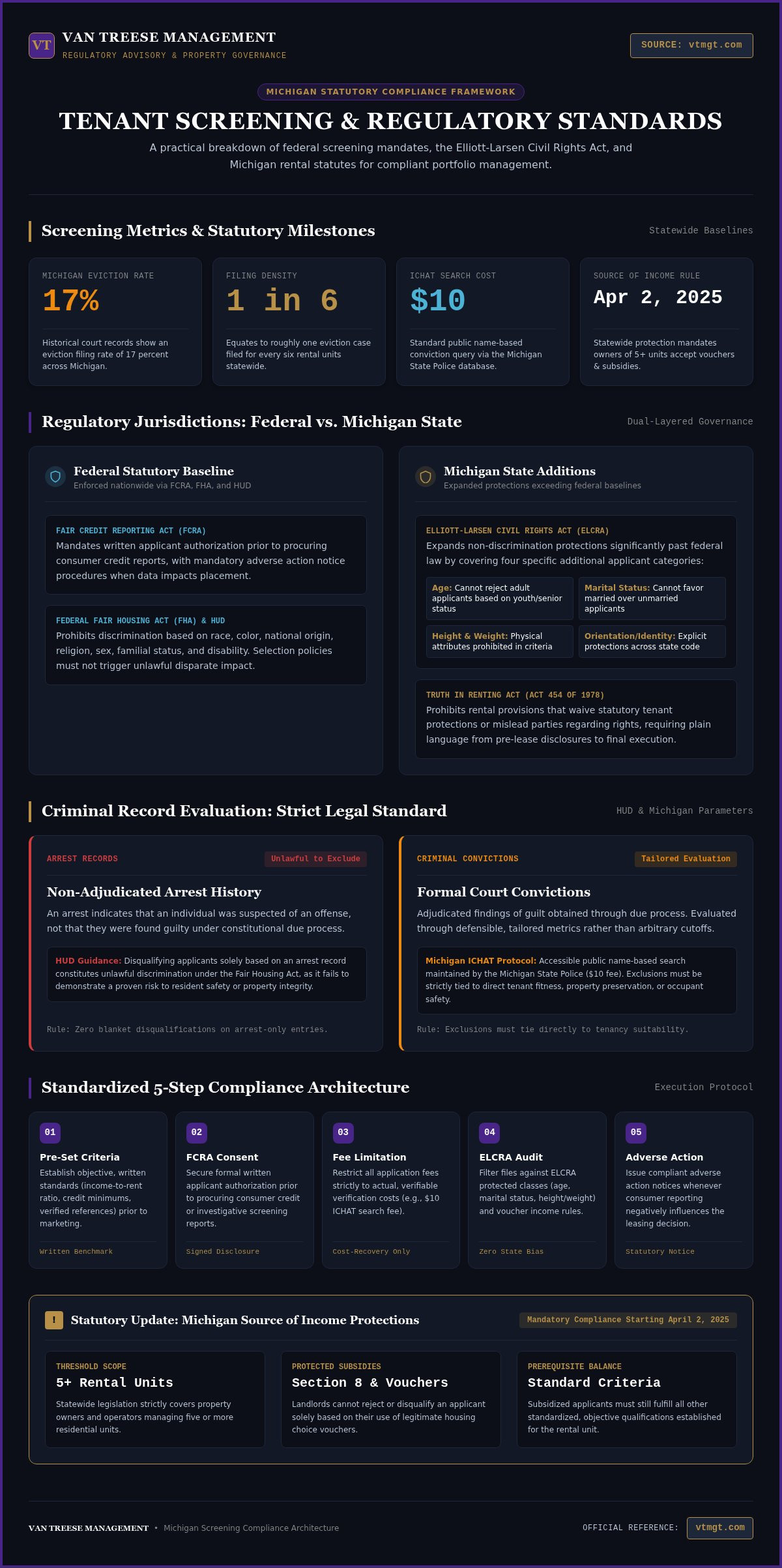
In Michigan, historical court records show an eviction filing rate of 17 percent, which equates to roughly one eviction case for every six rental units statewide. Every property owner wants dependable occupants who care for the premises and pay on time, yet the constant concern over fair housing complaints or consumer reporting violations can paralyze your placement process. Managing background checks for tenants Michigan laws govern requires balancing federal disclosure mandates with state-specific privacy rules and civil rights protections.
You can eliminate that operational liability. By mastering these statutory standards, you'll establish a legally bulletproof screening procedure that filters out unqualified applicants while maintaining full regulatory compliance. This comprehensive guide examines Michigan's screening framework, covering criminal record parameters, Fair Credit Reporting Act updates, and Elliott-Larsen Civil Rights Act requirements, giving you the practical clarity needed to safeguard your rental investments across Northern Michigan and beyond.
Key Takeaways
- Executing background checks for tenants Michigan laws govern requires balancing federal Fair Credit Reporting Act standards with broader state protections under the Elliott-Larsen Civil Rights Act.
- Differentiate strictly between arrest records and criminal convictions to comply with HUD guidelines that prohibit blanket disqualification policies.
- Establish objective, written qualification criteria before accepting applications, ensuring every applicant receives identical screening disclosures and authorization forms.
- Restrict application fees to actual verification costs and always issue compliant adverse action notices when consumer reports influence a leasing decision.
- Standardize placement protocols across your rental portfolio to eliminate fair housing liability and protect long-term property performance.
Michigan Tenant Screening Laws: Legal Framework and Federal Overlays
Tenant background screening is the systematic verification of an applicant's financial stability, rental history, and legal background to evaluate tenancy suitability before entering into a binding contract. Conducting background checks for tenants Michigan laws govern requires operating within a layered legal structure where federal civil rights statutes intersect directly with state codes. Relying on casual intuition or ad-hoc vetting exposes rental owners to substantial legal liability, including administrative fines and fair housing lawsuits.
Every landlord must maintain transparent, written rental qualification criteria before marketing an available unit. Establishing objective minimum thresholds, such as verifiable income-to-rent ratios, clear credit benchmarks, and verifiable references, creates a standardized evaluation benchmark. When these operational standards are applied consistently across all prospective renters, they serve as your primary legal defense against arbitrary discrimination claims.
The Michigan Truth in Renting Act (Act 454 of 1978) complements this structure by regulating lease agreements and pre-lease communications. It prohibits rental terms that waive tenant rights or deceive parties about statutory protections, requiring plain language and transparent disclosures from initial application to final lease signing.
Federal Mandates: Fair Credit Reporting Act and Fair Housing
Consumer vetting procedures must strictly align with federal baselines. Under the Fair Credit Reporting Act (FCRA), landlords must secure written authorization prior to procuring credit reports and follow formal adverse action steps if that data impacts placement. Concurrently, the federal Fair Housing Act prohibits bias based on race, color, national origin, religion, sex, familial status, and disability. The U.S. Department of Housing and Urban Development (HUD) mandates that neutral-sounding selection rules must not create an unlawful disparate impact against these protected classes.
Michigan-Specific Regulations: ELCRA and Truth in Renting
State statutory requirements expand well past federal baselines. When processing background checks for tenants Michigan laws mandate strict adherence to the Elliott-Larsen Civil Rights Act (ELCRA). This legislation grants protections beyond standard federal categories, prohibiting housing discrimination based on:
- Age: Screening criteria cannot reject legally adult candidates simply due to youth or senior status.
- Marital Status: Property owners cannot prioritize married couples over unmarried individuals or co-applicants.
- Height and Weight: Physical attributes cannot factor into qualification metrics.
- Sexual Orientation and Gender Identity: Explicitly protected classes under expanded state civil rights definitions.
Additionally, Michigan enacted statewide source-of-income protections taking effect on April 2, 2025. Landlords operating five or more units cannot deny an applicant based on legitimate subsidies, such as Section 8 Housing Choice Vouchers, provided they meet other standard qualification guidelines.
Criminal Background Checks in Michigan: Limits, Arrests, and ICHAT
When running criminal background checks for tenants, Michigan laws and federal enforcement standards distinguish sharply between an arrest record and an actual conviction. An arrest indicates that an individual was suspected of an offense, not that they were found guilty under due process. HUD enforcement guidance establishes that disqualifying an applicant solely based on an arrest record constitutes unlawful discrimination under the Fair Housing Act, as it does not demonstrate a demonstrable risk to resident safety or property integrity.
Structuring background checks for tenants Michigan laws authorize means evaluating criminal histories through tailored, defensible metrics rather than arbitrary cutoffs. Property owners must limit exclusions strictly to convictions directly tied to the applicant's fitness for tenancy.
Using Michigan ICHAT and Official State Police Records
Michigan landlords can access public conviction histories via the state's Internet Criminal History Access Tool (ICHAT), maintained by the Michigan State Police. A standard public name-based search costs $10 per submission. While ICHAT provides efficient statewide verification for Michigan misdemeanors and felonies, its scope has technical boundaries. The database excludes federal offenses, tribal court proceedings, juvenile records, and criminal histories originating outside Michigan. Prior to initiating an inquiry, property owners must collect explicit written consent from the prospective renter, keeping procedures aligned with federal mandates on FCRA and Tenant Rights.
Avoiding Disparate Impact and Blanket Criminal Exclusions
Adopting blanket disqualification policies, such as rejecting any applicant with a criminal record, violates federal disparate impact doctrine. Because systemic arrest and conviction rates disproportionately affect specific demographic groups, rigid exclusions trigger federal civil rights scrutiny. Michigan housing providers must conduct an individualized assessment for each candidate before issuing a denial. This protocol evaluates:
- The underlying nature and severity of the specific offense.
- The exact time elapsed since the conviction or completion of the sentence.
- Demonstrated evidence of stable tenancy and positive post-conviction conduct.
Local jurisdictions can enact even stricter standards. Municipalities like Ann Arbor enforce fair chance housing ordinances that prohibit criminal background reviews until a conditional lease offer is extended. To evaluate how these local ordinances align with broader statutory obligations, review our complete breakdown of Michigan Landlord Laws. For rental owners who prefer to bypass these complex compliance hurdles, partnering with Van Treese Management ensures your placement procedures remain consistent, structured, and legally protected.
Step-by-Step Legally Compliant Screening Process for Michigan Landlords
Executing a legally defensible intake process demands methodical discipline. Standardizing background checks for tenants Michigan laws regulate protects your rental portfolio against accusations of bad faith or preferential treatment. When every candidate undergoes an identical sequence of evaluations, you eliminate operational ambiguity.
A rigorous five-stage screening architecture includes:
- Criteria Publication: Formulate and publish written qualification guidelines before public marketing begins.
- Intake and Disclosure: Collect signed applications alongside standalone consumer disclosure and authorization forms.
- Primary Verification: Cross-reference government-issued identification, current income sources, and verifiable employment data.
- Consumer Reporting: Procure credit histories and Michigan public records through FCRA-certified screening providers.
- Systematic Evaluation: Apply qualification thresholds without deviation, issuing formal statutory notices when required.
Establishing Written Rental Criteria and Obtaining Consent
Under the FCRA, consumer reporting authorizations cannot hide within standard application boilerplate. Applicants must execute a standalone disclosure document authorizing credit, criminal, and eviction investigations. Publishing clear benchmarks, like an income-to-rent threshold of three times the monthly obligation, establishes an objective operational baseline. Providing this written policy before collecting an intake packet prevents subjective rejections, creating a documented evidentiary defense against potential discrimination claims.
Verifying Rental History and Employment Objectively
Subjective impressions introduce liability. Standardize verbal reference interviews by posing identical, verifiable questions to prior property managers. Direct your inquiries to payment timeliness, lease covenant compliance, documented property conditions upon surrender, and whether the party gave proper notice before vacating. When verifying earnings, rely exclusively on authoritative documents like recent W-2 forms, certified tax filings, or consecutive banking records showing steady inflows.
Maintaining Records and Secure Document Retention
Proper file management serves as your primary shield during a regulatory investigation. Maintain complete files for every applicant, including rejected submissions, consumer reports, and scoring notes, for at least three years. This timeline covers the two-year federal Fair Housing Act statute of limitations and the three-year window under the Michigan Elliott-Larsen Civil Rights Act.
Michigan's Identity Theft Protection Act (Act 452 of 2004) mandates strict confidentiality for social security numbers, banking details, and birth dates. Digital archives must utilize encrypted storage protocols with restricted access controls. When disposing of consumer information, federal law requires permanent physical destruction via cross-cut shredding or complete cryptographic wiping of digital storage media.
Credit Reports, Application Fees, and Adverse Action Notices in Michigan
Financial evaluations form the core of tenancy risk management. When managing credit reports and background checks for tenants Michigan laws dictate clear financial parameters, prohibiting landlords from turning the vetting intake into a profit center. Every fee collected must directly tie to legitimate, verifiable verification costs.
Federal and state consumer protection standards strictly regulate how financial data influences tenancy approvals. If consumer file information causes you to deny an applicant or alter lease conditions, federal law mandates explicit written disclosures. Misunderstanding these disclosure rules leaves rental property owners vulnerable to civil penalties under the Fair Credit Reporting Act.
Managing Application Fees Legally in Michigan
Michigan state statute sets no universal cap on rental application fees, but fees must remain reasonable and reflect out-of-pocket screening expenses. In urban centers like Grand Rapids, local ordinances impose specific guidelines regarding application fees, whereas markets like Petoskey and Traverse City adhere primarily to state and federal cost-recovery thresholds. A prudent administrative practice involves providing an itemized receipt showing actual expenses, such as third-party screening bureau charges. If you accept a fee but fill the vacancy before executing the screening, refund those unused funds immediately to prevent claims of bad-faith enrichment.
Issuing Compliant Adverse Action Notices
An adverse action extends beyond outright application rejections. Under federal law, an adverse action occurs whenever a consumer report leads to unfavorable lease terms, including:
- Requiring a qualified co-signer or guarantor where one was not initially required.
- Demanding a higher security deposit (which cannot exceed Michigan's statutory ceiling of 1.5 times the monthly rent).
- Assessing an increased rental rate based on credit tier analysis.
- Rejecting the prospective tenant outright.
Never convey an adverse leasing determination orally. A compliant written Adverse Action Notice must state the specific consumer reporting agency (CRA) used, including its name, address, and toll-free telephone number. It must clearly state that the bureau did not make the decision to reject the applicant and cannot explain the rationale behind it. The notice must also inform the candidate of their right to obtain a free copy of their consumer file within 60 days and their legal right to dispute inaccurate information. Maintain copies of every notice alongside the relevant consumer reports in your administrative archive. To eliminate compliance exposure and streamline your tenant onboarding, contact Van Treese Management today for professional screening and leasing solutions.
Standardizing Your Screening System: Self-Management vs. Professional Solutions
Managing rental investments independently often seems straightforward until complex fair housing challenges emerge. Running background checks for tenants Michigan laws govern requires absolute consistency across every applicant interaction. A private owner who makes exceptions for one applicant while enforcing rigid requirements for another creates immediate legal liability under both federal civil rights mandates and the Michigan Elliott-Larsen Civil Rights Act.
Online screening portals provide raw reports, but they leave regulatory compliance squarely on the property owner. Software tools do not draft legally compliant criteria, manage nuanced communication during property tours, or execute compliant adverse action workflows. Standardized, professional protocols remove personal bias from applicant evaluations, protecting owners from civil rights claims while securing reliable tenants.
Common Screening Pitfalls Facing Northern Michigan Landlords
Rental housing across Northern Michigan presents distinct operational challenges. In regions like Emmet and Charlevoix counties, seasonal employment shifts and limited housing inventory often compress placement timelines. Private owners, anxious to fill vacancies quickly, frequently skip verification steps or evaluate applicants using casual conversational impressions during showings. Asking prospective tenants about family plans, ancestral backgrounds, or relationship statuses during an informal walkthrough directly breaches state fair housing laws.
Small-scale landlords also struggle to reconcile seasonal income with standard earnings benchmarks. Rejecting seasonal workers without an objective evaluation framework risks violating source-of-income provisions or civil rights statutes. Property owners looking for regional market strategies can consult our detailed analysis on Petoskey Property Management to understand local tenancy demands.
The Value of Professional Screening and Management Systems
Professional property management eliminates subjective exposure by converting placement into a structured, repeatable system. Founded in 2018, Van Treese Management deploys standardized, legally vetted operational systems across Emmet County, Charlevoix County, Grand Rapids, and Traverse City. We oversee the entire lifecycle of tenant placement, combining precise qualification parameters with full Fair Housing and FCRA compliance.
Our residential property management services relieve owners of operational friction. We manage marketing, handle applicant intake, execute objective background checks for tenants Michigan laws permit, prepare ironclad lease agreements, and coordinate ongoing property maintenance. To protect your real estate investments with an objective, turnkey solution, partner with Van Treese Management for Compliant Tenant Placement.
Securing Your Rental Portfolio Through Systematic Screening Compliance
Operating a successful rental business requires disciplined precision rather than casual intuition. Mastering the statutory rules surrounding background checks for tenants Michigan laws enforce shields your business from severe fair housing claims, regulatory fines, and costly placement errors. When you anchor your intake process in transparent qualification benchmarks, individualized criminal reviews, and compliant adverse action notifications, you insulate your rental investments from legal exposure.
You don't have to navigate these complex regulatory frameworks on your own. Since 2018, Van Treese Management has delivered standardized, legally vetted placement systems to property owners throughout Petoskey, Charlevoix, and Northern Michigan. We maintain strict adherence to Michigan's Elliott-Larsen Civil Rights Act, Truth in Renting legislation, and federal Fair Housing mandates, transforming tenant placement into a smooth, dependable operation. Protect Your Investment with Professional Tenant Screening from Van Treese Management and enjoy the lasting confidence of an expertly managed rental property.
Frequently Asked Questions
Can a Michigan landlord reject an applicant based on an arrest record alone?
No, a Michigan landlord cannot deny housing solely based on an arrest record. An arrest does not establish guilt or prove conduct that threatens resident safety or property condition. HUD administrative guidance and federal civil rights enforcement prohibit blanket exclusions based on arrests. Property owners must evaluate actual convictions and perform an individualized assessment regarding the severity, time elapsed, and underlying nature of the criminal conduct.
Does Michigan law set a statutory cap on rental application fees?
Michigan state law doesn't impose a statewide statutory cap on rental application fees, though fees must strictly reflect out-of-pocket screening expenses. However, municipal regulations vary; for example, Grand Rapids enforces localized guidelines on application processing charges. In northern markets like Petoskey and Boyne City, charging unreasonable fees or keeping unspent verification funds exposes property owners to deceptive trade and consumer protection claims under state statute.
What is an Adverse Action Notice, and when is it required under Michigan law?
An Adverse Action Notice is a formal written statement required under the Fair Credit Reporting Act whenever a consumer report influences an unfavorable leasing decision. You must issue this notice if an applicant is denied, required to provide a co-signer, or assessed higher deposits. It must provide the reporting agency's contact information, explain dispute procedures, and confirm that the reporting agency didn't make the final rental determination.
Are landlords in Michigan allowed to run criminal background checks using ICHAT?
Yes, Michigan landlords can lawfully utilize the Internet Criminal History Access Tool (ICHAT) to review public conviction records maintained by the Michigan State Police. Conducting background checks for tenants Michigan laws authorize requires securing explicit written consent before accessing state databases. Landlords should also recognize that ICHAT captures only Michigan state convictions, excluding federal infractions, tribal court actions, and criminal histories originating outside the state.
Can a Michigan property owner refuse to rent to someone with poor credit?
Yes, Michigan property owners can lawfully establish objective credit standards and deny applicants who fail to meet them. However, you must establish written, transparent credit benchmarks before advertising vacancies and apply them uniformly across all applicants. If you reject a candidate or adjust lease requirements based on credit bureau information, you must issue a written adverse action notice detailing their FCRA dispute rights to maintain regulatory compliance.
What protected classes are unique to Michigan under the Elliott-Larsen Civil Rights Act?
Beyond federal Fair Housing classifications, Michigan's Elliott-Larsen Civil Rights Act explicitly protects age, marital status, height, weight, sexual orientation, and gender identity. When executing background checks for tenants Michigan laws prohibit denying an application based on these attributes. Additionally, rental providers with five or more units must recognize legal sources of income, including housing choice vouchers, when screening prospective renters across regions like Traverse City and Gaylord.
How long must landlords retain tenant screening reports and applications in Michigan?
Property owners should retain all tenant applications, screening files, and adverse action records for at least three years. This timeframe aligns with the three-year statute of limitations under the Michigan Elliott-Larsen Civil Rights Act and exceeds federal Fair Housing limits. Under Michigan's Identity Theft Protection Act, all stored files containing sensitive applicant personal information must remain securely protected and destroyed via permanent, certified disposal methods.