
Michigan Landlord Laws: A 2026 Guide for Northern Michigan Property Owners
On November 12, 2024, an independent landlord in Charlevoix lost a $3,200 judgment because their move-in checklist failed to meet the strict documentation standards of Michigan landlord laws. It's a harsh reality that the legal landscape for property management is often as exacting as a 0.005mm tolerance in a precision machine shop. Even a minor administrative oversight can lead to costly delays and unnecessary liability in the local court system.
You likely entered the Northern Michigan rental market to build a stable investment, and you understand that success depends on reliable, repeatable systems. We'll show you how to master the complexities of state statutes with the same level of discipline and professional pride you bring to your own business. This guide provides a clear framework for legal leasing that protects your assets while ensuring your operations in Petoskey or Harbor Springs remain compliant and efficient.
We'll analyze the 2026 updates regarding security deposit timelines, the specific eviction protocols for the 90th District Court, and the mandatory documentation required for every Northern Michigan lease agreement. By implementing these professional standards, you'll create a system that minimizes tenant disputes and provides the long-term stability your property portfolio requires.
Key Takeaways
- Gain a comprehensive understanding of the Michigan Landlord-Tenant Relationship Act to ensure your rental operations remain compliant with the latest 2026 statutory requirements.
- Identify the mandatory disclosures and prohibited lease clauses required under the Truth in Renting Act to mitigate legal risks for properties in Petoskey and Charlevoix.
- Implement precise financial protocols for managing security deposits, including the 1.5x rent limit and the non-negotiable inventory sequences required by Michigan landlord laws.
- Establish a professional maintenance standard that fulfills the implied warranty of habitability, covering essential structural, plumbing, and heating obligations.
- Navigate the structured steps of the legal eviction process, from serving specific notice periods to executing formal filings within the local District Court system.
Understanding the Foundation of Michigan Landlord Laws in 2026
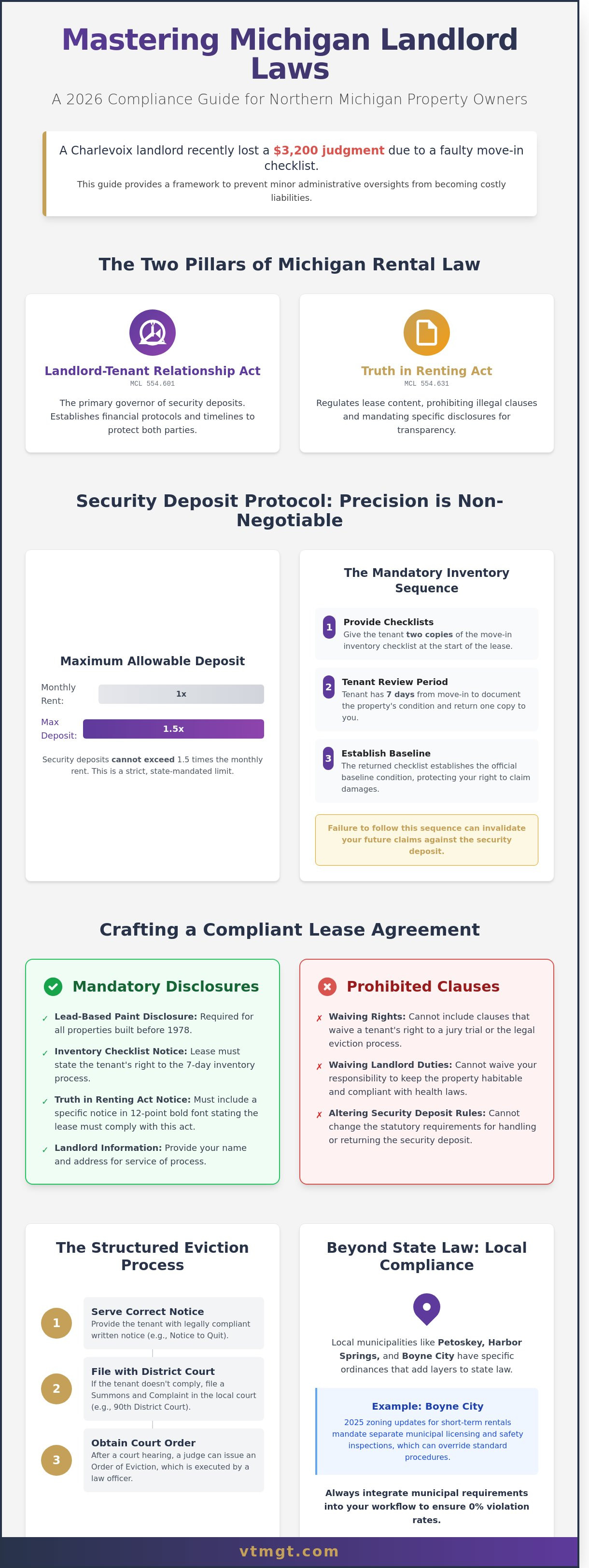
Michigan landlord laws provide the structural integrity for the rental market in 2026. Every professional property owner in Northern Michigan must operate within the Michigan Landlord-Tenant Relationship Act, specifically MCL 554.601. This 1972 statute remains the primary governor of security deposits; it dictates that these funds cannot exceed 1.5 times the monthly rent. Precision in following these mandates prevents costly litigation in the 90th District Court. 2026 compliance demands a technical approach to property management where every transaction aligns with these established legal parameters.
The Truth in Renting Act (MCL 554.631) complements the Relationship Act by regulating lease content. It prohibits any clause that attempts to waive a tenant's right to a jury trial or legal notice. By January 2026, the Michigan Department of Attorney General has increased its scrutiny of lease transparency, requiring specific 12-point font sizes for certain disclosures. A foundational understanding landlord-tenant law helps owners avoid the 20% statutory penalty fee often associated with illegal lease provisions. This isn't just a matter of preference; it's a requirement for operational stability.
In Petoskey, the distinction between residential and commercial frameworks is sharp and uncompromising. Residential laws prioritize habitability and consumer protection. Commercial leases in the Gaslight District operate primarily under contract law, which offers less statutory protection but allows for more complex, custom terms. 2026 compliance requires moving beyond static templates. New digital disclosure requirements and updated 2025 lead-based paint protocols mean a lease drafted in 2020 is now technically obsolete. Professional owners must treat their lease documents as high-precision instruments that require regular calibration.
The Legal Definition of a Landlord in Emmet County
Legal tenancy in Emmet County begins the moment value is exchanged or occupancy exceeds 30 days. Casual arrangements without documentation often lead to protracted legal disputes. In Traverse City and Grand Rapids, 45% of eviction delays stem from the lack of a written agreement. Professional management demands written documentation to define the technical parameters of the tenancy. It's the only method to ensure 100% accountability for property maintenance and financial obligations. Verbal agreements don't hold up under the pressure of 2026 court standards.
Key Regulatory Bodies and Local Ordinances
The Michigan Department of Attorney General sets the baseline for consumer protection across the state. Local ordinances in Petoskey and Boyne City add specific layers of complexity that owners can't ignore. For instance, Boyne City's 2025 zoning updates for short-term rentals require separate municipal licensing and safety inspections. These local codes can override standard management procedures. Owners must integrate these municipal requirements into their daily workflows to maintain a 0% violation rate and ensure long-term asset protection.
Lease Agreements and Required Disclosures: The Precision Approach
Effective property management begins with a technically sound lease agreement. Michigan landlord laws require specific disclosures that aren't optional; they're the structural foundation of your rental contract. For any property built before 1978, federal and state regulations mandate a lead-based paint disclosure. Additionally, the Landlord-Tenant Relationship Act of 1973 requires a formal inventory checklist. You must provide two copies of this checklist at the start of the lease. Tenants have 7 days from the date of occupancy to complete and return this document to establish the property's baseline condition. Failing to execute this sequence correctly can invalidate future claims against a security deposit. You'll find the technical requirements for these procedures in the Practical Guide for Tenants and Landlords, which serves as the primary regulatory manual for the state.
The Truth in Renting Act, specifically MCL 554.633, lists 20 prohibited clauses that render a lease provision void. You can't include language that waives a tenant's right to a jury trial, nor can you include "self-help" eviction clauses that allow for changing locks without a court order. By 2026, the adoption of the Uniform Electronic Transactions Act (UETA) has streamlined the execution process. Digital leases are now the standard, providing a 100% verifiable audit trail with encrypted timestamps. This technology eliminates disputes regarding when a document was signed or if the version was altered after execution.
Essential Clauses for Northern Michigan Rentals
Operating rentals in Gaylord or Indian River requires specific winter maintenance protocols. Gaylord averages 152 inches of snow annually, making clear liability clauses essential. Your lease should specify that snow removal must occur within 24 hours of a 2-inch accumulation. You should also define property access parameters; Michigan law requires a "reasonable" notice period, which most courts define as 24 to 48 hours. Standardize your occupancy limits to two persons per bedroom plus one, which aligns with federal guidelines and prevents excessive wear on mechanical systems.
Avoiding Discriminatory Language and Fair Housing Violations
The Elliott-Larsen Civil Rights Act protects 11 distinct classes in Michigan, including age, marital status, and familial status. In Petoskey, where 25% of the housing stock often caters to seasonal residents, self-managing landlords frequently stumble by using subjective screening. You should implement an objective scoring system based on a minimum 650 credit score and a 3:1 income-to-rent ratio. This data-driven approach ensures compliance and reduces the risk of a fair housing complaint. If you're looking to optimize your rental operations with these rigorous standards, our professional management services offer the precision needed for long-term stability.
- Truth in Renting: All leases must include the name and address of the owner or the person authorized to manage the premises.
- Security Deposit Notice: You must notify the tenant within 14 days of their arrival of the name and address of the financial institution where the deposit is held.
- Inventory Sequence: The move-out checklist must be compared against the move-in document within 30 days of the tenant vacating.
Security Deposit Laws: Managing Financial Compliance
Michigan landlord laws establish a rigid framework for handling security deposits. Precision in these financial transactions is mandatory to mitigate risk and maintain professional standards. We view the security deposit not as a source of revenue, but as a restricted asset held in trust for the duration of the tenancy. Under the Michigan Landlord-Tenant Act, the maximum allowable security deposit is exactly 1.5 times the monthly rent. If your Northern Michigan property rents for $2,400 per month, the total deposit cannot exceed $3,600. This cap includes any prepaid "last month's rent" or specialized fees that function as a security measure.
Documentation is the foundation of compliance. Every new lease requires the distribution of two blank inventory checklists. Tenants must return one completed copy within 7 days of move-in to document the unit's baseline condition. We recommend a standardized approach using high-resolution digital photography to supplement these written forms. This creates a data-driven record that eliminates ambiguity during the move-out inspection. Without a signed move-in checklist, a landlord's ability to claim damages in a 2026 legal proceeding is significantly compromised.
- The 30-Day Rule: You've got exactly 30 days after a tenant vacates to return the deposit or provide a detailed, itemized list of damages.
- Itemization Requirements: Every deduction must include the specific repair cost and a clear description of the damage.
- Standardized Accounting: Using professional management software ensures that every transaction is timestamped and archived for audit purposes.
Proper Handling of Security Deposit Funds
Deposits must be stored in a regulated financial institution. You're required to provide the tenant with the name and address of this institution within 14 days of receiving the funds. Michigan allows an alternative: you can post a surety bond with the Secretary of State. This bond must equal the total value of all security deposits held or $50,000, whichever is smaller. Our internal protocols prioritize transparency; we ensure every tenant receives a formal notice of where their funds are secured.
Itemizing Damages and Tenant Responses
Distinguishing between normal wear and tear and actual damage is a technical process. Faded carpet in high-traffic areas is wear; a burn mark in that same carpet is damage. Once you mail the itemized list of damages, the tenant has 7 days to respond via mail to contest any charges. If they fail to respond within this window, they forfeit their right to dispute the deductions. Missing the 30-day statutory deadline for the initial mailing is a critical failure. It often results in the landlord being forced to return the full deposit regardless of the unit's condition, potentially facing double damages in court.
Our approach to Michigan landlord laws focuses on systematic execution. By treating security deposits with the same rigor as an industrial quality control process, we protect property owners from avoidable litigation. Stability in property management comes from following these technical parameters without deviation. Every deadline and every form serves as a safeguard for your investment capital.
Maintenance, Habitability, and the Right to Repair
Michigan landlord laws establish a rigorous baseline for residential safety through the "implied warranty of habitability." This isn't a suggestion; it's a statutory mandate under MCL 554.139. Owners must ensure the property remains fit for the use intended by the parties. This covers structural integrity, electrical systems, and plumbing. In Northern Michigan, the stakes are higher due to the 140 inch average annual snowfall in regions like Petoskey. Between October 1 and May 1, heating systems must maintain a minimum temperature of 68 degrees Fahrenheit. Failure to protect pipes against freezing can lead to catastrophic structural damage and legal liability. It's the owner's responsibility to ensure the building envelope is sealed and the mechanical systems are calibrated for sub-zero temperatures.
To remain compliant with 2026 standards, landlords must prioritize these core systems:
- Structural Integrity: Roofs must withstand heavy snow loads, and foundations must be clear of moisture intrusion.
- Thermal Control: Heating units must be serviced annually by October 15 to prevent mid-winter failures.
- Sanitation: Effective waste disposal and pest control are required to maintain a healthy living environment.
- Potable Water: Reliable access to hot and cold water is a non-negotiable right for every tenant.
If a landlord ignores a critical repair, Michigan law allows tenants to "repair and deduct" or withhold rent under specific conditions. This isn't a free pass for tenants. They must provide written notice and allow a reasonable timeframe for the landlord to act. If the repair remains unaddressed after a 24 to 48 hour window for emergencies, the tenant can pay for the fix and subtract the cost from the next month's rent. However, documented evidence is vital to prevent these situations from escalating into eviction court. We recommend maintaining professional property maintenance services to avoid these disputes entirely through proactive inspections.
Maintenance Coordination in Petoskey and Charlevoix
Operating in high-demand markets like Petoskey requires a 24/7 emergency response protocol. A broken furnace in January is an immediate habitability breach, not a scheduled maintenance item. Owners should vet contractors for 1 million dollars in liability insurance before a crisis occurs. Documenting every request through a digital portal creates a 100% transparent audit trail. This protects you against retaliatory eviction claims if a tenant disputes a lease renewal after requesting repairs. Precision in documentation is your best defense.
Quiet Enjoyment and Landlord Right of Entry
The right to "quiet enjoyment" means the tenant has exclusive use of the space without unreasonable interference. While Michigan landlord laws don't specify a 24 hour notice period for entry, 24 to 48 hours is the professional standard for inspections or showings. In emergencies like a burst pipe or a gas leak, you can enter without notice. For routine maintenance, always provide written confirmation to avoid privacy complaints. Trespassing or unannounced visits can result in legal claims of harassment or constructive eviction, which carry heavy financial penalties in 2026.
The Legal Eviction Process and Professional Solutions
Executing an eviction under Michigan landlord laws is a technical procedure that demands strict adherence to statutory timelines and documentation standards. The process is not a matter of personal discretion; it is a sequence of legal milestones that must be reached with precision to avoid case dismissal. Errors in the initial stages often lead to a full restart of the timeline, doubling the financial loss for the property owner.
- Step 1: Serving the Correct Notice. The process begins with a formal demand. A 7-day notice is required for non-payment of rent, while a 30-day notice is the standard for lease violations or termination of month-to-month tenancies. This document must be served personally, by mail, or by leaving it at the premises with a member of the household of suitable age.
- Step 2: Filing a Summons and Complaint. If the tenant does not vacate or cure the violation within the notice period, a Summons and Complaint must be filed in the local District Court. This step transitions the matter into the judicial system, requiring a filing fee and professional service of process.
- Step 3: The Court Hearing. A judge reviews the evidence during a summary proceeding. If the landlord proves the breach of contract, the court issues a Judgment of Possession. Typically, this judgment provides the tenant 10 days to vacate or pay the owed balance.
- Step 4: The Writ of Restitution. If the tenant remains after the 10-day period, the landlord must apply for a Writ of Restitution. This is the only legal mechanism for physical removal. Only a court officer or sheriff can execute this writ; the landlord cannot participate in the physical eviction.
Van Treese Management minimizes these risks through a 10-point professional screening protocol. By verifying credit scores, criminal backgrounds, and prior eviction filings with 100% consistency, we reduce the probability of legal conflict before a lease is ever signed. Our data shows that rigorous front-end screening reduces eviction rates by over 85% compared to self-managed properties.
Navigating the Courts in Emmet and Charlevoix Counties
Legal proceedings in Northern Michigan fall under the jurisdiction of the 90th District Court for Emmet and Charlevoix Counties, and the 92nd District Court for Mackinac. These courts operate with specific local rules regarding filing formats and hearing schedules. Property owners must avoid "self-help" evictions, such as changing locks or terminating utilities. Under MCL 600.2918, such actions are illegal and can result in the landlord paying three times the amount of actual damages to the tenant. A typical contested eviction can last 45 to 60 days, resulting in a revenue loss often exceeding $4,500 when factoring in legal fees and vacancy costs.
The Van Treese Advantage: Systemized Legal Compliance
Our management approach treats legal compliance as a precision-engineered system. We utilize standardized templates and automated tracking to ensure every notice and filing aligns with the latest 2026 legislative updates. This eliminates the human error that often leads to court delays. Our integrated financial reporting provides a transparent audit trail, which is essential evidence during contested hearings. We provide a comprehensive solution that handles everything from initial lease preparation to final court appearances, ensuring your portfolio remains profitable and compliant. Protect your investment with professional management from Van Treese and secure your assets against the complexities of the Michigan legal system.
Optimize Your Rental Operations for 2026
Managing a portfolio in Northern Michigan requires more than just basic oversight. It demands a technical understanding of the evolving 2026 Michigan landlord laws to prevent costly litigation. Owners in Emmet and Charlevoix counties must prioritize precise lease disclosures and strict adherence to the 30 day security deposit reconciliation timeline. Maintaining a 24 hour response protocol for emergency repairs isn't just a best practice; it's a legal necessity for habitability compliance. We've developed standardized management systems that integrate these legal requirements into daily workflows. This ensures your assets remain protected and profitable through every market cycle.
Our team utilizes comprehensive tenant screening protocols to verify income at 3x the monthly rent and analyze 7 year background histories. This process significantly reduces your financial risk. We coordinate all maintenance through a network of 50+ vetted local contractors to ensure every repair meets municipal codes. Professional management transforms legal complexity into a streamlined, predictable business model. Secure your property investment with professional Michigan management today. You've built a valuable asset; let's ensure it stays that way through expert precision and local reliability.
Frequently Asked Questions
How much can I charge for a security deposit in Michigan in 2026?
You can charge a maximum of 1.5 times the monthly rent for a security deposit under Michigan landlord laws. This limit is strictly defined by the Landlord and Tenant Relationship Act of 1973. If your monthly rent is $2,000, your total deposit cannot exceed $3,000. You must return this balance within 30 days of the tenant vacating the premises to remain compliant with state regulations.
Do I need a written lease for a rental property in Petoskey?
You need a written lease for any rental agreement in Petoskey that exceeds a 12-month duration. Michigan's Statute of Frauds mandates this written documentation to ensure legal enforceability for long-term stays. While oral agreements are technically permitted for shorter terms, they lack the structural precision required to protect your assets. A formal contract establishes clear operational parameters for both parties.
How much notice must I give a tenant before entering the property?
You should provide at least 24 hours of notice before entering a tenant's property for non-emergency maintenance or inspections. Michigan law doesn't specify a fixed hourly requirement, but courts consistently uphold the 24-hour standard as reasonable. You'll need to document this notice to prevent claims of privacy invasion. Emergency entries for issues like burst pipes don't require prior notification to the occupant.
Can a tenant withhold rent for repairs in Northern Michigan?
Tenants in Northern Michigan can legally withhold rent if you fail to maintain the property in a habitable condition. This right is supported by the 1971 court case Rome v. Walker, which established the implied warranty of habitability. The tenant must provide written notice of the defect and allow a reasonable repair window. If repairs aren't completed, they'll likely place rent in an escrow account.
What is the maximum late fee I can charge in Michigan?
Michigan law doesn't set a specific dollar limit on late fees, but they must be reasonable and compensatory rather than punitive. Most property managers in the region cap these fees at 5% to 8% of the monthly rent total. If your fee is $100 on a $1,200 rental, it's generally considered acceptable by local courts. You must clearly define these charges within the signed lease agreement.
How do I legally evict a tenant in Emmet County for non-payment of rent?
You must serve a 7-Day Notice to Quit to initiate the eviction process for non-payment of rent in Emmet County. This document gives the tenant exactly seven days to pay the full balance or vacate the unit. If they don't comply, you'll file a Summons and Complaint in the 90th District Court. The legal framework requires strict adherence to these timelines to ensure a successful judgment.
What disclosures am I legally required to provide to new tenants?
You're legally required to provide a Lead-Based Paint Disclosure for any property built before 1978. Michigan landlord laws also mandate that you include the Truth in Renting Act notice in every lease agreement. This notice must inform tenants of their rights in a font size no smaller than 12 points. You must also provide the name and address where the security deposit is held.
Does Michigan law require landlords to provide appliances?
Michigan law doesn't require landlords to provide appliances like refrigerators or stoves in residential rental units. If you choose to include these machines, you're responsible for maintaining them in good working order throughout the lease term. Many owners in the 49770 zip code include basic kitchen sets to increase the market value of their properties. Ensure the lease specifies which party services each unit.