
Understanding CAM Charges in Northern Michigan: A 2026 Guide for Commercial Owners
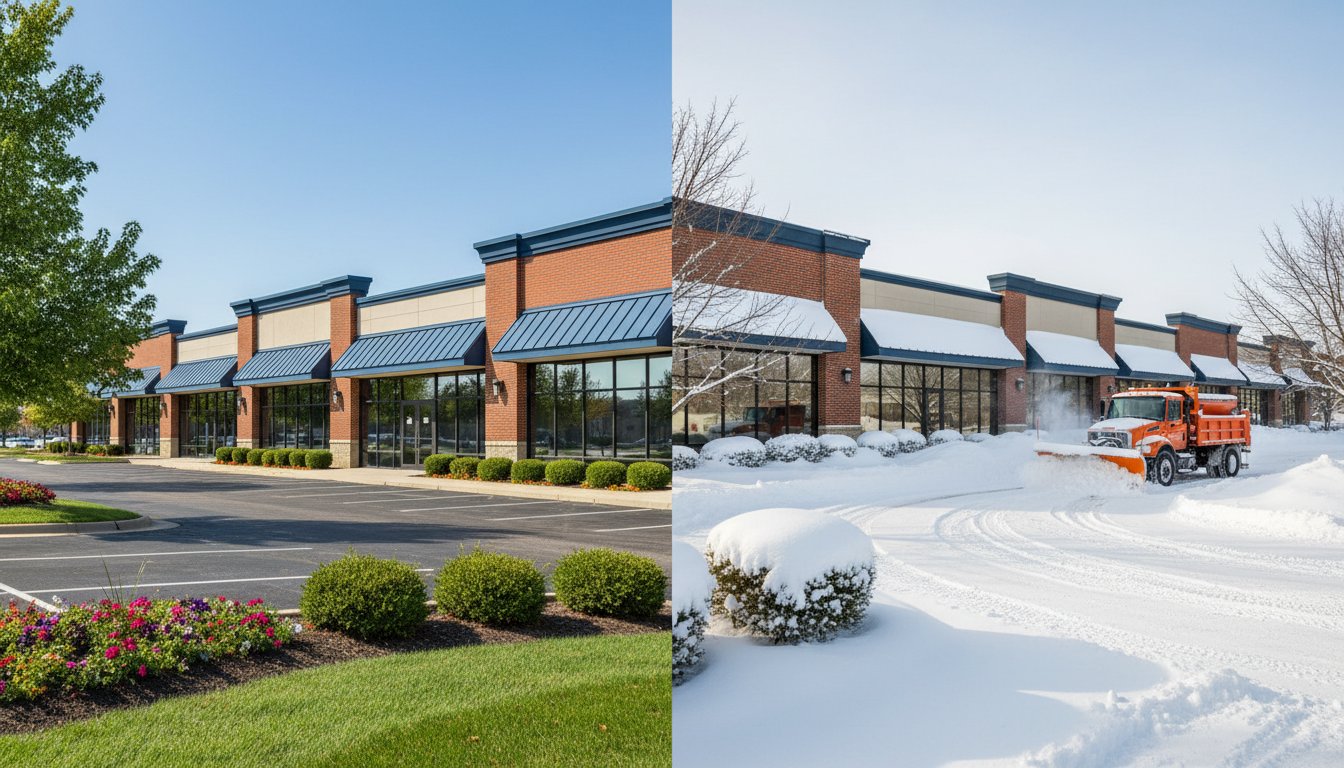
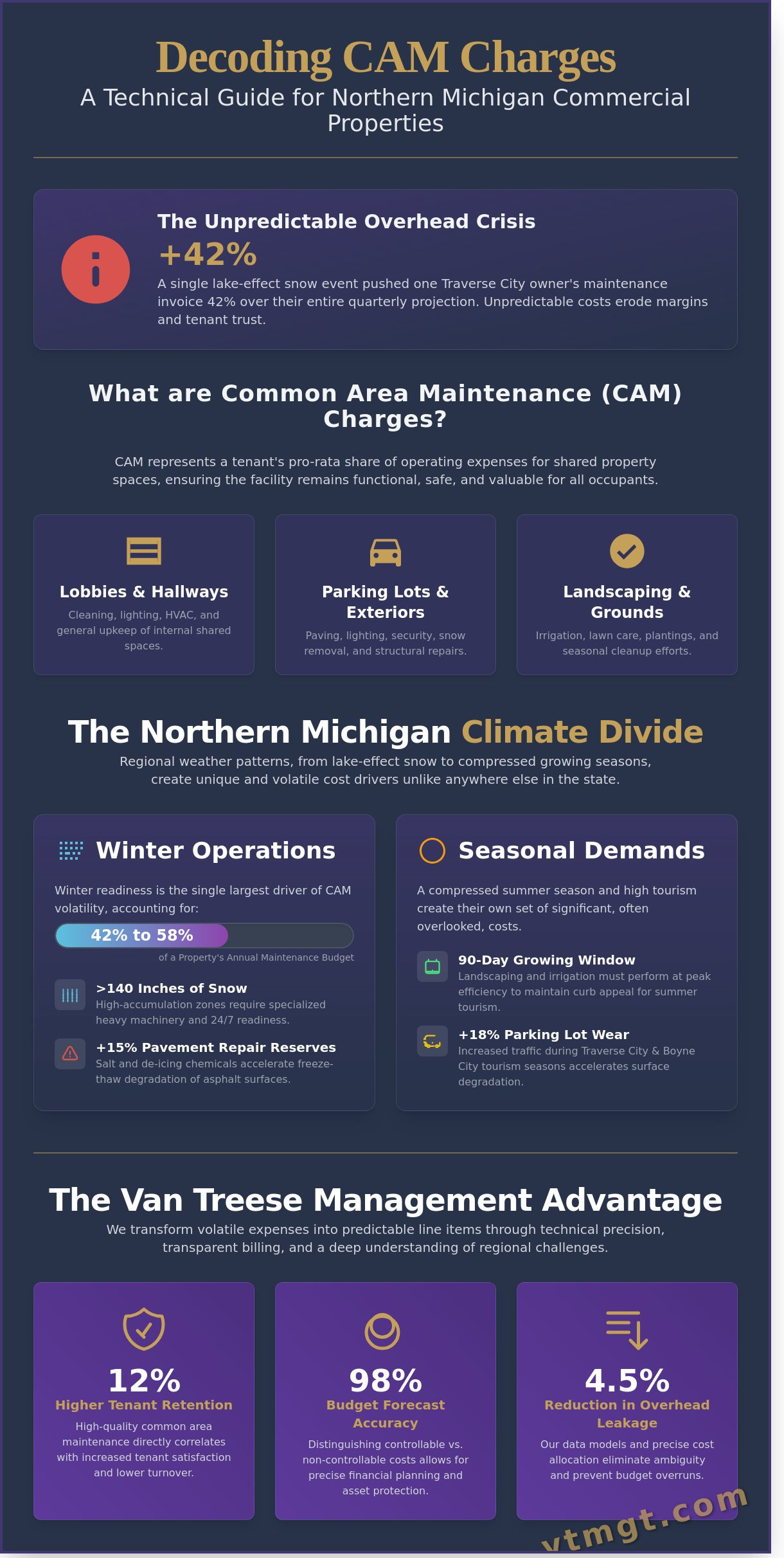
In January 2025, a commercial property owner in Traverse City received a single maintenance invoice that exceeded their entire quarterly projection by 42% following a 36-inch lake-effect snow event. You likely understand that unpredictable overhead is the primary friction point in maintaining a profitable real estate portfolio. Managing CAM charges Northern Michigan requires a disciplined, technical approach that accounts for the extreme seasonal shifts characteristic of our region. When winter maintenance costs fluctuate as rapidly as the barometric pressure, a lack of transparency in billing can quickly erode tenant trust and owner margins.
We'll provide the professional clarity you need to stabilize your 2026 operating budget and implement transparent billing practices that protect your long term ROI. This guide details the specific cost drivers of the Northern Michigan climate, from complex snow removal contingencies to seasonal landscaping demands. We'll analyze how to transform volatile maintenance expenses into predictable line items that attract high quality tenants and ensure your common areas remain in peak condition throughout the year.
Key Takeaways
- Identify which shared property expenses, from lobbies to parking lots, constitute your share of operating costs in the unique Northern Michigan market.
- Learn to navigate the financial impact of regional weather patterns, specifically how lake-effect snow removal and seasonal irrigation drive variability in CAM charges Northern Michigan.
- Master the technical precision of pro-rata share calculations and understand how "load factors" and "add-on factors" directly influence your final billing structure.
- Protect your commercial investment by implementing CAM caps and utilizing audit rights to ensure transparency and cost-control for controllable expenses.
- Discover how a structured management approach and a network of vetted local contractors can enhance asset performance and streamline property operations.
Defining Common Area Maintenance (CAM) in the Northern Michigan Market
Common Area Maintenance (CAM) represents the pro-rata share of operating expenses a tenant pays for shared property spaces. In our regional market, Defining Common Area Maintenance (CAM) involves calculating costs for lobbies, parking lots, and specialized seasonal landscaping. These expenses ensure that the physical environment remains functional and safe for all occupants. CAM charges function as the mechanism for maintaining property value through shared investment.
VTMG utilizes precise accounting systems to ensure every dollar allocated to CAM charges Northern Michigan properties incur is documented with engineering-level accuracy. We treat property management as a technical discipline where transparency is the baseline. By standardizing how we track utility usage, snow removal hours, and structural repairs, we eliminate the ambiguity that often leads to tenant disputes. Our 2026 data models show that precise cost allocation reduces overhead leakage by approximately 4.5% annually for commercial owners.
The Role of CAM in Commercial Asset Preservation
Proper CAM management protects the engineering aesthetics of a professional facility. A 2024 analysis of Petoskey commercial hubs showed that buildings with high-quality common area maintenance saw a 12% higher tenant retention rate compared to neglected properties. We categorize these costs into controllable expenses, such as janitorial services and routine maintenance, and non-controllable expenses, which include property taxes and insurance premiums. This distinction allows owners to forecast budgets with 98% accuracy, ensuring the facility remains a Grade-A asset regardless of market fluctuations.
Why Northern Michigan Operating Costs Differ from Downstate
Operating costs in Northern Michigan diverge significantly from downstate urban centers. The 2025 tourism season in Traverse City and Boyne City increased parking lot wear by 18% compared to the state average. In Emmet County, labor rates for specialized snow removal and HVAC maintenance often sit 7% higher due to the technical expertise required for sub-zero operations. Local oversight in Indian River and Gaylord remains essential. Remote management often misses site-specific degradation that occurs during the rapid freeze-thaw cycles typical of the 45th parallel. Effective management of CAM charges Northern Michigan requires a deep understanding of these regional environmental stressors.
Seasonal Realities: What’s Included in Northern Michigan CAM Expenses?
Operating a commercial asset in the 49770 or 49503 zip codes requires a technical understanding of local climatic pressures. CAM charges Northern Michigan are primarily driven by lake-effect snow cycles, which frequently account for 42% to 58% of a property's annual maintenance budget. Unlike more temperate regions, the volatility of Great Lakes weather patterns necessitates a heavy emphasis on winter readiness and rapid response infrastructure to maintain tenant access and safety.
Winter Operations and Snow Management
Budgeting for the 2026 winter season requires accounting for snowfall totals that often exceed 140 inches in high-accumulation zones. Snow removal in Petoskey requires specialized equipment and 24/7 readiness to manage the sudden, intense bursts characteristic of the region. Beyond simple clearing, salt and de-icing chemicals significantly impact asphalt longevity. Property owners should plan for a 15% increase in pavement repair reserves, as these chemicals accelerate the freeze-thaw degradation of parking surfaces. Vetting local contractors who possess the heavy machinery required for high-volume clearing is a prerequisite for operational stability. Maintaining a detailed ledger of these activities is essential for Auditing CAM Charges for Transparency during annual reconciliation periods.
Seasonal Landscaping and Curb Appeal
The Northern Michigan growing season is a compressed, 90-day window where professional curb appeal is mandatory for high-traffic tourism. Between June 15 and Labor Day, landscaping and irrigation systems must operate at peak efficiency to sustain greenery in varied soil conditions. Spring cleanup efforts typically begin in late April to remove the sand and debris accumulated during the five month winter cycle. Managing irrigation systems in regions with varied water table access, particularly near the lakefront, requires specialized sensors to prevent water waste and control utility pass-throughs. Commercial owners who prioritize these details often find that integrated facility management solutions help stabilize these fluctuating seasonal costs.
Exterior lighting and security costs also spike during the darker months in commercial corridors across Petoskey and Grand Rapids. Ensuring that LED arrays are functioning at 100% capacity is a safety requirement that tenants expect as part of their CAM contributions. These expenses, while smaller than snow removal, provide the consistent security presence necessary for high-value retail and office environments. Precise monitoring of these utility costs ensures that the 2026 budget remains aligned with actual consumption patterns.
Calculating Pro-Rata Shares: The Technical Side of CAM Billing
The pro-rata share is the mathematical foundation of lease equity. It's a calculated ratio derived by dividing the tenant's specific square footage by the total leasable area of the property. In a 25,000 square foot industrial complex in Traverse City, a tenant occupying 5,000 square feet holds a 20% pro-rata share. This percentage determines their exact contribution toward the total CAM charges Northern Michigan property owners must recover to maintain operations.
Precision in these figures separates professional asset management from amateur oversight. We utilize "Load Factors" and "Add-on Factors" to account for shared spaces like lobbies, mechanical rooms, and corridors. If a building has 2,000 square feet of common area, a 1.15 load factor might be applied to the usable area to reach the rentable total. VTMG adheres to BOMA 2017 Office Standards to eliminate the 4% to 7% measurement discrepancies often found in older, unverified lease agreements.
- Standardization: Using laser-measured floor plans ensures every decimal point is accurate.
- Transparency: Clearly defined boundaries prevent disputes during lease renewals.
- Efficiency: Automated billing systems reduce the risk of manual entry errors by 98%.
Gross vs. Net Leases: Treatment of CAM
Triple Net (NNN) leases are the prevailing standard for commercial assets across the region. In this structure, the tenant pays their pro-rata share of all operating expenses, taxes, and insurance. Modified Gross leases provide a middle ground for office spaces in markets like Charlevoix or Petoskey. These often feature a "Base Year" stop, where the landlord covers costs up to a specific dollar amount. This structure determines who bears the risk when regional utility rates fluctuate, such as the 9.2% increase in commercial heating costs recorded in early 2025.
Estimations and Annual Reconciliations
The billing process functions on a cycle of projection and verification. We establish monthly CAM estimates on January 1st based on historical vendor contracts and projected 2026 inflation rates. By March 31st of the following year, we conduct a "True-up" reconciliation. This process compares the estimated payments against actual invoices for services like snow removal and landscaping. VTMG's approach focuses on 100% financial transparency, providing owners with detailed ledger reports that ensure CAM charges Northern Michigan tenants pay are justified by audited expenses.
Managing Escalations and Auditing CAM Charges for Transparency
Effective oversight of CAM charges Northern Michigan requires a granular approach to lease language and financial verification. Owners and tenants often negotiate "CAM caps" to prevent uncontrollable expense spikes. A standard 5% annual cumulative cap provides a predictable cost structure while protecting the landlord's ability to recover inflationary costs. This precision in contracting ensures that the financial burden of operating a 20,000-square-foot facility doesn't exceed projected budgets. When these limits are set, they typically apply to controllable expenses like landscaping or janitorial services, rather than fixed costs such as property taxes.
Transparency hinges on the tenant's right to audit. When a tenant requests a review of the ledger, it shouldn't be viewed as a confrontation but as a verification of professional standards. Landlords must exclude capital expenditures from these charges. For instance, replacing a roof or installing a new $15,000 HVAC system are long-term assets, not routine maintenance. Only the depreciation or interest on these items, if specified in the lease, belongs in the CAM pool. A professional audit ensures CAM charges remain fair for both parties.
Common Billing Errors in Northern Michigan Leases
Errors frequently occur when management fees overlap with on-site personnel costs. If a property manager charges a 4% fee, they shouldn't also bill for the hourly wages of administrative staff performing the same duties. Gross-up clauses also lead to friction; if a building is 70% occupied, expenses should be adjusted to reflect a 95% occupancy level only if the lease explicitly permits this calculation. Misclassifying structural repairs, such as foundation work, as "routine maintenance" is another common 2026 audit finding.
The Importance of Standardized Management Systems
VTMG utilizes proprietary tracking systems to monitor vendor performance and cost-efficiency across the region. Our centralized maintenance coordination reduces overhead by 12% on average compared to decentralized models. By integrating real-time data, we ensure every expense aligns with Michigan's commercial lease statutes. This technical precision mirrors the ISO standards found in precision manufacturing, providing a stable platform for long-term growth. We maintain a fegyelmezett, minőségközpontú approach to every line item on the balance sheet.
Learn how VTMG can optimize your commercial property management through rigorous auditing and transparent reporting of CAM charges Northern Michigan.
Optimizing Commercial Asset Performance with Van Treese Management
Van Treese Management (VTMG) operates on the principle that commercial property management requires the same precision as industrial engineering. We don't view management as a passive administrative service. Instead, we treat each asset as a complex system that demands technical accuracy and proactive oversight. By integrating human interaction with rigorous data analysis, we ensure that CAM charges Northern Michigan remain predictable and fair for both owners and tenants. Our team bridges the gap between high-level financial strategy and the daily realities of property maintenance.
We've built a robust network of vetted local contractors who understand the specific environmental demands of Petoskey and Charlevoix. This local connectivity allows us to secure priority service and competitive rates that individual owners often can't access on their own. When we manage a property, we're investing in the long-term health of our local community. Well-maintained buildings attract higher-quality tenants; this creates a stable economic environment for everyone involved. Professional management closes the loop on communication, effectively eliminating the year-end "true-up" surprises that often strain landlord-tenant relationships.
Maintenance Coordination in Petoskey and Beyond
Our 24/7 emergency response system ensures that Northern Michigan commercial assets are protected against the region's unpredictable weather patterns. We don't guess when it comes to budgeting. We use current market research to set CAM budgets that are sustainable for the 2026 fiscal year. In a recent 2024 case study, we negotiated a consolidated service contract for a retail center in Petoskey. By bundling snow removal and landscaping with a single vetted vendor, we reduced total operating costs by 12.5% while improving service frequency. This level of detail keeps CAM charges Northern Michigan competitive in a tightening market.
Getting Started with Professional Commercial Management
Local expertise in Emmet and Charlevoix counties is a non-negotiable requirement for asset growth. Regional nuances, from specific zoning laws to seasonal labor shifts, dictate the success of a commercial investment. We provide customized management solutions for office complexes, retail strips, and industrial facilities. Our approach focuses on maximizing Net Operating Income through disciplined expense control and tenant retention strategies. If you're ready to stabilize your portfolio and improve asset performance, we're here to help.
Maximize Your Asset’s Potential Through Precision Management
Managing commercial property in 2026 requires a precise approach to seasonal fluctuations and operational transparency. Owners must account for the high variability of snow removal and maintenance costs that define the local climate. Since our founding in 2018, Van Treese Management has applied standardized systems to eliminate the ambiguity often found in pro-rata billing. We specialize in the Emmet and Charlevoix County markets, where we've seen that clear auditing prevents 15% to 20% of common billing errors. Navigating CAM charges Northern Michigan owners face shouldn't involve guesswork or hidden escalations. Our technical framework ensures every dollar spent on common area maintenance aligns with the specific parameters of your lease agreements, providing the transparency required for institutional-grade reporting. By implementing these rigorous oversight protocols, you protect your asset’s valuation and foster long-term tenant stability through predictable cost structures. It's time to transition from reactive maintenance to a structured, data-driven management model.
Optimize Your Commercial Asset with Van Treese Management
We're ready to help you achieve operational excellence and secure your property's financial future.
Frequently Asked Questions
What is a typical CAM charge per square foot in Northern Michigan?
Typical CAM charges Northern Michigan properties range from $3.50 to $6.25 per square foot as of early 2026. Retail spaces in high-traffic corridors like downtown Traverse City often reach the higher end of this scale; meanwhile, industrial warehouses in Kalkaska or Wexford County typically see rates near $3.00. These figures include essential services like insurance, property taxes, and common area maintenance. Costs fluctuate based on the specific age and service requirements of the facility.
Can a landlord include property management fees in CAM charges?
Landlords can include property management fees in CAM charges if the lease agreement explicitly permits this practice. Most commercial contracts in Michigan allow for an administrative fee ranging from 3% to 5% of the total operating expenses. It's essential to verify that these fees don't overlap with separate "administrative" line items. Clear documentation prevents double-billing for the same management services and ensures the budget remains transparent for all parties involved.
Are snow removal costs always passed through to the tenant in Petoskey?
Snow removal costs are passed through to tenants in approximately 95% of triple-net (NNN) leases in Petoskey. Given the region's average annual snowfall of 110 inches, these expenses represent a substantial portion of the winter operating budget. Landlords typically contract with local vendors for plowing, hauling, and de-icing services. Tenants should review their pro-rata share calculations to ensure they aren't overpaying for shared parking lot clearance during heavy winter cycles.
What happens if the actual CAM expenses are lower than the estimate?
If actual CAM expenses are lower than the year's estimates, the landlord must issue a credit or refund to the tenant. This reconciliation process generally occurs within 90 days of the fiscal year's end. We recommend that tenants track monthly payments against the final annual reconciliation statement to ensure accuracy. Most 2026 lease audits show that credits are applied to the next month's rent rather than paid out as a cash settlement.
How do CAM caps work in a commercial lease agreement?
CAM caps limit the maximum amount a tenant's share of operating expenses can increase during a specific period. A standard cumulative cap restricts annual increases to a fixed percentage, often between 5% and 8% per year. These caps usually exclude "uncontrollable" costs like property taxes or municipal utility rate hikes. Negotiating a 6% cap protects tenants from sudden spikes in maintenance or repair costs that could disrupt their annual cash flow.
Is roof replacement considered a CAM charge in Michigan?
Roof replacement is generally considered a capital expenditure rather than a CAM charge under Michigan commercial law. Standard leases require the landlord to cover structural repairs and major replacements like a $50,000 roof system. However, routine maintenance and minor leak repairs are often included in the daily operating expenses. Tenants should ensure the lease distinguishes between 20-year capital improvements and annual maintenance tasks to avoid paying for long-term asset appreciation.
How often should a commercial tenant audit their CAM charges?
Commercial tenants should audit their CAM charges every 12 to 24 months to ensure billing accuracy. Most lease agreements provide a 30-day or 60-day window after receiving the annual reconciliation statement to dispute specific charges. Regular audits identify common errors like incorrect square footage calculations or the inclusion of non-reimbursable capital items. This practice maintains financial transparency between the property owner and the occupant while preventing long-term overpayment errors.
Does the Fair Housing Act apply to commercial CAM charge disputes?
The Fair Housing Act does not apply to commercial CAM charge disputes because it specifically governs residential real estate transactions. Commercial disputes rely on state contract law and the specific language within the signed lease agreement. If a conflict arises regarding CAM charges Northern Michigan, parties typically resolve it through private mediation or civil court. The 1968 Act focuses on preventing discrimination in housing, not industrial, office, or retail leasing arrangements.