
Asset Management vs. Property Management: Which Does Your Investment Need?

High occupancy rates are frequently mistaken for total investment success, yet many Northern Michigan owners discover their net returns don't reflect a full building. This discrepancy usually stems from a fundamental misunderstanding of asset management vs property management and how these distinct functions impact your bottom line. You might feel frustrated by overlapping service fees or overwhelmed by the technical demands of long term financial planning. It's a common challenge for investors who have the boots on the ground covered but lack the strategic framework to scale.
We'll clarify the critical differences between operational oversight and strategic investment growth so you can optimize your real estate portfolio with precision. By the end of this article, you'll understand how to divide responsibilities effectively to drive improved Net Operating Income. We're going to examine the specific duties that keep your properties functional today and the financial strategies that ensure they remain valuable assets for decades to come. Whether you're managing commercial units in Petoskey or residential portfolios across Emmet County, a structured approach is the only way to secure professional oversight and lasting stability.
Key Takeaways
- Understand the distinction between tactical property operations and the strategic financial oversight required for long-term investment growth.
- Learn why the debate of asset management vs property management is central to moving beyond high occupancy toward true Net Operating Income (NOI) optimization.
- Identify the specific "threshold of complexity" in your portfolio that signals the need for professional systems to handle sophisticated financial reporting and accounting.
- Discover how standardized management systems preserve the physical integrity of Northern Michigan assets while strategic vision creates measurable equity.
- Gain clarity on how local market research and professional maintenance coordination work together to stabilize cash flow and mitigate operational risks.
Defining the Roles: Asset Management vs. Property Management
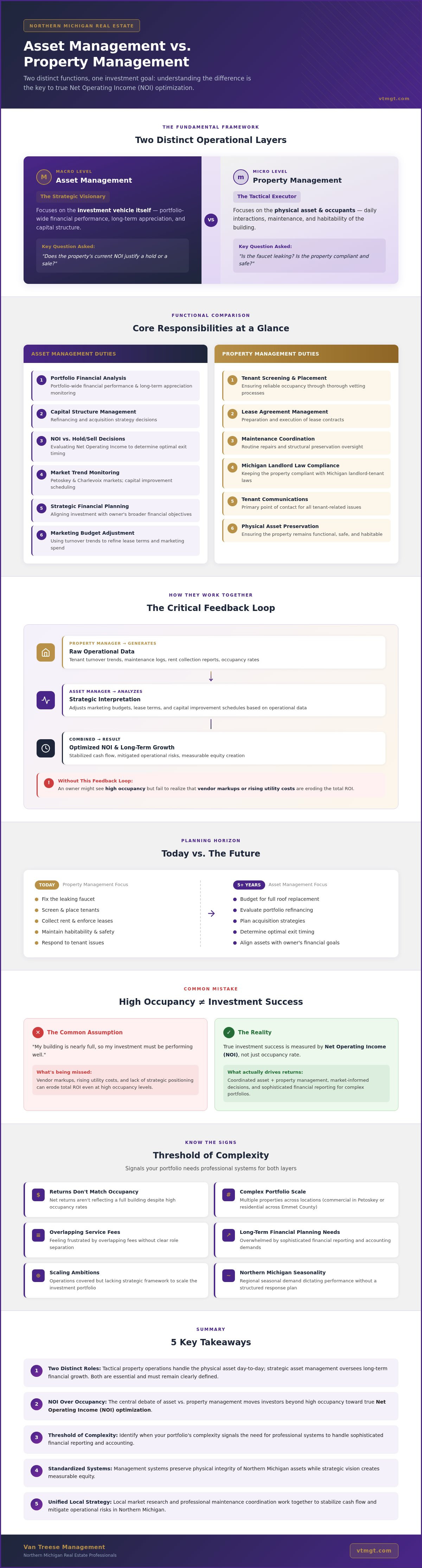
Real estate investment functions through two distinct operational layers. Understanding the difference between asset management vs property management is essential for any owner seeking to move beyond simple rent collection toward genuine wealth creation. In the Northern Michigan market, where seasonality and specific regional demand dictate performance, these roles must operate in a symbiotic, yet clearly defined, hierarchy. We define the property manager as the tactical executor and the asset manager as the strategic visionary. This division represents a "Macro" versus "Micro" perspective of real estate ownership.
What is Property Management?
Property management serves as the operational foundation of a real estate asset. This role focuses on the "micro" details: the daily interactions and physical upkeep that maintain a building's habitability. Managers handle the following core responsibilities:
- Tenant screening and placement to ensure reliable occupancy.
- Lease agreement preparation and execution.
- Maintenance coordination for routine repairs and structural preservation.
- Ensuring the property remains compliant with Michigan landlord laws.
The property manager is the primary point of contact for tenant communications. Their objective is to ensure the asset remains functional and safe. Without disciplined property management, the physical asset deteriorates; this eventually compromises the financial integrity of the entire investment.
What is Asset Management?
Asset management operates at the "macro" level. It shifts the focus from the building to the investment vehicle itself. An asset manager analyzes portfolio wide financial performance and long term appreciation, managing the capital structure through refinancing or acquisition strategies. While a property manager asks if a faucet is leaking, an asset manager asks if the property's current Net Operating Income justifies a hold or a sale. They monitor market trends in Petoskey and Charlevoix to determine optimal exit timing or capital improvement schedules. This strategic oversight ensures that the investment aligns with the owner's broader financial objectives.
For Northern Michigan investors in 2026, the distinction between these roles has never been more critical. The regional market is maturing, and simple occupancy is no longer enough to guarantee competitive returns. A clear division between day to day operations and high level financial planning allows for a structured approach to growth. It prevents the owner from becoming bogged down in maintenance logs while losing sight of the property's market valuation. Distinguishing between asset management vs property management ensures that every decision, from a furnace repair to a portfolio refinance, is handled by the appropriate expert.
Daily Operations vs. Strategic Vision: A Functional Comparison
Effective real estate ownership requires a structured hierarchy where daily execution feeds into long term planning. While both roles aim for property success, their functional focus differs significantly. A property manager handles the immediate needs of the physical structure and its occupants. Conversely, the asset manager oversees the financial trajectory of the investment. The relationship is vertical; the property manager provides the raw operational data that the asset manager uses to refine the broader strategy. This distinction is the difference between fixing a leak today and budgeting for a full roof replacement five years from now.
The interaction between these roles creates a critical feedback loop. The property manager reports on tenant turnover trends, which the asset manager then uses to adjust marketing budgets or lease terms. This communication flow ensures that the "boots on the ground" perspective informs the "eyes on the bank" strategy. Without this link, an owner might see high occupancy but fail to realize that vendor markups or rising utility costs are eroding the total ROI. A clear understanding of Asset Management vs. Property Management prevents administrative bottlenecks and ensures that operational issues don't distract from financial goals.
The Property Manager’s Checklist
This role centers on maintaining the status quo and preserving the asset's current state through standardized systems. Property managers implement rigorous rent collection processes and handle delinquency management to ensure consistent cash flow. They coordinate rental property maintenance in Northern Michigan, ensuring that regional environmental factors like lakefront humidity or heavy snowfall don't compromise building integrity. Their checklist includes conducting move-in and move-out inspections, managing security deposits, and serving as the primary liaison for all tenant related legal compliance.
The Asset Manager’s Dashboard
The asset manager views the property as a line item in a broader financial portfolio. They conduct regular property valuations and market rent analyses to ensure the asset remains competitive against regional benchmarks. By analyzing expense ratios and identifying operational inefficiencies, they focus on optimizing the Net Operating Income (NOI). Their dashboard includes developing 5-year and 10-year capital improvement plans, managing the capital stack, and determining if the market conditions in Emmet or Charlevoix counties favor a refinance or a sale. For owners seeking this level of structured oversight, partnering with a firm that offers comprehensive management solutions is the most efficient path to scaling a portfolio.
Impact on ROI and Long-Term Performance
The financial success of a real estate portfolio depends on the precise execution of two distinct wealth preservation strategies. Property management preserves the current value of the asset through standardized operations, while asset management actively creates equity through strategic financial engineering. When investing in rental property in Northern Michigan, understanding how these forces interact is essential to achieving optimal portfolio scaling. A property manager protects the baseline, but the asset manager moves the baseline higher.
Consider the structural transformation of a multi family property to understand this dynamic. A property manager keeps the units full, collects the rent, and coordinates seasonal repairs to maintain the Capitalization (Cap) Rate. However, an asset manager reviews the broader market data and identifies that a structured interior modernization program could justify a rent increase that outpaces the local average. By calculating the exact cost of the upgrade against the projected increase in Net Operating Income, the asset manager effectively compresses the Cap Rate and increases the overall property valuation. This approach exposes hidden costs, such as inefficient vendor contracts or outdated utility setups, that an operational manager might overlook.
Preserving Value Through Operations
Operational discipline is the first line of defense against equity erosion. Property managers maintain financial stability by focusing on the immediate physical and relational needs of the building. Their standardized systems protect the asset through several key mechanisms:
- Reducing vacancy rates through high quality tenant placement and screening.
- Implementing preventative maintenance programs to avoid costly emergency structural repairs.
- Preserving the curb appeal and physical integrity of the unit to protect the baseline market value.
These actions ensure that the asset remains functional and compliant with local regulations, preventing unexpected capital drains.
Driving Growth Through Strategy
Asset managers use operational data to drive proactive financial growth. They analyze broader economic indicators to position the portfolio ahead of regional market shifts. Their strategic responsibilities include:
- Leveraging real time market research to adjust rents before competitor properties adapt.
- Managing debt structures and monitoring mortgage interest rates for refinancing opportunities.
- Analyzing the precise ROI of specific physical upgrades, such as installing energy efficient HVAC systems optimized for the harsh Michigan climate.
This strategic framework ensures that every dollar spent on capital improvements directly enhances the long term performance and valuation of the investment. Balancing asset management vs property management allows owners to protect their current income while simultaneously building long term wealth.
Determining the Right Fit for Your Portfolio
A Northern Michigan landlord with a single residential unit might effectively handle both operational and strategic roles during the initial phases of ownership. However, as a portfolio expands, investors inevitably reach a "Threshold of Complexity." This is the specific point where manual oversight fails to maintain the precision required for high level returns. Determining the right balance of asset management vs property management depends on your available time, technical expertise, and long term financial objectives. You must evaluate whether you are acting as an active employee of your properties or a strategic owner of an investment vehicle.
Assessing your current management structure is the first step toward optimization. If you currently employ help, you should ask if you are receiving proactive strategic advice or simply receiving rent checks. Professional oversight should provide more than just basic administration; it should offer a structured path to equity growth. For those holding business assets, the cost benefit analysis of hiring specialized commercial property management often reveals that professional fees are quickly offset by reduced vacancy and superior lease terms. The technical depth required for commercial assets necessitates a level of precision that general residential management rarely provides.
Signals You Need a Property Manager
Operational fatigue is a clear indicator that your portfolio requires professional intervention. If you spend more than five hours a week addressing tenant concerns or coordinating basic repairs, your time is being used inefficiently. You should consider hiring a property manager if:
- Maintenance requests are piling up or remaining unanswered for more than 48 hours.
- Tenant delinquency is rising because you lack a standardized collection system.
- You are unfamiliar with specific Emmet County eviction procedures or security deposit laws.
Standardized systems eliminate these administrative bottlenecks, allowing the property to function as a reliable income stream without constant personal involvement.
Signals You Need an Asset Manager
Stagnant financial performance in a growing market indicates a lack of strategic vision. You might have a property manager keeping the building full, but that doesn't guarantee the investment is reaching its full potential. You need asset management oversight if:
- Your cash flow remains stagnant despite maintaining high occupancy rates.
- You are unsure of the current market valuation or the optimal exit timing for your assets.
- You have no clear five year plan for future acquisitions, refinancing, or divestment.
Strategic oversight ensures that your capital is working as hard as possible. If your current structure feels reactive rather than proactive, it's time to shift your approach. Request a professional portfolio review to determine how our standardized systems can improve your Net Operating Income.
How Van Treese Management Bridges the Gap
Van Treese Management operates at the intersection of operational stability and financial optimization. We recognize that the debate between asset management vs property management is often a false choice for the private investor; both functions are necessary for sustainable long term success. Our "Investor-First" approach to property management in Petoskey integrates these roles into a single, cohesive service model. We provide the standardized systems typically reserved for institutional large scale firms while maintaining the high touch human interaction required in Northern Michigan communities. This dual focus ensures that your assets are not only well maintained but also positioned for maximum market valuation.
Standardized Systems, Personalized Service
We utilize rigorous maintenance and leasing systems to eliminate the operational friction that often leads to owner stress. Our commitment to technological innovation ensures that every property under our care benefits from modern management tools, ranging from predictive maintenance scheduling to automated financial tracking. This technical precision allows us to provide owners with direct access to local market data for Emmet and Charlevoix counties. By grounding every decision in verified regional statistics, we ensure that rent adjustments and capital improvements are based on empirical fact rather than intuition. Our financial reporting and accounting processes are designed to be granular enough for daily operations yet comprehensive enough for high level strategic planning. This data driven approach serves the tactical needs of the building while satisfying the strategic requirements of the investment portfolio.
Your Partner in Thriving Communities
Professional management extends beyond simple "landlording" to encompass comprehensive community building. We believe that a well managed property contributes to the overall stability and growth of Northern Michigan. By maintaining high standards for tenant screening and physical upkeep, we actively increase the long term property values within the region. We act as a local partner who understands the nuances of the Petoskey and Charlevoix markets, providing a level of insight that distant management firms cannot replicate. This local expertise is vital for navigating regional seasonality and maintaining high occupancy throughout the year.
Bridging the gap between asset management vs property management requires a partner who understands the unique economic landscape of the Midwest. We invite you to move beyond reactive oversight and toward a structured framework for investment growth. Contact Van Treese Management today for a comprehensive property analysis to determine how our systems can better serve your specific financial goals.
Securing Long Term Growth in Northern Michigan
Success in real estate investment requires a disciplined balance between tactical execution and strategic oversight. We've explored the functional differences of asset management vs property management to demonstrate that while operational excellence preserves the physical building, strategic foresight engineers its financial future. Standardized systems for maintenance and tenant relations provide the necessary foundation for stability; however, genuine wealth creation is only possible through precise market analysis and capital planning. It's not enough to simply react to tenant needs; you've got to proactively manage the investment vehicle.
Van Treese Management operates as a specialized technical partner across Petoskey, Traverse City, and Grand Rapids. Our team utilizes standardized systems to ensure 24/7 emergency response and comprehensive financial reporting, allowing your residential or commercial assets to remain competitive in an evolving market. We prioritize professional accountability and data driven results to help you move beyond simple rent collection toward portfolio optimization. Request a Professional Property Analysis from Van Treese Management to align your operational needs with your long term investment objectives. It's the most reliable path to achieving professional stability and driving community growth in Northern Michigan.
Frequently Asked Questions
Can one person do both asset and property management?
Yes, an individual can execute both roles, though it becomes increasingly difficult as a portfolio scales. The tactical requirements of property oversight often consume the time necessary for high level strategic planning. Owners who self manage must be disciplined enough to switch between operational tasks and financial analysis. In professional settings, separating these duties ensures that daily tenant needs don't distract from the long term goal of maximizing the property's total market valuation.
What is the typical fee difference between asset and property management?
Fees for asset management vs property management are calculated using different metrics. Property management typically involves recurring monthly fees for operational tasks like rent collection and maintenance coordination. Asset management fees are often based on a percentage of the total assets under management or performance based incentives. These distinct fee structures reflect the difference between paying for the physical operation of a building and paying for the strategic growth of an investment portfolio.
Do I need an asset manager for a single-family rental?
Most single family rentals in areas like Boyne City or Indian River don't strictly require a dedicated asset manager. The owner can typically handle the strategic side if they have access to accurate market data and property valuations. The primary need for a single unit is professional property management to ensure tenant screening and lease compliance. However, as an owner acquires multiple units across Gaylord or Traverse City, the need for structured strategic oversight grows significantly.
How does property management affect my property’s resale value?
Professional management significantly improves resale value by maintaining the asset's physical and financial health. Regular maintenance coordination prevents the accumulation of deferred repairs that often lead to price reductions during the sale process. Additionally, standardized financial reporting and accounting provide prospective buyers with a transparent view of the property's performance. A well documented property in Petoskey or Grand Rapids suggests a lower risk investment, which naturally justifies a higher asking price in the local market.
What financial reports should a professional property manager provide?
A professional firm should provide detailed income statements, expense ledgers, and cash flow summaries on a monthly basis. These reports are vital for tracking the property's Net Operating Income and identifying areas for expense reduction. By maintaining accurate financial records, owners can better evaluate the performance of their asset management vs property management strategies. Detailed reporting also simplifies tax preparation and provides the necessary documentation for refinancing or securing future investment capital.
Does Van Treese Management handle commercial asset strategy?
Van Treese Management provides commercial property management that incorporates both operational excellence and strategic market insights. We handle the complexities of lease compliance and common area maintenance for assets throughout Northern Michigan. Our team provides the detailed financial reporting and local market research necessary to inform your broader investment strategy. We serve as a dedicated partner in Traverse City and Grand Rapids, ensuring your commercial assets contribute to the growth of thriving local communities.