
Dealing With Unauthorized Tenants or Pets: A Michigan Landlord’s Guide

What if the most important first step in dealing with unauthorized tenants or pets isn’t confronting the tenant, but checking the facts? An unfamiliar occupant or animal can raise valid concerns about lease compliance, property damage, and safety. Start by confirming who may be living in the home, reviewing the signed lease, and determining whether an animal may be an assistance animal rather than an ordinary pet.
It’s reasonable to want the issue resolved promptly, but acting before you understand the situation can create legal and practical problems. This guide explains how to assess a possible lease violation, record relevant observations, and communicate with the tenant in a consistent, lease-based way. It also explains why assistance animals require a separate review from ordinary pet policies.
A measured response includes organized records, clear communication, and Michigan-specific legal guidance when needed. A property manager can help with lease administration and tenant communication, but questions about legal rights and required procedures should be confirmed with a qualified Michigan professional. Do not try to remove a person or animal outside the proper process.
Key Takeaways
- In dealing with unauthorized tenants or pets, distinguish a visitor from an unapproved occupant and assess animal-related concerns separately.
- Compare the signed lease, addenda, and written approvals with facts you can document before deciding whether a violation occurred.
- Match your response to what you can verify, from asking clarifying questions to making a written request or seeking formal legal guidance.
- Keep relevant lease records, tenant messages, dated observations, and property-condition information organized and secure.
- Professional property management can support consistent tenant communication and lease administration, while legal questions require qualified counsel.
Dealing With Unauthorized Tenants or Pets Starts With Identifying the Issue
A person seen entering the property isn’t automatically an unauthorized tenant. They may be a visitor, an additional resident with written approval, or a tenant named in the lease. An animal also needs careful classification. It may be an ordinary pet subject to lease terms, a source of property-condition concerns, or part of an assistance-animal accommodation request. Before acting, review the signed lease and any written amendments or approvals. A lease agreement sets out the terms between the parties, including provisions about occupants and animals.
Quick distinction: An unauthorized occupant is someone who appears to live in the rental without being named or otherwise approved under the lease. An ordinary guest visits but doesn’t necessarily reside there. The lease and verified facts help distinguish the two.
When does a guest become an unauthorized occupant?
Start with the lease language on guests, additional residents, occupancy limits, and approval requirements. There’s no single guest-duration threshold that applies to every rental. Check the specific agreement and confirm applicable Michigan requirements before drawing a conclusion.
Use observable details rather than assumptions. Dated notes might record how often someone is present, whether they keep belongings there, whether they appear to have regular access, or whether the tenant has described them as a resident. No single observation necessarily establishes that someone lives at the property. Keep records factual and avoid presenting suspicion as proof.
What counts as an unauthorized pet under a lease?
Check whether the lease prohibits animals, requires written approval, or sets conditions such as registration or other tenant responsibilities. Compare those terms with signed addenda and any written permission already on file. An animal’s presence alone doesn’t establish a lease violation. First clarify the circumstances and review the relevant documents.
Keep ordinary pet rules separate from assistance-animal requests. A tenant may request an accommodation, which requires a fair-housing review rather than automatic application of pet restrictions or fees. If the request or animal-related concern is unclear, document the facts neutrally and seek qualified guidance before deciding how to respond.
For both occupants and animals, the initial goal is accurate classification, not immediate enforcement. Record dates and relevant observations, preserve related communications, and compare what you know with the actual lease terms. This evidence-based starting point makes the next step in dealing with unauthorized tenants or pets more consistent and helps reduce the risk of acting on an assumption.
Check the Lease and Michigan Rules Before Enforcing a Violation
Once you’ve documented the concern, compare the facts with the executed lease, signed addenda, written approvals, and relevant tenant communications. A standard lease template may explain common terms, but it doesn’t replace the agreement signed for this tenancy. For example, written approval may affect how a pet restriction applies, while an occupancy clause may specify when an additional resident needs consent.
Which lease terms should landlords review?
Read the specific provisions on occupants, guests, occupancy limits, pets, approval requirements, notices, and opportunities to correct a violation. Review the complete document, including attached addenda, then match each relevant term to dated observations and records. Don’t rely on memory or a generic form when the signed agreement and later written communications may affect how a clause applies.
Lease language is only part of the analysis. Michigan notice requirements and available remedies depend on the circumstances. A lease violation, such as an unauthorized occupant or pet, generally requires a 30-day Notice to Quit before a landlord may proceed with a court filing if the issue remains unresolved. Confirm current state requirements and local court procedures before serving notice. This summary isn’t a substitute for reviewing the facts of your case. The Michigan Legislature’s landlord-tenant law guide is a useful state resource, and our Michigan landlord laws guide offers additional context for Northern Michigan property owners.
How should landlords assess an assistance-animal request?
Don’t automatically classify an assistance animal as an ordinary pet or apply pet restrictions and charges unchanged. Assistance-animal requests involve fair-housing obligations separate from standard lease pet rules. Review current Fair Housing Act requirements and authoritative guidance before requesting information or responding. If the request or circumstances are unclear, consult a Michigan attorney rather than making a legal determination based on assumptions.
Careful review matters because an apparent lease violation may involve prior written permission, a different interpretation of the agreement, or an accommodation request. This article is educational, not legal advice, and doesn’t replace advice from a Michigan attorney. Owners who need ongoing lease administration and consistent tenant communication may also consider residential property management. Those services support property operations, not legal interpretation or court representation.
Choose a Proportionate Response to an Unauthorized Occupant or Pet
After checking the records and lease, choose a response that fits what you can verify. A question about a visitor or an animal with unclear approval may call for clarification, not immediate escalation. If the facts support a possible lease violation, a written request can state the concern and ask the tenant to respond. Voluntary resolution may be possible, but don’t promise a particular outcome or treat an informal conversation as a substitute for required legal steps.
| Response | Purpose and appropriate use | When to seek legal guidance |
|---|---|---|
| Fact-checking | Compare dated observations with the lease and existing approvals when details are incomplete. | If gathering information raises privacy, access, or safety questions. |
| Direct conversation | Ask neutrally who resides at the property or clarify an animal’s status when the facts are uncertain. | If the tenant disputes the facts or raises an accommodation request. |
| Written request | Summarize the concern and request clarification or a response when records indicate a possible lease issue. | Before serving a formal notice or setting legal deadlines. |
| Formal legal escalation | Consider only after reviewing the evidence, lease terms, and prior communication. | Before pursuing court action, and whenever the proper process is unclear. |
When is a direct conversation or written clarification appropriate?
Keep your wording factual and non-accusatory. For example, ask whether a person is residing at the property or whether an animal has written approval instead of declaring a violation before confirming the details. Record the date, communication method, tenant’s response, and any documents shared. Consistent, professional communication helps create a clear record. Avoid threats, retaliatory language, or comments that could be discriminatory.
When should a landlord seek legal guidance?
Consult a Michigan landlord-tenant attorney before serving a formal notice or pursuing court action. Get prompt guidance if the tenant disputes key facts, requests an accommodation, or raises safety concerns. Michigan Legal Help’s overview of landlord rights and responsibilities can provide general context, but it can’t determine how the law applies to a specific tenancy.
Don’t change the locks, remove belongings, shut off utilities, or otherwise try to force someone out. Michigan evictions must follow the court process. Dealing with unauthorized tenants or pets calls for a deliberate response: verify the concern, communicate proportionately, and get legal advice when the next step may affect a tenant’s rights. Owners seeking ongoing support with lease administration and tenant communication can learn about residential property management in Northern Michigan.
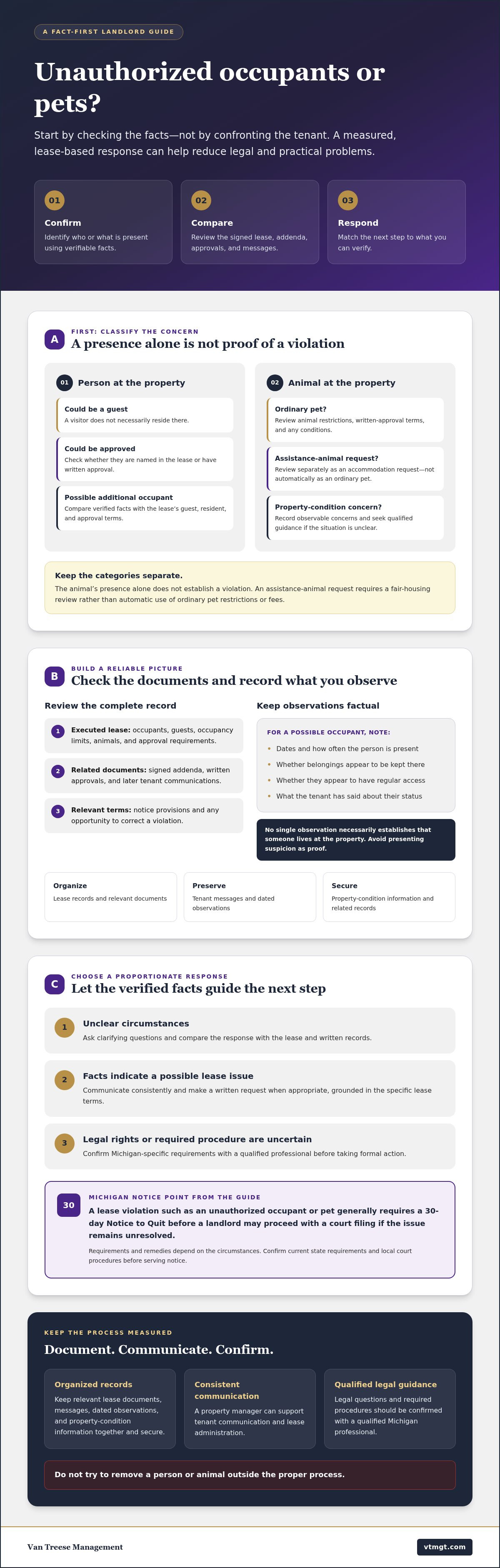
Follow a Documented Process for Resolving Unauthorized Occupants or Pets
A consistent record helps you move from an initial concern to a measured next step. Use the same sequence for an occupant or animal: document what you know, review the signed lease and related approvals, clarify uncertain facts, communicate in writing, then reassess based on the response. This keeps observations distinct from assumptions and makes it easier to identify what still needs verification.
What should landlords document before contacting a tenant?
Record dates, firsthand observations, relevant messages, and the lease provisions you’re reviewing. If there’s a property-condition concern, preserve appropriate dated records of the condition and related maintenance communication. Identify whether information came directly from you, the tenant, or another source. Don’t present an unverified report as established fact. Gather information only through lawful, appropriate means and handle tenant records securely, with access limited to those who need them.
How should landlords communicate and follow up?
Send a clear, neutral message that describes the concern without assuming a violation and asks the tenant to clarify. For example, ask whether a person is residing at the rental or whether an animal has received written approval. Keep the complete message, delivery details, response, and documents exchanged together in the property record. Give the tenant a reasonable opportunity to respond, then compare the new information with the lease and your dated notes.
Before formal notices, deadlines, or court action, verify current Michigan requirements and local procedures with qualified counsel. Don’t assume an informal message satisfies a legal notice requirement. For help reviewing common lease terms in the region, see this Northern Michigan lease agreement guide.
Process checklist
- Document firsthand observations and relevant property conditions.
- Review the executed lease, addenda, approvals, and communications.
- Clarify uncertain facts using appropriate means.
- Send a neutral written message and retain the complete record.
- Reassess the facts and verify legal steps with counsel as needed.
“Document what you know, check what the lease says, clarify what remains uncertain, communicate clearly, and reassess before taking the next step.” A well-maintained record supports consistent decisions when dealing with unauthorized tenants or pets, but it doesn’t replace legal advice. For owners seeking support with tenant communication and ongoing lease administration, explore residential property management in Northern Michigan.
When Northern Michigan Landlords May Benefit From Professional Management
Handling a lease concern takes more than one conversation. Owners must organize records, communicate consistently, track follow-up, and coordinate next steps while managing the rest of the property. For owners with rentals in several Northern Michigan communities, a defined management process can reduce administrative work and help prevent important messages or lease documents from being overlooked.
What can a property manager help coordinate?
Van Treese Management provides residential property management in Northern Michigan, including tenant communication, lease administration, and maintenance coordination. Within an agreed management scope, a property manager can help maintain lease records, document tenant communications, and coordinate operational follow-up. For example, if a reported animal-related concern is accompanied by a maintenance issue, maintenance coordination can help organize the property-related response. A property manager doesn’t determine whether a lease has been violated or resolve a legal dispute.
Standardized records and communication practices can help owners managing rentals in Petoskey, Boyne City, Indian River, Gaylord, Traverse City, and Grand Rapids. The Petoskey property management guide provides additional context for owners considering professional support. As with any management arrangement, confirm which tasks are included and who makes decisions about escalation.
What should owners ask before choosing management support?
Before engaging a manager, clarify how the working relationship will operate. Ask who handles tenant communications, maintains lease records, administers the agreement, and coordinates property-related follow-up. Confirm how information is shared with you, which decisions remain yours, and what circumstances should be referred to an attorney. These questions establish clear roles before a concern arises, rather than during a time-sensitive disagreement.
- What tenant communication and lease administration tasks are included?
- How are messages, approvals, and property records organized?
- How are maintenance concerns coordinated and reported to the owner?
- When should the owner consult a Michigan attorney about legal interpretation, notices, or court proceedings?
Professional management can support consistent administration, but it doesn’t replace legal counsel for statutory interpretation or court representation. That distinction matters when dealing with unauthorized tenants or pets: a manager may help coordinate records and communications, while an attorney advises on legal rights and formal proceedings. If you’re evaluating ongoing support for a Northern Michigan rental, discuss your residential property management needs with Van Treese. Base any management arrangement on a clear scope of services, without assuming a particular legal or tenancy outcome.
Build a Consistent Approach for Your Rental
Dealing with unauthorized tenants or pets begins with careful classification, not an assumption. Review the signed lease and written approvals, keep factual records, and communicate clearly before deciding what to do next. If a formal notice or court action may be involved, verify current Michigan requirements with a qualified attorney.
For owners, consistent lease administration and tenant communication can make ongoing property responsibilities easier to coordinate. Van Treese Management provides residential property management that includes tenant communication and rent collection. Tenant placement includes background checks and lease execution, helping establish clear records from the start of a tenancy. Service coverage includes Petoskey and communities across Northern Michigan.
A property manager can support day-to-day administration, but doesn’t replace an attorney for legal advice or court representation. If you’re considering management support for your rental, discuss residential property management with Van Treese. Clear records, measured communication, and appropriate professional guidance can help you address concerns thoughtfully and manage your property with greater confidence.
Frequently Asked Questions
Can a landlord evict a tenant for having an unauthorized occupant in Michigan?
A landlord may be able to seek eviction if an occupant violates the signed lease, but an unapproved person’s presence doesn’t automatically establish grounds or guarantee removal. Review occupancy terms and approvals, document the facts, and verify applicable Michigan requirements. A 30-day Notice to Quit is generally required for a lease violation before a court filing if the issue remains unresolved. Consult a Michigan attorney before formal notice or court action.
Can a landlord evict a tenant for an unauthorized pet in Michigan?
A landlord may be able to pursue a lease-based remedy if an ordinary pet violates the signed agreement, but first check for written approval and determine whether the animal is part of an assistance-animal accommodation request. A 30-day Notice to Quit is generally required for a lease violation before filing in court if the matter remains unresolved. Confirm current Michigan requirements and seek legal advice before formal action.
How long can a guest stay before becoming an unauthorized occupant?
Michigan doesn’t have one guest-duration threshold that applies to every rental. Start with the signed lease’s guest, occupancy, and approval terms, then assess the facts. Relevant observations may include how regularly the person stays, whether they keep belongings at the property, and whether the tenant identifies them as a resident. Record firsthand details, avoid assumptions, and confirm applicable requirements before treating a guest as an unauthorized occupant.
Does a landlord have to allow an assistance animal in a no-pet rental?
Generally, a landlord must consider a reasonable accommodation request for an assistance animal even if the lease prohibits pets. Assistance animals aren’t treated as ordinary pets under fair-housing rules, so don’t automatically apply pet restrictions or fees. Specific circumstances matter, including whether the animal poses a direct threat or may cause substantial physical damage. Review current Fair Housing Act guidance and consult qualified legal counsel about a fact-specific request.
What should a landlord do first after discovering an unauthorized tenant or pet?
When dealing with unauthorized tenants or pets, begin by documenting what you directly observed, then review the signed lease, addenda, and written approvals. Clarify uncertain details with a neutral question before deciding whether a violation occurred. Keep dated notes and relevant communications organized, and distinguish verified facts from reports or assumptions. If the issue may involve an assistance-animal request or formal enforcement, get qualified guidance before taking the next step.
Can a landlord remove an unauthorized occupant or pet without going to court?
A landlord can’t use self-help measures to force a tenant or occupant out. Don’t change locks, shut off utilities, or remove belongings to compel someone to leave. Michigan evictions must follow the court process, with an order of eviction carried out by a court officer or sheriff. If an unauthorized pet is involved, don’t assume you can remove it yourself. Review the lease and get legal guidance on the appropriate response.
When should a landlord hire a property manager to handle an unauthorized occupant or pet?
Consider a property manager if tenant communication, lease records, and follow-up are taking time away from managing the rental. A manager can help coordinate tenant communications and lease administration, but doesn’t replace an attorney for legal interpretation or court representation. Van Treese Management serves Petoskey, Boyne City, Indian River, Gaylord, Traverse City, and Grand Rapids. Ask which tasks are included and when the owner should consult legal counsel.