
Investing in Rental Property in Northern Michigan: The 2026 Investor Guide

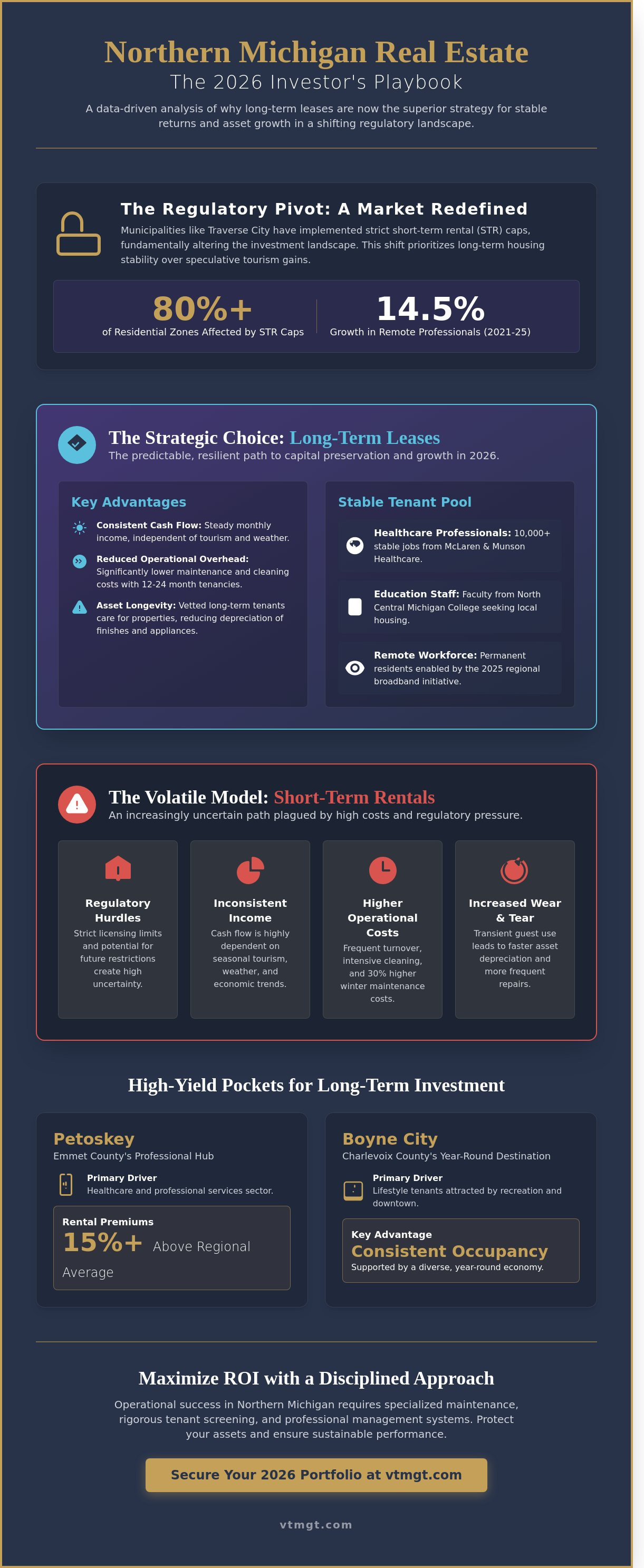
What if the most profitable move for your 2026 portfolio isn't the vacation rental everyone is chasing, but the year-round lease your competitors are ignoring? You likely recognize that investing in rental property Northern Michigan has become more complex since municipalities like Traverse City implemented caps affecting over 80% of residential zones. These strict licensing limits have made the traditional short-term rental model increasingly volatile for serious investors. While the allure of the Great Lakes remains permanent, the regulatory environment is shifting toward long-term stability and workforce housing.
We understand that successful acquisition requires a disciplined approach to overcome 30% higher winter maintenance costs and the scarcity of reliable local oversight. This guide provides the technical framework you need to identify high-yield long-term opportunities that bypass the uncertainty of local ordinances. You'll learn how to secure stable cash flow, reduce vacancy rates through strategic tenant placement, and implement professional management systems that handle remote oversight with precision. We will examine the specific climate-resilient upgrades and local market data necessary to ensure your assets remain profitable through the 2026 season and beyond.
Key Takeaways
- Analyze the transition of Northern Michigan into a year-round economic hub and the resulting impact of remote work on residential demand.
- Identify high-yield locations like Petoskey and Boyne City to ensure long-term appreciation when investing in rental property Northern Michigan.
- Evaluate the 2026 regulatory landscape to understand the tax and legal differences between short-term and long-term rental asset classifications.
- Implement specialized maintenance protocols, such as winter-proofing and 24/7 emergency response, to protect property value in harsh northern climates.
- Learn how standardized management systems and community-focused operations can maximize ROI and ensure sustainable asset performance.
The Northern Michigan Rental Market Outlook for 2026
Strategic investors view 2026 as a stabilization point for the regional real estate market. Northern Michigan's transition from a seasonal destination to a year-round economic hub is now documented through census data and infrastructure investment. When considering investing in rental property Northern Michigan, the focus shifts toward the structural demand created by a permanent workforce. This shift is particularly evident in regional centers where the traditional summer peak no longer dictates the entire fiscal year's performance. It's a market defined by professional management and calculated growth rather than speculative gains.
Economic Drivers in Northern Michigan
Regional hubs like Petoskey and Traverse City have experienced a sustained population increase, partly driven by the 14.5% growth in remote work professionals who relocated permanently between 2021 and 2025. Northern Michigan's economy benefits from a diversified base, including the expansion of McLaren Northern Michigan and Munson Healthcare, which employ over 10,000 residents combined. These institutions provide a stable tenant pool of medical professionals and administrative staff. Additionally, the completion of the 2025 regional broadband initiative has made rural Emmet and Charlevoix counties viable for high-tech employment. Property values remain supported by year-round recreation, ensuring that assets maintain their valuation regardless of broader market fluctuations.
Why Long-Term Rentals Win in 2026
The 2026 market favors long-term residential leases over the volatile short-term vacation model. Many municipalities in Northern Michigan have implemented stricter caps on short-term rental permits, making the long-term approach a more predictable path for capital preservation. This regulatory environment makes investing in rental property Northern Michigan a safer bet for those seeking stability over high-turnover hospitality models. Long-term rentals offer several technical advantages for the disciplined investor:
- Reduced Operational Overhead: Maintenance and cleaning costs are significantly lower when turnover happens once every 12 to 24 months.
- Consistent Cash Flow: Monthly rental payments provide a steady stream of income that isn't dependent on weather patterns or tourism trends.
- Asset Longevity: Vetted, long-term tenants generally treat properties with more care than transient guests, reducing the depreciation of interior finishes and appliances.
Acquiring residential property in Emmet and Charlevoix counties during 2026 allows investors to capture the rising demand from the education sector, specifically staff and faculty at North Central Michigan College. The region's infrastructure developments, including improved highway access and expanded regional airports, have shortened the commute times between these residential pockets and major employment centers. This connectivity ensures that vacancy rates remain low even as new inventory enters the market.
Top Northern Michigan Towns for Rental Investment
Investors targeting the 2026 market must distinguish between seasonal vacation hubs and year-round residential centers. Success in investing in rental property Northern Michigan depends on aligning specific asset types with regional economic drivers. The current landscape favors locations with diversified employment bases over those reliant solely on summer tourism. Precision in site selection is the primary factor in maintaining long-term yield stability.
Petoskey and Boyne City: High-Yield Pockets
Petoskey remains a primary target for residential demand within Emmet County. The city maintains a consistent occupancy rate for high-end units, largely driven by its status as a healthcare and professional hub. Proximity to McLaren Northern Michigan and top-tier school districts allows landlords to command rental premiums that often exceed the regional average by 15% or more. Boyne City, located in Charlevoix County, has evolved into a year-round destination. Its growth is tied to the expansion of recreation centers and a revitalized downtown corridor that attracts long-term tenants. You can find a technical breakdown of these neighborhood shifts in our guide on Invest in Petoskey Real Estate: 2026 Market Trends and Investment Strategies.
Analyzing the Grand Rapids and Gaylord Corridors
The I-75 and US-131 corridors are no longer just transit routes; they're now strategic focal points for logistics and workforce housing. Gaylord has transitioned into a major regional distribution center, which has created a persistent shortage of attainable housing for the local workforce. A University of Michigan report on housing indicates that many Michigan counties face a widening gap between available inventory and the needs of moderate-income renters. This supply-demand imbalance in Gaylord and Indian River offers a stable environment for those investing in rental property Northern Michigan who prioritize low vacancy rates over high-turnover vacation rentals.
Traverse City continues to function as the region's urban anchor, though the regulatory landscape there is increasingly complex. New zoning ordinances passed between 2023 and 2025 have restricted short-term rental permits in many residential districts. This shift has pushed capital toward long-term multi-family assets. Many regional investors are also tracking the influence of Grand Rapids. As the West Michigan metropolitan area expands, the US-131 corridor acts as a pipeline for both capital and residents moving north, seeking lower density without sacrificing connectivity. Leveraging professional property management services can help you stay compliant with these evolving local ordinances while maximizing your portfolio's performance.
Long-Term vs. Short-Term: Navigating the 2026 Regulatory Landscape
The operational framework for investing in rental property Northern Michigan has shifted significantly as we enter 2026. Investors no longer face a simple choice between two different guest types; they face two entirely different regulatory and tax environments. While short-term rentals (STRs) once dominated the profit conversation, the increased complexity of local ordinances has made long-term residential leases the preferred vehicle for risk-averse capital. Success in this market now requires a technical understanding of how municipal zoning affects your bottom line.
The Regulatory Shift in Michigan
By the start of 2026, over 40% of Michigan lakefront communities have implemented strict caps or outright bans on new short-term rental permits. Municipalities like Traverse City and various townships in Leelanau County have moved toward a "primary residence only" model for STRs, effectively locking out non-resident investors from the vacation market. These zoning changes aren't temporary fluctuations but permanent structural shifts designed to protect local housing stock.
Long-term rentals serve as a safe harbor in this environment because they fall under standard residential zoning, which remains protected from the volatile "nuisance" ordinances targeting vacation properties. Investors who prioritize stability find that 12-month leases bypass the need for annual permit renewals and the risk of sudden license revocation. For a detailed breakdown of the current legal requirements, consult our Michigan Landlord Laws: A 2026 Guide for Northern Michigan Property Owners.
Financial Comparison: Stability vs. Volatility
The primary objection to long-term leasing is the perceived loss of "peak season" revenue. However, a technical analysis of Net Operating Income (NOI) often tells a different story. Short-term rentals in Northern Michigan carry heavy overhead costs, including platform fees (often 15% to 18%), professional cleaning costs that have risen 22% since 2024, and specialized commercial insurance premiums. When these variables are subtracted, the "premium" of an STR often evaporates, especially during the shoulder seasons from November to April.
- Tax Efficiency: Long-term rentals generally maintain residential tax classifications, avoiding the 5% to 6% "lodging taxes" or "resort fees" now common in tourist zones.
- Financing Advantages: Lenders in 2026 value the predictability of a signed 12-month lease over the speculative projections of a vacation rental, leading to better debt-service coverage ratios (DSCR).
- Maintenance Control: Fixed-term tenants take better care of the mechanical systems and building envelope than weekly vacationers, reducing long-term capital expenditure.
Standardized Management is the process of implementing uniform operational protocols and technical maintenance schedules to ensure predictable performance when scaling a long-term rental portfolio. By focusing on investing in rental property Northern Michigan through a long-term lens, owners achieve a level of precision and scalability that the fragmented STR market cannot match. This approach treats real estate as a high-performance asset rather than a hospitality project.
Operational Success: Maintenance and Tenant Screening in the North
Operational efficiency in the 2026 market demands a technical approach to asset preservation. Investing in rental property Northern Michigan involves managing assets in high-stress environments where climate variables directly impact the bottom line. Success depends on standardized maintenance protocols and a rigorous vetting process that prioritizes long-term stability over short-term occupancy. We focus on a preventative model to ensure structural integrity and system reliability throughout the year.
Managing the Northern Michigan Climate
Properties in the Gaylord and Petoskey snow belts require specialized winter-proofing to mitigate risk. Gaylord averages approximately 152 inches of snow annually, which creates significant structural loads and drainage challenges. Our maintenance framework includes several critical technical checkpoints:
- Hydraulic System Protection: We mandate pipe insulation and heat tape installation for external-facing plumbing to prevent freezing when temperatures drop below 10 degrees Fahrenheit.
- Structural Snow Management: Implementing scheduled roof raking prevents ice damming, which is the primary cause of roof leaks and gutter failure in Emmet County.
- Proactive Ice Mitigation: Contractors must apply salt and sand mixtures before 6:00 AM to ensure tenant safety and reduce liability during the freeze-thaw cycles common in late winter.
Professional management provides a 24/7 emergency response network. In remote locations, a burst pipe or furnace failure at 2:00 AM can lead to thousands of dollars in damages within hours. We maintain a verified list of local vendors who specialize in rapid deployment during blizzard conditions, ensuring that technical failures are addressed before they escalate into structural losses.
Effective Tenant Placement Strategies
The 2026 labor market in Northern Michigan has shifted toward a more permanent workforce in the healthcare and specialized manufacturing sectors. Identifying these stable residents requires a data-driven screening process. We utilize standardized criteria to evaluate income-to-rent ratios, credit history, and employment longevity. This objectivity removes bias and ensures that every applicant is measured against the same performance metrics.
Compliance is a core component of our placement strategy. All screening procedures adhere strictly to Michigan Fair Housing laws to protect the investor from legal exposure. For a detailed breakdown of regulatory requirements, review our guide on Top Landlord Mistakes in Petoskey: A 2026 Compliance Checklist. By maintaining high standards for entry, we reduce turnover rates and lower the total cost of ownership for your portfolio. Investing in rental property Northern Michigan is most profitable when vacancies are minimized through the placement of reliable, long-term tenants.
To optimize your property performance and secure high-quality maintenance support, contact us for professional property management solutions today.
Maximizing ROI with Van Treese Management
Successful results when investing in rental property Northern Michigan require more than just acquiring assets. It demands a rigorous, systems-based approach to daily operations. Our team utilizes standardized management protocols that apply to both residential and commercial portfolios. This structure ensures that every property meets specific performance benchmarks regardless of its size or location. We focus heavily on Emmet and Charlevoix counties, providing precise market research and property valuations based on 2026 data trends. Our goal is to eliminate the guesswork from property ownership through technical accuracy and local market intelligence.
While our systems are technical, we prioritize the "Human Interaction" advantage. We build thriving local communities by maintaining high standards for tenant relations and selection. This focus reduces turnover rates and protects the long-term value of your asset. For out-of-state investors, we provide comprehensive financial reporting that mirrors the transparency found in industrial sectors. These reports offer a clear view of cash flow, operating expenses, and capital reserves. You can monitor your portfolio's health from any location with total confidence in the data provided.
Our Approach to Property Management
Our methodology transforms traditional oversight through technical innovation and deep local expertise. We've implemented a dedicated maintenance coordination system that tracks every repair request from initial submission to final inspection. This prevents minor issues from evolving into costly structural failures. We treat every property as a high-performance asset that requires regular preventative care. Efficient management also involves understanding the fiscal environment. You can learn more about optimizing your returns in our guide on Rental Property Tax Benefits in Michigan: A 2026 Landlord’s Guide.
Getting Started with Your Northern Michigan Investment
Transitioning from self-management to professional oversight is a critical step for scaling your portfolio. We simplify this process through a structured onboarding framework designed to minimize disruption for existing tenants. Our experts conduct a detailed rental analysis for your property, identifying specific opportunities to increase yield based on 2026 Emmet and Charlevoix county metrics. We analyze comparable data and local demand drivers to set optimal lease rates.
If you're ready to secure your financial future through investing in rental property Northern Michigan, we're prepared to provide the necessary infrastructure. Our team handles the complexities of compliance, maintenance, and tenant placement so you can focus on your broader investment strategy. Partner with Van Treese Management for your Northern Michigan portfolio to ensure your assets are managed with engineering-grade precision and local insight.
Strategize for Long-Term Growth in the Northern Market
The 2026 landscape for investing in rental property Northern Michigan requires a transition from passive ownership to precise, technical management. Success in high-demand hubs like Petoskey and Traverse City depends on navigating the regulatory frameworks that have evolved significantly since 2023. Investors must prioritize standardized maintenance and rigorous tenant screening to protect their asset's value against market volatility. Since our founding in 2018, Van Treese Management has applied a structured, engineering-based approach to both residential and commercial property oversight.
Our deep local roots in Grand Rapids and across Northern Michigan allow us to provide the stability and technical proficiency necessary for complex portfolio management. We don't guess at operational efficiency; we implement proven systems that maximize your return on investment through every season. Whether you're managing a single-family home or a commercial complex, your property deserves a partner who values precision and long-term reliability.
Take the first step toward a more secure investment. Request a Professional Rental Analysis for Your Northern Michigan Property to see how our specialized management can stabilize your 2026 outlook. We're ready to help you build a legacy of professional excellence in the North.
Frequently Asked Questions
Is Northern Michigan a good place to invest in rental property in 2026?
Northern Michigan remains a stable environment for real estate capital because of a persistent housing deficit. The Michigan State Housing Development Authority projected a statewide shortage of 190,000 units leading into 2026, which keeps demand high. Investing in rental property Northern Michigan provides a hedge against volatility through consistent occupancy and long-term appreciation in counties like Grand Traverse.
What are the best towns for long-term rental properties in Northern Michigan?
Traverse City, Cadillac, and Alpena offer the most reliable returns for long-term portfolios. Traverse City experienced a 1.8 percent annual population growth through 2025, which maintains high demand for workforce housing. Cadillac functions as a regional manufacturing hub where multi-family units frequently see occupancy rates above 94 percent, ensuring steady cash flow for disciplined investors.
How do Michigan landlord-tenant laws affect Northern Michigan investors?
Investors must operate within the framework of the Michigan Truth in Renting Act and the Landlord and Tenant Relationship Act of 1972. These laws limit security deposits to 1.5 times the monthly rent and require specific notice periods for lease terminations. Maintaining strict compliance with these statutes is essential to protect your investment and avoid the legal costs associated with improper eviction procedures.
Can I manage a Northern Michigan rental property from out of state?
Remote ownership is a standard practice in this region, as roughly 35 percent of property owners in the Leelanau Peninsula live outside the state. Success depends on establishing a reliable network of local contractors and using digital platforms for rent collection. Professional oversight ensures that the technical requirements of the property are met without the owner needing to be physically present.
What are the typical property management fees in Northern Michigan?
Property management firms in the region typically charge between 8 percent and 12 percent of the monthly gross rent. Some agencies utilize a flat fee structure ranging from $100 to $200 per unit depending on the level of service required. These costs generally cover tenant screening and rent collection, though specialized maintenance and emergency repairs often incur additional charges.
How does the Northern Michigan climate impact rental property maintenance?
The regional climate, characterized by annual snowfall exceeding 100 inches in areas like Petoskey, requires a rigorous maintenance schedule. Owners should conduct roof inspections every 24 months and service heating systems annually to prevent mechanical failure. Proper insulation and moisture control are critical technical requirements to prevent ice damming and structural degradation during the winter months.
What is the vacancy rate for long-term rentals in Petoskey, MI?
The long-term rental vacancy rate in Petoskey stayed below 3 percent throughout 2025. This low figure is driven by the consistent staffing needs of McLaren Northern Michigan Hospital and the local service economy. Low vacancy rates allow investors to maintain predictable revenue streams and reduce the costs associated with frequent tenant turnover.
Are short-term rental regulations becoming stricter in Northern Michigan?
Local governments have significantly increased oversight of short-term rentals since 2023. Municipalities like Traverse City now enforce strict caps on the number of available licenses and often require a 30 day minimum stay in specific residential zones. It's vital to verify the current zoning ordinances for each township, as over 60 percent of local districts have updated their permit requirements recently.