
Petoskey Rental Market: 2026 Trends and Strategic Analysis for Landlords

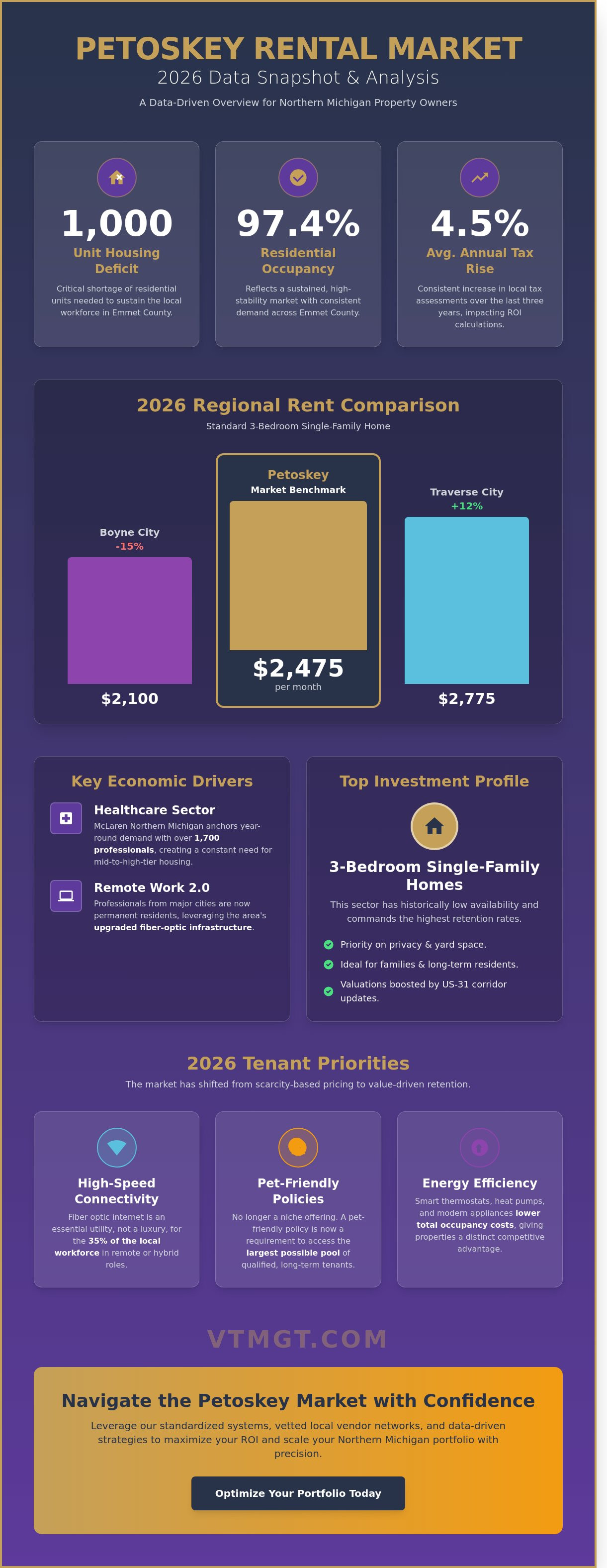
Recent data from the 2023 Emmet County Housing Needs Assessment indicates a critical deficit of 1,000 residential units required to sustain the local workforce. For property owners, this gap represents both a significant operational challenge and a strategic opportunity within the Petoskey rental market. We understand that managing a portfolio in this region currently requires more than just listing a property; it demands a precise understanding of shifting supply dynamics and the fiscal impact of rising property taxes. Our team recognizes the complexity of balancing high demand for workforce housing against the constraints of limited inventory and tightening local regulations.
You've likely noticed that traditional management strategies are no longer sufficient to offset the 4.5% average annual increase in local tax assessments recorded over the last three years. This article provides a technical, data-driven analysis of the 2026 landscape to help you navigate these shifts and maximize your long-term ROI. We'll examine specific occupancy forecasts for the coming 24 months, identify data-backed target rent benchmarks, and outline the necessary steps to mitigate legal risks associated with evolving zoning laws. By the end of this analysis, you'll have the structural framework needed to maintain a resilient and profitable property portfolio.
Key Takeaways
- Analyze current occupancy benchmarks and economic drivers to effectively position your portfolio within the 2026 Petoskey rental market.
- Transition from scarcity-based pricing to value-driven retention strategies by optimizing properties for remote work and pet-friendly requirements.
- Navigate the latest 2026 Michigan Landlord-Tenant Act updates and Emmet County zoning changes to ensure full regulatory compliance.
- Calculate your true return on investment by factoring in long-term maintenance coordination and professional oversight into your financial strategy.
- Leverage standardized systems and vetted local vendor networks to scale your Northern Michigan real estate holdings with precision and efficiency.
The State of the Petoskey Rental Market in 2026
Petoskey serves as the primary economic engine for the Little Traverse Bay region, maintaining a unique position that balances seasonal tourism with a robust year-round institutional core. As of the first quarter of 2026, the Petoskey rental market exhibits high stability, characterized by a residential occupancy rate of 97.4% across Emmet County. This figure reflects a sustained housing shortage that has persisted despite several targeted development projects. The local economy relies on a foundation of healthcare and professional services, ensuring that demand remains consistent even outside the traditional summer and winter peak seasons.
A significant supply-demand gap exists within the single-family home sector. While multi-family developments along the Mitchell Street corridor added 185 units to the inventory between 2024 and 2025, the availability of detached single-family residences remains at a historic low. Landlords owning three-bedroom homes currently see the highest retention rates, as families and long-term residents prioritize the privacy and yard space these properties offer. Recent infrastructure improvements along the US-31 corridor have further enhanced local desirability, reducing commute times to major employment centers and increasing the valuation of adjacent rental properties.
Economic Drivers in Northern Michigan
The healthcare sector, led by McLaren Northern Michigan, continues to be the largest driver of year-round rental demand. With a workforce exceeding 1,700 professionals, the hospital creates a constant need for mid-to-high-tier housing options within a 10-mile radius of Petoskey, Michigan. Additionally, the Remote Work 2.0 movement has matured. Professionals from Detroit and Grand Rapids have transitioned from temporary seasonal visitors to permanent residents, leveraging the city's upgraded fiber-optic infrastructure. Regional planning data projects a population growth of 0.9% for Emmet and Charlevoix counties through 2027, suggesting that the pressure on the rental inventory won't subside in the near term.
2026 Pricing Benchmarks
Rent growth in 2026 has transitioned to a more sustainable pace, showing a 4.5% increase compared to 2025 averages. This follows a period of rapid appreciation and indicates a market reaching a mature phase. When comparing regional metrics, Petoskey maintains a distinct pricing structure:
- Petoskey vs. Traverse City: Petoskey remains approximately 12% more affordable than Traverse City, making it an attractive alternative for regional professionals.
- Petoskey vs. Boyne City: Petoskey commands a 15% premium over Boyne City due to its higher concentration of retail, dining, and specialized medical services.
The 2026 market equilibrium price for a standard 3-bedroom single-family home in Petoskey is currently $2,475 per month. This specific price point represents the intersection where landlord yield requirements align with the median household income of the local professional workforce.
Key Trends Shaping the 2026 Rental Landscape
The Petoskey rental market in 2026 reflects a structural realignment from simple scarcity to a value-centric model. Landlords who prioritize precision in property management and asset maintenance are seeing higher yields than those relying solely on annual rent increases. This shift aligns with national rental housing trends which indicate that while inventory remains tight, tenant stability is now the primary driver of long-term profitability. Success in this environment requires a disciplined approach to property upgrades and a commitment to technological integration.
Current data shows that 2026 tenants prioritize specific functional amenities over aesthetic fluff. High-speed fiber optic connectivity and dedicated workstations have moved from "optional" to "essential" for the 35% of the local workforce engaged in remote or hybrid roles. Additionally, pet-friendly policies are no longer a niche offering; they're a requirement for accessing the largest possible pool of qualified applicants. Properties that integrate energy-efficient systems, such as heat pumps or smart thermostats, gain a distinct competitive advantage by lowering the total cost of occupancy for the tenant.
The Quality-Driven Retention Shift
In the current Petoskey rental market, the cost of turnover is a significant drain on annual net operating income. Between professional cleaning, marketing expenses, and screening processes, a single vacancy cycle in Northern Michigan can cost a landlord upwards of $2,500. Tenants in 2026 are increasingly willing to pay a premium for responsive maintenance and professional communication. They don't just want a roof; they want a reliable living environment. Implementing standardized management systems reduces vacancy periods by ensuring that maintenance requests are handled with the same precision one would expect in a technical manufacturing facility. Landlords who maintain this level of operational excellence find that professional management solutions are the most effective way to secure high-quality, long-term residents.
Infrastructure and Accessibility
Local infrastructure developments are redrawing the map of premium rental zones in Emmet County. The 2025 expansion of utility lines in Bear Creek has stabilized rental values in previously underserved pockets, creating new opportunities for multi-family investments. Proximity to the Little Traverse Wheelway remains a critical valuation metric, with units within a half-mile radius of the trail commanding a 12% price premium over isolated properties. Downtown Petoskey continues to be the anchor for high-demand rentals, but the focus has shifted toward accessibility. Tenants now look for properties that offer seamless integration with local transit and proximity to the region's expanding healthcare corridor. These geographical advantages, combined with modern technological standards for rent collection and communication, define the top tier of the 2026 market.
Regulatory and Legal Considerations for Petoskey Landlords
The 2026 updates to the Michigan Landlord-Tenant Act introduce stricter protocols for lease terminations and mandatory fee disclosures. Owners operating within the Michigan landlord laws framework must align their operations with these statewide mandates to avoid costly litigation. According to recent Petoskey Housing and Demographic Data, the market maintains a high density of renter-occupied units, making legal compliance a high-stakes priority for property performance. Emmet County has also implemented specific zoning adjustments for 2026 that limit the conversion of residential units into short-term vacation rentals in high-density districts.
Landlords must maintain a clear distinction between long-term management and short-term stays. The Petoskey rental market currently enforces a 28-day threshold for short-term stays; anything exceeding this duration falls under standard residential lease protections. Violating these local caps or failing to obtain the necessary permits results in immediate permit revocation and significant daily fines. This regulatory environment requires a disciplined approach to property usage and tenant classification.
Compliance and Security Deposits
Security deposits require dedicated escrow accounts at regulated financial institutions. Common landlord mistakes Petoskey owners make include commingling funds or failing to provide detailed inventory checklists within the 2026 statutory window. New habitability standards for this year now mandate annual inspections for high-efficiency heating systems and structural integrity. Implementing professional screening protocols is the most effective way to mitigate legal risks and minimize the costs associated with the 2026 eviction process.
Fair Housing and Local Ordinances
Fair Housing Act compliance remains a pillar of the Petoskey rental market. Landlords must apply screening criteria uniformly to avoid claims of discrimination in this small-market environment. Local ordinances also dictate specific exterior maintenance schedules that owners can't ignore. In Petoskey, municipal codes require:
- Snow removal from public sidewalks adjacent to the property within 24 hours of a snowfall exceeding two inches.
- Strict adherence to blight ordinances regarding exterior storage and lawn height.
- Updated signage for multi-unit dwellings to assist emergency services.
Standardized lease agreements are non-negotiable for 2026 compliance. These documents ensure every tenant is held to the same operational benchmarks, which protects the landlord during dispute resolution. Precise documentation of all property interactions serves as the primary defense against regulatory scrutiny.
Maximizing ROI: Strategy for Northern Michigan Investors
Achieving a sustainable yield in the Petoskey rental market requires a shift from simple cash flow estimates to a comprehensive True ROI calculation. This metric integrates technical oversight and preventative maintenance schedules into the bottom line. Professional investors don't just look at the monthly check. They factor in a 10% to 15% reserve for capital expenditures and professional management to ensure long-term asset stability. To effectively invest in Petoskey real estate, owners must analyze 2026 inventory data, which indicates a 4.2% increase in demand for high-efficiency, modernized units compared to older, unrenovated stock.
Seasonal maintenance impacts annual cash flow more significantly in Northern Michigan than in southern climates. Harsh winters necessitate rigorous roof inspections and HVAC servicing every October. Failure to execute these technical checks often results in emergency repair costs that are 2.5 times higher than scheduled maintenance. When investing in rental property Northern Michigan, your financial model should account for snow mitigation and moisture control as fixed operational parameters rather than variable expenses.
Optimizing Rental Rates
Utilizing a Comparative Market Analysis (CMA) every six months prevents landlords from losing revenue to outdated pricing structures. We've observed that many owners hit a psychological plateau at certain price points, fearing that crossing a specific threshold will increase vacancy. However, data from early 2026 shows that the correlation between property condition and cap rates is stronger than ever. Specifically, properties with updated insulation and smart thermostats see a 0.75% higher cap rate due to lower utility-adjusted turnover rates.
Tax Benefits and Financial Reporting
Landlords can significantly improve their net position by leveraging specific rental property tax benefits Michigan offers. Depreciation and expense pass-throughs serve as vital tools to offset rising labor costs for repairs. Transparent, monthly financial reporting is the foundation of portfolio growth, allowing for real-time adjustments to the Petoskey rental market conditions. Professional management fees are rarely a pure cost. They're typically offset by a 3% to 5% reduction in vacancy duration and the elimination of costly legal errors in lease enforcement.
Precise asset management is the difference between a struggling property and a high-performing investment. Partner with our professional management team to secure your 2026 returns.
Scaling Your Portfolio with Van Treese Management
Managing a growing portfolio within the Petoskey rental market requires a transition from reactive tasks to systematic oversight. Van Treese Management (VTMG) provides the infrastructure necessary to convert active property ownership into a passive investment model. Our approach integrates technical precision with standardized operations, ensuring that every asset performs at its peak capacity without requiring the landlord's daily intervention. We treat property management as a disciplined engineering process where efficiency and reliability are the primary metrics of success.
The VTMG difference lies in our commitment to human interaction supported by innovative, repeatable systems. We don't just fill vacancies; we execute a rigorous tenant placement protocol designed to stabilize long term occupancy. Our maintenance coordination relies on a vetted network of over 45 local contractors across Emmet and Charlevoix counties. This localized expertise allows us to address mechanical or structural issues with the speed and accuracy expected in industrial environments. We prioritize preventative maintenance schedules to reduce the frequency of high cost emergency repairs, effectively protecting the physical integrity of your investment.
Our Standardized Management Systems
We utilize a data driven framework to manage the Petoskey rental market fluctuations. This involves detailed market research and bi annual analysis to ensure your rental rates remain competitive and profitable. Our 24/7 emergency response coordination operates on a strict protocol, removing the burden of midnight repairs from the owner. This system ensures every tenant request is logged, tracked, and resolved with documented precision. By applying these standardized systems, we contribute to building stable, thriving communities in Northern Michigan while maximizing the long term yield for our clients.
Next Steps for Petoskey Property Owners
Optimization begins with an accurate assessment of your current assets. We provide professional property valuations that reflect current 2026 market conditions and potential ROI improvements. Once the assessment is complete, our onboarding process is designed for maximum efficiency. We typically complete the transition of management responsibilities within a 14 day window. This structured transition ensures that tenant communication remains clear and professional throughout the changeover, maintaining the stability of your cash flow.
Securing Your Investment Future in Northern Michigan
Navigating the Petoskey rental market in 2026 requires a transition from passive ownership to a structured, data-driven management approach. Current trends indicate that regulatory shifts in Emmet and Charlevoix Counties will continue to favor landlords who prioritize compliance and high-quality maintenance standards. Our data shows that properties utilizing standardized, 24/7 maintenance coordination systems maintain higher occupancy rates and better long-term asset value. Since 2018, Van Treese Management has integrated deep local roots with professional engineering principles to stabilize and grow investor portfolios. We don't rely on luck; we rely on proven systems that have served this region for years. By focusing on the technical details of property oversight, you can ensure your assets remain competitive as Northern Michigan’s landscape evolves. It's time to move beyond basic property management and adopt a strategy built on precision and reliability.
Maximize your ROI with Petoskey’s professional management experts at Van Treese Management.
The path to a resilient portfolio starts with a partner who understands the specific mechanics of the local market.
Frequently Asked Questions
What is the average rent for a 3-bedroom home in Petoskey in 2026?
The average rent for a three bedroom home in Petoskey reaches approximately $2,650 per month in 2026. This figure reflects a 4.2 percent annual growth rate based on data from regional housing reports. High demand from families and a limited supply of single family units continue to drive these valuation increases across the Petoskey rental market. Landlords with updated properties often command a premium above this baseline.
Is Petoskey, MI a good place for long-term rental investments?
Petoskey remains a stable environment for long term rental investments due to a 98 percent occupancy rate in the residential sector. The local economy benefits from the McLaren Northern Michigan hospital system and North Central Michigan College. These institutions provide a consistent tenant base of professionals and educators. Investors see steady appreciation as the region's inventory remains constrained by geographical and zoning limitations.
What are the current vacancy rates for residential properties in Emmet County?
Residential vacancy rates in Emmet County currently sit at 3.1 percent as of the first quarter of 2026. This tight inventory creates a competitive environment where well maintained properties often receive multiple applications within 48 hours of listing. Landlords benefit from this scarcity, though it requires precise tenant screening to ensure long term stability and asset protection for the Petoskey rental market.
Does Van Treese Management handle short-term vacation rentals in Petoskey?
Van Treese Management focuses exclusively on long term residential and commercial asset management to ensure maximum operational efficiency. We don't manage short term vacation rentals as our infrastructure is optimized for technical precision in long term leasing and preventative maintenance. Our team prioritizes stable cash flow and rigorous maintenance schedules that short term turnover models often disrupt. This focus allows us to maintain a higher standard of property care.
What are the biggest challenges facing Petoskey landlords in 2026?
Rising maintenance costs and aging infrastructure represent the primary challenges for landlords in 2026. Material costs for HVAC and roofing systems have increased by 12 percent since 2024. Additionally, updated municipal energy efficiency requirements in Petoskey demand specific technical upgrades. Landlords must implement proactive maintenance cycles to avoid costly emergency repairs and maintain the structural integrity of their investment portfolios.
How have Michigan landlord-tenant laws changed for the 2026 calendar year?
Michigan implemented new regulations in January 2026 that extend the notice period for rent increases to 60 days for all annual leases. These changes also include stricter documentation requirements for security deposit deductions. Landlords must provide itemized receipts for any repair exceeding 100 dollars. Staying compliant requires a structured administrative approach and precise record keeping to mitigate legal risks and ensure transparency with tenants.
Do I need a local property manager if I live outside of Northern Michigan?
Remote owners require a local property manager to navigate regional regulations and handle immediate technical requirements. Michigan law necessitates a point of contact for specific emergency situations to ensure tenant safety. A professional manager provides the boots on the ground needed for inspections and vendor oversight. This local presence ensures your investment remains protected and compliant without requiring frequent travel to the job site.