
Rental Property Tax Benefits in Michigan: A 2026 Landlord's Guide

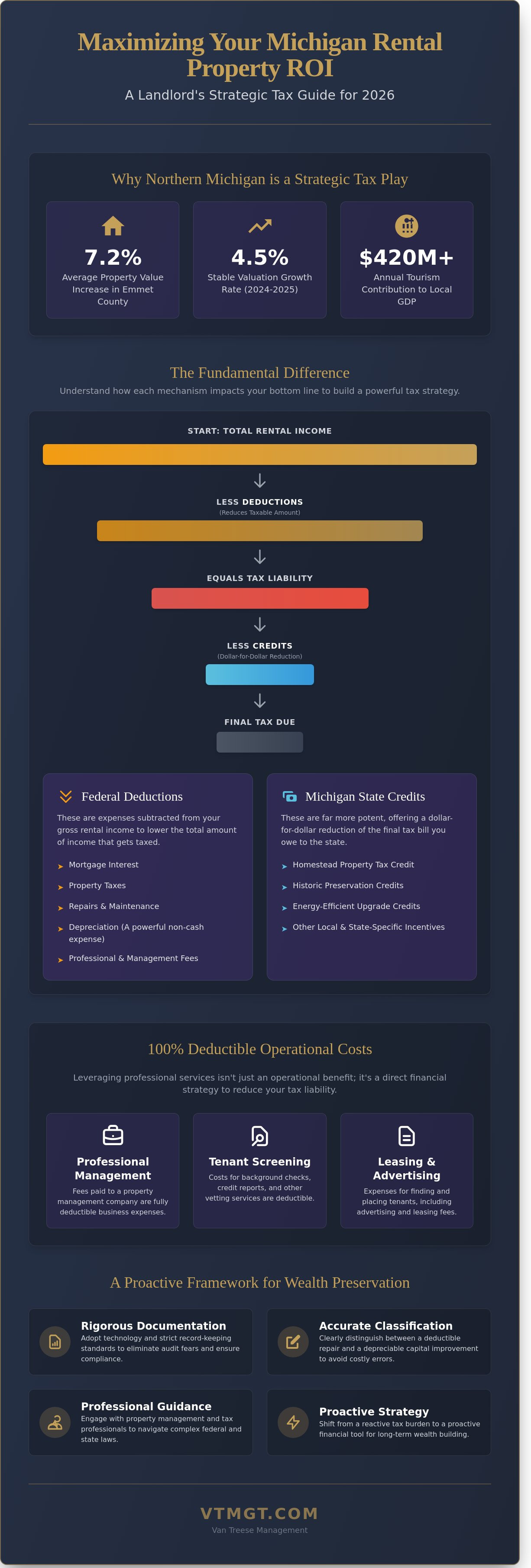
While Michigan property values in Emmet County rose by an average of 7.2% according to recent assessment data, many landlords are inadvertently forfeiting thousands in credits because they cannot distinguish between a deductible repair and a depreciable capital improvement. It's a common frustration for property owners in Northern Michigan who see rising assessments in high-demand hubs like Petoskey. You likely recognize that these valuation spikes are a double-edged sword; they increase your long-term equity but simultaneously inflate your annual tax obligations. Understanding the specific rental property tax benefits Michigan offers is no longer optional if you intend to maintain a healthy cash flow.
Our 2026 guide provides a structured framework to help you maximize your real estate ROI through federal and state-specific deductions. We'll provide a clear list of Michigan-specific tax credits, explain how professional management fees reduce your overall tax liability, and outline the record-keeping standards necessary to eliminate the fear of IRS audits. By applying these precise financial strategies, you can transform your tax strategy from a reactive burden into a proactive tool for wealth preservation.
Key Takeaways
- Analyze the 2026 Michigan fiscal landscape to leverage the strategic tax advantages inherent in Northern Michigan real estate investments.
- Implement a structured approach to federal deductions by accurately calculating property basis and maximizing depreciation schedules.
- Navigate state-level complexities, such as the Homestead Property Tax Credit, to fully capture all available rental property tax benefits Michigan offers.
- Recognize professional management, tenant screening, and leasing fees as 100% deductible business expenses to enhance operational ROI.
- Adopt rigorous documentation standards and technological tracking solutions to maintain compliance and ensure readiness for potential regulatory audits.
Understanding the Michigan Rental Property Tax Landscape in 2026
The 2026 fiscal year marks a critical transition point for real estate investors across the Great Lakes State. Michigan's tax environment has evolved into a sophisticated framework that rewards precision and long-term asset management. For landlords, staying ahead of these shifts isn't just about compliance; it's about optimizing the rental property tax benefits Michigan provides to protect narrow margins in a high-interest environment. As federal tax provisions from previous years continue to sunset, the state's specific exemptions and credits have become the primary tools for maintaining portfolio liquidity.
2026 is a pivotal year because it represents the first full reporting cycle under the updated Michigan Treasury guidelines regarding short-term versus long-term classification. Investors who fail to calibrate their accounting methods to these standards risk missing out on structural advantages. Success in this market requires a move away from generalized estimates toward a data-driven approach that mirrors the precision of the state's industrial sectors. Every deduction and credit must be documented with the same rigor one would apply to a manufacturing ISO audit.
Why Northern Michigan Real Estate is a Strategic Tax Play
The corridor stretching from Petoskey through Grand Rapids has emerged as a high-performance zone for tax-efficient investing. In Emmet and Charlevoix counties, property valuations have maintained a steady 4.5% growth rate through the 2024-2025 period, providing a stable tax base that lacks the volatility of urban centers. This stability is largely driven by a regional tourism economy that now contributes over $420 million annually to the local GDP. For those looking to secure their capital, the decision to Invest in Petoskey Real Estate allows for the utilization of local development incentives that aren't available in more saturated markets.
Regional tax bases in Northern Michigan are often more predictable than those in Southeast Michigan. Landlords here benefit from a transparent assessment process that reflects the actual utility of the property. When you combine this with the high demand for seasonal and workforce housing, the result is a robust ROI that's shielded by favorable local millage rates. It's a calculated move for investors who value consistency over speculative gains.
The Fundamental Difference Between Deductions and Credits
Achieving fiscal efficiency requires a clear understanding of how different tax mechanisms impact your bottom line. Deductions are the most common tool. They function by reducing your total taxable income at the federal level. Key examples include mortgage interest, repair costs, and Understanding Depreciation, which remains one of the most powerful non-cash expenses available to Michigan landlords. By lowering the income base, you effectively lower the percentage of revenue lost to federal brackets.
Credits, however, are far more potent because they offer a dollar-for-dollar reduction of the actual tax you owe to the State of Michigan. While deductions lower the "input" of the tax equation, credits apply directly to the "output." Common misconceptions often lead landlords to ignore state-specific credits, such as those for historic preservation or energy-efficient upgrades, thinking they're redundant with federal deductions. In reality, a well-structured 2026 tax strategy uses both:
- Federal Deductions: Used to minimize the gross income reported to the IRS.
- State Credits: Used to eliminate or significantly reduce the final Michigan tax liability.
- Property Exemptions: Used to lower the assessed value of the asset before the tax rate is even applied.
Investors shouldn't view these as optional bonuses. They're essential components of a professional real estate operation. Proper application of these rental property tax benefits Michigan offers can mean the difference between a 3% and a 7% net yield on a single-family unit.
Maximizing Federal Deductions for Michigan Landlords
The foundation of rental property tax benefits Michigan relies on the "Big Three" federal deductions: mortgage interest, depreciation, and repairs. For landlords in Northern Michigan, maximizing these benefits starts with an accurate determination of the property's cost basis. This technical calculation includes the purchase price plus specific closing costs, such as title insurance and recording fees, while subtracting the estimated value of the land. Since land does not wear out, it cannot be depreciated, making the initial appraisal or tax assessment ratio vital for establishing a precise recovery schedule.
Pass-through income regulations in 2026 continue to favor small-scale investors. Most Michigan landlords operate as sole proprietors or through LLCs, which allows them to utilize the Qualified Business Income (QBI) deduction under Section 199A. This provision permits owners to deduct up to 20% of their net rental income from their taxable income, provided they meet the 250-hour annual service requirement. Maintaining a fegyelmezett (disciplined) log of hours spent on tenant screening, maintenance, and property inspections is essential to defend this deduction during an IRS audit.
Depreciation: The Most Powerful Non-Cash Expense
Residential rental structures are recovered over a 27.5-year period. This allows owners to claim an annual expense that does not require an actual cash outlay, effectively reducing taxable profit while maintaining liquidity. According to the IRS Depreciation Rules, this process begins the moment the property is "placed in service" or ready for occupancy. For high-value assets in Traverse City, landlords often implement cost segregation. This engineering-based approach identifies components like cabinetry, specialized lighting, or landscaping that can be depreciated over 5, 7, or 15 years rather than the standard 27.5. It's vital to remember that when you sell the asset, the IRS requires "depreciation recapture," taxing the accumulated depreciation at a maximum rate of 25%.
Repairs vs. Capital Improvements: Navigating IRS Rules
Distinguishing between a repair and a capital improvement is a matter of structural precision. A repair is a "keep-in-working-order" expense that is fully deductible in the current tax year. For example, fixing a single leak on a Petoskey rental roof is a repair. Conversely, replacing the entire roof is a capital improvement that must be depreciated over several years. The IRS provides a "Safe Harbor" election for small taxpayers, allowing an immediate deduction for building expenses that don't exceed $2,500 per invoice or item.
Implementing a rigorous documentation system ensures that every expense is categorized correctly to minimize tax liability. Owners who utilize professional management solutions benefit from standardized financial reporting that aligns with these federal requirements. This level of technical accuracy prevents the misclassification of expenses, which could lead to penalties or missed savings. Consistent maintenance tracking not only preserves the asset but also builds a transparent trail for tax season.
Michigan-Specific Tax Credits and Local Property Tax Nuances
Michigan’s tax code provides specific mechanisms that directly affect your bottom line. While the primary Tax Advantages for Landlords often focus on federal depreciation, state-level nuances in Michigan require precise management to maintain profitability. Our firm observes that many owners overlook how local millage rates and state exemptions interact with their long-term investment strategy.
The Homestead Property Tax Credit (HPTC) and Your Tenants
Landlords in Michigan must understand that the HPTC is a credit designed for tenants, not the property owner of a rental unit. In 2026, Michigan law continues to mandate that landlords provide specific rent data to tenants. This documentation allows renters to claim a credit if their property taxes exceed a defined percentage of their total household income. Providing this information is a legal requirement outlined in our comprehensive guide to Michigan Landlord Laws. We ensure our clients maintain these records to avoid local compliance penalties.
It's also vital to distinguish between your primary residence and your inventory. Most rental properties don't qualify for the Principal Residence Exemption (PRE). This means you'll typically pay the full 18-mill non-homestead levy. This higher rate is a fixed cost that must be factored into the calculation of rental property tax benefits Michigan investors use to determine their internal rate of return.
Managing Property Tax Assessments in Petoskey and Grand Rapids
Michigan’s Proposal A, established in 1994, limits how much a property's taxable value can increase annually to the lesser of 5% or the rate of inflation. However, a transfer of ownership triggers an "uncapping" event. This resets the taxable value to the current state equalized value (SEV), which represents 50% of the true market value. In high-growth markets like Grand Rapids or Petoskey, this jump can be substantial, often increasing the tax burden by 20% or more overnight.
In Kent County and Emmet County, local assessors monitor these transfers with high precision. We recommend a proactive approach to managing these costs:
- Review Assessment Notices: Every February, local municipalities send out assessment notices. Check these for errors in property classification or square footage.
- The March Board of Review: This is the only time of year you can appeal your valuation. In Northern Michigan cities like Boyne City, successful appeals require a professional appraisal or a comparative market analysis (CMA) from the previous 12 months.
- Analyze Millage Rates: Different townships in the Petoskey area have varying millage rates. Choosing a property in a township with lower debt service millages can improve your rental property tax benefits Michigan profile.
Our team treats tax management as a technical discipline. We focus on the data to ensure your property isn't over-assessed relative to its actual market performance. By challenging inaccurate SEV figures, we help owners protect their margins against local inflationary pressures.
Deducting Professional Management and Operational Costs
Professional management fees represent one of the most straightforward ways to maximize rental property tax benefits Michigan offers to investors. Under IRS Publication 527, these fees are classified as ordinary and necessary business expenses. This means every dollar paid to a management firm is 100% tax-deductible against your rental income. Our firm focuses on providing a disciplined financial structure that ensures these costs are tracked with engineering precision. Operational expenses extend beyond monthly management percentages. Landlords can deduct the full cost of advertising vacancies on digital platforms, conducting comprehensive tenant screenings, and paying leasing commissions. When these tasks are outsourced, the administrative overhead shifts from a personal burden to a deductible business cost. Maintenance coordination is another critical area. While the actual repair cost is deductible, the logistical management of vendors and site inspections is also a recognized business expense. Van Treese Management simplifies this process by providing structured year-end reports. These documents categorize every expenditure, allowing your CPA to process returns without the need for manual reconciliation of disorganized receipts.Travel and Transportation Deductions for Remote Owners
Owners managing properties in Northern Michigan from a distance can leverage significant travel deductions. For the 2026 tax year, you can choose between the standard mileage rate or the actual expense method. If you drive a dedicated service vehicle, the actual expense method often yields higher returns through depreciation. The primary purpose rule remains the standard for multi-purpose trips. If the 51% of your trip's duration is dedicated to property inspections or meeting contractors in Petoskey, the core travel costs are typically deductible. You must maintain a precise log including dates, mileage, and the specific business purpose of every visit to withstand an audit.Professional Services: Legal, Accounting, and Management
The cost of maintaining legal and financial compliance is a necessary investment in your property's infrastructure. Fees paid for lease preparation, eviction proceedings, or annual tax filing are fully deductible. Investing in these services provides a high ROI because the government effectively subsidizes the cost through reduced tax liability. Professional oversight also functions as a risk mitigation strategy. By utilizing experts, you reduce the probability of landlord mistakes that often result in expensive litigation or state compliance penalties. Our management systems integrate these professional requirements into a single, cohesive operational flow. This technical approach ensures that your rental property tax benefits Michigan are fully realized while protecting your asset from avoidable legal exposure.Strategic Tax Planning and Documentation for Northern Michigan Owners
Precision in documentation is the foundation of long-term rental profitability. For the 2026 fiscal year, the IRS and the Michigan Department of Treasury require rigorous proof for every deduction claimed. We prioritize a systematic approach to record-keeping. This prevents the loss of valuable rental property tax benefits Michigan offers to diligent owners. Every maintenance request, repair invoice, and capital improvement must be logged immediately. Relying on paper receipts or end-of-year memory creates unnecessary risk. We utilize integrated property management technology to capture expenses in real-time. This provides a digital breadcrumb trail that simplifies the audit process and ensures no deductible expense is overlooked.
The Role of Standardized Management Systems in Tax Compliance
Our financial reporting protocols mirror industrial quality control standards. We treat every rental unit in Emmet and Charlevoix counties as a distinct cost center. Standardizing maintenance receipts allows us to distinguish between immediate repairs and long-term capital improvements. This distinction is critical for accurate depreciation schedules. By maintaining transparent accounting, we ensure that every dollar spent on a property is accounted for and correctly categorized. This level of detail provides a clear audit trail that protects your assets during regulatory reviews.
To prepare for the 2026 year-end, landlords should follow this essential checklist:
- Verify all 1099-NEC forms for independent contractors are issued by January 31, 2027.
- Reconcile all monthly bank statements against property management ledgers to ensure 100% accuracy.
- Review depreciation schedules for any appliances or structural components retired during 2026.
- Confirm the accuracy of mileage logs for property-related travel to and from Northern Michigan sites.
- Validate that all property tax payments to local municipalities are recorded in the correct fiscal period.
Partnering with Local Experts to Protect Your ROI
Ready to optimize your property's financial performance? Contact Van Treese Management for Expert Rental Oversight to secure your investment's future.
Optimize Your 2026 Michigan Tax Strategy
Navigating the 2026 tax landscape requires more than just basic record-keeping; it demands a technical understanding of the 18-mill non-PRE tax rate and federal depreciation schedules. Landlords who fail to document operational costs or miss local property tax nuances often leave significant capital on the table. Maximizing rental property tax benefits Michigan provides depends on the precision of your financial tracking and the consistency of your maintenance protocols. By establishing a rigorous documentation system, you protect your basis and ensure every eligible expense is accounted for during the annual filing process. It's a matter of technical accuracy rather than guesswork.
VTMG has delivered comprehensive asset oversight across Northern Michigan since 2018, bridging the gap between complex tax requirements and daily operations. Our process utilizes standardized financial reporting to simplify your tax filing while our 24/7 maintenance coordination prevents asset depreciation. We provide the structural stability your portfolio needs to thrive in a shifting regulatory environment. Maximize Your ROI with Professional Management and secure the long-term performance of your real estate assets. Your success in the 2026 market starts with professional precision today.
Frequently Asked Questions
Are property management fees tax-deductible in Michigan?
Property management fees are fully deductible as a professional business expense on your federal and state tax returns. You can subtract the total cost of management services from your gross rental income to reduce your taxable liability. This deduction falls under the operational expenses category defined by IRS Publication 527 for the 2026 tax year.
What is the Homestead Property Tax Credit for Michigan landlords?
The Homestead Property Tax Credit is a credit for Michigan residents whose household income is $67,300 or less as of the 2024 tax year. Landlords don't qualify for this credit on their rental properties because the state reserves it for principal residences. If you live in one unit of a multi-family complex you own, you can claim the credit only for the specific portion of the property you occupy.
Can I deduct travel expenses to my rental property in Petoskey?
You can deduct travel costs to your Petoskey rental property if the primary purpose of the trip is for maintenance, management, or inspection. For the 2024 tax year, the IRS set the standard mileage rate at 67 cents per mile, and we expect similar inflation-adjusted rates for 2026. Keep a precise log of your odometer readings and the specific business purpose for every trip to Northern Michigan to satisfy audit requirements.
How do I distinguish between a repair and an improvement for tax purposes?
Repairs are immediate fixes that keep a property in its current operating condition, such as repairing a faucet or replacing a broken window pane. Improvements add value or extend the property's life, like installing a new HVAC system or a roof. While you can deduct repairs in the year they occur, you must depreciate improvements over 27.5 years to maximize the rental property tax benefits Michigan provides.
What documents do I need to keep for my Michigan rental property taxes?
Maintain a precise archive of all lease agreements, 1099-MISC forms, and detailed receipts for at least seven years. You'll also need records of local property tax assessments and insurance premiums. Organized documentation ensures you're prepared for audits and helps verify the specific rental property tax benefits Michigan landlords claim on their annual Schedule E filing.
Is depreciation mandatory for Michigan rental properties?
Depreciation is a mandatory deduction according to IRS regulations, even if you don't claim it on your annual return. The government calculates your tax basis as if you took the deduction, which often leads to higher taxes when you sell the property. Residential buildings are depreciated over a 27.5-year schedule, providing a consistent method to offset your rental income through non-cash expenses.
How does 'uncapping' affect property taxes when I buy a rental in Traverse City?
Uncapping occurs when a property title transfers, allowing the local assessor in Traverse City to reset the taxable value to the current state equalized value. Under Michigan's Proposal A of 1994, annual tax increases are limited to 5 percent or the rate of inflation. A new purchase removes this cap, which frequently results in a 20 percent to 40 percent increase in property taxes for the new owner.
Can I deduct the cost of tenant screening and background checks?
You can deduct 100 percent of the costs associated with tenant screening, background checks, and credit reports as professional service expenses. These costs are considered ordinary and necessary for the operation of a rental business. If you collect application fees from prospective tenants to cover these costs, you must report that fee as income before deducting the actual expense paid to the screening provider.