
How Much Does a Bad Tenant Really Cost? The Complete Financial Breakdown

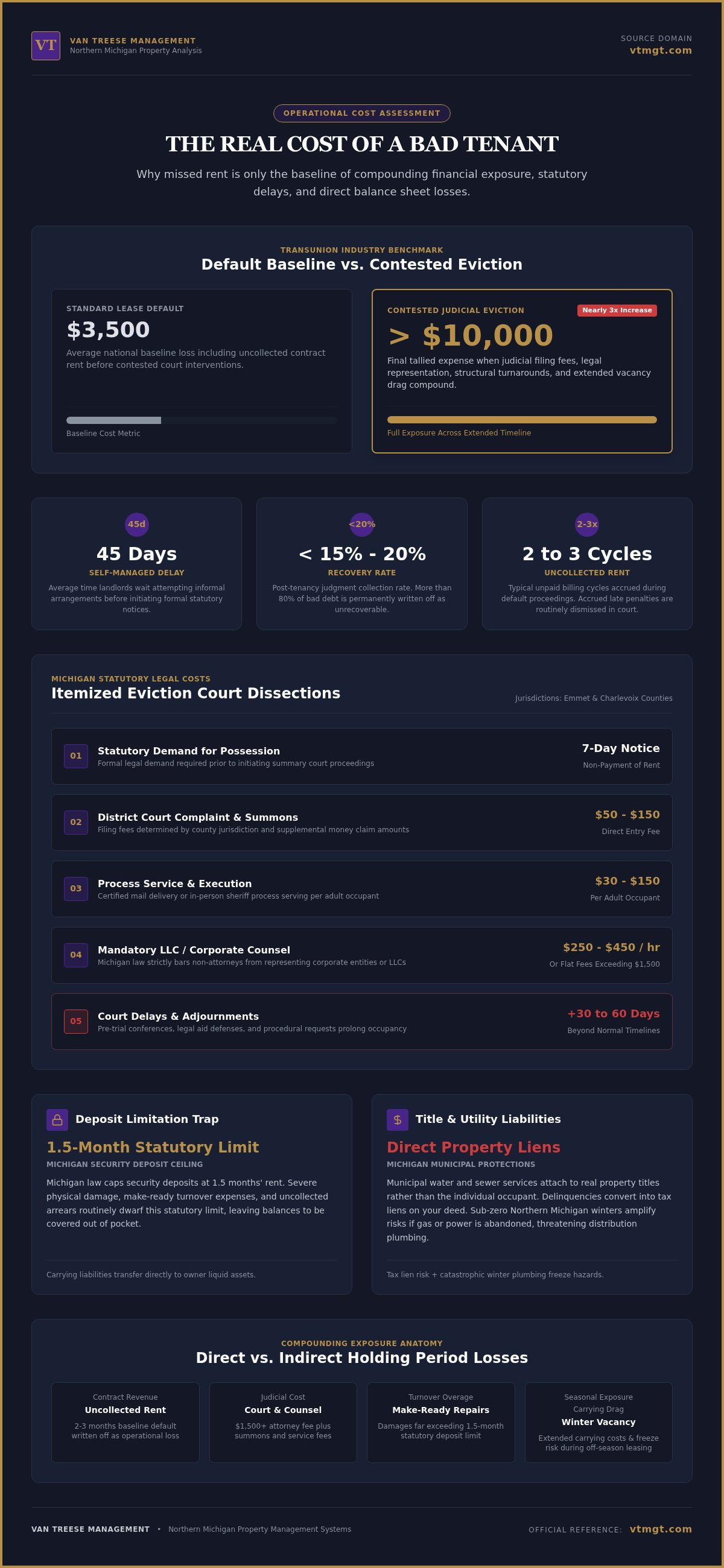
According to TransUnion data, a standard lease default averages $3,500, but a contested eviction frequently exceeds $10,000 once court expenses, make-ready repairs, and vacancy drag are tallied. When rental property owners evaluate how much does a bad tenant really cost, they often focus solely on missed rent checks. In truth, that uncollected rent is just the baseline of an accelerating financial loss that strains your balance sheet while statutory timelines and property carrying costs run their course.
You shouldn't have to cover mortgage payments out of pocket while waiting out court backlogs, only to inherit repair bills that dwarf the security deposit during critical Northern Michigan leasing cycles. You'll discover the true, compounding financial damage of an unqualified placement and see how disciplined management systems actively protect your rental asset. We break down every direct and indirect line-item expense ahead, providing the clarity required to eliminate unnecessary exposure and secure predictable revenue.
Key Takeaways
- Benchmark the direct balance-sheet drain of missed payments and see why informal payment arrangements compound financial exposure.
- Navigate Michigan statutory eviction procedures and court filing requirements to avoid costly procedural errors that extend non-paying occupancy.
- Analyze why structural repairs and turnover expenses routinely exceed Michigan's 1.5-month statutory security deposit limit.
- Evaluate the hidden carrying costs of off-season turnover, particularly the severe revenue impact of winter vacancies in Northern Michigan.
- Discover how much does a bad tenant really cost across an entire holding period and how rigorous tenant screening acts as an engineered risk shield.
The Direct Balance Sheet Hit: Unpaid Rent, Late Balances, and Arrears
Direct financial failure rarely happens overnight; it starts with partial payments, broken payment arrangements, and compounding arrears. Self-managed property owners frequently wait an average of 45 days before initiating formal action, hoping a tenant will catch up. In residential leasing, bad debt represents uncollectible rent written off as an operational loss, with post-tenancy judgment recovery rates historically lingering below 15 to 20 percent. When investors assess how much does a bad tenant really cost, this baseline revenue loss serves as the initial blow to cash flow.
Calculating the Cumulative Rental Income Loss
Defaulted rent accrues rapidly across contested tenancies. A tenant withholding rent for two or three billing cycles creates a structural deficit that late fees cannot fix. When cases transition into formal eviction legal proceedings, district courts routinely strip accrued late penalties during mediation or summary judgment hearings. As uncollected rent mounts, landlords are forced to execute emergency capital transfers from personal savings to service debt obligations, absorb bank overdraft fees, and maintain liquidity.
Utility Default Liabilities and Municipal Charge-Backs
The financial bleed frequently extends beyond unpaid base rent into utility defaults. In Michigan, municipal water and sewer services attach directly to the real property title rather than the individual debtor, leaving owners legally liable for liens created by delinquent occupants. Operational liabilities compound when tenants abandon electric accounts or shut off gas during sub-zero Northern Michigan winter months, triggering automatic landlord interim billing agreements or risking catastrophic freeze-ups across unheated distribution plumbing.
Every week of deferred action broadens this balance sheet deficit. Analyzing how much does a bad tenant really cost begins with recognizing these compounding arrears:
- Unrecoverable Arrears: Multiple months of missed contract rent that collections agencies rarely recoup.
- Waived Fees: Contractual late charges that are consistently dismissed or negotiated away during court appearances.
- Utility Backcharges: Municipal sewer and water balances converted into tax liens against your property deed.
- Capital Drag: Carrying costs, including mortgages and insurance premiums, funded out of pocket while cash flow remains frozen.
The Legal Price Tag: Eviction Filings, Court Fees, and Timelines
Regaining legal possession of an asset requires strict adherence to statutory notice requirements and judicial procedures. A minor clerical mistake on a notice can invalidate weeks of effort, forcing you to restart the process and absorb additional months of zero cash flow. Reviewing our guide to Michigan Landlord Laws helps avoid these administrative pitfalls before initiating summary proceedings in local district courts.
Statutory Notice Requirements and Court Filing Costs
The formal removal process begins with drafting and serving a valid Demand for Possession, such as a 7-Day Notice for non-payment of rent. If the tenant fails to vacate or cure the default, the matter moves to court. At this stage, self-managed owners often face unexpected disbursements:
- Complaint and Summons Filing: District court entry fees across jurisdictions like Emmet and Charlevoix counties range between $50 and $150, depending on supplemental money claim amounts.
- Process Service: Certified mail delivery or in-person sheriff process serving adds another $30 to $150 per adult occupant.
- Mandatory Representation: Michigan law bars non-attorney owners from representing corporate entities or LLCs in court, meaning property owners must hire counsel at hourly rates running from $250 to $450 or flat fees exceeding $1,500.
The True Cost of Judicial Delays and Writ Execution
Litigation timelines represent an underappreciated variable when calculating how much does a bad tenant really cost. A contested court hearing rarely resolves on day one. Pre-trial conferences, adjournment requests, and legal aid defenses can prolong occupancy by 30 to 60 days beyond normal statutory windows. Examining the broader legal costs and procedures of eviction shows that total litigation fees often eclipse the baseline debt owed.
Once a judgment of possession is secured, Michigan provides a mandatory 10-day appeal and payment window before a landlord can request an Order of Eviction (Writ of Restitution). Executing this writ introduces another round of statutory expenses, including court officer fees ($50 to $400) and labor costs for clearing remaining personal property to the curb line. Engaging professional residential property management establishes rigorous, upfront documentation that keeps leasing workflows strictly aligned with judicial timelines, keeping legal exposure contained.
Understanding how much does a bad tenant really cost clarifies that statutory legal enforcement is not merely an administrative chore; it is an expensive legal intervention where every day of court delay directly increases carrying debt.
Property Damage and Turnover Expenses Beyond the Security Deposit
Physical asset destruction regularly shatters the assumption that a tenant deposit provides an adequate risk buffer. Under Michigan law (MCL 554.602), residential security deposits are capped at a maximum of 1.5 months of rent. When an unvetted occupant defaults, that capped reserve is quickly exhausted by unpaid balances before structural remediation even begins. Property owners calculating how much does a bad tenant really cost discover that severe property damage transforms a routine unit turn into a major capital expenditure.
Malicious Destruction vs. Normal Wear and Tear
Differentiating ordinary wear from actionable damage requires rigorous documentation. Disgruntled occupants facing possession proceedings often retaliate with physical vandalism, such as punched drywall, cracked plumbing fixtures, or deliberate drain clogs. Pet waste saturated into subflooring requires tearing out carpet and laying specialized chemical sealing primers before new flooring can go down. Uncooperative occupants who conceal slow plumbing leaks create extensive subfloor rot and hidden black mold, compounding basic plumbing repairs into full-scale remediation projects.
Trash-Out Logistics and Specialized Remediation
The operational overhead required to return a neglected property to leasable condition involves specialized trade intervention. Clearing out heavy furniture, abandoned trash, and hazardous debris requires commercial roll-off dumpsters and dedicated hauling crews. Once trash-out operations wrap up, standard cosmetic refreshes prove insufficient:
- Odor Elimination and Encapsulation: Heavy biological odors and tobacco smoke demand specialized ozone treatments alongside full-coverage shellac primer coatings across all wall assemblies.
- Locksmith and Security Hardware: Rekeying exterior deadbolts, replacing damaged entry sets, and repairing breached strike plates ensure basic property security.
- Appliance and Fixture Refurbishment: Deep sanitization or outright replacement of grease-laden ovens, broken refrigerators, and cracked porcelain basins.
Standard unit turnovers benchmark between $1,750 and $4,000, but repairing malicious vandalism and prolonged neglect routinely pushes expenses between $8,000 and $15,000. Applying the engineering-minded maintenance protocols detailed in our guide on Rental Property Maintenance in Northern Michigan helps catch subtle mechanical failures before neglect escalates. Reviewing comprehensive tenant screening reports prior to lease execution provides the initial defensive filter, verifying prior rental conduct and payment reliability before keys are handed over.
When measuring how much does a bad tenant really cost, these physical restoration bills often deal the heaviest operational blow, depleting operating accounts and eliminating multiple quarters of anticipated net operating income.
The Hidden Carrying Toll: Extended Vacancy, Seasonality, and Administrative Drag
Beyond legal invoices and repair estimates, unbudgeted downtime creates an insidious drain on investment capital. While an ordinary unit turn averages 34.4 days, recovering from a defaulted lease pushes vacancy windows to 60 or 90 days. When examining how much does a bad tenant really cost, localized climate cycles and indirect administrative overhead compound to suppress annual asset yields.
The Seasonal Vacancy Penalty in Northern Michigan
Northern Michigan rental dynamics do not operate on a flat calendar. Renter migration drops significantly between November and March across Emmet and Charlevoix counties. Regaining possession during late autumn forces properties into off-peak winter vacancy cycles, where qualified tenant pools contract sharply. As detailed in our guide on Investing in Rental Property in Northern Michigan, timing dictates performance. During an off-season vacancy, holding costs accumulate without offsetting income:
- Baseline Holding Expenses: Continuous heating to prevent pipe freeze-ups, municipal winter service, and contracted snow removal run concurrently with mortgage interest and insurance.
- Rate Concessions: Securing a tenant during off-peak months often requires lowering asking rent by 3 to 7 percent or offering concessions, depressing the property's baseline valuation for an entire lease cycle.
- Compounded Revenue Gap: At median daily vacancy carrying costs of $50 to $60, every additional month of winter dormancy strips over $1,500 directly from your net yield.
Quantifying Landlord Stress and Administrative Hours
Self-managing property owners consistently surrender hundreds of non-billable hours attempting to manage non-compliant tenancies. Industry operational data indicates that housing operators expend up to 80 percent of their working hours resolving delinquent accounts, structural disputes, and court filings. That lost time carries a steep opportunity cost, diverting attention away from professional careers, family commitments, and strategic portfolio expansion.
Unplanned capital calls often force owners to drain emergency liquid reserves or accept unfavorable short-term credit terms just to cover routine operations. Systemic oversight through Van Treese Management replaces reactive troubleshooting with disciplined, process-driven operations, eliminating owner burnout. Partner with Van Treese Management to protect your Northern Michigan real estate asset through standardized operational systems that eliminate vacancy drag and safeguard asset stability.
Calculating how much does a bad tenant really cost requires accounting for these operational carrying tolls, which quietly compound long after physical possession has been restored.
Mitigating Bad Tenant Risk: Prevention Systems vs. Reactive Expenses
Rigorous tenant underwriting acts as an engineered risk-mitigation system, costing a fraction of a single contested eviction. According to industry risk analyses, structured front-end screening delivers up to a 100-to-1 cost-prevention ratio compared to reactive legal removals. When property owners analyze how much does a bad tenant really cost over a multi-year investment horizon, front-end quality control consistently proves far more economical than post-default recovery. As outlined in our resource on Professional Property Management in Petoskey, MI, structured placement protocols replace gut feelings with verified data points.
Multi-Tiered Tenant Underwriting Architecture
National Multifamily Housing Council data reveals that over 6 percent of rental applications contain fraudulent alterations, while roughly 25 percent of eviction filings trace back to fabricated application records. Mitigating this risk requires multi-layered verification rather than surface-level document checks:
- Income Verification: Cross-referencing payroll records and bank statement transactions directly through secure verification networks to identify synthetic documents and altered PDF stubs.
- Independent Landlord Audits: Contacting confirmed property owners directly via county tax records rather than accepting phone numbers provided for personal references or friendly contacts.
- Judicial Record Screening: Searching regional and nationwide court dockets for previous unlawful detainer filings, uncollected money judgments, and persistent contract breaches.
Standardized Property Management as Long-Term Asset Protection
Once underwriting clears an applicant, long-term asset security relies on institutional lease preparation and active oversight. Standardized lease agreements structured under Michigan statutory guidelines establish unambiguous rules regarding payment grace periods, utility retention responsibilities, and structural maintenance duties. Pair this documentation with periodic physical condition assessments to catch unauthorized alterations, deferred maintenance alerts, or lease violations before they compromise your balance sheet.
Operating without a standardized leasing framework leaves capital assets exposed to volatile operational liabilities. Partner with Van Treese Management to safeguard your residential real estate assets through disciplined tenant screening, compliant lease preparation, and systematic property oversight across Northern Michigan.
Ultimately, answering how much does a bad tenant really cost reinforces a core operational reality: prevention systems systematically protect yield, while reactive measures simply document capital losses after the damage is done.
Engineered Operational Controls for Long-Term Asset Security
Unpaid base rent represents only the visible surface of balance sheet exposure. When factoring in statutory filing procedures, specialized restoration bills that exceed deposit caps, and off-peak winter vacancy carrying tolls, evaluating how much does a bad tenant really cost proves that reactive management is an unsustainable strategy. Sustainable portfolio growth requires disciplined, engineered operational controls long before keys are handed over.
Van Treese Management delivers structured protection for residential assets across Emmet and Charlevoix counties. By implementing institutional-grade tenant underwriting, statutory lease execution, and an established network of licensed local trade contractors for rapid turnover, we eliminate the costly vulnerabilities that disrupt rental yields. Real estate investments shouldn't drain cash reserves through unbudgeted capital calls. Protect your rental investment with Van Treese Management and build lasting, reliable performance across every leasing cycle.
Frequently Asked Questions
How much does a bad tenant really cost the average landlord?
A bad tenant typically costs an owner between $8,000 and $10,000 in total direct and indirect losses, though severe situations exceed $15,000. When calculating how much does a bad tenant really cost, you must look past missed base rent. Compounding balances, legal representation, court filing fees, property damage remediation, and multi-month vacancy holding costs rapidly accumulate against your bottom line.
What is the average cost to evict a tenant in Michigan?
Baseline direct costs for an uncontested eviction average $3,500, but contested proceedings frequently climb to $5,000 or more in legal and filing disbursements. In jurisdictions like Emmet and Charlevoix counties, expenses include summons fees, process server delivery, court officer writ execution, and hourly attorney billables. Corporate owners must hire legal counsel by law, raising out-of-pocket costs.
Can a landlord recover repair costs that exceed the security deposit?
Yes, property owners can pursue a civil judgment against the tenant in district court for excess damages. Under Michigan law (MCL 554.602), residential security deposits are capped at 1.5 months of rent. If physical repairs exceed that reserve, recovering additional funds requires formal money judgments, though historical recovery rates on defaulting tenant judgments remain below 20 percent.
How long does the legal eviction process take from start to finish?
The standard eviction workflow in Michigan generally takes between four and eight weeks, assuming zero procedural delays. The timeline begins with a mandatory 7-Day Notice to Quit for non-payment, followed by summons issuance, formal court appearances, and a mandatory 10-day post-judgment appeal period. Contested matters or requests for adjournment can extend occupancy even further.
What happens if a tenant stops paying rent in the middle of winter?
Michigan law strictly prohibits "self-help" evictions, meaning you cannot terminate utility services, adjust thermostats, or change locks despite freezing outdoor temperatures. Landlords must continue financing baseline heating and structural utilities to prevent frozen or burst distribution plumbing. Regaining possession during Northern Michigan winters also forces units into prolonged holding vacancies when prospective tenant activity hits seasonal lows.
Is hiring a property manager cheaper than dealing with a bad tenant?
Yes, professional management acts as a cost-effective operational safeguard against lease defaults. When evaluating how much does a bad tenant really cost across legal, turnover, and holding lines, a single eviction easily wipes out multiple years of management fees. Van Treese Management eliminates this exposure in markets like Petoskey and Traverse City by applying systematic operational standards that ensure consistent income.
How does professional tenant screening differ from a standard online check?
Professional underwriting goes far beyond automated online background checks, which frequently fail to catch synthetic applications or altered PDF pay stubs. Robust placement systems cross-examine direct payroll data, audit banking transactions via secure networks, review regional court filings, and independently verify past landlords using county property records to eliminate biased personal references.