
Petoskey Multi-Family Investing: 2026 Strategic Guide

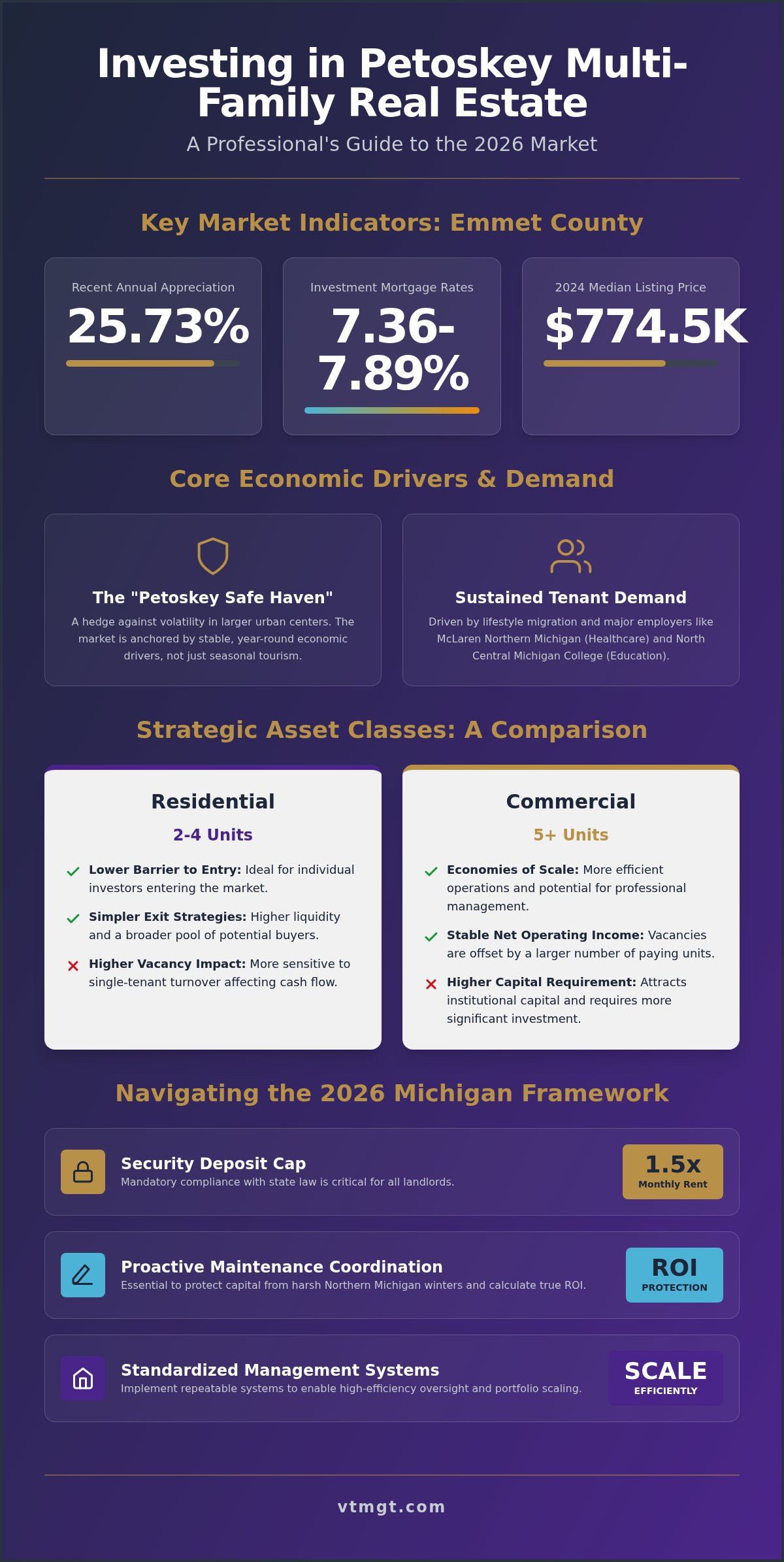
With Petoskey property values experiencing recent annual appreciation rates as high as 25.73 percent, the financial threshold for entry has shifted significantly. You likely recognize that Northern Michigan represents a stable, high-demand environment for real estate, but the complexities of seasonal vacancy and Michigan's 2026 regulatory updates require more than just a casual interest. Successful investing in multi-family homes Petoskey now demands the same level of precision and structural oversight as a complex industrial process.
We recognize that remote management logistics and the 1.5 times monthly rent security deposit cap create operational friction for many out-of-state investors. This guide provides a professional roadmap to identify, analyze, and manage profitable multi-family real estate using standardized, repeatable systems. We will move beyond surface-level metrics to analyze true ROI in a climate where investment mortgage rates currently range between 7.36 percent and 7.89 percent. You will learn how to navigate the stringent licensing rules adopted in July 2026 and how a structured maintenance coordination plan protects your capital from harsh Northern Michigan winters. This article outlines a clear framework for selecting a reliable local management partner to secure your long-term position in Emmet County.
Key Takeaways
- Understand how lifestyle migration and stable professional employment in Emmet County drive sustained demand for multi-family units over single-family inventory.
- Distinguish between residential (2-4 units) and commercial (5+ units) asset classes to align your risk-reward profile with the 2026 Northern Michigan market.
- Learn to calculate true ROI by incorporating specialized maintenance reserves essential for mitigating the operational risks of the local climate.
- Master the 2026 Michigan landlord framework to ensure compliance when investing in multi-family homes Petoskey, specifically regarding security deposit limits and documentation.
- Discover how implementing standardized management systems and professional maintenance coordination allows you to scale your portfolio with high-efficiency oversight.
2026 Outlook: Petoskey Multi-Family Home Investing
The 2026 Petoskey real estate market has solidified its position as a primary destination for lifestyle migration and professional employment. Unlike markets driven by speculative bubbles, Emmet County's growth is anchored by a diverse economic base. Many high-net-worth individuals and remote professionals are relocating to Northern Michigan, seeking the stability and quality of life the region offers. This shift has transformed the area from a seasonal destination into a year-round economic engine. Investors find that the local economy provides a structural foundation that is often missing in purely resort-based markets.
Investing in multi-family homes Petoskey provides a unique capital preservation strategy, often referred to by institutional players as the "Petoskey Safe Haven" concept. This perspective views the local market as a hedge against the volatility found in larger urban centers. While major metropolitan areas struggle with fluctuating occupancy and regulatory shifts, Petoskey maintains a steady trajectory. Understanding the fundamentals of real estate investing in this context requires looking beyond simple appreciation. It involves analyzing how local employment and infrastructure support long-term asset performance. Petoskey's multi-family potential represents a precise balance between high-yield seasonal tourism and the consistent cash flow of year-round residency.
Economic Drivers in Northern Michigan
The stability of the local rental market is fundamentally linked to the healthcare and education sectors. McLaren Northern Michigan and North Central Michigan College serve as major anchors, providing a consistent pool of professional-class tenants who require high-quality housing. In 2026, infrastructure improvements, including enhanced digital connectivity and road expansions, have further integrated Petoskey into the regional economy. These developments attract a demographic that prioritizes proximity to work and modern amenities. Additionally, limited land availability in the historic downtown and waterfront districts creates a natural barrier to entry. This scarcity ensures that existing multi-family property values remain resilient against oversupply.
Supply vs. Demand in Emmet County
Current data indicates a significant inventory gap for quality multi-family units in Emmet County. While single-family homes have seen dramatic price increases, multi-family assets offer superior risk-adjusted returns due to their operational efficiency. The 2024 median listing price of $774,500 for residential properties has pushed many prospective residents toward high-end rentals. This creates a supply-constrained environment where owners of multi-family assets can command premium rates. Compared to larger Michigan urban centers, Petoskey offers a more predictable regulatory environment and a higher concentration of long-term professional tenants. This structural advantage makes investing in multi-family homes Petoskey a more viable technical strategy for capital growth in 2026.
Strategic Asset Classes: Residential vs. Commercial Multi-Family
Successful investing in multi-family homes Petoskey requires a technical understanding of the distinction between residential and commercial classifications. Residential assets, which comprise two to four units, operate under different financing and valuation models than commercial properties of five units or more. In the Northern Michigan context, residential multi-family units often serve as entry points for individual investors seeking higher liquidity and simpler exit strategies. Conversely, commercial multi-family buildings attract institutional capital due to their economies of scale and capacity for professionalized oversight. High-growth zones in Petoskey currently center on the corridors adjacent to McLaren Northern Michigan and the historic downtown district, where demand for professional-grade housing remains consistently high regardless of seasonal shifts.
The risk-reward profile of each class depends heavily on your long-term capital objectives. Residential units typically offer a lower barrier to entry but are more sensitive to individual tenant turnover. In contrast, commercial assets provide a more stable net operating income as vacancies are offset by a larger number of paying units. Identifying the right zone for acquisition involves analyzing local zoning laws and proximity to major employment hubs. If you're evaluating a specific asset, consulting with a partner experienced in residential property management can help verify your projected returns and operational assumptions.
Residential Multi-Family Opportunities
Small-scale investing in rental property Northern Michigan often begins with duplexes or triplexes located within the city limits. These assets offer the flexibility of traditional long-term leasing or specialized housing for regional professionals. In 2026, the tenant demographic for these properties consists largely of healthcare workers and remote professionals who prioritize modern amenities and dedicated office spaces. Suburban multi-family units provide more parking and green space, which appeals to young families and long-term residents. Meanwhile, downtown units command premium rents due to their architectural character and proximity to Petoskey’s retail and dining core. Successful owners in this segment focus on high-quality tenant placement to maintain low turnover rates.
Scaling into Commercial Multi-Family
Commercial multi-family buildings with five or more units provide greater stability through diversified income streams. A single vacancy has a significantly lower impact on the total cash flow compared to a duplex, making these assets highly attractive for risk-averse investors. However, the management intensity of these larger structures is considerably higher, which is why professionalized systems are essential when investing in multi-family homes Petoskey. Scaling into this asset class requires the specialized oversight provided by commercial property management Northern Michigan. VTM offers the structured framework necessary to manage these complex assets with engineering-like precision, ensuring that maintenance coordination and financial reporting are handled through standardized, reliable processes. For commercial-scale investing, these professional systems are non-negotiable for preserving asset value and ensuring consistent ROI.
Calculating ROI: Beyond the Purchase Price
Determining the true profitability of investing in multi-family homes Petoskey requires a technical analysis that extends beyond simple gross yield. While data from June 2026 indicates a gross rental yield of approximately 7.49 percent for the Petoskey market, this figure does not account for the specific operational burdens of Northern Michigan. Investors must factor in the 0.85 percent effective property tax rate in Emmet County and the additional 18 mills typically applied to non-primary residences due to the lack of Principal Residence Exemption. A disciplined approach to calculating Net Operating Income (NOI) involves adjusting for these fixed costs alongside variable management expenses. Implementing standardized management systems directly mitigates operational leakage and elevates net operating income by providing a structured framework for every asset interaction.
Achieving a sustainable cash-on-cash return in 2026 depends on how effectively an investor transitions from active oversight to professionalized systems. With investment mortgage rates for Michigan multi-family properties hovering between 7.36 percent and 7.89 percent, the margin for error is narrow. Professional management should not be viewed as a cost center but as a risk-mitigation tool that protects the asset's structural integrity and financial performance. By utilizing a professional partner like VTM, investors can ensure that their financial reporting and accounting are handled with the precision required for long-term capital growth.
Operational Expenses in Northern Michigan
The climate in Emmet County necessitates a specialized "Maintenance Reserve" that exceeds standard industry benchmarks. Budgeting for rental property maintenance Northern Michigan involves accounting for heavy snow loads, sub-zero temperatures, and the resulting stress on HVAC and plumbing systems. In older multi-family structures, utility costs and shared meters can further complicate the expense profile if not managed through rigorous oversight. VTM’s maintenance coordination protocols prevent high-cost emergency repairs by deploying a vetted contractor network for proactive winterization. This systematic approach ensures that small technical issues don't escalate into major capital expenditures during the peak of winter.
The Value of Professional Tenant Placement
In a market where the average rent for a two-bedroom apartment has reached $1,600 as of August 2026, the cost of a single month of vacancy is substantial. Professional tenant placement reduces the "true cost" of turnover by utilizing standardized marketing and screening systems that identify high-quality residents quickly. Given that Michigan law caps security deposits at 1.5 times the monthly rent, the margin for recovering damages is limited; therefore, rigorous upfront screening is essential. Standardized leasing documentation and professionalized marketing ensure compliance with 2026 source-of-income protection laws while minimizing legal risks. This precision in placement directly correlates to higher retention rates and a more predictable ROI for those investing in multi-family homes Petoskey.
Compliance and Logistics: The Michigan Landlord Framework
Maintaining regulatory compliance when investing in multi-family homes Petoskey requires a disciplined understanding of the Michigan landlord laws. As of 2026, the legal environment in Emmet County has become increasingly structured, particularly following the April 2025 implementation of source-of-income protections. Landlords can't deny applicants based on housing vouchers or other lawful subsidies. Additionally, Michigan law strictly caps security deposits at 1.5 times the monthly rent. This limitation places a technical premium on rigorous tenant screening and standardized documentation to protect the asset's financial health. You must return remaining deposit funds within the mandated 30-day window after move-out to avoid statutory penalties that erode your net operating income.
Remote investors often encounter what we define as the "Distance Penalty." This phenomenon occurs when the physical gap between the owner and the multi-family asset leads to operational inefficiencies. In Northern Michigan, this is most evident during winter months when snow removal and pipe protection require immediate, onsite action. Self-management from a distance frequently results in delayed responses to maintenance events. These delays degrade tenant satisfaction and increase the risk of structural damage. Standardized multi-unit safety standards also mandate regular inspections of common areas and fire suppression systems, tasks that are difficult to coordinate without a local presence.
Legal Risk Mitigation for Investors
Fair Housing Act considerations are vital in small-town rental markets where community interactions are frequent. We utilize standardized lease agreements for all multi-family properties to ensure that every tenant interaction is documented and legally sound. These systems prevent the "handshake deal" mentality that often leads to litigation in Northern Michigan. VTM ensures 100 percent legal compliance for out-of-state owners by integrating updated Michigan regulations directly into our leasing workflows. This structured approach mitigates the risk of wrongful eviction claims or security deposit disputes.
Managing Maintenance from a Distance
The logistics of multi-family ownership involve complex common area upkeep, including lawn care and the critical requirement of snow removal. In Petoskey, a single heavy snowfall can block access to a triplex, creating a liability if not addressed within hours. We maintain a vetted local contractor network to ensure rapid response to these environmental challenges. Professional maintenance coordination acts as a strategic asset for remote investors, transforming reactive repairs into a predictable, engineered process. If you want to secure your investment against the logistical hurdles of Northern Michigan, it's essential to align with a professional management partner who understands local operational requirements.
Scaling Your Portfolio with Professional Management Systems
The transition from asset acquisition to operational stability represents the most critical phase for any investor. While the initial purchase secures the property, the long-term performance of investing in multi-family homes Petoskey is determined by the efficiency of your management framework. Many owners fail to scale because they rely on manual, reactive processes that don't account for the technical complexities of multi-unit oversight. Moving toward high-efficiency property management Petoskey MI allows you to treat your real estate portfolio as a structured business rather than a collection of individual tasks. This shift is essential for those looking to expand their footprint in Northern Michigan without increasing their personal workload.
The Van Treese Management (VTM) approach is built on the principle that standardized systems should drive every interaction. We combine rigorous technological oversight with the nuanced human interaction required to maintain high tenant retention. Financial transparency is a cornerstone of this model. We provide comprehensive financial reporting and accounting, delivering the same level of precision expected in industrial or engineering sectors. This level of detail ensures that multi-family owners have a clear, real-time understanding of their cash flow, allowing for data-driven decisions regarding future acquisitions or capital improvements.
Standardization as a Growth Engine
Standardized systems act as a force multiplier for investors. When your maintenance coordination and tenant placement follow a repeatable, documented protocol, scaling from a single duplex to a 20-unit portfolio becomes a matter of replication rather than increased complexity. Technology plays a vital role here, providing centralized oversight for assets spread across Petoskey and Boyne City. However, local expertise remains irreplaceable. Understanding the specific vendor landscape and seasonal demands of Emmet County ensures that your technology is backed by practical, boots-on-the-ground knowledge. This combination of structural discipline and local insight is what differentiates a high-performing portfolio from a stagnant one.
Your 2026 Multi-Family Action Plan
Success in the current market requires a disciplined, step-by-step approach to growth. To begin scaling your portfolio, we recommend the following action plan:
- Step 1: Local Market Research and Property Valuation. Request a detailed report to verify that your target asset aligns with 2026 market drivers and professional housing demands.
- Step 2: Securing Professional Tenant Placement and Leasing. Implement a standardized screening system to secure high-quality residents, ensuring compliance with Michigan’s latest legal updates.
- Step 3: Implementing Ongoing Management and Maintenance Coordination. Transition the asset into a professional management framework that includes rigorous financial reporting and proactive upkeep.
By following this structured path, you ensure that every asset added to your portfolio strengthens your overall financial position. Investing in multi-family homes Petoskey offers significant rewards for those who prioritize professionalized systems over fragmented, manual oversight. If you're ready to evaluate your current holdings or plan a new acquisition, our team is prepared to provide the technical analysis and management infrastructure necessary for your success.
Securing Your Multi-Family Future in Northern Michigan
The 2026 market presents a technical opportunity for both capital preservation and sustainable growth. Success now hinges on moving beyond simple acquisition toward a structured management framework that accounts for Northern Michigan's unique operational variables. By prioritizing regulatory compliance and specialized maintenance coordination, you protect your asset against the environmental and legal risks that often erode passive income. Detailed financial reporting and accounting provide the transparency required to measure true performance in a high-demand, supply-constrained landscape.
Investing in multi-family homes Petoskey remains a highly viable strategy when supported by engineering-like precision and local expertise. Whether you're scaling a residential portfolio or managing a commercial-grade asset, the implementation of repeatable systems is non-negotiable for long-term stability. We invite you to Partner with Van Treese Management for Your Petoskey Portfolio to leverage our professional standardized management systems and vetted local contractor network. Securing your position in Emmet County's real estate market requires a partner committed to excellence and structural integrity. Your path to a resilient Northern Michigan portfolio begins with a disciplined approach to oversight.
Frequently Asked Questions
Is investing in multi-family homes Petoskey profitable in 2026?
Yes, investing in multi-family homes Petoskey is profitable in 2026, supported by a reported gross rental yield of 7.49 percent. The market benefits from limited housing supply and significant annual appreciation rates. Investors find that the regional shift toward professional employment provides a stable tenant base for multi-unit assets. Maintaining profitability requires a technical focus on managing operational expenses like property taxes and specialized winter maintenance reserves to preserve net operating income.
What are the typical management fees for multi-family properties in Petoskey?
Management fees in the Petoskey market are structured based on the specific requirements of the asset and the scope of required oversight. These typically include recurring monthly fees for residential or commercial management alongside one-time costs for tenant placement and leasing. While we don't quote specific percentages, our fees reflect the implementation of professional standardized systems. These systems ensure that maintenance coordination and financial reporting are handled with engineering-like precision for your portfolio.
Does Van Treese Management handle commercial multi-family assets?
Yes, Van Treese Management specializes in the administration and operational management of commercial real estate assets with five or more units. Our approach involves managing the unique complexities of larger residential buildings, including common area maintenance and detailed financial reporting. We apply the same structural discipline to commercial properties as we do to residential ones, ensuring that institutional-grade assets maintain their value. This comprehensive service allows owners to scale their portfolios efficiently while maintaining full transparency.
What is the average vacancy rate for rentals in Emmet County?
While specific 2026 multi-family vacancy rates are subject to seasonal fluctuations, the demand for housing in Emmet County remains high. The construction of new developments, such as the 204-unit "The Block at Petoskey," indicates a significant inventory gap that needs to be filled. Stabilized properties in prime locations often experience high occupancy due to the influx of professional-class tenants. Professionalized management ensures that vacancies are filled rapidly through standardized marketing and screening protocols.
How do Michigan landlord laws affect out-of-state investors in 2026?
Michigan's 2026 legal framework requires out-of-state investors to adhere to strict documentation and habitability standards. Key regulations include a security deposit cap of 1.5 times the monthly rent and a 30-day window for deposit returns. Additionally, the 2025 source-of-income protection laws prohibit landlords from denying housing based on subsidies like vouchers. Remote owners find that professional management is essential to ensure 100 percent compliance with these evolving state laws and local Emmet County requirements.
Can VTM help with maintenance for remote owners?
Yes, VTM provides a comprehensive maintenance coordination service designed specifically to mitigate the risks associated with Northern Michigan’s climate. We utilize a vetted local contractor network to handle everything from emergency winter repairs to routine common area upkeep. This standardized system ensures that remote owners don't face the "distance penalty" of delayed responses. By treating maintenance as a technical process, we protect the structural integrity of your asset and ensure tenant safety year-round.
What is the difference between residential and commercial multi-family management?
The primary difference lies in the scale of oversight and the complexity of the financial reporting involved. Residential management covers properties with two to four units, focusing on individual tenant placement and basic maintenance. Commercial management handles buildings with five or more units, requiring more intensive common area oversight and institutional-grade accounting. Both classes benefit from our standardized systems, but commercial assets demand a higher level of operational coordination to maintain consistent net operating income across multiple units.
Why is professional tenant screening critical in Petoskey?
Professional tenant screening is critical when investing in multi-family homes Petoskey because Michigan’s security deposit limits provide a narrow margin for error. Since deposits are capped at 1.5 times the monthly rent, upfront verification of income and rental history is the most effective way to prevent costly evictions. Our standardized screening process identifies reliable, professional-class tenants who respect lease agreements. This structural approach to placement reduces turnover costs and ensures the long-term financial stability of your investment.