
2026 Michigan Fair Housing Laws for Northern MI Landlords

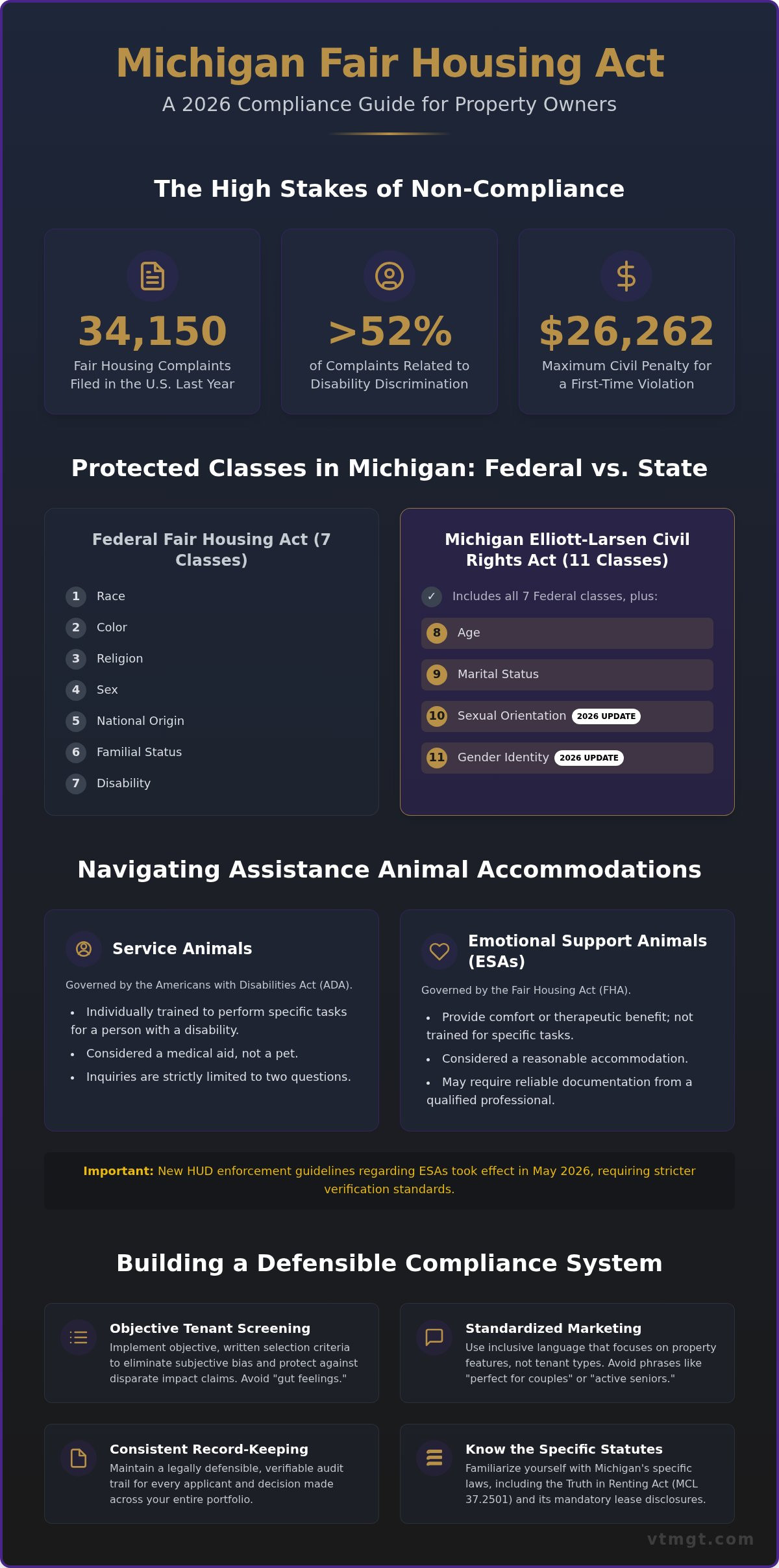
Did you know that fair housing complaints reached a record 34,150 in the United States last year, with disability claims accounting for over 52 percent of those filings? For property owners in Northern Michigan, these statistics represent more than just data. They signify a high-stakes environment where a single oversight in Michigan Fair Housing laws can result in civil penalties as high as $26,262 for a first violation. It's common to feel a sense of uncertainty regarding local ordinances in Emmet and Charlevoix counties, particularly following the May 2026 HUD enforcement changes for emotional support animals.
We recognize that managing a rental portfolio requires the same precision and structural integrity as any industrial operation. This article will help you master the complexities of state statutes and protect your investment with a standardized system for legal compliance. We'll examine the 2026 updates to the Elliott-Larsen Civil Rights Act, clarify the narrowing federal stance on assistance animals, and provide a technical framework to reduce liability while maintaining professional tenant relations across your entire portfolio.
Key Takeaways
- Identify the eleven distinct protected classes under Michigan Fair Housing laws, including state-specific protections for age, marital status, sexual orientation, and gender identity.
- Distinguish between service animals and emotional support animals to ensure your leasing policies align with the latest 2026 HUD enforcement guidelines.
- Implement objective, written tenant selection criteria to eliminate subjective bias and protect your portfolio from disparate impact liability.
- Adopt standardized management systems for marketing and screening to maintain a consistent, legally defensible record for every applicant in the Petoskey and Charlevoix markets.
The Michigan Fair Housing Legal Landscape in 2026
The legal framework governing rental properties in Northern Michigan is a multi-layered structure requiring technical precision to navigate. At the foundational level, the Federal Fair Housing Act of 1968 prohibits discrimination based on race, color, religion, sex, national origin, familial status, and disability. However, Michigan property owners must adhere to a more rigorous standard. The Elliott-Larsen Civil Rights Act (ELCRA) expands these protections to include age and marital status, while 2026 updates have further codified protections regarding sexual orientation and gender identity. This state-level legislation ensures that the scope of civil rights in Michigan remains broader than the federal baseline.
Understanding the hierarchy of these regulations is critical for long-term investment stability. Federal law sets the absolute floor, but Michigan Fair Housing laws often impose stricter requirements that take precedence. Local ordinances in municipalities like Petoskey may introduce additional layers of compliance. In 2026, both the U.S. Department of Housing and Urban Development (HUD) and the Michigan Department of Civil Rights (MDCR) maintain active oversight. These agencies utilize sophisticated testing programs and citizen complaints to identify non-compliant practices, making it essential for owners to view legal adherence as a core operational process rather than an afterthought.
Key Statutes Every Northern Michigan Owner Must Know
Specific attention must be paid to MCL 37.2501, which defines discriminatory housing practices with surgical clarity. Unlike federal law, which provides certain exemptions for small owner-occupied buildings or single-family homes sold without a broker, Michigan's state statutes are significantly more inclusive. We find that most Northern Michigan rentals fall under these expanded state-level mandates regardless of the owner's portfolio size. Additionally, the Truth in Renting Act requires specific disclosures in every lease agreement. Ensuring these mandatory clauses are present is a technical requirement that protects the validity of the entire contract.
Standardization as a Compliance Tool
We believe that legal risk is best managed through the implementation of Standardized Management Systems. Moving away from subjective "gut feelings" during the application process is a technical necessity to prevent disparate impact claims. By utilizing objective, data-driven criteria, we eliminate the variability that often leads to accidental discrimination. Documented market research and standardized financial reporting ensure that every decision, from setting rent prices to approving an applicant, is backed by a verifiable audit trail. Integrating these practices with a broader understanding of Michigan landlord laws establishes a professional baseline for all property operations in Emmet and Charlevoix counties.
Protected Classes and Prohibited Discriminatory Practices
To maintain a legally sound operation, landlords must recognize that Michigan Fair Housing laws protect eleven distinct groups. While federal mandates cover seven classes: race, color, religion, sex, national origin, familial status, and disability; the state of Michigan provides additional safeguards for age, marital status, sexual orientation, and gender identity. You can find a comprehensive breakdown of these protections at Michigan Legal Help. Adhering to Michigan Fair Housing laws requires a high degree of administrative oversight, as state-level protections often exceed the federal baseline.
It's a common misconception that discrimination requires malicious intent. In the eyes of the law, a policy that appears neutral but results in a "disparate impact" on a protected class is equally problematic. For example, a requirement that all tenants must have a full-time job could be seen as discriminating against retirees or individuals with disabilities who rely on alternative income sources. With first-time violation penalties reaching $26,262 as of August 2026, the financial cost of an oversight is substantial. These risks, combined with potential legal fees and reputational damage, make a structured approach to compliance essential for protecting your capital investment.
Common Advertising and Selection Blunders
Precision in communication is a technical requirement for every listing. Phrases like "perfect for couples" or "active seniors" may seem harmless, but they effectively exclude families or younger individuals, violating familial status or age protections. Steering is another critical risk area. This occurs when a landlord suggests a specific neighborhood or building wing based on a tenant's background. For instance, suggesting that a tenant would "feel more comfortable" in a specific part of Charlevoix because of their national origin is a direct violation. Utilizing professional tenant screening and placement services ensures every applicant is evaluated against the same objective, data-driven criteria.
Fair Housing in the Digital Age
Modern marketing requires an understanding of algorithmic bias. Social media platforms often use automated delivery systems that can inadvertently limit the visibility of your listings to specific demographics. This lack of transparency doesn't absolve the property owner of responsibility. Additionally, digital applications must be compatible with screen readers to meet disability accessibility requirements. For Petoskey families with children, familial status protections ensure that landlords cannot refuse to rent, charge higher deposits, or restrict access to amenities based on the presence of minors in the household. Adopting disciplined digital systems prevents these technological oversights from becoming legal liabilities.
Navigating Reasonable Accommodations and Assistance Animals
Managing disability-related requests requires a disciplined understanding of the technical distinctions between household pets and assistance animals. Under Michigan Fair Housing laws, assistance animals aren't classified as pets; they're viewed as a reasonable accommodation necessary for a person with a disability to have an equal opportunity to use and enjoy a dwelling. Consequently, standard "no-pet" policies or pet-related fees don't apply to these animals. Landlords must evaluate each request through a structured lens to determine if it meets legal criteria without imposing an undue financial or administrative burden on the property’s operation.
Service Animals vs. Emotional Support Animals (ESAs)
The distinction between service animals and emotional support animals is critical for compliance. Service animals are typically dogs trained to perform specific tasks, whereas ESAs provide therapeutic support. As of May 22, 2026, HUD updated its enforcement policy to prioritize complaints involving animals trained to perform work or tasks, aligning more closely with ADA definitions. However, property owners must remain cautious, as the Michigan Guide to Fair Housing and state-level civil rights protections may still offer broader coverage for ESAs than federal enforcement priorities suggest. If a disability isn't obvious, you can request documentation from a reliable healthcare provider, though 2026 standards have largely rendered "online certifications" insufficient if they lack a meaningful professional relationship between the tenant and the provider.
While the animal is an accommodation, the tenant remains technically responsible for any physical damage the animal causes to the unit. We recommend referencing our Northern Michigan rental maintenance guide to understand how to document habitability standards during move-out inspections. Maintaining clear records of property condition before and after the tenancy is a vital part of a professional management system.
Standardized Intake Systems
We utilize Standardized Management Systems to handle every accommodation request with engineering-like precision. This involves documenting the "interactive process", which is a series of communications where the landlord and tenant discuss the request in good faith. Failing to document this dialogue is a common procedural error that increases legal exposure. By maintaining a centralized record of all correspondence and verification documents, we provide owners in Emmet and Charlevoix counties with a robust defense against claims of non-compliance. This systematic approach ensures every request is handled fairly while protecting the property’s long-term value.
Fair Housing in Marketing and Tenant Screening Systems
Marketing and screening serve as the primary interface between a property owner and the public. In this phase, Michigan Fair Housing laws are most frequently tested. To mitigate risk, we treat marketing as a structured process where every variable is controlled. This begins with the rental listing and extends through to the final lease signing. Any deviation from a set protocol can be interpreted as bias, making a uniform approach the only reliable defense against litigation.
Consistency in property showings is a critical legal requirement. If a landlord provides more detailed information to one prospect or offers different lease terms based on a subjective assessment, they've created a liability. We advocate for a "blind" screening process where applicants are measured against predetermined data points. This includes staying abreast of "Fair Chance" housing trends, which involve more nuanced evaluations of criminal histories to avoid discriminatory outcomes. Standardizing these background checks ensures that your selection process remains objective and defensible.
The ROI of Objective Screening
Implementing a rigorous tenant screening in Petoskey does more than identify qualified residents. It builds a protective barrier around your investment. By establishing clear, written thresholds for income, credit scores, and rental history before the first lead arrives, you remove the "gut feeling" from the equation. We utilize a "First-Come, First-Served" processing system, which is a highly effective method for demonstrating compliance with Michigan Fair Housing laws. When the first qualified applicant is always offered the unit, the opportunity for subjective bias is effectively eliminated.
Local Dynamics in Northern Michigan
Our regional market presents unique challenges, particularly regarding seasonal transitions. Landlords in Petoskey and Boyne City must be careful when marketing properties during the off-season. You cannot use seasonal demand as a justification for policies that might violate familial status protections, such as attempting to limit occupancy in a way that unfairly targets families with children. Occupancy limits should be based on square footage and local building codes rather than the composition of the household. Every interaction, from the initial inquiry to the denial or approval, must be recorded in standardized communication logs. This documentation is the only way to prove that your systems were applied consistently to every prospect.
To ensure your portfolio is protected by these rigorous standards, consider our professional property marketing and advertising services.
Mitigating Risk Through Professional Property Management
The financial return on compliance is most effectively measured by the absence of litigation costs and administrative penalties. In a regulatory landscape where a first-time violation of Michigan Fair Housing laws can result in a $26,262 penalty, professional oversight functions as a critical insurance premium for your portfolio. We view property management as an engineering challenge where risk mitigation is built into the operational architecture. Standardized financial reporting and accounting are the cornerstones of this approach; they provide a verifiable audit trail that is indispensable during legal inquiries or MDCR audits. By maintaining precise, structured records of every transaction and tenant interaction, we ensure that your portfolio remains a stable, low-liability asset.
Beyond the technical avoidance of fines, professional systems foster a higher standard of tenant relations. When rules are applied with absolute consistency, it removes the ambiguity that often leads to conflict or perceived bias. We utilize innovation to streamline these processes, but we never lose sight of the human element. Our methodology ensures that every tenant is treated with professional respect within a disciplined framework, which ultimately reduces turnover and enhances the long-term value of the community.
The Van Treese Management System
Our expertise is rooted in a comprehensive understanding of Emmet and Charlevoix County court dynamics and specific local ordinances. We've developed Standardized Management Systems that govern every phase of the property lifecycle, from technical lease preparation to maintenance coordination. These systems are designed to eliminate the variability that often leads to accidental legal exposure. By applying the same rigorous standards to every unit we manage, we stabilize investments in Northern Michigan real estate and contribute to the overall economic health of our region. This systematic approach allows owners to delegate the complexities of law and maintenance while retaining full control over their investment goals.
Next Steps for Northern Michigan Owners
The transition from informal "handshake" deals to a standardized management framework is the most significant step an owner can take to reduce risk in 2026. While personal relationships are a hallmark of Northern Michigan business, they lack the procedural rigor required to withstand a modern fair housing challenge. We provide the infrastructure needed to professionalize your operations, including comprehensive property valuations and data-driven market research. These tools allow you to make informed decisions based on technical parameters rather than speculation. We invite you to contact Van Treese Management for a professional compliance consultation to evaluate your current systems and implement a robust framework for legal safety.
Engineering Compliance for Long-Term Portfolio Stability
Mastering Michigan Fair Housing laws requires more than general awareness; it demands the implementation of disciplined, data-driven systems. We've examined how state-level protections for age, marital status, and gender identity create a rigorous legal landscape that exceeds federal baselines. By standardizing your approach to assistance animal requests and utilizing objective tenant screening criteria, you eliminate the subjective variability that often leads to accidental legal exposure.
Since 2018, we've specialized in the specific regulatory and market dynamics of Emmet and Charlevoix Counties. Our Standardized Management Systems provide the technical infrastructure necessary to ensure 100% compliance across your entire portfolio. Transitioning from informal management to professional oversight is the most effective way to protect your capital and stabilize your residential or commercial assets. This systematic approach allows you to focus on growth while we manage the complexities of maintenance and legal adherence.
Protecting your investment starts with a commitment to precision and professional oversight. Secure Your Investment with Professional Management today and ensure your property operations meet the highest industry standards.
Frequently Asked Questions
What are the 11 protected classes under Michigan Fair Housing laws?
Michigan Fair Housing laws protect eleven specific groups. The seven federal classes are race, color, religion, sex, disability, familial status, and national origin. Under the Elliott-Larsen Civil Rights Act, Michigan adds protections for age, marital status, sexual orientation, and gender identity. Maintaining a precise understanding of these categories is a technical requirement for every landlord in Petoskey and Boyne City to ensure their screening processes remain compliant and legally defensible.
Can a Michigan landlord refuse to rent to someone with an emotional support animal?
A landlord cannot refuse an emotional support animal if the tenant has a disability-related need for the animal. While HUD narrowed its enforcement focus in May 2026 to animals trained for specific tasks, Michigan state laws still provide broad protections for ESAs. You shouldn't treat these animals as pets; they're reasonable accommodations. However, you can request verification from a healthcare provider who has an established professional relationship with the tenant to confirm the need.
Is it illegal to say 'no children' in a Michigan rental advertisement?
It is illegal to include "no children" or similar exclusionary language in any rental advertisement. This practice violates familial status protections under both federal and Michigan Fair Housing laws. Even subtle phrases like "adults preferred" or "perfect for a quiet couple" are prohibited because they steer families away from the property. All marketing materials for your Northern Michigan rentals must be neutral and focus on the physical attributes of the property rather than the household.
Do Michigan fair housing laws apply to single-family homes in Petoskey?
Yes, Michigan Fair Housing laws apply to single-family homes, including those in Petoskey and across Emmet County. While federal law contains limited exemptions for some owner-occupied buildings or homes sold without a broker, Michigan's state statutes are significantly more comprehensive. We operate under the assumption that all residential rentals must adhere to these civil rights protections to mitigate the risk of accidental discrimination claims and ensure professional management standards across Northern Michigan.
How much can a landlord be fined for a fair housing violation in Michigan?
Civil penalties for fair housing violations are substantial and adjusted for inflation. As of August 20, 2026, a first-time violation can result in a maximum fine of $26,262. A second violation within five years can cost up to $65,653, and subsequent violations within seven years can reach $131,308. These figures don't include private legal fees or potential damages awarded to the complainant, making the financial risk of non-compliance a major concern for property owners.
What is the difference between a reasonable accommodation and a reasonable modification?
A reasonable accommodation is a change in a rule, policy, or service, such as waiving a "no pets" rule for an assistance animal. A reasonable modification is a physical change to the structure of the property, like installing a ramp or grab bars. In most residential leases, the tenant is responsible for the cost of modifications, but the landlord must permit them if they're necessary for the tenant’s safe use of the dwelling.
Can I suggest a specific neighborhood to a tenant based on their national origin?
Suggesting a specific neighborhood based on a tenant's national origin is a prohibited practice known as steering. This behavior is a direct violation of Michigan Fair Housing laws because it limits a tenant's housing choices based on a protected characteristic. Your role is to provide objective information about available units and let the applicant decide which location meets their needs. We recommend using standardized communication logs to document that every prospect was offered the same property information.
How can a professional property manager help with fair housing compliance?
A professional property manager uses Standardized Management Systems to eliminate subjective bias from the leasing process. Van Treese Management handles complex legal landscapes by implementing uniform tenant screening and placement protocols. We provide an administrative layer of protection through precise documentation of the interactive process and objective marketing. This systematic approach reduces your liability while ensuring that your properties in Charlevoix and Emmet counties are managed with engineering-level precision and strict legal safety.