
Handling Security Deposits in Northern Michigan: A 2026 Landlord’s Guide

Imagine a scenario where a minor clerical error regarding a move-out date results in a court order for twice the original security deposit amount. For many property owners, the process of handling security deposits Northern Michigan feels like navigating a technical minefield where one missed deadline can compromise an entire year of rental yield. It's a high-stakes environment where subjective interpretations don't hold up in small claims court, especially with the jurisdictional limit now set at $7,000.
We recognize that distinguishing between "normal wear and tear" and compensable tenant damage is often the most complex variable in the property management equation. You require a stable, compliant system that protects your assets without the constant threat of litigation or statutory penalties. This guide provides the structural framework necessary to master Michigan's security deposit laws through precision and standardized documentation. We'll analyze the critical 30-day window for itemized lists, the 45-day litigation deadline, and the specific notice requirements that ensure operational stability in Emmet and Charlevoix counties.
Key Takeaways
- Integrate the mandatory 12-point bold font notice and respect the 1.5x monthly rent limit within your lease agreements to satisfy Michigan statutory requirements.
- Implement a standardized inventory checklist system that provides tenants with their legal seven-day review window to establish a precise baseline for property condition.
- Apply a technical framework to differentiate between normal wear and tear and actual damages, ensuring all deductions remain defensible in local courts.
- Maintain a disciplined 30-day timeline for handling security deposits Northern Michigan to provide itemized damage lists and avoid the double-penalty for non-compliance.
- Leverage professional property management systems to automate statutory deadlines and ensure all financial accounting meets high-level compliance standards.
The Legal Framework: Michigan Security Deposit Limits and Notices
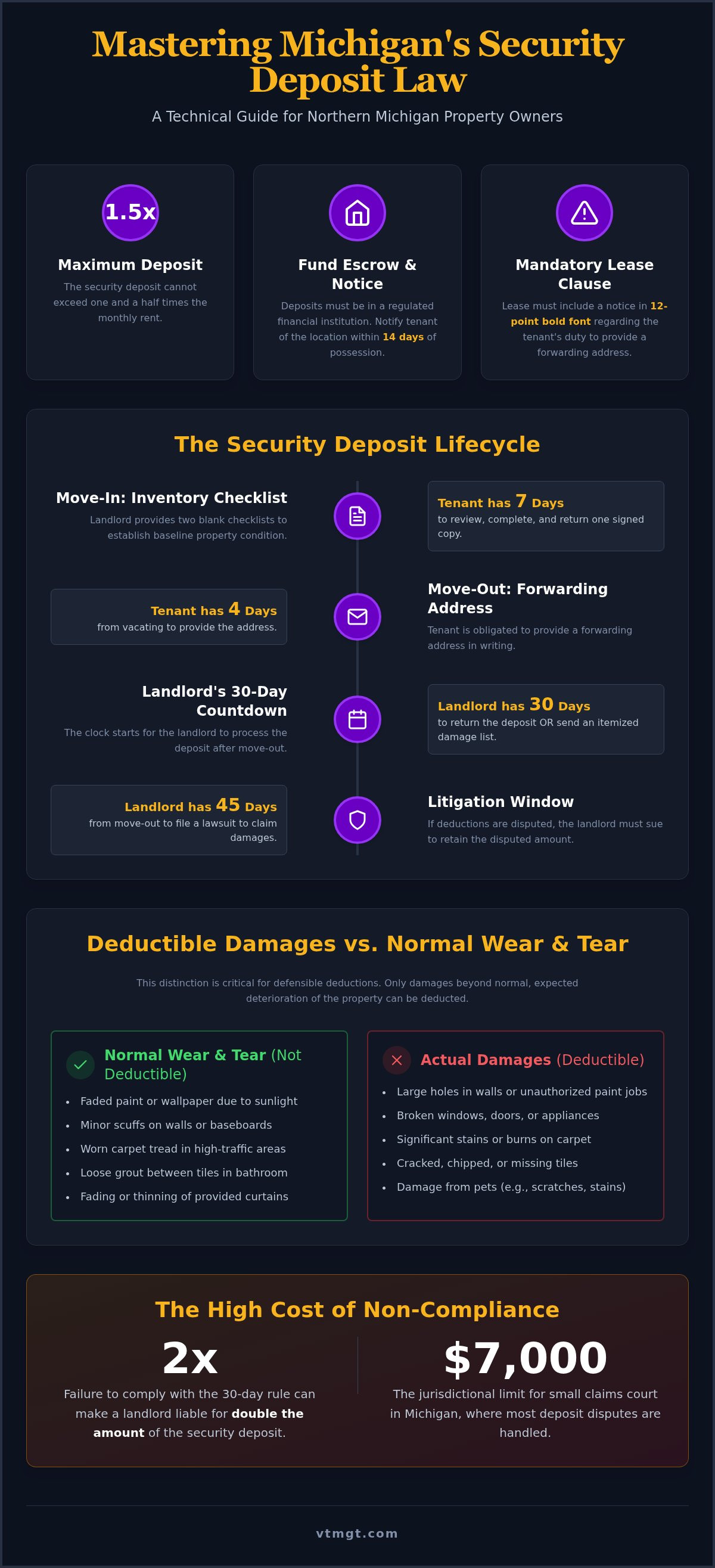
The Michigan Landlord and Tenant Relationships Act (Act 348 of 1972) establishes the technical parameters for handling security deposits Northern Michigan. One of the most rigid constraints is the 1.5x rule, which dictates that a security deposit cannot exceed one and a half times the monthly rent. This calculation must be precise. If a property owner collects a deposit exceeding this limit, they are in immediate violation of MCL § 554.602, regardless of whether the tenant agreed to the amount in the lease. Understanding security deposit basics is essential, but Michigan's specific statutory caps require strict adherence to protect the owner's legal standing.
Property owners must also manage the physical location of these funds with technical care. Michigan law requires that deposits be held in a regulated financial institution. Alternatively, an owner may post a surety bond with the Secretary of State, though this is less common for residential owners in Emmet and Charlevoix counties. Within 14 days of the tenant taking possession, you must provide them with a written notice containing the name and address of the financial institution where the funds are secured, alongside your own contact information. This initial transparency is the first step in a standardized management process.
Mandatory Notice Requirements
The Landlord and Tenant Relationships Act includes a specific requirement that often catches DIY landlords off guard. Every lease agreement must include a notice informing the tenant of their obligation to provide a forwarding address within four days of moving out. This notice isn't just a recommendation; the law mandates it be printed in a 12-point boldface type that is at least 4 points larger than the rest of the lease text. Failure to include this specific formatting can strip a landlord of their right to use the security deposit for damages later. This level of technical detail is why professional lease preparation is a core component of risk mitigation.
Financial Compliance and Record Keeping
A clear distinction exists between a refundable security deposit and non-refundable fees. Under Michigan law, any money intended to secure performance under the lease is treated as a security deposit and counts toward the 1.5x limit. For owners managing multiple assets, maintaining a rigorous accounting system is vital. Each deposit must be tracked individually to ensure timelines for returns and itemizations are met. For a deeper analysis of the broader regulatory environment, refer to our guide on Michigan Landlord Laws. Standardized financial reporting ensures that every dollar is accounted for, reducing the friction often found during the move-out phase.
Standardized Documentation: The Inventory Checklist System
Establishing a technical baseline for property condition is the only way to ensure precision when handling security deposits Northern Michigan. The inventory checklist isn't a mere suggestion; it's a structured tool that defines the "zero point" of an asset's state. Without this data, any future claim for damages lacks the evidentiary support required to withstand legal scrutiny in local courts. This documentation process must be treated with the same rigor as a quality control audit in a manufacturing environment.
The Move-In Protocol
The process begins at the moment of possession. Landlords must provide two blank copies of the inventory checklist to the tenant at the start of the lease. Under Michigan law, the tenant has a seven-day window to review the property, note any existing defects, and return one signed copy to the owner. The Inventory Checklist serves as the primary evidence in a security deposit dispute. To enhance this record, we recommend supplementing the written notes with high-resolution digital photography that captures timestamps and specific angles of high-wear areas like flooring, cabinetry, and appliance seals.
As the tenancy concludes, the move-out inspection must mirror the initial move-in data point-by-point. This comparison ensures that any deductions are based on objective changes rather than subjective memory. Additionally, the tenant must provide a written forwarding address within four days of vacating the unit. If the landlord failed to provide the required 12-point bold notice regarding this four-day rule in the lease, the tenant's failure to provide the address doesn't waive their rights. Maintaining a standardized management system ensures these technical timelines are never overlooked and your data remains organized for potential court reviews.
Northern Michigan Seasonality and Inspections
Regional climate factors introduce unique variables into property inspections. Conducting a move-out assessment in Petoskey or Gaylord during February often means exterior surfaces, roofs, and landscaping are obscured by significant snow accumulation. Landlords must differentiate between snow-related wear, such as salt damage on entryways or frost heave on decks, and actual tenant negligence. If an exterior inspection is impossible due to weather, you should document the limitation clearly in the report. For more information on preserving asset value through the winter months, see our guide on Rental Property Maintenance in Northern Michigan. This level of environmental awareness prevents disputes over damages that were actually caused by the harsh Northern Michigan climate rather than the tenant's actions.
Deductions vs. Normal Wear and Tear: A Technical Comparison
The distinction between natural depreciation and tenant-caused damage is the primary friction point when handling security deposits Northern Michigan. In a legal context, "normal wear and tear" refers to the gradual deterioration of an asset resulting from its intended use without negligence or abuse. For property owners, applying a technical framework to these assessments is vital to ensure that any financial withholding remains defensible under Michigan law. This process requires moving beyond subjective opinions and adopting a standardized system of evaluation.
Actual damages, which are legally deductible, represent a decrease in property value or utility that exceeds the expected lifespan of the materials. While a landlord cannot charge a tenant for the inevitable fading of paint or the thinning of carpet fibers in high-traffic areas, they can seek compensation for structural breaches or chemical alterations. Precision in these definitions protects the owner's rental yield while maintaining the integrity of the security deposit as a tool for loss prevention.
The Wear and Tear Framework
Evaluating property condition requires a structured comparison of usage patterns. Minor scuff marks on a baseboard from vacuuming represent mechanical friction typical of daily life; conversely, a hole in the drywall indicates a failure of care. In the high-end residential market of Northern Michigan, where properties often feature premium finishes, this distinction is even more critical. Standardized systems for evaluating appliance longevity and flooring integrity help eliminate the "grey areas" that often lead to disputes. For instance, pet stains and odors are never classified as wear and tear; they are considered biological damage that requires specific remediation protocols. Faded carpet is a result of UV exposure and foot traffic, whereas a localized burn or tear is a clear instance of damage.
Calculating Fair Deduction Costs
When damage is identified, the calculation of the deduction must account for the depreciated value of the item rather than the full replacement cost. Michigan courts typically utilize "useful life" tables to determine the remaining economic value of a property component. If a carpet with a ten-year lifespan is destroyed in its fifth year, the landlord is generally entitled to 50% of the replacement cost, not the total amount. Utilizing vetted local contractors for repair quotes provides a layer of transparency and professional validation for these costs. Effective maintenance coordination ensures that all repairs are documented with itemized invoices from third-party experts. This data-driven approach transforms a potentially emotional negotiation into a structured financial settlement, reducing the likelihood of a tenant successfully disputing the charges in a small claims environment.
The 30-Day Countdown: Returning the Deposit and Itemizing Damages
The 30-day window following a tenant's departure is the most critical period for handling security deposits Northern Michigan. Under Michigan Compiled Laws § 554.609, landlords must return the full deposit or an itemized list of damages within exactly 30 days of the tenant vacating the property. This timeline is absolute. It leaves no room for administrative delays. Missing this deadline by even 24 hours creates a significant operational vulnerability, as the burden of proof shifts entirely away from the landlord. It's a binary system of compliance: either the documentation is delivered on time, or the right to withhold funds for physical damages is lost. This statutory pressure requires a disciplined approach to post-tenancy accounting.
The Itemized Statement of Damages
The statement must be highly specific and include a notice to the tenant that they must respond in writing within seven days if they dispute the findings. This notice must be clear. It must include the landlord's contact information for the response. Beyond physical repairs, the final accounting should include deductions for unpaid utilities or rent, provided these are supported by invoices or ledger entries. Failure to send an itemized list within 30 days waives the landlord’s right to withhold for damages. Professional documentation ensures that every line item is backed by the evidence established during the move-in inspection. Utilizing standardized templates for these notices reduces the risk of omitting mandatory legal language.
Managing Tenant Disputes
Once the tenant receives the itemized list, they have a seven-day window to object to the charges in writing. This phase requires a disciplined approach to negotiation. Managing tenant expectations while handling security deposits Northern Michigan requires a firm grasp of these statutory windows. If an agreement isn't reached, Michigan law requires the landlord to file a lawsuit within 45 days of the tenant vacating the property to retain the disputed portion of the deposit. In Emmet and Charlevoix counties, local courts expect high-quality evidence, including the move-in checklist and repair receipts. Because the small claims court limit in Michigan was raised to $7,000 in 2024, more disputes are being resolved in a formal legal setting than ever before.
The risk of non-compliance is severe. If a landlord wrongfully withholds funds or misses the 30-day deadline, they may be liable for double the amount of the deposit, plus attorney fees. This "double damages" penalty is designed to ensure strict adherence to the statutory timeline. To protect your rental yield from these avoidable costs, we recommend implementing our professional financial reporting and accounting systems to track every deadline with technical precision. This ensures your property remains a stable asset rather than a litigation liability. Consistency in these processes is the hallmark of a professional property management strategy.
Mitigating Liability with Professional Management Systems
The transition from manual oversight to an institutional-grade management framework is the most effective method for handling security deposits Northern Michigan. DIY landlords often rely on calendar reminders or physical files, which creates a high probability of failure in a state where missing a 30-day window results in a double-penalty. Our approach replaces these manual vulnerabilities with standardized software architectures designed to track every statutory deadline with technical precision. By integrating these protocols into your investment strategy, you ensure that your property remains a source of predictable income rather than a recurring legal obligation.
Institutional-grade documentation is the primary defense against the $7,000 small claims limit. When every move-in checklist, digital photograph, and itemized invoice is stored in a centralized, audit-ready system, the landlord’s burden of proof is easily satisfied. This level of organization signals to tenants and local courts that the property is managed with professional rigor, which often discourages frivolous disputes before they escalate into formal litigation.
Standardized Systems for Peace of Mind
Our management model balances technological precision with a human interaction strategy that de-escalates move-out tensions. We act as a neutral third party, applying the law objectively to reduce the emotional friction often associated with damage assessments. We continuously monitor changes in Michigan Landlord-Tenant law to ensure your lease agreements and notice procedures remain fully compliant with current 2026 standards. This proactive legal monitoring is a core component of our Property Management in Petoskey, providing full-service oversight for owners who prioritize operational stability. When the system is standardized, the results are consistent.
Protecting Northern Michigan Property Owners
The return on investment for professional compliance is measured in the avoidance of catastrophic legal fees and statutory penalties. A single "double damages" ruling can erase the profit margin of an entire year. By implementing professional tenant screening and placement, we reduce the frequency of damage claims from the outset, ensuring that only qualified individuals occupy your assets. This commitment to fair and legal practices builds thriving local communities in Emmet and Charlevoix counties while protecting the long-term value of your real estate portfolio. You don't have to manage the risks of the 2026 rental market alone. Protect your assets with Van Treese Management and secure a professional partner for your property's lifecycle.
Securing Long-Term Operational Stability
Mastering the technical requirements of Michigan law is a prerequisite for any successful residential investment. By implementing standardized management systems, you replace subjective uncertainty with a structured framework for handling security deposits Northern Michigan. The process requires absolute adherence to the 30-day statutory timeline and the use of precise inventory checklists to establish an evidentiary baseline. These protocols don't just prevent the double-penalty; they protect your rental yield from avoidable litigation and administrative friction.
Van Treese Management provides the local expertise in Emmet and Charlevoix counties necessary to navigate these complex regulatory environments with precision. Our approach is built on detailed market research and property valuations that ensure your assets are positioned for long-term stability. Transitioning from DIY management to a professional system mitigates your liability while fostering better tenant relations through transparent, data-driven accounting. This structured methodology ensures that your property remains a performing asset rather than a legal vulnerability.
Ready to optimize your compliance and protect your equity? Request a professional management consultation for your Northern Michigan rental today. Securing your investment requires the right technical partner.
Frequently Asked Questions
What is the maximum security deposit a landlord can charge in Michigan?
A landlord in Michigan cannot require a security deposit that exceeds 1.5 times the monthly rent. This statutory limit is absolute and applies to all residential leases across Petoskey and the surrounding communities. Any amount collected beyond this cap is a violation of Michigan Compiled Laws. Property owners must ensure their lease accounting precisely reflects this calculation to avoid legal challenges during the move-out phase or in small claims court.
How many days does a landlord have to return a security deposit in Michigan?
Landlords must return the security deposit or provide an itemized list of damages within 30 days of the tenant vacating the property. This deadline is a critical component of handling security deposits Northern Michigan. If you miss this window, you lose the legal right to withhold any portion of the deposit for physical damages. Timely delivery via mail or personal service is essential to maintain compliance with the Landlord and Tenant Relationships Act.
Can a Michigan landlord charge a non-refundable cleaning fee?
Non-refundable fees are generally permitted in Michigan if they are clearly labeled as such in the lease agreement. However, these fees cannot be used to circumvent the 1.5x rent limit for the total security deposit. If a fee is intended to secure the performance of the lease, it may be legally classified as part of the deposit. Owners in Emmet and Charlevoix counties should use precise language to distinguish these from refundable security funds.
What happens if a tenant does not provide a forwarding address within 4 days?
If a tenant fails to provide a forwarding address in writing within four days of moving out, the landlord is technically relieved of the obligation to send an itemized list of damages. This exception only applies if the landlord included the mandatory 12-point bold notice in the original lease agreement. Even without a forwarding address, the landlord must still return the remaining deposit balance once the tenant's new location is eventually established or identified.
Can I use a security deposit to cover unpaid rent in Northern Michigan?
Yes, Michigan law explicitly allows landlords to use security deposit funds to cover unpaid rent that is legally due under the lease agreement. You can also apply the deposit toward unpaid utility bills or other financial obligations specified in the contract. When handling security deposits Northern Michigan, ensure that these financial deductions are clearly documented in the final itemized statement provided to the tenant within the 30-day statutory window.
Does a Michigan security deposit have to be kept in a separate interest-bearing account?
Michigan law does not require landlords to keep security deposits in a separate interest-bearing account. The funds must be held in a regulated financial institution, or the owner must post a surety bond with the Secretary of State. While interest is not mandated at the state level, you must notify the tenant in writing within 14 days of the bank's name and address. Standardized accounting systems help track these deposits across multi-property portfolios in Gaylord and Traverse City.
What font size is required for security deposit notices in a Michigan lease?
Michigan law requires that specific security deposit notices in the lease be printed in 12-point boldface type. This text must also be at least 4 points larger than the surrounding body text in the agreement. This technical requirement is a common point of failure for DIY lease documents. Ensuring this exact formatting is present is necessary to enforce the four-day forwarding address rule and to protect the landlord's right to withhold for damages.
How do I handle a security deposit dispute in Emmet County small claims court?
Handling a dispute in the Emmet County small claims court requires a structured presentation of evidence. The jurisdictional limit for these cases is currently $7,000. You should bring the original signed inventory checklists, high-resolution move-out photographs, and itemized repair invoices from vetted contractors. Because the burden of proof lies with the landlord, having a standardized documentation system is the most effective way to validate deductions and defend against tenant claims of wrongful withholding.