
Maximizing Rental Income in Traverse City: The 2026 Landlord Strategy
What if the most effective way to secure your Michigan real estate portfolio isn't chasing peak summer nightly rates, but rather engineering a stabilized long-term asset? While the allure of July's high revenue peaks is undeniable, the reality for many owners involves navigating a supply of short-term listings that has nearly doubled since 2021. For those focused on maximizing rental income Traverse City, the 2026 market demands a shift toward disciplined, structural efficiency. You've likely realized that high-yield property ownership is increasingly difficult when faced with rising maintenance costs and a complex patchwork of local regulations that vary by township.
We understand that operational burnout from constant guest turnover and the stress of 7-day "Demand for Possession" notices can undermine the stability of your investment. This article provides a technical framework for achieving superior ROI through professional management systems and precise market data. We'll examine how structured tenant screening, rigorous financial reporting, and proactive maintenance coordination create a hands-off path to asset appreciation. You'll discover a clear strategy for maintaining stable monthly cash flow while minimizing the legal risks inherent in Michigan's evolving rental landscape.
Key Takeaways
- Evaluate the critical shift in 2026 housing demand and why prioritizing Net Operating Income (NOI) over gross revenue is essential for long-term portfolio stability.
- Implement data-driven pricing strategies to prevent "vacancy bleed," a key component in maximizing rental income Traverse City while securing high-quality tenant placement.
- Reframe maintenance from a recurring cost center to a proactive wealth protection strategy through the use of vetted local vendor networks.
- Mitigate financial risk by ensuring all lease agreements and operational processes strictly adhere to updated 2026 Michigan landlord-tenant regulations.
- Leverage standardized management systems to bridge the gap between technological efficiency and personalized human interaction for local and remote asset owners.
The 2026 Traverse City Rental Market: Long-Term Stability vs. STR Volatility
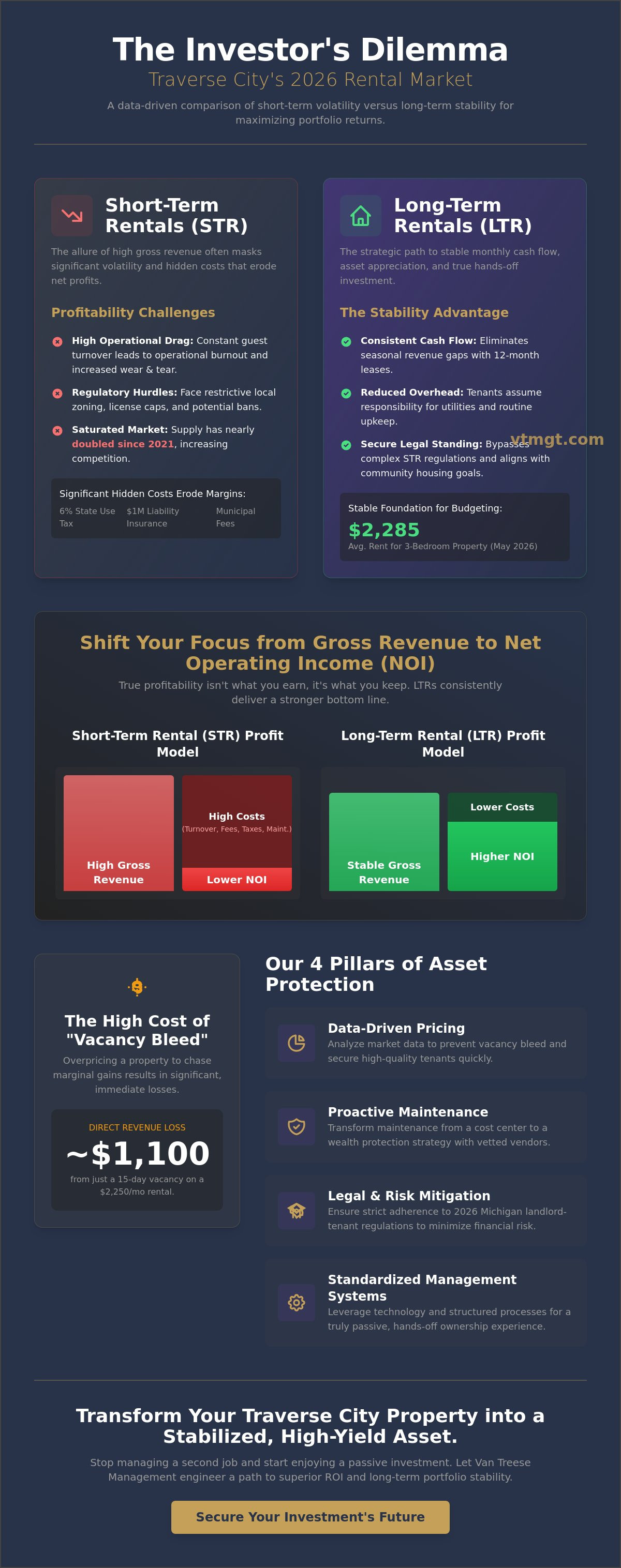
The real estate environment in Traverse City, Michigan has reached a critical inflection point in 2026. The market is evolving. While the local tourism sector remains robust, a fundamental shift toward permanent residency is redefining the region's housing requirements. Many investors remain focused on the high gross revenue figures associated with short-term rentals, often overlooking the volatility and operational friction inherent in that model. For those prioritized on maximizing rental income Traverse City, the focus must shift from gross receipts to Net Operating Income (NOI).
A disciplined analysis of the local market reveals that short-term rentals carry significant hidden costs that erode profit margins. These include a 6% state use tax, mandatory $1 million liability insurance, and recurring municipal licensing fees. When combined with utility expenses and high-frequency guest turnover, the actual net yield often falls below that of a well-managed long-term asset. Achieving a truly passive investment requires the implementation of standardized management systems. Without structured maintenance coordination and rigorous financial reporting, what should be an asset becomes a second job. We focus on stabilizing these variables to ensure long-term profitability.
Why Long-Term Rentals Win on Net Profit
The primary advantage of a 12-month lease is the elimination of seasonal revenue gaps. In Traverse City, the average rent for a three-bedroom property reached approximately $2,285 by May 2026, providing a stable foundation for annual budgeting. Long-term tenants assume responsibility for utilities and routine upkeep, which significantly reduces the owner's operational overhead. Unlike the weekly guest rotations found in vacation rentals, long-term placements minimize wear and tear on the property's mechanical systems and structural finishes. This stability allows for precise long-term capital planning and consistent monthly cash flow.
Traverse City Zoning and Regulatory Trends
The regulatory landscape for short-term rentals has become increasingly restrictive. Local municipalities have implemented caps on licenses and buffer zones between rental units to preserve neighborhood character. Some areas have even moved toward outright bans on new short-term permits. Long-term residential holdings bypass these complex municipal hurdles, offering a more secure legal standing. By providing housing for the local workforce and families, landlords contribute to the community's structural health. This alignment with local policy goals creates a more resilient investment environment. Maximizing rental income Traverse City isn't just about the next check; it's about the long-term viability of the asset within the local ecosystem.
Strategic Pricing and Tenant Placement: The Foundation of ROI
Precision in asset valuation determines the ultimate trajectory of your investment's performance. Setting a rental rate isn't a matter of intuition; it's a technical calculation that must account for local inventory levels and macroeconomic shifts. When an owner overprices a property, they encounter "vacancy bleed." This phenomenon occurs when a unit remains unoccupied for several weeks while seeking a rate that exceeds market equilibrium. For a property with an average market rent of $2,250, a 15-day vacancy period results in a direct loss of over $1,100. This loss often outweighs the marginal gains of a higher monthly rent. Achieving a balance between competitive rates and rapid occupancy is a critical pillar for maximizing rental income Traverse City.
Data-Driven Rent Setting in Traverse City
Our methodology for establishing rental rates involves a comprehensive analysis of market trends across Northern Michigan, specifically examining data from Emmet and Charlevoix counties. We track seasonal fluctuations to ensure that lease terms begin and end during periods of peak demand. High-quality property marketing and advertising campaigns are then deployed to reach a specific demographic of reliable professionals. By implementing the same rigorous rental management Charlevoix systems used in our neighboring markets, we provide owners with pricing accuracy that eliminates guesswork and stabilizes cash flow.
Standardized Tenant Screening Protocols
Risk mitigation begins with a structured vetting process. We utilize a multi-layered screening protocol that examines criminal backgrounds, credit scores, and verified eviction histories. This process must align strictly with Michigan's Landlord and Tenant Relationships Act to ensure full legal compliance and protect the owner's interests. While automated metrics provide a baseline, our team incorporates professional human interaction to assess an applicant's suitability for a long-term commitment. High-quality tenant placement reduces property damage and ensures lease compliance, which are essential for maximizing rental income Traverse City over a multi-year horizon.
Effective management requires a combination of technological precision and local expertise. Owners who seek to optimize their portfolios often find that professional tenant screening and placement services provide the necessary infrastructure to scale their investments without increasing their personal workload. A disciplined approach to the selection process is the most effective way to secure the structural integrity of your rental business.
Protecting Your Asset through Maintenance and Repair Coordination
Maintenance is frequently categorized as a mere operational expense, yet in the 2026 real estate market, it serves as a primary mechanism for wealth protection. Shifting this perspective from a reactive cost center to a proactive strategy is fundamental for maximizing rental income Traverse City. When property owners implement standardized maintenance systems, they prevent the gradual erosion of their asset's value. A single deferred repair can escalate into a significant capital expenditure, particularly when dealing with the complex mechanical systems of modern residential units. Landlords must understand their structural obligations regarding property habitability, as detailed in A Practical Guide for Tenants & Landlords. This regulatory compliance ensures that the asset remains legally viable while protecting the owner from liability and financial loss.
Proactive vs. Reactive Maintenance
Northern Michigan's climate presents unique challenges for property endurance. High humidity levels in the summer and extreme freeze-thaw cycles in the winter require a disciplined inspection schedule. We recommend conducting seasonal audits to identify potential vulnerabilities in roofing, plumbing, and HVAC systems before they fail. Utilizing a technical checklist, such as the one found in our rental property maintenance Northern Michigan guide, ensures no critical component is overlooked. Furthermore, a documented maintenance history significantly increases property resale value; it provides prospective buyers with a verifiable log of structural stewardship and mechanical reliability.
The Efficiency of Standardized Repair Systems
Centralized coordination is the most effective way to reduce repair timelines and maintain tenant satisfaction. When a maintenance request is processed through a structured system, it eliminates the communication lag that often leads to tenant frustration. A robust management framework provides access to a vetted local vendor network capable of 24/7 emergency response. This immediate availability is a critical factor in tenant retention; residents are far more likely to renew their leases when they know structural issues will be addressed promptly. Standardizing these workflows also allows for the use of pre-negotiated vendor rates, which directly reduces the cost of maximizing rental income Traverse City by lowering annual operating expenses. Our approach focuses on technical precision and vendor accountability to ensure every repair meets the highest quality standards.
Legal Compliance and Risk Mitigation under Michigan Law
Legal errors represent the most significant threat to the structural integrity of a rental portfolio. In the 2026 market, a single misstep in the eviction process or a mishandled security deposit can erase months of profit. Achieving the goal of maximizing rental income Traverse City requires more than just high occupancy; it demands a disciplined adherence to state statutes. Legal compliance isn't a secondary task; it's a fundamental risk management tool that protects your capital from litigation and avoidable financial penalties. By implementing standardized protocols for every tenant interaction, we ensure that the asset remains protected under the current legal framework.
Navigating Michigan Landlord-Tenant Laws
The regulatory environment has become increasingly technical. Owners must manage a complex range of requirements, from the 1.5-times-rent limit on security deposits to the strict 30-day window for returning those funds after a tenant moves out. Our approach centers on the use of Michigan landlord laws as a blueprint for operational excellence. For instance, when rent remains unpaid, landlords must provide a precise 7-day "Demand for Possession" notice. Any deviation from this standardized procedure can lead to costly delays in the court system. Professional management ensures these timelines are met with engineering-like precision, preventing the "vacancy bleed" that occurs when legal errors stall the re-leasing process.
Financial Reporting and Transparency
Accurate accounting is the bedrock of a successful investment. We provide owners with monthly financial statements that offer a granular view of their property's performance. This level of transparency is essential for maximizing rental income Traverse City, as it allows for precise tax planning and the identification of cost-saving opportunities. Our systems automate rent collection and late-fee enforcement, ensuring that cash flow remains predictable. For out-of-area investors, these reports serve as a vital link to their Northern Michigan assets, providing the data necessary to make informed decisions about future capital improvements or portfolio expansions.
Protecting your investment requires a partner who understands the intersection of law and finance. For owners seeking a secure framework for their holdings, our professional lease agreement preparation services ensure every document meets current statutory requirements while prioritizing your long-term ROI.
Van Treese Management: Transforming Traverse City Property Ownership
Van Treese Management operates at the intersection of technical innovation and human expertise. We don't just manage properties; we engineer systems that ensure long-term asset stability. For owners focused on maximizing rental income Traverse City, our approach replaces the traditional, fragmented method of landlording with a structured framework. We prioritize the operational health of residential and commercial portfolios across Northern Michigan, including Petoskey and the surrounding regions. Our objective is to provide a solid, long-term partnership that allows owners to view their real estate as a high-performing financial instrument rather than an operational burden. This disciplined focus ensures that every property under our care meets the highest standards of efficiency and profitability.
The Van Treese Advantage
We focus exclusively on long-term residential excellence. Unlike firms that prioritize the high-turnover hospitality model of vacation rentals, we invest in the structural health of local communities. Our methodology is built on the premise that quality housing and stable tenancies are the most reliable drivers of ROI. This specialization allows us to master the nuances of investing in rental property Northern Michigan. By concentrating on 12-month lease cycles and standardized maintenance, we eliminate the volatility that often plagues Northern Michigan real estate. Our systems are designed to provide both local and remote owners with total control over their assets through transparent financial reporting and rigorous accounting.
Getting Started: Your Free Rental Analysis
Transitioning to professional management begins with a comprehensive property valuation. We perform a technical assessment of your asset, analyzing current market data and identifying specific opportunities for growth. This process isn't a simple price estimate; it's a deep dive into the property's structural and financial potential. We examine current lease agreements, maintenance logs, and market benchmarks to build a roadmap for maximizing rental income Traverse City. During this initial phase, we identify immediate improvements in marketing and tenant placement that can stabilize your cash flow. We provide the data necessary to make informed decisions about the future of your portfolio.
Owners ready to move away from operational burnout can contact our team for a professional consultation. We provide the infrastructure necessary to transform a property into a hands-off, appreciating asset. Contact Van Treese Management today to begin the process of modernizing your property management strategy and securing your investment's future in the 2026 market.
Engineering Long-Term Success in Northern Michigan
The 2026 rental market requires a disciplined shift toward operational precision. By prioritizing Net Operating Income over gross revenue and implementing standardized maintenance coordination, you protect the structural and financial integrity of your asset. Achieving the objective of maximizing rental income Traverse City is no longer about chasing seasonal high rates. It's about data-driven tenant placement and rigorous legal compliance that eliminates the "vacancy bleed" caused by avoidable errors. These technical foundations ensure that your real estate remains a high-performing financial instrument rather than a source of operational friction.
Our framework is built on expert local market research for Emmet and Charlevoix counties, providing the technical infrastructure needed for 24/7 peace of mind. We combine this technological felicity with professional human interaction to ensure your portfolio remains resilient and compliant. Maximize your Traverse City rental ROI with Van Treese Management and secure a partner dedicated to your long-term asset appreciation. Your investment deserves the stability that only a structured, professional management system can provide. We look forward to helping you build a more secure financial future in Northern Michigan.
Frequently Asked Questions
How much can I realistically charge for rent in Traverse City in 2026?
Rental rates are determined by property configuration and current market demand. As of May 2026, a three-bedroom property in Traverse City commands an average rent of approximately $2,285 per month. Two-bedroom units typically average $1,870, while one-bedroom and studio apartments settle near the $1,509 mark. These figures serve as a technical baseline for owners focused on maximizing rental income Traverse City through competitive, data-driven pricing models.
Is long-term rental management more profitable than Airbnb in Northern Michigan?
Long-term rentals often yield higher Net Operating Income (NOI) due to lower operational friction and stabilized occupancy. While short-term rentals show high gross revenue during the July peak, they are subject to a 6% state use tax, high turnover costs, and increasing municipal restrictions. A long-term strategy eliminates these variables, providing a predictable cash flow that isn't dependent on the volatility of the seasonal tourism market.
What are the key Michigan landlord-tenant laws I need to follow?
Landlords must comply with strict statutory requirements regarding security deposits and lease enforcement. Michigan law limits security deposits to 1.5 times the monthly rent and requires their return within 30 days of a tenant vacating the property. Furthermore, a 7-day "Demand for Possession" notice is a mandatory legal prerequisite for any non-payment of rent. Adhering to these structural rules is essential for mitigating legal risk and protecting your capital.
How does Van Treese Management handle emergency repairs in Traverse City?
We utilize a centralized maintenance coordination system supported by a vetted local vendor network. This structure allows for prompt technical response to critical mechanical or structural failures, ensuring property habitability is maintained. Every repair is documented within our financial reporting systems, providing owners with a transparent log of maintenance activities. This proactive approach prevents minor issues from escalating into significant capital expenditures.
Do I need to live in Traverse City to manage my rental property effectively?
Owners don't need to be physically present in the region to maintain a high-performing asset. Professional management systems bridge the geographical gap by providing on-site oversight and comprehensive financial accounting. Remote investors can leverage our local market expertise and vendor relationships to ensure their properties are managed with the same precision as a local portfolio. This allows for effective asset appreciation without the need for personal proximity.
What is the typical management fee for residential properties in Traverse City?
Management fees in the Traverse City area generally align with industry standards, typically ranging between 8% and 12% of the monthly rent. These costs should be viewed as an investment in operational efficiency rather than a simple expense. This fee structure usually covers essential services such as tenant screening, lease preparation, and ongoing maintenance coordination, all of which are critical for maximizing rental income Traverse City over the long term.
How do you ensure tenants pay rent on time?
Consistent rent collection is the result of a rigorous screening process and automated payment infrastructure. We select applicants based on verified credit history and income stability to minimize the risk of delinquency. Our systems provide tenants with structured payment channels, while our management team enforces lease terms with disciplined consistency. This professional framework ensures that monthly cash flow remains predictable and transparent for the property owner.
What happens if a tenant needs to be evicted in Grand Traverse County?
The eviction process follows a specific legal sequence starting with a 7-day notice for non-payment of rent. If the tenant does not rectify the balance, the case is moved to the local district court for a formal hearing. We manage this process with technical precision, ensuring all documentation is accurate to avoid procedural delays. This structured approach minimizes the time a property remains non-performing, allowing for a faster return to revenue-generating status.