
In Michigan, the financial recovery of your repair costs is won or lost in the first 48 hours through standardized documentation systems. Knowing exactly what to do when a tenant damages property Michigan is the primary safeguard between a successful restoration and a costly legal penalty. We understand that discovering significant damage creates immediate friction, especially when the distinction between normal wear and tear and actionable negligence feels unclear. You shouldn't have to bear the financial burden of repairs due to procedural errors or a misunderstanding of the Landlord-Tenant Relationship Act.
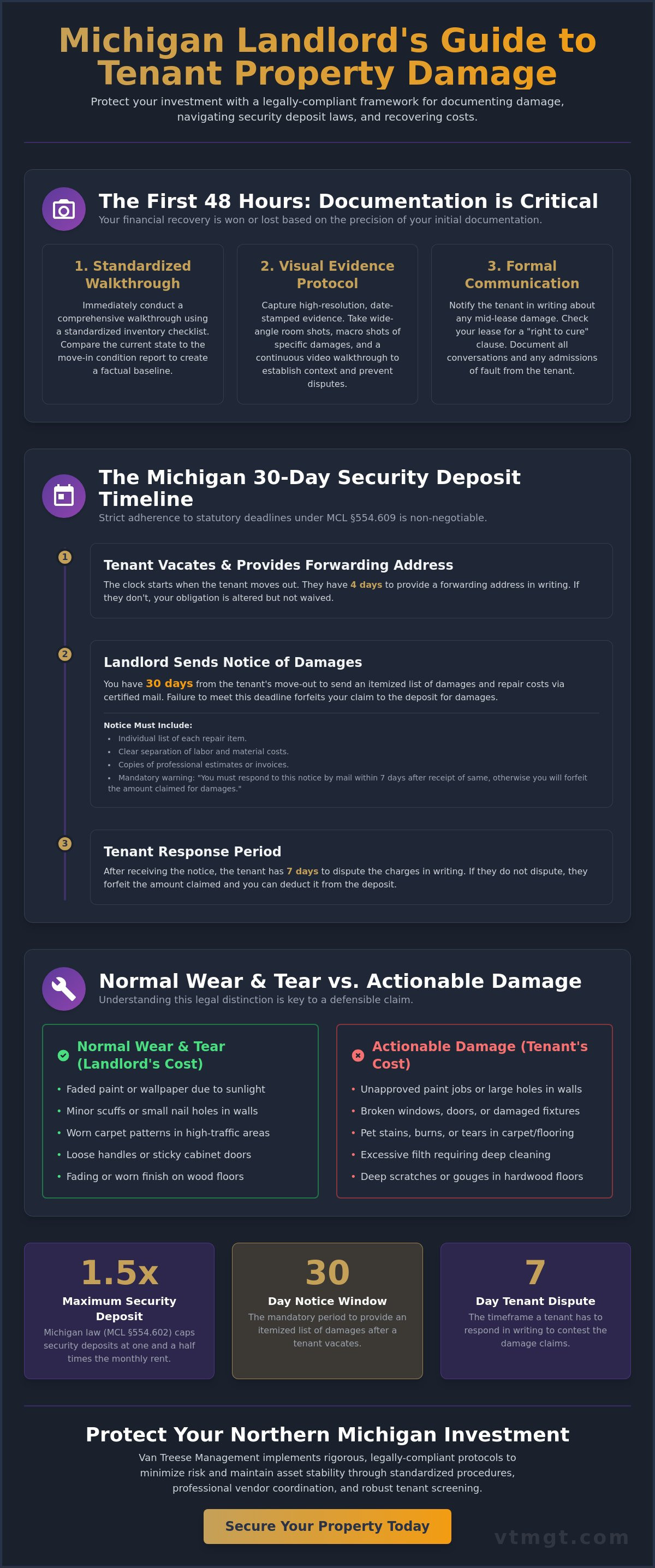
This guide provides the precise legal and logistical framework required to document damage, comply with Michigan law, and recover your costs efficiently. We'll outline the critical 30-day itemization timeline required by MCL §554.609, the 1.5x security deposit cap, and the documentation standards needed to minimize vacancy time. By following these structured steps, you'll ensure your property management processes remain legally bulletproof and financially sound.
Key Takeaways
- Establish a factual baseline through standardized walkthroughs and comparative inventory checklists to document the precise condition of your asset.
- Master the mandatory 30-day window for issuing an itemized Notice of Damages to understand exactly what to do when a tenant damages property Michigan legally.
- Define the technical distinction between normal wear and tear and actionable damage to ensure all financial recovery claims remain legally defensible.
- Coordinate with professional vendor networks to obtain transparent repair estimates that clearly separate labor from material costs for accurate accounting.
- Implement structured management protocols and rigorous tenant screening to minimize high-impact damage risks and maintain investment stability.
Immediate Steps for Documenting Property Damage in Michigan
The integrity of a property damage claim depends entirely on the precision of the initial documentation. When a landlord identifies a breach in the property's physical condition, they must initiate a comprehensive walkthrough immediately. This process isn't merely a visual inspection; it's a technical audit of the asset's current state compared to its baseline condition. Understanding what to do when a tenant damages property Michigan starts with the rigorous application of a standardized inventory checklist. This document serves as the primary evidence in any future dispute, transforming subjective observations into verifiable facts that hold up under legal scrutiny.
The Standardized Evidence Protocol
Capturing high-resolution digital evidence is the most critical phase of the documentation process. We recommend a multi-layered approach to visual recording to ensure no detail is overlooked. First, capture wide-angle photographs of the entire room to establish the environment and spatial context. Following these, take macro shots of specific damages, such as deep gouges in hardwood floors or structural cracks in drywall. A continuous video walkthrough adds a layer of spatial context that static images cannot provide, preventing tenants from claiming the damage existed in a different area. All files must be date and time-stamped to ensure they align with Michigan landlord laws regarding move-out timelines and inspection windows. This data-driven approach removes ambiguity from the recovery process.
Formal Communication and "Right to Cure"
Once you've secured the physical evidence, you must maintain a formal communication log. Notify the tenant in writing as soon as you identify mid-lease damage. It's essential to review the specific terms of your lease agreement to determine if the tenant possesses a "right to cure." This provision allows a tenant to repair the damage themselves to a professional standard before you intervene. During these initial conversations, document any admissions of fault or explanations provided by the tenant. These records are vital when navigating security deposit laws, as they establish a clear timeline of accountability.
Failing to follow these structured steps can lead to the forfeiture of repair costs or even legal penalties. We've found that consistent, disciplined documentation protects the landlord's investment from the common "gray area" of tenant disputes. By treating property management with the same precision as a technical engineering project, you ensure that every claim is backed by irrefutable data, minimizing the risk of financial loss.
Navigating Michigan Security Deposit Laws and Notice Requirements
Once you've completed the technical documentation of the property, the process enters a strictly regulated legal phase. Michigan law is uncompromising regarding deadlines and procedural accuracy. If you're determining what to do when a tenant damages property Michigan, your first priority is the 30-day statutory window. This period begins the moment a tenant vacates the premises, provided they've supplied a forwarding address in writing. Per Michigan landlord-tenant law, tenants must provide this address within four days of moving out. If they fail to do so, it doesn't waive your obligation to provide notice, but it does alter the timeline for returning the remaining deposit.
The 30-Day Itemized Notice of Damages
Precision is the primary requirement for the "Notice of Damages." You must list each repair item individually, clearly separating labor costs from material expenses. Vague entries like "cleaning fees" or "general repairs" often fail under judicial review. Instead, attach copies of professional estimates or invoices to the formal notice to provide a factual basis for the deduction. You're required to send this notice via certified mail with a return receipt. This provides the necessary legal proof of delivery. Crucially, the notice must include a specific warning: the tenant has seven days from the date of receipt to contest the claims in writing, or they forfeit the amount deducted for damages.
Escrow Compliance and the 1.5x Rent Rule
Before you can legally withhold funds, the initial collection of the deposit must comply with MCL §554.602. In Michigan, a security deposit cannot exceed 1.5 times the monthly rent. These funds must be held in a compliant escrow account or secured by a bond. If you've failed to maintain these standards, you may lose the right to withhold any portion of the deposit, regardless of the extent of the damage. Establishing these rigorous standards during lease agreement preparation ensures all parties understand their financial obligations and the consequences of property negligence from the start of the tenancy.
Failure to adhere to these notice requirements carries significant risk. If a landlord misses the 30-day deadline or fails to include the required statutory warning language, they may be liable for double the amount of the deposit wrongfully withheld. This financial penalty makes the "Notice of Damages" one of the most critical documents in your management workflow. By treating these deadlines with the same rigor as an industrial production schedule, you protect your capital and maintain a professional standing within the Michigan rental market.
Distinguishing Between Normal Wear and Tear vs. Tenant Damage
The technical differentiation between expected deterioration and actionable damage is where many property owners encounter legal friction. "Normal wear and tear" is defined as the natural decline in a property's condition resulting from ordinary, intended use without negligence or abuse. It's an unavoidable cost of doing business in the rental sector. Conversely, "tenant damage" results from specific incidents of abuse, accidents, or unauthorized structural alterations. When determining what to do when a tenant damages property Michigan, you must apply an objective lens to these classifications to ensure your financial recovery efforts remain legally defensible under the Landlord-Tenant Relationship Act.
Landlords must also factor in the "useful life" rule to avoid overcharging. This principle dictates that you cannot charge a tenant for the full replacement cost of an item that was already nearing the end of its functional lifespan. For instance, if a carpet with a five-year life expectancy is damaged in its fourth year, the tenant is only responsible for the remaining 20% of its value. This calculation requires a disciplined review of the property's age and the total duration of the tenancy. Applying this structured approach prevents the common error of seeking "betterment," where a landlord attempts to upgrade their property at a tenant's expense, which is prohibited by Michigan courts.
Objective Comparison Framework
Establishing a factual baseline requires a side-by-side comparison of specific surface conditions. We utilize the following technical standards to categorize property state:
- Carpet: Subtle traffic patterns or thinning fibers in hallways constitute wear. Cigarette burns, pet urine saturation, or large bleach stains are classified as damage.
- Walls: Small nail holes from standard picture frames are typically considered wear. Large punctures, holes from mounted televisions, or significant drywall indentations represent actionable damage.
- Flooring: Minor scuffs on a hardwood finish are expected over time. Deep gouges from dragging heavy furniture or warped planks caused by neglected spills are damage.
Northern Michigan Climate Considerations
The regional environment introduces unique variables into the maintenance equation. In our region, entryways endure significant salt and moisture exposure during winter months. If a landlord provides industrial-grade mats and a tenant fails to use them, resulting in permanent floor degradation, this may be classified as damage. However, minor salt tracking despite reasonable care is generally viewed as wear. Moisture management is equally critical; you must determine if mold issues resulted from a failure in the building envelope or a tenant's poor ventilation habits. Adhering to professional rental property maintenance Northern Michigan standards helps establish these baseline expectations, ensuring your property remains a high-functioning asset throughout the extreme seasonal shifts.
The Repair Process: Coordinating Vendors and Calculating Costs
Transitioning from legal documentation to physical restoration requires a structured maintenance workflow. When deciding what to do when a tenant damages property Michigan, landlords must prioritize the acquisition of professional, third-party repair estimates. These documents must clearly bifurcate labor costs and material expenses. This transparency is vital because Michigan law prohibits "upcharging" for repairs. You can only deduct the actual, verified cost of the restoration from the security deposit. Any attempt to add administrative surcharges or profit margins to repair invoices often leads to judicial rejection during a dispute.
Efficiency in the repair phase is the primary driver of your return on investment. Every day a unit remains under repair is a day of lost rental income. By maintaining a fegyelmezett (disciplined) approach to vendor scheduling, you ensure that the property returns to the market at peak performance levels as quickly as possible. This requires a logistical framework that treats property maintenance with the same precision as a technical manufacturing schedule.
Professional Maintenance Coordination
Relying on a network of vetted local contractors in Petoskey and surrounding counties ensures that the quality of work meets professional standards. While DIY repairs might seem cost-effective, they carry significant legal risk in the Michigan rental market. In small claims court, professional invoices carry substantially more weight than receipts for materials and self-reported labor hours. Standardizing repair specifications across your portfolio ensures consistent quality and provides a clear audit trail. This is especially important when managing emergency repairs mid-lease, where the speed of restoration directly impacts the preservation of the asset's value. Our team provides comprehensive maintenance coordination to streamline this entire process for owners.
Calculating Depreciated Value
Calculating the depreciated value of damaged assets is a technical necessity to prevent "betterment" claims. If a tenant damages a carpet with a 10-year useful life that was installed five years ago, you can only legally charge for 50% of the replacement cost. Documenting the "before" and "after" state of the repair work provides the necessary data to justify these deductions. Ensuring that all deductions are "reasonable" based on the asset's age and condition prevents judicial pushback and maintains your professional reputation. This objective calculation method removes the emotional friction from the recovery process and replaces it with a factual, data-driven system.
Scheduling these repairs immediately is essential for minimizing vacancy and maximizing your return on investment. A vacant unit represents a total loss of revenue, so the restoration process must be executed with industrial efficiency. By integrating these logistical steps into your management routine, you move beyond mere compliance and into active asset protection.
How Van Treese Management Protects Your Northern Michigan Investment
Managing a rental asset requires more than just reactive repairs; it demands a methodological framework that anticipates risks before they materialize. When owners consider what to do when a tenant damages property Michigan, the most effective strategy is the implementation of standardized management systems. We eliminate the "gray area" of property damage by applying rigorous technical standards to every phase of the tenancy. This structured approach ensures that every interaction, from the initial lease signing to the final move-out inspection, is documented with industrial precision. Our team maintains a constant focus on stability and technological readiness to protect your capital.
Our process begins with rigorous tenant screening and placement. By analyzing historical data and conducting thorough background checks, we minimize the risk of high-impact damage before a key is ever handed over. This proactive mitigation is coupled with a deep expertise in local Michigan statutes. We ensure 100% legal compliance with the Landlord-Tenant Relationship Act, protecting you from the double-damage penalties associated with procedural errors. By maintaining fegyelmezett (disciplined) oversight, we provide a buffer between the property owner and the logistical friction of tenant disputes.
The Van Treese Advantage: Systems Over Stress
Understanding what to do when a tenant damages property Michigan becomes much simpler when you have a digital move-in/move-out report that creates an indisputable paper trail. We utilize advanced reporting tools that include high-resolution imagery and detailed condition descriptions, removing the subjectivity from damage assessments. Our relationship-based management style encourages tenants to report maintenance issues early, preventing minor leaks from becoming structural failures. Additionally, our established local vendor network allows for priority scheduling and fair, transparent pricing. This coordination ensures that repairs are handled by qualified professionals whose invoices carry the necessary weight in a legal environment.
Protecting Long-Term ROI
Professional management serves as the most effective form of damage insurance for Northern Michigan investors. By maintaining an emergency response and maintenance coordination system, we protect the physical integrity of the building envelope against the region's harsh climate. Our commitment to building thriving communities through well-maintained properties ensures high tenant retention and sustained asset appreciation. We view ourselves as your long-term partner in industrial-scale property management, providing the stability needed to scale your portfolio without the burden of daily operational stress. Protect your property with Van Treese Management today.
Maximizing Asset Protection and Legal Resilience
Recovering from tenant-induced damage requires a disciplined combination of technical documentation and strict adherence to Michigan's statutory timelines. By maintaining a clear baseline through comparative inventory reports and respecting the 30-day itemization window, you remove the financial and legal friction from the restoration process. Knowing exactly what to do when a tenant damages property Michigan transforms a stressful incident into a structured operational task that preserves your asset's value. Proactive management and clear communication are the most effective tools for minimizing these risks over the long term.
We provide the professional framework necessary to manage these complexities with the same precision you'd expect from a heavy industrial partner. Our systems include standardized 24/7 maintenance protocols and an extensive network of vetted local contractors to ensure every restoration is executed to the highest quality standards. With our 100% Michigan legal compliance guarantee, you can rest assured that your documentation and security deposit handling are legally bulletproof. Protect Your Northern Michigan Investment with Professional Management and secure the long-term performance of your rental assets. We're ready to ensure your property remains a stable, thriving investment for years to come.
Frequently Asked Questions
Can I charge a tenant for cleaning if they left the property dirty in Michigan?
Yes, you can deduct cleaning costs if the property's condition falls below the baseline established at move-in. Michigan law distinguishes between normal wear and tear and excessive filth. If a tenant leaves behind trash, stained carpets, or uncleaned appliances, these are actionable items. You must document these conditions with photos and include the specific cleaning charges in your itemized Notice of Damages to ensure legal recovery.
What happens if the tenant does not provide a forwarding address within 4 days?
If a tenant fails to provide a forwarding address within four days of vacating, they don't automatically forfeit their deposit, but it complicates the notification process. You should still prepare the itemized list of damages within the 30-day window. Send this notice via certified mail to the tenant's last known address, which is typically the rental unit itself. This demonstrates a good-faith effort to comply with Michigan's notice requirements.
Can I use the security deposit for unpaid rent as well as physical damage?
Michigan's MCL §554.607 explicitly allows landlords to use security deposits for unpaid rent, utility bills, and physical damage. When determining what to do when a tenant damages property Michigan, you must ensure your accounting clearly separates these categories. Providing a transparent breakdown prevents the tenant from claiming that funds were misappropriated. This structured approach is vital for maintaining 100% legal compliance during the move-out phase.
How long do I have to sue a tenant for damages that exceed the security deposit?
You generally have six years to initiate a lawsuit for damages that exceed the security deposit under Michigan's statute of limitations for breach of contract. If the repair costs surpass the held funds, you can pursue the remaining balance in small claims court for amounts up to $6,500. For larger claims, you'll need to file in the appropriate district court. Maintaining a detailed evidence file is essential for success in these proceedings.
Do I need to provide receipts for the repairs listed in the Notice of Damages?
While the initial 30-day notice only requires estimated costs, you should provide actual professional invoices if the tenant contests the claim. Michigan courts prioritize third-party receipts over self-reported labor or material estimates. Providing copies of these documents in your formal response to a tenant's objection strengthens your position. This technical transparency removes the emotional friction often found in security deposit disputes and establishes a factual basis for deductions.
Can I evict a tenant in Michigan specifically for property damage?
Yes, you can initiate eviction proceedings if a tenant causes extensive or continuing physical injury to the premises. Michigan law allows for a 7-day notice to quit in cases involving significant property damage. This is a faster timeline than standard non-payment evictions. You must have clear evidence that the damage was intentional or resulted from gross negligence to succeed in a summary proceeding for possession of the property.
Is it better to settle a damage dispute or go to small claims court?
Settlement is often the preferred outcome because it minimizes vacancy time and eliminates legal fees. A structured settlement allows you to recover costs quickly and prepare the unit for the next occupant. However, if a tenant is unresponsive or the damage is severe, small claims court provides a necessary legal judgment. We find that having professional maintenance coordination data makes settlements much easier to reach because the evidence is indisputable.