
How to Increase Rental Property ROI Petoskey: The 2026 Investor’s Guide

While Petoskey properties are currently seeing an annual appreciation rate of 25.73%, many local investors find their monthly bank statements don't reflect that growth. You might assume that simply raising the rent is the best way to improve your bottom line, but in a market where the median rent sits at $1,500, the real secret to how to increase rental property ROI Petoskey isn't found in the top line. It's found in eliminating the silent killers of profit, such as emergency winter maintenance and inconsistent tenant quality.
We understand that managing a portfolio in Northern Michigan requires a level of precision that standard property management often lacks. You want predictable monthly cash flow and reduced emergency repair costs rather than constant operational surprises. This 2026 guide outlines the standardized systems and local market strategies that successful landlords use to maximize yields and minimize leakage. We'll explore how professional tenant screening and structured maintenance coordination can transform your property from a high-maintenance burden into a high-performing asset that delivers long-term appreciation.
Key Takeaways
- Leverage the transition toward long-term residential demand in Emmet County to prioritize consistent cash flow and long-term asset preservation.
- Discover how to increase rental property ROI Petoskey by utilizing standardized market research to establish optimal rent levels that balance yield with zero-vacancy targets.
- Minimize operational leakage by integrating structured maintenance coordination and accessing vetted local contractor networks to reduce unforeseen repair expenses.
- Protect annual returns by adopting high-performance tenant placement strategies that focus on rigorous screening and proactive retention to avoid the high costs of turnover.
- Transition from passive oversight to professional management systems that offer precise financial reporting and structured accounting for a scaling portfolio.
Analyzing the Petoskey Rental Market Dynamics in 2026
Petoskey's real estate environment in 2026 is defined by a tightening supply of long-term residential units. While seasonal tourism traditionally dictated market fluctuations, the current trend shows that long-term residential demand in Emmet County is now outpacing seasonal supply. This shift is primarily driven by the expansion of the local workforce in the healthcare and education sectors. Although the prime working-age population (25-54) declined by 14% since 2010, it has seen a 2% uptick since late 2025. For investors, understanding Return on Investment (ROI) in this context requires looking beyond simple monthly margins. It's a strategic balance between immediate cash flow and the preservation of assets that are appreciating at an annual rate of 25.73%.
The local economy's stability is anchored by major employers like McLaren Northern Michigan and North Central Michigan College. These institutions ensure a year-round demand that mitigates the risks associated with the "shoulder seasons" typical of resort towns. We recognize that when assessing how to increase rental property ROI Petoskey, the most resilient yields come from properties that serve this professional demographic. High property valuations are no longer just a byproduct of tourism; they are increasingly supported by a robust, year-round economic foundation that requires a disciplined management approach.
Long-Term vs. Short-Term: The Real ROI Comparison
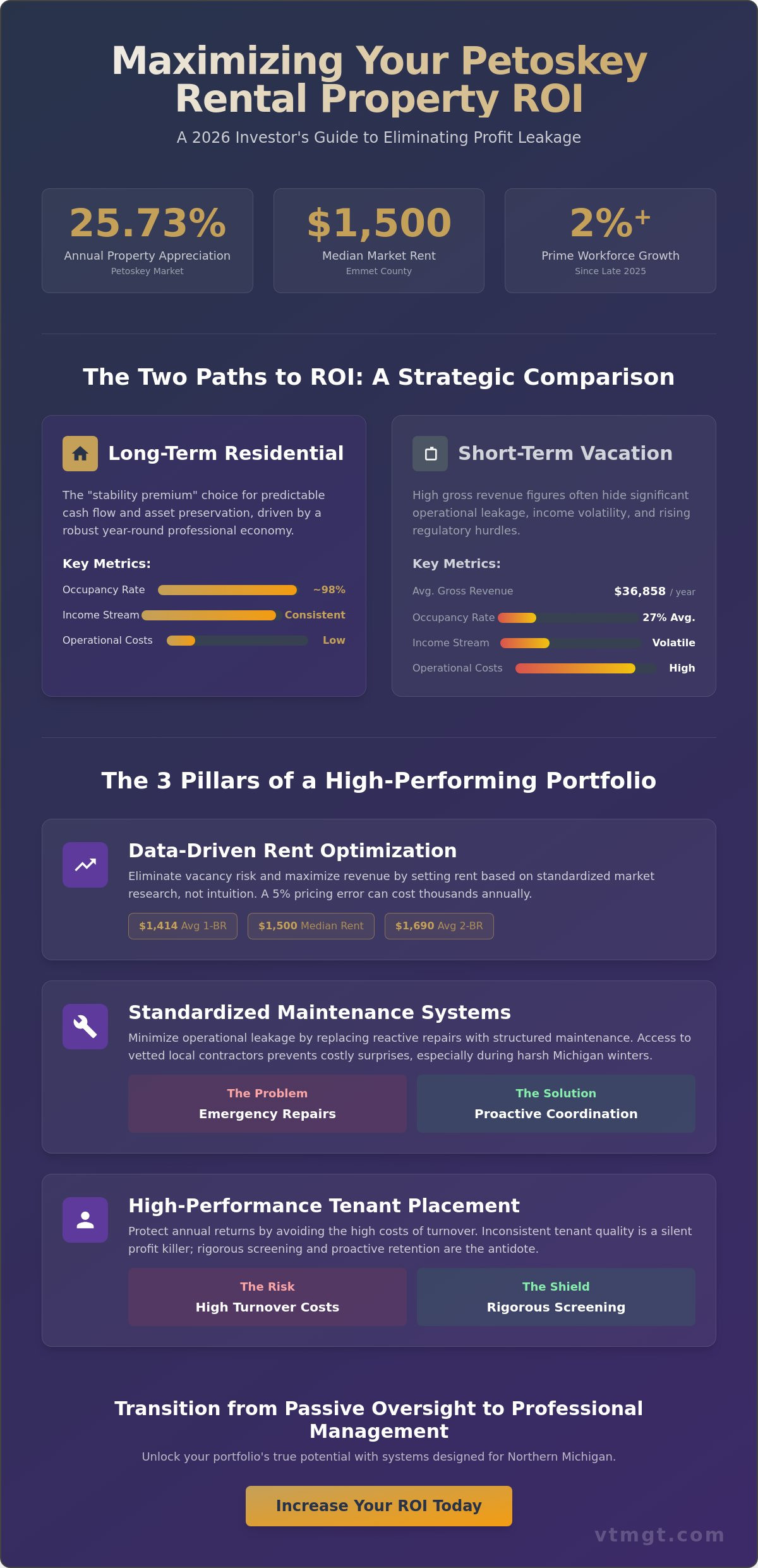
Competitors often emphasize the high gross revenue of vacation rentals, which reached an average of $36,858 annually as of April 2026. However, these figures frequently omit the significant operational leakage caused by high-frequency cleaning, increased utility consumption, and accelerated wear-and-tear. Long-term leases in Petoskey offer a "stability premium" by providing predictable income without the volatility of a 27% average occupancy rate. Additionally, local regulations have become increasingly restrictive. With short-term licenses limited to business districts and a $350 annual fee, the barrier to entry for vacation rentals continues to rise, making long-term residential assets a more technically sound choice for portfolio stability.
Petoskey Neighborhood Performance
The geographic location of your asset significantly impacts its performance metrics. Properties situated near the McLaren Northern Michigan hospital corridor continue to show the highest demand for professional-grade housing. These units often command the average 2-bedroom rent of $1,690 while maintaining near-zero vacancy rates. In contrast, outlying Emmet County offers lower entry costs but requires more robust maintenance systems to account for Michigan's harsh winters. With a median effective property tax rate of 0.85% as of April 2026, the region remains attractive for those investing in rental property Northern Michigan, provided they focus on neighborhoods where the infrastructure supports year-round occupancy.
Maximizing Revenue Through Data-Driven Rent Optimization
Relying on intuition or outdated listings creates substantial financial risk for investors. In Petoskey's 2026 market, where the median rent sits at $1,500, even a 5% error in pricing can lead to extended vacancy or thousands in lost annual revenue. We advocate for a technical approach to property valuation that moves beyond "gut feeling" and utilizes standardized market research. This process identifies exactly how to increase rental property ROI Petoskey by aligning your asset's features with current Emmet County demand metrics.
Finding the pricing sweet spot requires balancing top-line rent with the goal of zero vacancy. While high-end amenities like smart home technology and pet-friendly policies allow for rent premiums, they must be calibrated against the local average of $1,414 for 1-bedroom apartments and $1,690 for 2-bedroom units. Professional valuations ensure that every square foot of your portfolio is performing at its maximum capacity without alienating the local workforce.
The Science of Rent Setting in Emmet County
A competitive market analysis (CMA) should be a structured audit of local supply rather than a cursory glance at online listing sites. In Northern Michigan, you've got to factor in seasonal demand fluctuations when signing new leases. Signing a lease in the spring often yields higher results than in the late autumn. Interestingly, pricing a unit slightly below the absolute market ceiling can often result in a higher 3-year return. This strategy secures higher-quality tenants who stay longer, effectively eliminating the turnover costs that typically erode profits. Implementing professional property marketing and advertising allows you to test these price points with precision and reach the most qualified applicants.
Strategic Upgrades with the Highest Yield
Renovations should be treated as capital investments with specific yield targets. In Petoskey, certain upgrades provide superior returns compared to others because of our specific climate and demographic needs:
- Energy Efficiency: Upgrading insulation or windows reduces tenant utility burdens during harsh Michigan winters, making your property more competitive in a tight market.
- Kitchen Modernization: Clean, functional surfaces and updated appliances consistently drive higher rent premiums than expensive bathroom overhauls.
- Professional Photography: High-quality visual assets increase lead volume, allowing you to be more selective during the screening process and supporting a higher asking price.
Integrating smart home technology, such as keyless entry and remote thermostats, also appeals to the growing workforce in the healthcare and education sectors. These professionals value efficiency and security. When you provide a modern, well-maintained residence, it translates into a higher willingness to pay a premium and a lower likelihood of tenant turnover.
Reducing Operational Leakage with Standardized Maintenance Systems
Operational leakage represents the accumulation of unmanaged, minor expenses that systematically erode annual profit margins. In the Northern Michigan market, these costs often stem from fragmented maintenance protocols and reactive repair cycles. Understanding how to increase rental property ROI Petoskey requires a shift from "sweat equity" to standardized technical oversight. By implementing structured systems, investors can eliminate the inefficiencies that typically consume 10% to 15% of gross rental income. Our approach focuses on leveraging vetted local contractor networks to secure preferred pricing and ensure that every repair meets professional quality standards.
The financial impact of a failed system is often catastrophic. A single burst pipe during a sub-zero January night can result in an emergency remediation invoice exceeding $9,500. Professional maintenance coordination mitigates these risks by providing 24/7 emergency response. This ensures that critical failures are addressed immediately, preventing minor leaks from evolving into major structural insurance claims. When maintenance is treated as a controlled process rather than a series of emergencies, the predictability of your monthly cash flow improves significantly.
Asset Protection vs. Reactive Repair
Adopting the "22% rule" is a core component of high-yield property management. Data shows that proactive oversight can reduce long-term capital expenditures by up to 22% over a five-year holding period. Instead of waiting for a component to fail, we recommend a 5-year capital improvement plan for every Petoskey asset. This allows for the scheduled replacement of high-wear items, such as water heaters or roofing, during the off-season when contractor availability is higher. For a deeper technical breakdown of these protocols, consult our guide on rental property maintenance Northern Michigan.
Systematizing the 'Winterization' Path
In Emmet County, winterization isn't a suggestion; it's a critical ROI strategy. Precision HVAC calibration ensures that heating systems operate at peak efficiency, which is vital for avoiding mid-winter outages that lead to tenant displacement and emergency repair premiums. Exterior envelope sealing serves as a secondary preventative layer. By identifying and closing thermal gaps, you protect the building's core and reduce the strain on mechanical systems. Documenting these maintenance steps provides a verifiable service history. This level of detail is invaluable for insurance audits and serves as a significant value-add when you eventually position the asset for resale in the competitive Petoskey market.
High-Performance Tenant Placement and Retention Strategies
Tenant turnover is often the most significant variable in a portfolio's financial performance. In the Petoskey market, where the average monthly rent is $1,414, a single month of vacancy effectively negates a $117 monthly rent increase for an entire year. This loss is compounded by the costs of marketing, cleaning, and administrative processing. Analyzing how to increase rental property ROI Petoskey requires a focus on tenant longevity. By implementing standardized placement protocols, we ensure that every lease agreement is supported by a resident who values the stability and quality of the asset.
Building a legal safeguard around your investment is a primary requirement for long-term yield. High-performance placement minimizes the likelihood of facing the eviction process Emmet County MI, which often results in months of lost revenue and substantial legal fees. Our approach centers on professional human interaction and clear communication, which reduces friction and fosters a sense of community within residential units. When tenants feel their residency is treated with professional respect, they are statistically more likely to renew their lease.
The VTMG Tenant Screening Framework
Our screening process goes beyond a basic credit score to evaluate the long-term fit for Petoskey's professional communities. We utilize a standardized technical framework that includes comprehensive background checks, income verification, and local reference audits. This ensures compliance with the Fair Housing Act while protecting the owner's financial interest. Every residency begins with a precise lease agreement that defines maintenance responsibilities and payment structures. For owners seeking to stabilize their portfolio, utilizing professional tenant screening and placement services is a critical step in risk mitigation.
Retention as a Revenue Driver
Retention is a deliberate strategy, not a passive outcome. Data indicates that responsive maintenance is the leading driver of lease renewal rates in Northern Michigan. We use standardized communication protocols to ensure every tenant request is acknowledged and scheduled within defined timeframes. Furthermore, we strategically time lease expirations to avoid the winter months. Attempting to fill a vacancy in January or February in Petoskey is technically difficult and often leads to prolonged vacancy periods. By aligning lease terms with the peak demand cycles of the local workforce, we maintain high occupancy levels and maximize the how to increase rental property ROI Petoskey equation through consistent, uninterrupted cash flow.
Scaling Your Northern Michigan Portfolio with Professional Management
Many investors view property management as a fixed overhead cost rather than a strategic profit center. However, the technical reality of the 2026 Petoskey market suggests that professional oversight is the primary lever for capital optimization. When you implement an "institutional-grade" management approach, you're not just paying for a service; you're investing in a standardized system designed to protect and grow your equity. Understanding how to increase rental property ROI Petoskey requires moving beyond basic landlord duties and focusing on high-level financial reporting and accounting. These systems ensure you're maximizing tax benefits and maintaining a clear view of your portfolio's performance metrics.
Scaling a portfolio across Emmet County requires a shift from reactive, individual property management to a systematic, multi-unit strategy. Professional financial reporting and accounting provide the data necessary to make informed decisions about property acquisitions or divestments. By treating your real estate holdings as a structured business enterprise, you reduce the risk of operational drift and ensure that every asset contributes to your long-term wealth goals. This disciplined approach is what separates casual landlords from professional investors who successfully capitalize on Petoskey's 25.73% annual appreciation rate.
The ROI of Time: Opportunity Cost for Investors
DIY management often masks significant opportunity costs. If you're spending ten hours a month on tenant inquiries or maintenance logistics, you're essentially working as a property manager rather than an investor. Calculating your hourly rate is a sobering exercise. Is your time better spent vetting contractors or identifying your next acquisition? Professional oversight allows for seamless scaling across Northern Michigan by removing the bandwidth constraints of self-management. We've seen many investors transition from a reactive state to a systematic growth phase once they offload the technical complexities of daily operations and focus on capital allocation.
The Van Treese Difference
Our operational philosophy is rooted in a deep commitment to Petoskey and the Little Traverse Bay community. We don't use generic, one-size-fits-all management templates. Instead, we utilize standardized systems specifically engineered for the unique demands of the Northern Michigan climate and its workforce housing needs. This includes specialized maintenance coordination and rigorous tenant placement protocols that have been refined through years of local experience. If you're ready to transition your portfolio into a high-performance asset, the next step is a professional rental analysis to identify untapped equity. You can maximize your Petoskey ROI with Van Treese Management through our data-driven, professional management framework.
Optimizing Your Petoskey Portfolio for 2026 and Beyond
Sustained profitability in Emmet County requires a transition from passive ownership to a structured, technical management framework. We've established that the most effective way to address how to increase rental property ROI Petoskey is through the elimination of operational leakage and the implementation of standardized maintenance protocols. By prioritizing long-term residential stability over seasonal volatility, you protect your asset's appreciation while ensuring predictable monthly cash flow. Precision in tenant selection and rent optimization creates a foundation for scalable growth.
Van Treese Management was founded in 2018 with deep local roots and a commitment to the Little Traverse Bay area. We provide the specialized climate-specific maintenance and standardized financial reporting systems necessary for transparent, institutional-grade portfolio oversight. Our team manages the technical complexities so you don't have to manage the daily friction of property ownership. Get a Professional Rental Analysis for Your Petoskey Property to identify the untapped potential within your Northern Michigan holdings. Your portfolio deserves a partner dedicated to precision and long-term asset preservation.
Frequently Asked Questions
What is the average rental property ROI in Petoskey, MI for 2026?
Total return on investment in Petoskey is currently driven by a 25.73% annual appreciation rate as of March 2026. While monthly cash flow yields depend on individual leverage and acquisition costs, the combination of high asset appreciation and a $1,500 median rent provides a robust total return profile for disciplined investors. We focus on maximizing this figure by optimizing operational efficiency and asset preservation.
How do management fees impact my overall rental ROI?
Professional management fees should be viewed as a strategic investment rather than a simple overhead cost. Professional oversight identifies exactly how to increase rental property ROI Petoskey by securing higher-quality tenants and reducing the operational leakage associated with uncoordinated maintenance. These systems often offset the fee by increasing the property's net operating income through lower vacancy rates and preferred contractor pricing.
Is it better to invest in long-term or short-term rentals in Petoskey?
Long-term rentals currently provide superior stability because of Petoskey's restrictive short-term rental ordinances and the $350 annual licensing fee. While vacation rentals can show high gross revenue, the 27% average occupancy and high turnover costs often make long-term residential assets more technically sound. Long-term leases offer predictable cash flow and significantly lower wear-and-tear on the property's mechanical systems.
What are the most cost-effective upgrades for a Northern Michigan rental?
Upgrades that directly address the Northern Michigan climate offer the highest returns. High-efficiency HVAC systems and improved insulation reduce tenant utility burdens, which increases the property's marketability and supports higher rent levels. Kitchen modernizations, such as updated appliances and durable surfaces, also consistently drive higher rent premiums compared to cosmetic bathroom changes or high-end landscaping.
How can I reduce my vacancy rate in Emmet County?
Reducing vacancy requires aligning lease expirations with peak demand cycles in the spring and summer months. Professional property marketing and advertising ensure a wider reach among the local healthcare and education workforce, who prioritize year-round stability. Implementing a standardized tenant retention program also keeps turnover low, which is critical since a single month of vacancy can wipe out an entire year's rent increase.
Does professional property management really pay for itself?
Professional management pays for itself by eliminating the high costs of unmanaged turnover and emergency repairs. Through rigorous tenant screening and placement, landlords avoid the legal friction and lost revenue associated with poor-quality residents. Maintenance coordination also prevents expensive remediation by identifying system failures before they become catastrophic, effectively protecting the asset's long-term valuation.
What are the common landlord mistakes that hurt ROI in Petoskey?
The most frequent mistakes include reactive maintenance cycles and inaccurate rent setting based on outdated market data. Landlords who ignore the specific technical demands of the Michigan winter or fail to use standardized screening protocols often see their annual yields eroded by emergency remediation and high turnover. Miscalculating the true cost of DIY management also leads to significant opportunity costs that hinder portfolio scaling.