
Rental Property Tax Deductions Checklist Michigan: The 2026 Landlord Guide
If you misclassify a structural repair as a capital improvement on your 2026 tax return, you effectively lock that capital away for a 27.5-year federal depreciation cycle. For landlords in Northern Michigan, where high seasonal maintenance costs are a mathematical certainty, these technical errors represent a direct threat to annual ROI. We understand that the complexity of IRS Schedule E requirements and the nuance of city-specific income taxes, such as Detroit’s 2.4% resident rate, create significant administrative pressure. This rental property tax deductions checklist Michigan guide provides the precise, research-backed framework you need to standardize your financial reporting and maximize legal tax savings.
You shouldn't have to face an IRS audit because of ambiguous recordkeeping or a misunderstanding of the temporarily increased $40,000 SALT deduction cap. We'll provide a clear, structured checklist that you can hand directly to your CPA to ensure your property management operations remain both compliant and profitable. This article examines the specific categories of deductible expenses, from professional management fees to energy-efficient upgrades under the Inflation Reduction Act, giving you total control over your portfolio's fiscal health.
- Define gross rental income beyond monthly payments by including pet fees and non-refundable deposits within your tax strategy.
- Utilize our rental property tax deductions checklist Michigan to identify every eligible expense from mortgage interest to local property tax assessments.
- Account for Northern Michigan climate demands by properly deducting snow mitigation and annual winterization costs as ordinary and necessary expenses.
- Apply the 27.5-year depreciation rule and the BAR test to ensure accurate classification of property repairs versus capital improvements.
- Implement standardized recordkeeping systems that provide a transparent, audit-proof framework for your professional financial reporting.
The Framework of Michigan Rental Income and Deductible Expenses
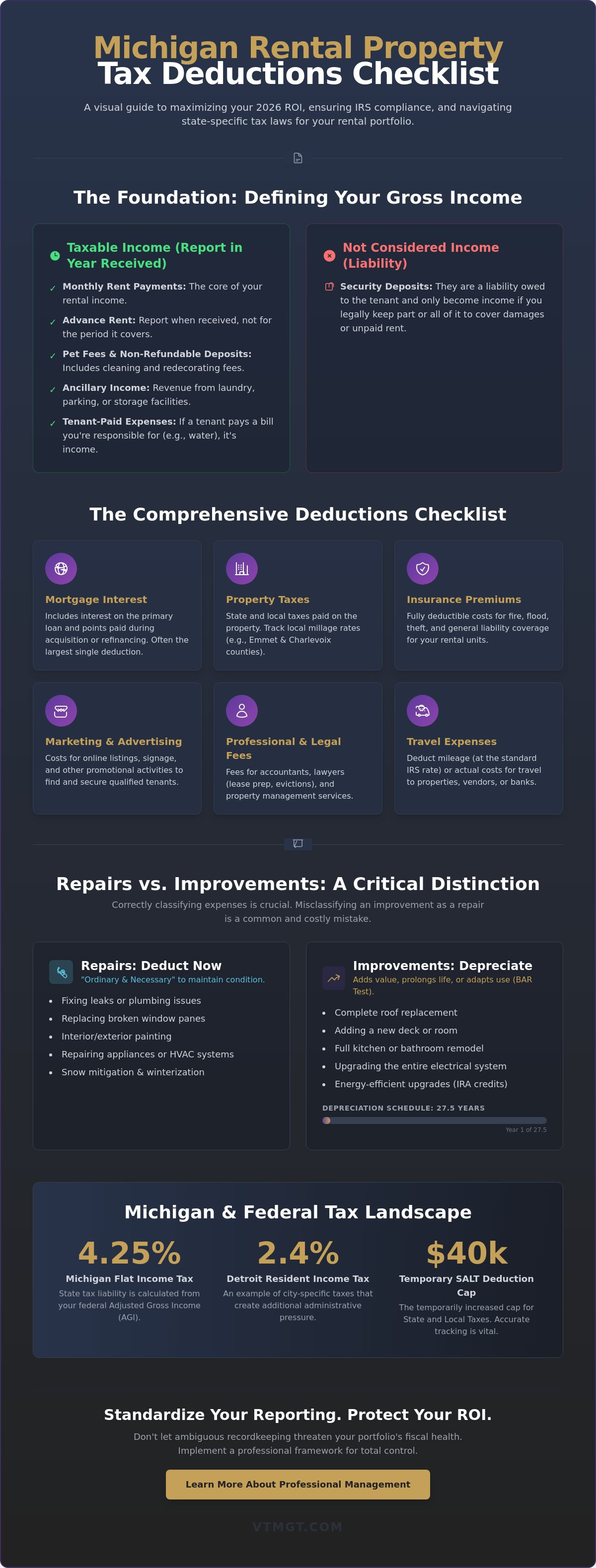
Efficient tax management for property owners requires a rigorous understanding of how the IRS and the State of Michigan define revenue. For the 2026 tax year, Michigan maintains a 4.25% flat income tax rate. Because the state uses federal Adjusted Gross Income (AGI) as its starting point, your accuracy on federal Schedule E determines your total tax liability. Most landlords in Northern Michigan, particularly in the Petoskey area, utilize the cash method of accounting. This approach records transactions only when funds actually change hands, which aligns with the seasonal cash flow cycles typical of our region.
What Counts as Taxable Rental Income in 2026?
Taxable income extends beyond the base monthly rent. You must report pet fees, non-refundable cleaning deposits, and any income from laundry facilities or parking fees. If a tenant pays an expense that is traditionally the landlord's responsibility, such as a water bill or a local assessment, that amount must be included as gross income. Security deposits are a notable exception; they're considered a liability rather than income unless you forfeit them to cover damages or a breach of lease. Additionally, "advance rent" must be reported in the year it's received, regardless of which period the payment covers.
The Core Principle of Deductibility
To qualify for the rental property tax deductions checklist Michigan framework, an expense must meet the "ordinary and necessary" threshold. The IRS defines ordinary expenses as those common and accepted in the property management industry. Necessary expenses are those that are helpful and appropriate for your rental business. For owners of multi-unit properties who occupy one unit, expenses must be meticulously bifurcated between personal and business use based on square footage or unit count.
Precision in recordkeeping isn't merely an administrative preference; it's a structural requirement for protecting your ROI. A thorough understanding depreciation is also vital, as it represents one of the most significant non-cash deductions available to landlords. This allows you to recover the cost of the building structure over 27.5 years. Utilizing standardized financial reporting systems ensures that every maintenance coordination fee and marketing cost is documented with a clear business intent. This professional trail is your most effective tool for maintaining compliance and defending your filings during a state or federal audit.
The Comprehensive Rental Property Tax Deductions Checklist
Strategic asset management requires a disciplined approach to expense categorization. Utilizing a standardized rental property tax deductions checklist Michigan ensures that every dollar spent on asset preservation and operation is accounted for on your 2026 return. Mortgage interest remains the primary deduction for leveraged investors. This includes not only the interest on the primary loan but also any points paid during the acquisition or refinancing phase. These costs are often the largest offset against your gross rental income, making them critical for protecting your annual ROI.
Property taxes represent another significant line item. In Northern Michigan, specifically within Emmet and Charlevoix counties, tax assessments vary based on local millage rates. It's essential to track these payments accurately to offset your gross rental income. Additionally, insurance premiums for fire, flood, and general liability coverage are fully deductible for residential units. When you invest in professional and legal services, such as lease agreement preparation or eviction coordination, these costs are considered ordinary business expenses. Marketing and advertising costs are equally vital for maintaining occupancy. Fees paid for property marketing and advertising to secure tenants in the Northern Michigan market should be recorded as immediate deductions. According to the IRS guidelines on rental expenses, these costs must be directly related to the rental activity to qualify.
Operating and Administrative Expenses
Administrative costs often include office supplies and subscriptions for property management software. Travel and transportation expenses are also deductible. You should maintain a precise log for mileage tracking during property inspections or vendor meetings. When properties are vacant, or if the lease structure dictates, utilities such as water, trash, and electricity paid by the landlord are deductible. These small, recurring costs accumulate quickly and require rigorous documentation to survive an audit.
Professional Management and Labor
Engaging a firm for residential property management offers significant tax advantages, as management fees are 100% deductible. This includes monthly oversight fees and leasing commissions. Maintenance coordination charges, which cover the administrative effort of managing repairs, are also categorized as deductible service fees. When hiring independent contractors for repairs, you must comply with 1099-NEC reporting requirements for the 2026 tax year for any vendor paid $600 or more. Implementing financial reporting and accounting systems ensures these labor costs are documented correctly for your CPA.
Northern Michigan Climate-Specific Maintenance Deductions
Operating a rental portfolio in Northern Michigan requires a specialized approach to maintenance that generic national guides often overlook. For properties in Petoskey or Harbor Springs, snow removal and ice mitigation are not merely aesthetic choices; they are essential safety requirements. These seasonal costs should be a primary entry on your rental property tax deductions checklist Michigan. Because these services protect the property from structural damage and reduce liability risks, they meet the IRS "ordinary and necessary" criteria. Landscaping and exterior upkeep also qualify, as maintaining curb value is vital in a seasonal tourism market where property presentation directly impacts tenant placement.
Annual winterization represents another critical deduction. This includes professional furnace inspections, cleaning of heating systems, and the installation of pipe insulation to prevent freezing during extreme temperature drops. When storm damage occurs due to heavy snow loads or high winds, landlords must distinguish between insurance reimbursements and out-of-pocket deductible expenses. While the insurance payout isn't a deduction, the deductible you pay to initiate repairs is generally deductible as a business expense. According to IRS guidelines on rental income and expenses, these costs must be separated from capital improvements that add significant value or extend the property's life.
Seasonal Operational Oversight
Preventing catastrophic failures requires a disciplined schedule of recurring maintenance. By establishing a structured system for seasonal transitions, you ensure that your assets remain functional and your tenants remain satisfied. Effective vendor management is a core component of this process. Relying on vetted local contractors for emergency repairs ensures that technical issues are resolved with precision. For a deeper analysis of these processes, refer to our guide on Rental Property Maintenance Northern Michigan. This proactive oversight is a hallmark of professional management and a key factor in protecting your long-term ROI.
Geographic Tax Considerations
Tax liabilities vary significantly across the region. Property tax rates in Traverse City differ from those in Boyne City or Petoskey due to varying local millage rates. Michigan's average effective property tax rate is 1.19%, but specific county assessments demonstrate the need for local precision. You must also account for the loss of the Michigan Principal Residence Exemption (PRE) when converting a primary home into a rental. This conversion typically results in an 18-mill increase in property taxes, a substantial operational cost that is fully deductible against your rental income. Understanding these local nuances is vital for accurate financial reporting and maximizing your net operating income.
Depreciation and Improvements vs. Routine Repairs
The IRS mandates a 27.5-year recovery period for residential structures, a process known as MACRS depreciation. For Michigan landlords, this non-cash expense is a cornerstone of any rental property tax deductions checklist Michigan. It allows you to offset rental income by accounting for the gradual wear and tear of the building itself. However, land doesn't wear out. You must subtract the value of the land from the total purchase price before calculating your annual depreciation. This technical distinction prevents overstatement of deductions and ensures your financial reporting remains structurally sound.
Distinguishing between a routine repair and a capital improvement requires applying the 'Betterment, Adaptation, or Restoration' (BAR) test. A betterment fixes a condition that existed before purchase or increases the building's physical size. An adaptation changes the property's use. A restoration replaces a major component. Improvements must be depreciated over the full 27.5-year cycle. Conversely, routine repairs are immediately deductible in the year they occur, providing a more immediate impact on your cash flow.
Categorizing Your Property Spend
Precise categorization is essential for maintaining an accurate balance sheet. Routine repairs keep the property in efficient operating condition without adding significant value. Examples include:
- Fixing a leaky faucet or clearing a clogged drain.
- Replacing a single broken window pane.
- Touch-up painting between tenant placements.
Capital improvements represent a structural investment in the asset's longevity. Projects such as roof replacements, new HVAC systems, or building additions must be capitalized. This distinction is critical for long-term asset valuation and prevents immediate tax-time errors that could trigger a compliance review.
Maximizing Your ROI Through Depreciation
Strategic investors often utilize the De Minimis Safe Harbor to accelerate deductions. This rule allows you to deduct the cost of tangible property, such as small equipment or appliances, up to $2,500 per item immediately rather than depreciating them. For items exceeding this limit, shorter recovery periods apply to personal property. Carpets and appliances typically depreciate over five or seven years, providing a faster return of capital than the building structure itself. For those Investing in Rental Property Northern Michigan, understanding these recovery periods is vital for cash flow planning. For 2026, Section 179 deductions may also apply to certain structural improvements like fire protection or security systems. To ensure your portfolio utilizes every available tax advantage, consider professional maintenance coordination and accounting services to track every structural spend with engineering precision.
Standardized Recordkeeping and Professional Management
Maintaining an audit-proof paper trail is a structural requirement for any landlord seeking to protect their ROI. This involves more than just saving paper receipts. It requires a disciplined system where every invoice, bank statement, and digital payment is cross-referenced with precision. Utilizing a rental property tax deductions checklist Michigan framework allows you to categorize these documents with technical accuracy. When your financial reporting is standardized, you eliminate the risk of classification errors that often lead to IRS scrutiny. Meticulous records aren't just for defense; they're the foundation of a profitable investment strategy.
Professional management fees represent a unique "Net-Zero" benefit for property owners. Since these fees are 100% tax-deductible, the net cost of professional oversight is significantly reduced by your tax savings. It's a strategic move that essentially pays for itself through increased efficiency. Beyond the immediate deduction, a professional manager provides the standardized year-end financial reporting your CPA needs. This includes a comprehensive summary of all income and expenses, which simplifies the preparation of your federal Schedule E and Michigan state filings. This high-level reporting ensures you capture every legal deduction, from maintenance coordination to marketing costs.
The Role of Professional Oversight
Automated management portals provide a centralized repository for all property data. These systems track rent collection and expenses in real-time, so you don't overlook any deductible items during the busy tax season. Compliance with Michigan Landlord Laws is another critical factor in financial health. Professional oversight prevents costly legal fees resulting from lease disputes or improper security deposit handling. Additionally, strategic maintenance coordination allows you to spread out tax-deductible costs across the fiscal year. This approach optimizes your cash flow and ensures the property remains in peak operating condition without sudden, unmanageable expenses.
Conclusion and Action Steps
Success in the Northern Michigan rental market requires a disciplined approach to fiscal management. We recommend conducting a mid-year tax review of your portfolio to identify opportunities for additional deductions before the 2026 tax year concludes. It's the best way to ensure you're prepared for the April 15, 2026, filing deadline. Always consult with a Michigan-based tax professional to verify your final filings and ensure full compliance with local city treasury regulations. By following this rental property tax deductions checklist Michigan, you position your portfolio for maximum efficiency and stability. To optimize your rental performance with Van Treese Management, contact our team to discuss our financial reporting and accounting systems.
Securing Your Portfolio’s Fiscal Stability
Maintaining the structural integrity of your rental investment requires more than just physical upkeep; it demands a disciplined approach to financial management. By correctly applying the BAR test to your maintenance spend and utilizing the 27.5-year depreciation rule, you ensure your asset valuation remains accurate and compliant. Implementing a comprehensive rental property tax deductions checklist Michigan landlords can rely on is the first step toward optimizing your annual net operating income.
The complexities of Northern Michigan’s seasonal maintenance and city-specific tax rates shouldn't compromise your investment’s profitability. Professional oversight provides the standardized systems necessary to capture every deductible expense with engineering precision. Management fees are 100% tax-deductible, which means the decision to outsource becomes a strategic advantage for your bottom line. It's a net-zero cost that delivers expert results while protecting your time.
Streamline your rental accounting with professional property management to access standardized financial reporting and expert maintenance coordination tailored for our region. We're here to help you navigate the 2026 tax landscape with confidence and technical expertise.
Frequently Asked Questions
Are property management fees tax deductible in Michigan?
Property management fees are 100% tax deductible as ordinary and necessary business expenses for your rental operation. These costs reduce your taxable income on both federal and state returns. Utilizing professional oversight ensures that these fees are clearly documented in your year-end financial reporting, providing a transparent trail for your CPA.
Can I deduct the cost of traveling to my rental property in Petoskey?
You can deduct travel expenses for business-related trips to your Petoskey rental, including property inspections, maintenance coordination, or meeting with vendors. Landlords typically utilize the standard mileage rate or track actual expenses such as fuel and tolls. You must maintain a precise mileage log to satisfy IRS documentation requirements and protect your ROI during an audit.
How do I distinguish between a repair and an improvement for tax purposes?
Repairs restore a property to its original condition, while improvements add significant value or extend the asset's useful life. Fixing a leaky faucet is a routine repair that is immediately deductible. Replacing an entire roof is a capital improvement that you must depreciate over 27.5 years. This technical distinction is a critical element of any rental property tax deductions checklist Michigan.
What is the De Minimis Safe Harbor election for landlords?
The De Minimis Safe Harbor election allows landlords to immediately deduct the full cost of tangible property up to $2,500 per item or invoice. This rule prevents the need to depreciate smaller assets, such as appliances or tools, over several years. It's a strategic tool for accelerating tax savings and simplifying your standardized recordkeeping systems.
Can I deduct snow removal costs for my Michigan rental property?
Snow removal and ice mitigation costs are fully deductible as seasonal operating expenses. In Northern Michigan, these services are essential for protecting structural integrity and ensuring tenant safety. You should record these costs as they occur to ensure your annual maintenance coordination expenses accurately reflect the climate-specific demands of your portfolio.
Are security deposits considered taxable income when I receive them?
Security deposits are classified as liabilities rather than income because you intend to return them to the tenant. They only become taxable income if a tenant forfeits the deposit to cover property damage or a breach of the lease agreement. If you apply the deposit toward the final month's rent, it must be reported as income when received.
Do I need to issue 1099s to contractors who work on my rental?
You must issue Form 1099-NEC to any independent contractor or unincorporated business you pay $600 or more for services during the tax year. This includes payments for labor related to repairs, landscaping, or cleaning. Maintaining a standardized system for tracking vendor payments ensures you meet federal and state compliance requirements for 2026.
What tax forms do I need to file for a Michigan rental property?
Landlords report rental income and expenses on federal Schedule E (Form 1040). Because Michigan uses federal adjusted gross income as the foundation for state taxes, this data is used for your Michigan Form 1040. You should also verify if your property is located in one of the 24 Michigan cities that levy a local income tax.