
Landlord Maintenance Responsibilities in Michigan: The 2026 Legal & Strategic Guide

Could a single missed 48-hour repair window jeopardize the stability of your entire real estate portfolio? As the legislative landscape in 2026 shifts toward a high-precision regulatory environment, the traditional standard of habitability is no longer a sufficient baseline for professional operations. We recognize that managing landlord maintenance responsibilities Michigan requires more than just a reactive approach; it demands a disciplined system to handle unpredictable costs and the stringent new repair deadlines currently moving through the state senate.
This guide serves as a technical roadmap to help you master these legal requirements while implementing systems that safeguard both your tenants and your capital investment. We provide a clear analysis of the MCL 554.139 requirements and a structured framework for handling repair requests within the proposed 48-hour and 72-hour windows. By adopting these rigorous documentation and maintenance coordination standards, you will reduce liability and ensure your property management processes reflect the highest level of professional precision and reliability.
Key Takeaways
- Define the core statutory obligations under MCL 554.139 to ensure every residential lease meets the established implied warranty of habitability.
- Identify the essential structural and utility maintenance protocols necessary for navigating landlord maintenance responsibilities Michigan during extreme seasonal transitions.
- Prepare for the legislative shift toward strict repair deadlines, including the critical 48-hour response requirement for hazardous conditions and 72-hour windows for pest control.
- Establish a systematic documentation framework to mitigate legal liability and transition from reactive repairs to a strategic asset preservation model.
- Streamline your operational response through centralized maintenance coordination to ensure 24/7 compliance with evolving state-wide safety standards.
The Legal Foundation: Michigan’s Habitability Standards and MCL 554.139
Michigan's legal framework for residential leasing operates on a foundation of non-negotiable standards. At the center of this framework is the Implied Warranty of Habitability, a doctrine ensuring that every rental unit meets a baseline of safety and functionality. Understanding landlord maintenance responsibilities Michigan begins with a technical analysis of MCL 554.139. This statute dictates that a landlord must keep the premises fit for the use intended by the parties and maintain the property in reasonable repair during the term of the lease. Unlike certain commercial agreements, these residential obligations are not optional. They represent a mandatory baseline for any professional property operation.
MCL 554.139: The Landlord's Statutory Covenant
The covenant established by MCL 554.139 acts as a mandatory quality control mechanism for the housing market. It requires that the physical structure and its internal systems remain operational throughout the tenancy. Property owners cannot circumvent these requirements through clever phrasing in a lease; the law explicitly states that this covenant cannot be waived unless the lease term exceeds one year. This statutory rigidity is a core component of Michigan landlord laws, which prioritize tenant safety over contractual flexibility. While the law allows for a "reasonable" standard of repair, it does not permit the neglect of systems essential to the building's core function. This aligns with the broader principles of general landlord-tenant law, which balances the owner's property rights with the tenant's right to a functional living environment.
Defining 'Fit for Human Habitation'
The term "fit for human habitation" is the technical threshold for legal compliance. In Northern Michigan, this definition is heavily influenced by the regional climate. A property isn't considered fit if it lacks a reliable heating system capable of maintaining safe indoor temperatures during sub-zero winters. Beyond thermal control, habitability encompasses structural integrity, access to potable water, and functioning sanitation systems. Distinguishing between essential repairs and cosmetic improvements is vital for operational efficiency and liability management.
Essential repairs that fall under legal mandates include:
- Structural components: Roof leaks, foundation failures, and compromised exterior walls.
- Utility systems: Electrical wiring, plumbing, and HVAC functionality.
- Health and safety: Mold remediation, lead paint mitigation, and pest infestations.
In municipalities like Petoskey and Traverse City, compliance with local building codes is mandatory. Local inspectors look for specific safety parameters that may exceed basic state requirements. Failing to meet these standards can result in severe consequences, including rent escrow actions, municipal fines, or the total termination of the lease agreement. Maintaining these baselines isn't just a legal hurdle; it's a prerequisite for preserving the long-term value of the real estate asset and ensuring a stable, professional partnership with your tenants.
Essential Maintenance Categories: What You Must Provide and Maintain
Operational excellence in property management requires a granular understanding of the physical systems that define a habitable environment. Under the framework of Michigan landlord-tenant laws, maintenance is categorized by its impact on safety and structural stability. Landlords must ensure the fundamental integrity of the building envelope, including foundations, roofs, and exterior walls. This is particularly critical in Northern Michigan, where extreme thermal cycling and heavy snow loads place significant stress on building materials. A systematic failure in these areas often leads to a breach of the statutory covenant of habitability.
Legal obligations extend beyond the building's shell to include the continuous operation of essential utilities. This includes verified access to electricity, potable water, and functioning sewage systems. Safety protocols such as the installation and testing of smoke detectors and carbon monoxide alarms are mandatory. For multi-unit properties, the scope of landlord maintenance responsibilities Michigan also encompasses common areas. Hallways, shared facilities, and parking lots must be kept in a condition that prevents injury and allows for safe passage, which necessitates rigorous snow and ice management protocols during the winter months.
Heating and Weatherproofing in Northern Michigan
The thermal performance of a rental unit is a primary legal metric during the winter season. Michigan regulations require landlords to provide heating systems capable of maintaining specific minimum indoor temperatures to prevent health risks. Beyond tenant comfort, weatherproofing is a technical necessity for asset protection. Adequate insulation and sealed building envelopes are required to prevent catastrophic pipe bursts during deep-freeze events. Proactive roof maintenance is also essential to mitigate ice dams, which can cause significant water intrusion and structural damage. These aren't merely suggestions; they are core maintenance duties that define the property's fitness for use.
Plumbing and Electrical Systems
Maintaining the mechanical systems of a property requires a disciplined, schedule-based approach. Continuous access to clean water and reliable sewage disposal is a non-negotiable requirement. Similarly, electrical systems must be inspected to ensure they meet current safety codes and do not present fire hazards. Because the environmental stressors in our region are unique, rental property maintenance Northern Michigan often requires specialized vendor knowledge to handle high-demand heating units and well-water systems. Implementing a structured maintenance coordination system ensures these technical standards are consistently met without operational gaps.
The New Regulatory Landscape: Navigating Michigan’s Repair Deadlines (SB 19 & 20)
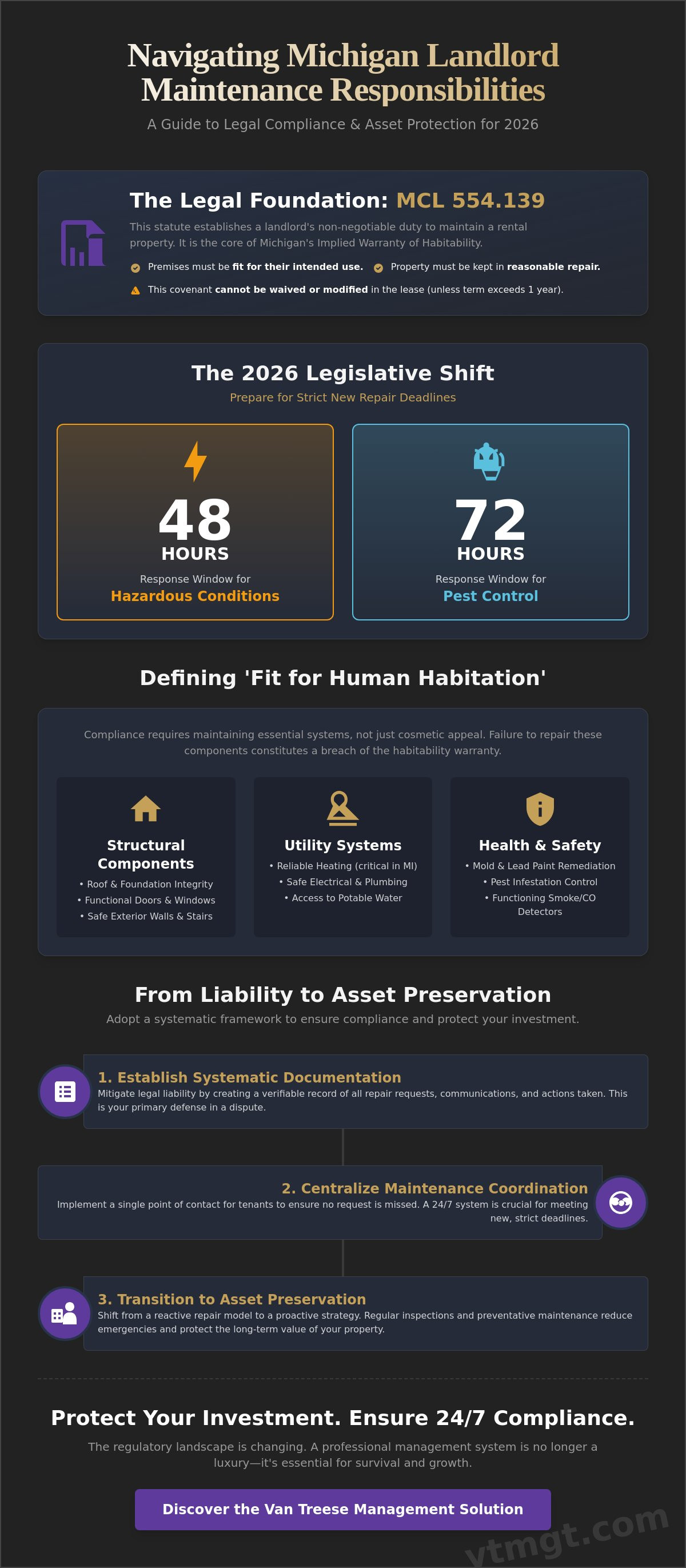
The regulatory environment governing landlord maintenance responsibilities Michigan is currently undergoing a structural shift. The introduction of the "Tenant Empowerment Package," specifically Senate Bills 19 and 20, signals a move away from vague "reasonable repair" timelines toward a high-precision, deadline-driven framework. Under these standards, the required response time is dictated by the severity of the maintenance failure. Life-threatening hazards or issues imminently hazardous to a tenant's health require remediation within a 48-hour window. This includes catastrophic failures such as gas leaks, structural instability, or a complete loss of primary heating during winter months.
Secondary critical issues, including mold remediation and pest infestations, fall under a 72-hour repair deadline. General maintenance tasks that don't compromise immediate safety typically remain within a 30-day window. In this accelerated environment, the burden of proof rests on the property owner. You must maintain timestamped logs to demonstrate a "reasonable effort" to secure parts or labor if external factors delay a repair. The State Bar of Michigan provides resources regarding property maintenance and repairs that detail the legal expectations for these interactions and how they influence the landlord-tenant relationship.
Tenant Remedies for Maintenance Failures
When a landlord fails to meet these statutory deadlines, Michigan law provides tenants with specific legal remedies. One of the most common is the "repair and deduct" mechanism, where a tenant pays for a repair out of pocket and subtracts that cost from their monthly rent. While this is legally permitted under certain conditions, it often leads to disputes over the quality of work or the necessity of the expense. Additionally, tenants may utilize rent escrow, where payments are directed to a court-held account until repairs are verified. Failing to address core habitability issues can even be classified as "constructive eviction," creating significant legal and financial exposure for the owner.
Compliance Pressure and Risk Mitigation
In a high-speed regulatory climate, manual maintenance tracking is no longer a viable strategy for professional owners. The risk of missing a 48-hour deadline is too high to manage via spreadsheets or paper logs. Implementing a digital maintenance coordination system is essential for maintaining timestamped communication and vendor dispatch logs. This level of administrative precision is a hallmark of professional commercial property management, and it's now a requirement for residential portfolios as well. By adopting these industrial-grade standards, you ensure that every repair request is handled within legal parameters, effectively mitigating the risk of litigation or municipal penalties.
From Liability to Asset Preservation: Building a Maintenance System
Transitioning from a reactive repair model to a structured asset preservation system is the technical standard for professional property operations in 2026. In Northern Michigan, where environmental stressors are constant, treating maintenance as an ad-hoc activity creates significant financial and legal exposure. Efficiently managing landlord maintenance responsibilities Michigan requires a disciplined framework that prioritizes the building's core systems before they reach a state of failure. By implementing a systematized approach, owners move beyond mere compliance and begin protecting the long-term structural integrity of their real estate assets.
A central component of this system is a seasonal maintenance calendar tailored to the regional climate. This includes specific protocols for:
- Winterization: Verifying HVAC efficiency, sealing building envelopes, and insulating exposed plumbing before the first deep freeze.
- Spring Runoff Management: Inspecting gutters, downspouts, and site drainage to prevent basement water intrusion during the thaw.
- Summer Prep: Servicing cooling systems and inspecting exterior paint or siding for UV damage and moisture penetration.
Execution of this calendar depends on a vetted local vendor network. Professional management requires verifying that every contractor carries up-to-date liability insurance and workers' compensation coverage. This vetting process ensures that technical work meets local building codes in Traverse City and Petoskey while shielding the property owner from third-party litigation. Standardized maintenance coordination ensures these vendors are dispatched according to a rigorous schedule, maintaining a high-precision operational flow.
The ROI of Preventative Maintenance
Consistent upkeep is a primary driver of property valuation and long-term profitability. Well-maintained systems reduce tenant turnover by providing a reliable living environment, which directly impacts the property's capitalization rate. When it's time for refinancing or an asset sale, a documented history of preventative care provides tangible proof of the building's condition. Implementing a standardized maintenance coordination system protects an owner’s fiduciary interests by optimizing repair expenditures and extending the lifecycle of expensive mechanical equipment.
Standardizing the Inspection Process
Regular inspections serve as the data collection layer of an asset preservation system. Move-in and move-out inspections provide the objective foundation for security deposit itemization, reducing disputes through clear documentation. Beyond these transitions, annual "health checks" for HVAC, roofing, and plumbing systems allow for the identification of minor issues before they escalate into major capital expenses. Leveraging cloud-based reporting technology ensures that every inspection is timestamped and stored securely, providing a transparent audit trail for both legal compliance and financial reporting.
Maintenance Coordination: The Van Treese Management Solution
Van Treese Management provides the technical infrastructure necessary to execute landlord maintenance responsibilities Michigan with industrial-grade precision. Our approach replaces the traditional, fragmented repair model with a centralized coordination system designed to meet strict regulatory deadlines. By integrating a 24/7 emergency response framework, we ensure that critical 48-hour and 72-hour windows are consistently met. This operational reliability is supported by our vetted vendor network, which leverages specialized local expertise to provide high-quality workmanship and volume-based pricing advantages for our clients.
Transparency is maintained through a dedicated cloud-based owner portal, providing real-time data on every repair request and maintenance lifecycle. This level of visibility is essential for those investing in rental property Northern Michigan, as it aligns daily operational execution with long-term capital appreciation goals. We don't just resolve immediate failures; we manage assets through a structured workflow that prioritizes both tenant safety and owner profitability. Every interaction is documented, creating an immutable audit trail that serves as your primary defense against liability.
Precision Maintenance Coordination
Our standardized systems eliminate the administrative burden and psychological stress associated with midnight emergency calls. For property owners in Petoskey and Boyne City, this means access to institutional-grade vendor management that was previously reserved for large-scale commercial portfolios. We ensure continuous legal compliance with evolving Michigan statutes by maintaining rigorous oversight of all mechanical and structural repairs. This disciplined coordination ensures that landlord maintenance responsibilities Michigan are handled without operational gaps or communication delays.
Protecting Your Legacy in Northern Michigan
Long-term stability in the real estate sector requires a synergy between innovative technology and professional human expertise. The Van Treese commitment to asset preservation ensures that your property remains a thriving part of the Northern Michigan community for decades. We treat every structure as a complex system that requires disciplined, professional oversight to reach its full economic potential and maintain its structural integrity against regional environmental stressors. Our goal is to provide a stable, predictable management environment that fosters growth and reduces risk.
Ready to secure your investment with a high-precision maintenance system? Schedule a professional maintenance audit with Van Treese Management today.
Securing Your Investment Through Operational Precision
The landscape of landlord maintenance responsibilities Michigan has evolved into a technical environment where reactive management is no longer sustainable. Compliance with MCL 554.139 and the strict repair deadlines of 2026 requires a disciplined, system-oriented approach to property oversight. By transitioning to a preventative model, you protect the structural integrity of your assets while mitigating the legal risks associated with modern habitability standards. Professional oversight ensures that your real estate portfolio remains resilient against both environmental stressors and regulatory shifts.
Van Treese Management offers the structural support needed to handle these complexities with precision. Our 24/7 Emergency Maintenance Coordination and Vetted Local Vendor Network provide the stability required for long-term asset preservation. We leverage specialized expertise in Northern Michigan compliance to ensure your operations meet the highest industrial standards. Don't leave your compliance to chance in an increasingly regulated market.
Request a Free Maintenance & Compliance Review from Van Treese Management to verify your current systems meet the 2026 legal benchmarks. Securing your investment today ensures a stable and profitable legacy for the future.
Frequently Asked Questions
What is the 'implied warranty of habitability' in Michigan?
The implied warranty of habitability is a mandatory legal doctrine requiring landlords to maintain properties in a condition fit for human occupation. Under MCL 554.139, this obligation includes ensuring structural integrity and functioning essential utilities. These landlord maintenance responsibilities Michigan are non-negotiable and cannot be waived in a standard residential lease. Compliance ensures the property meets all local health and safety codes throughout the tenancy.
How long does a landlord have to fix a furnace in Michigan?
Landlords must address a failed furnace within 48 hours if the lack of heat creates a hazardous condition. While current statutes require "reasonable" speed, the 2026 regulatory environment under SB 19 and 20 establishes a strict 48-hour window for life-threatening issues. In Northern Michigan, a lack of heat during winter months is classified as a critical emergency. Owners should maintain a vetted vendor network to ensure an immediate mechanical response.
Can a tenant withhold rent for repairs in Michigan?
Tenants in Michigan generally don't have the right to simply stop paying rent; however, they may utilize rent escrow or the "repair and deduct" method. If a landlord fails to perform essential maintenance, a tenant might pay for the repair and subtract the cost from the rent. This process requires strict adherence to notice requirements and documentation. We recommend owners use professional coordination to avoid these disputes and maintain consistent cash flow.
Are Michigan landlords responsible for pest control?
Landlords are responsible for remediating pest infestations that compromise the habitability of the property. Under the proposed Tenant Empowerment Package, owners must address issues like bed bugs or other pests within a 72-hour timeframe. While tenants are responsible for maintaining cleanliness, the structural remediation of an infestation falls under the landlord's statutory duty to keep the premises in reasonable repair and fit for its intended use.
What happens if a landlord ignores a repair request in Michigan?
If a landlord ignores a legitimate repair request, they face significant legal exposure, including lawsuits for damages or rent abatement. Tenants may claim "constructive eviction" if the property becomes uninhabitable, allowing them to terminate the lease without penalty. To mitigate this risk, professional managers implement timestamped tracking systems. These logs provide a defensive audit trail that proves the owner made a reasonable effort to comply with state deadlines.
Is snow removal a landlord's responsibility in Northern Michigan?
Landlords are typically responsible for snow removal in common areas, parking lots, and shared walkways of multi-unit properties. In Northern Michigan, this is a critical safety obligation to prevent slip-and-fall liability and ensure emergency access. For single-family rentals, the responsibility depends on the specific terms of the lease agreement. Regardless of the property type, owners must ensure that egress points remain clear to satisfy municipal safety codes.
What are the new repair deadlines under Michigan Senate Bills 19 and 20?
Proposed Senate Bills 19 and 20 introduce specific, tiered deadlines for property repairs. Life-threatening or imminently hazardous conditions require a response within 48 hours. Mold remediation and pest control issues must be addressed within 72 hours. All other non-emergency repairs have a 7-day compliance window. These changes represent a significant shift toward a high-precision regulatory environment that requires standardized maintenance coordination to ensure full legal compliance.
Does a landlord have to provide a refrigerator in Michigan?
Michigan state law does not mandate that a landlord provide a refrigerator in a rental unit. However, if a refrigerator is included in the lease agreement or provided at the start of the tenancy, the landlord is legally obligated to maintain it. Under the "reasonable repair" standard, any appliance provided by the owner must remain functional. Professional management ensures these assets are serviced regularly to prevent critical failures and maintain tenant satisfaction.