
DIY Landlord vs Property Manager Cost in Traverse City: 2026 Cost-Benefit Analysis

For many Northern Michigan investors, the decision to manage a rental property personally is driven by a desire to protect profit margins, yet this choice often functions as a hidden tax on your time and capital. It's understandable that you want to retain every dollar of rental income, especially as Traverse City rents have surged by over 9 percent in the last year. You likely believe that handling your own maintenance and tenant screening is the only way to ensure the work meets your specific standards.
However, a precise calculation of the DIY landlord vs property manager cost in Traverse City reveals that amateur management frequently leads to higher vacancy rates and expensive legal oversights. This article will show you how professional oversight secures your return on investment by mitigating the risks of Michigan's strict landlord-tenant regulations and high turnover expenses. We will provide a structured breakdown of the financial differences between DIY efforts and professional management systems, focusing on maintenance efficiency, legal compliance, and long-term asset valuation.
Key Takeaways
- Learn why the true DIY landlord vs property manager cost Traverse City comparison must include vacancy losses and marketing expenses rather than just monthly fees.
- Discover how professional tenant placement and rigorous screening processes significantly reduce the risk of long-term vacancies that erode annual profit margins.
- Calculate your personal "landlord hourly rate" to determine if managing maintenance calls and contractor schedules is a productive use of your professional time.
- Protect your investment from legal liabilities by understanding the 2026 updates to Michigan security deposit and eviction regulations that impact DIY owners.
- See how structured management systems and volume-based maintenance networks turn property ownership into a scalable, passive income stream.
The Hidden Math of DIY Landlording in Traverse City
DIY property management is frequently perceived as a simple administrative task focused on rent collection. In reality, it's a complex operational role requiring expertise in asset preservation, legal compliance, and technical maintenance. When evaluating the DIY landlord vs property manager cost Traverse City, many owners focus solely on the management fee, which typically ranges from 8 to 12 percent of collected rent. This narrow metric fails to account for the total investment health of the property. Selecting a professional property management company introduces a systematic approach to operations that minimizes the performance gap between amateur and institutional-grade assets. This gap is most visible in how quickly a unit is turned over and how effectively maintenance issues are triaged before they become structural failures.
The Baseline: Traverse City Rental Market in 2026
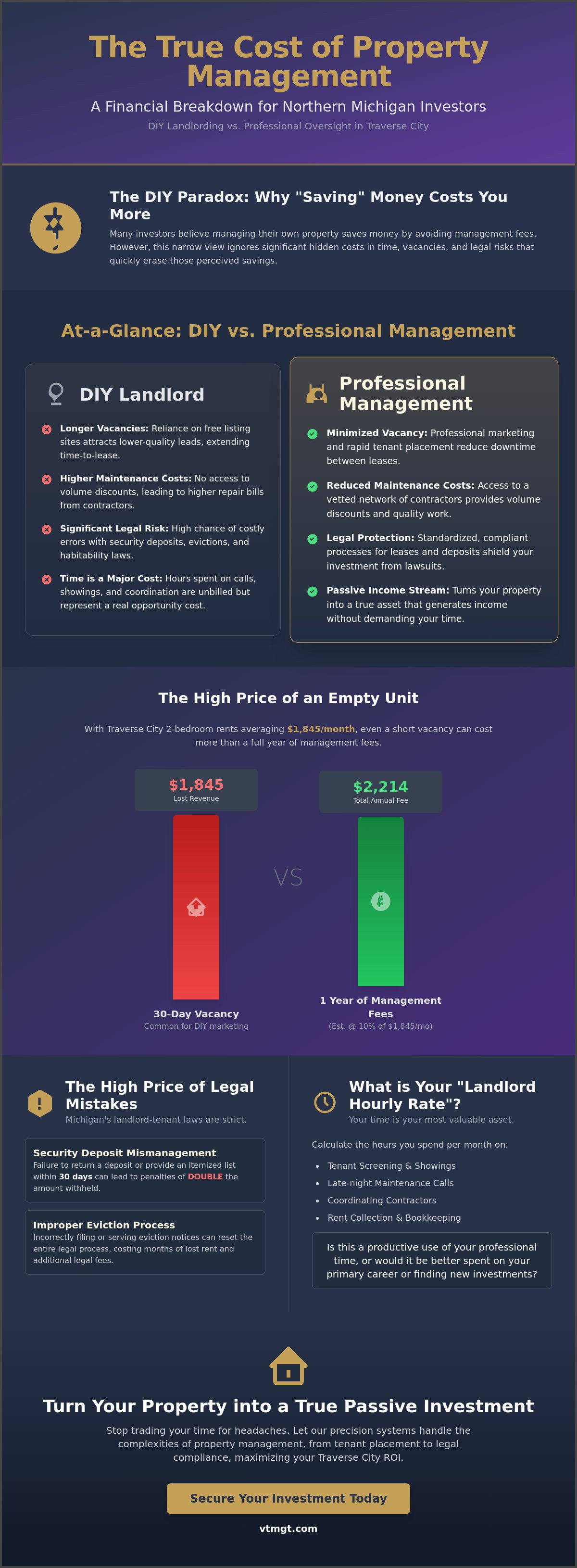
The rental environment in Grand Traverse County has become increasingly technical. As of June 2026, the median rent in Traverse City increased by 9.2 percent year-over-year. A one-bedroom apartment now averages between $1,425 and $1,540 per month, while two-bedroom units reach up to $1,845. These high valuations mean that even a brief period of vacancy results in a significant loss of liquidity. The "set it and forget it" mentality is no longer viable in Northern Michigan due to rising tenant expectations and a tighter regulatory framework. Owners must now operate with the precision of a business to maintain these high yields and protect their long-term property valuation.
The DIY Paradox: Why Free Labor Isn’t Free
Self-management creates a "shadow cost" that rarely appears on a balance sheet. DIY landlords often underprice their own time, ignoring the hours spent coordinating maintenance or screening applicants. Amateur tenant screening is particularly dangerous; a single bad placement can lead to months of non-payment or property damage. Michigan law requires landlords to return security deposits or provide itemized deductions within 30 days of move-out. Mistakes here can lead to lawsuits for double the amount withheld. When you factor in the stress of middle-of-the-night maintenance calls and the difficulty of finding reliable Traverse City contractors, the "saved" management fee quickly evaporates. Professional management leverages established vendor networks and standardized lease agreements to ensure the property functions as a stable investment rather than a demanding second job.
Hard Costs Comparison: DIY vs. Professional Management
A rigorous financial analysis of the DIY landlord vs property manager cost Traverse City must extend beyond the obvious monthly management fee. While professional fees generally align with the industry standard of 8 to 12 percent of collected rent, the total cost of ownership for a DIY landlord often exceeds this due to inefficient operational processes. Direct expenses for self-managed properties include premium listing subscriptions, credit screening fees, and administrative software, which lack the economies of scale available to a professional firm. The most significant financial drain, however, is the indirect cost of extended vacancy. With a two-bedroom apartment in Traverse City averaging $1,845 as of June 2026, every 30 days a unit remains empty represents a total loss of that revenue, a sum that frequently outweighs an entire year's worth of management fees.
Legal compliance represents another critical cost center. Michigan has precise statutes regarding security deposits and habitability. Failure to adhere to the Michigan landlord-tenant law can result in penalties that far exceed the cost of professional oversight. For instance, mismanaging a security deposit return beyond the 30-day window can lead to a judgment of double the amount withheld. To mitigate these risks, owners should review our comprehensive guide on Michigan landlord laws to understand the structural requirements of compliant leasing.
Marketing and Tenant Placement Expenses
Effective property marketing requires high-fidelity photography and broad listing syndication to reach qualified applicants quickly. DIY landlords often rely on free platforms that attract lower-tier leads, increasing the time-to-lease. Professional placement services include rigorous background checks and income verification, utilizing data sets that are often unavailable to individual owners. These systems ensure that the lease agreement is prepared with technical precision, protecting the owner's interests from the start of the tenancy.
Maintenance and Vendor Management
The cost of rental property maintenance in Northern Michigan is subject to seasonal volatility and contractor availability. Professional managers maintain vetted vendor networks that offer volume-based pricing and prioritized scheduling. In contrast, DIY landlords often pay "emergency" rates to contractors found through generic searches. This price delta is especially pronounced during the winter months when HVAC or plumbing failures require immediate response. A professional maintenance coordination system eliminates these markups and ensures repairs are completed according to established quality standards, ultimately preserving the property's capital value.
The "Landlord Hourly Rate": Calculating Your Opportunity Cost
Quantifying the DIY landlord vs property manager cost Traverse City requires a shift from simple expense tracking to a comprehensive evaluation of labor hours. Many property owners view their involvement as "free" labor, yet this perspective ignores the technical reality of operational efficiency. Managing a single unit effectively often consumes between 10 and 15 hours per month when accounting for maintenance coordination, financial reporting, and tenant communication. To find your true "Landlord Hourly Rate," subtract your monthly operating expenses from your gross rent, then divide that figure by the hours you actually worked. For a professional in Traverse City, this rate often falls significantly below their primary career's value, suggesting that self-management is a high-cost allocation of specialized time.
This misallocation of resources frequently leads to what we identify as operational fatigue. Industry data indicates that a high percentage of DIY landlords exit the market within three years due to the cumulative stress of property management. This "Burnout Factor" isn't merely emotional; it's a structural failure of the DIY model. When an owner reaches their capacity for manual labor, the quality of property oversight diminishes, leading to the very vacancies and maintenance delays we discussed in previous sections. Transitioning to professional systems allows you to redeploy your saved time toward investing in more Northern Michigan property, shifting your role from a technician to a high-level asset manager.
The Time-Intensive Reality of Tenant Relations
Tenant relations involve more than occasional rent collection. It requires a disciplined approach to showing properties, conducting rigorous background checks, and resolving disputes with technical precision. DIY owners often struggle with the psychological burden of being the final decision-maker in sensitive disputes. Without the buffer of a professional firm, these interactions become emotional rather than transactional. Adhering to the strict guidelines of Michigan's Landlord and Tenant Relationships Act requires constant vigilance. Standardized communication protocols eliminate the friction of late rent and lease violations, ensuring that all interactions remain within legal and professional boundaries.
Scaling Your Portfolio in Traverse City
Self-management acts as a physical ceiling for your investment growth. An individual can only manage a limited number of units before the operational complexity exceeds their available time. If your goal is to scale from a single unit in Traverse City to a diverse portfolio across Grand Rapids or other Michigan markets, DIY management is a bottleneck. Professional management provides the infrastructure necessary for geographic expansion. By utilizing our standardized management systems, you gain the ability to oversee multiple assets with minimal personal time investment, turning property ownership into a scalable and predictable financial instrument.
Risk Mitigation: The High Price of Legal Mistakes in Michigan
The financial framework of the DIY landlord vs property manager cost Traverse City debate often overlooks the catastrophic impact of legal non-compliance. In 2026, the regulatory environment for Michigan rental properties has become more stringent, requiring owners to operate with absolute procedural precision. A single administrative error in an eviction filing or a security deposit dispute can result in thousands of dollars in legal fees and months of lost revenue. While a DIY landlord might save on monthly fees, they remain personally liable for every operational decision. Professional management functions as a structural buffer, utilizing standardized systems to ensure that every lease agreement and tenant interaction adheres to current state and federal statutes.
Security Deposits and Move-Out Inspections
Michigan law dictates a rigid 30-day window for returning security deposits or providing an itemized list of deductions. Failing to meet this deadline or providing insufficient documentation can lead to a court judgment of double the amount withheld. DIY landlords frequently lack the technical documentation required to defend these deductions in a "he-said, she-said" court environment. We utilize high-fidelity move-in and move-out reports that serve as financial insurance for the owner. These standardized checklists and photographic evidence create a clear audit trail, neutralizing potential disputes before they escalate into expensive litigation.
Fair Housing and Discrimination Risks
Modern tenant screening must be entirely data-driven to avoid the significant liabilities of the Fair Housing Act. Relying on a "gut feeling" during the application process is a major liability that can lead to discrimination lawsuits. A single violation can result in civil penalties and legal settlements that far outweigh years of professional management costs. Our Residential Property Management systems utilize objective, consistent criteria for every applicant, ensuring that your screening process is both effective and legally defensible. This disciplined approach protects your asset from the volatility of human error and emotional decision-making.
The cost of a botched eviction is another critical factor. For non-payment of rent, Michigan requires a specific 7-day "Notice to Quit" before proceeding with legal action. An amateur landlord who misses a single step in this sequence must often restart the entire process, granting the non-paying tenant additional weeks of occupancy. Professional legal coordination ensures that these notices are served with technical accuracy, minimizing the time your property remains non-performing. By integrating these risk mitigation strategies, we turn a high-risk liability into a stable, compliant investment vehicle.
Van Treese Management: Precision Systems for Traverse City ROI
The analysis provided in the previous sections confirms that self-management is often a high-risk trade of professional precision for amateur labor. Van Treese Management addresses this inefficiency through our Standardized Management System, which replaces the chaos of DIY oversight with a predictable, data-driven framework for ROI. When considering the DIY landlord vs property manager cost Traverse City, the primary advantage of our approach is the elimination of operational variance. We treat each rental property as a technical asset that requires specific inputs to generate maximum yield. By integrating our systems, owners move away from reactive troubleshooting and toward proactive wealth preservation.
Our maintenance coordination utilizes a vetted network of contractors who understand the technical requirements of Northern Michigan properties. Because we manage a high volume of units, we secure priority scheduling and competitive pricing that individual landlords simply can't access. These savings are passed directly to our owners, further reducing the total cost of ownership. We provide 24/7 local oversight, serving as the primary point of contact for all tenant and maintenance issues. This allows you to reclaim your time while ensuring that your property is managed with the same level of care and precision that you'd apply yourself.
Standardization as a Wealth-Building Tool
Individual effort is inherently limited by time and specialized knowledge. Our systems outperform DIY management because they're built on repeatable processes that don't rely on a single person's availability. Whether your property is in Petoskey or downtown Traverse City, our local expertise ensures that all regional regulations and market trends are factored into your management plan. We provide transparent financial reporting and accounting, giving you a clear view of your investment's performance at any time. This level of visibility is essential for investors who want to scale their portfolios without increasing their personal workload.
Get Started with a Professional Rental Analysis
Determining the optimal rent for your property requires more than a cursory glance at local listings. We conduct deep market research to ensure your Traverse City rent is always optimized for current demand and local economic conditions. If you're currently self-managing, the transition to VTM is a structured process designed to minimize disruption for your tenants while immediately implementing our professional standards. We handle the technical details of lease preparation and tenant placement, ensuring your asset is protected from day one. It's time to stop treating your investment like a second job and start treating it like a professional asset. Request your Traverse City rental analysis today and discover the impact of precision management on your Northern Michigan ROI.
Optimizing Your Northern Michigan Real Estate Strategy
Choosing between self-management and professional oversight is a critical pivot point for any serious investor. As we've analyzed, the DIY landlord vs property manager cost Traverse City is not merely a matter of monthly fees; it's a trade-off between amateur labor and institutional precision. By shifting from manual property tasks to a structured management model, you eliminate the operational variance that leads to extended vacancies and legal liabilities. This transition allows you to focus on high-level portfolio growth while ensuring your current assets are maintained to professional standards.
Since 2018, we've refined our standardized management systems to protect both residential and commercial assets throughout Northern Michigan. We provide 24/7 local emergency response and technical maintenance coordination to ensure your investment remains secure regardless of the season. You can transform your Traverse City rental into a passive asset with Van Treese Management today. Moving toward a professional management framework isn't just about reducing stress; it's about building a scalable foundation for long-term wealth in Grand Traverse County.
Frequently Asked Questions
Is property management worth the 10% fee in Traverse City?
Professional management is generally worth the investment because the fee is typically offset by lower vacancy rates and more efficient maintenance coordination. In a market where Traverse City rents have increased by 9.2 percent year over year, the cost of a single month of vacancy far exceeds the annual management fee. Professional systems ensure your property remains at peak market value while mitigating the risks of expensive legal errors.
How much does the average DIY landlord lose in vacancy per year?
A single month of vacancy represents a loss of approximately 8.3 percent of your annual gross revenue. In Traverse City, where a two-bedroom apartment averages around $1,845 per month as of June 2026, losing 30 days of rent is a significant financial hit. Professional managers utilize broad listing syndication and data-driven tenant placement to reduce this downtime, often filling units weeks faster than an individual owner could.
What are the most common legal mistakes DIY landlords make in Michigan?
The most frequent errors involve mishandling security deposits and failing to follow strict eviction timelines. Michigan law requires landlords to return deposits or provide itemized deduction lists within 30 days of move-out. Additionally, for non-payment of rent, owners must serve a specific 7-day "Notice to Quit." Mistakes in these technical processes can lead to lawsuits for double the security deposit amount or the requirement to restart the eviction process from the beginning.
Can I still choose my own tenants if I hire a property manager?
Owners can remain involved in the selection process, but professional managers provide a critical layer of data-driven screening to ensure Fair Housing Act compliance. When evaluating the DIY landlord vs property manager cost Traverse City, it's important to recognize that professional screening uses objective criteria like credit history and verified income. This systematic approach protects you from discrimination claims that often arise from "gut feeling" selections made by individual landlords.
How does professional management affect my property’s resale value?
Professional management preserves and often increases resale value by maintaining a clear audit trail of all repairs and financial performance. Prospective buyers, especially institutional investors, value properties with documented maintenance histories and stable rent rolls. A well-maintained asset with institutional-grade reporting is viewed as a lower-risk investment, which can lead to a higher valuation when you decide to exit the market.
What happens if a tenant doesn’t pay rent under professional management?
The management team initiates a standardized legal process immediately following a missed payment deadline. This begins with the required 7-day notice and continues through legal coordination if the tenant fails to cure the debt. Because these systems are already in place, the timeframe for recovering the unit is minimized. This professional buffer also removes the emotional friction that often delays DIY landlords from taking necessary legal action.
Do property managers in Traverse City handle seasonal snow removal and lawn care?
Yes, maintenance coordination is a core component of professional management in Northern Michigan. We leverage a vetted network of contractors to handle seasonal requirements like snow plowing and landscaping. Because we manage a high volume of properties, our owners often benefit from prioritized scheduling and competitive rates that aren't available to individual landlords during the peak winter months.
How do management fees differ between residential and commercial properties in Northern Michigan?
Residential fees are typically a percentage of the monthly rent, while commercial management involves different structures based on the lease type, such as Triple Net (NNN) or Gross leases. Commercial assets often require more technical oversight regarding common area maintenance and long-term capital improvement planning. Regardless of the property type, our focus remains on operational precision and ensuring that every asset generates a predictable return on investment.