
Beyond the DIY Landlord: 5 Alternatives to Self-Managing Rental Property in 2026

What if the 24/7 availability required by your rental property isn't a badge of honor, but a structural failure in your investment strategy? For many property owners, the reality of DIY management has shifted from a cost-saving measure to a source of significant legal anxiety and operational fatigue. With tenant turnover costs now exceeding $2,000 for nearly 60% of landlords, exploring alternatives to self-managing rental property is no longer just a luxury. You likely entered real estate to build a stable foundation for your future, not to spend your weekends vetting contractors or navigating the complexities of Michigan landlord-tenant laws.
In this guide, you'll learn how to reclaim your time and protect your assets by implementing professional management systems that prioritize precision and legal compliance. We'll analyze five distinct models, ranging from specialized maintenance coordination to full-service oversight, that ensure your property value is preserved without the personal burnout. By shifting from an exhausted operator to a disciplined investor, you can secure passive income while maintaining full control over your portfolio's performance. Our objective is to provide a structured framework that allows you to scale your investments with confidence and technical accuracy.
Key Takeaways
- Identify the hidden financial and legal liabilities that often convert a passive investment into an exhausting operational burden.
- Compare various alternatives to self-managing rental property, including hybrid models that integrate digital tools with manual oversight.
- Evaluate the advantages of professional maintenance coordination, which provides access to vetted contractors and standardized quality assurance.
- Understand the role of rigorous tenant screening and lease preparation in protecting your long-term property value.
- Learn how a structured transition to professional management can eliminate day-to-day headaches while ensuring full regulatory compliance.
Why Landlords Seek Alternatives to Self-Managing Rental Property
The decision to move away from DIY management is often driven by the realization that saving a monthly percentage is a false economy. Professional investors recognize that their primary role is asset management, not technical execution. Operating as a lone landlord creates a single point of failure; if you're unavailable or unaware of a legislative update, the entire investment is at risk. Seeking alternatives to self-managing rental property is a strategic pivot toward institutional-grade stability and risk mitigation.
Firms like TBM Property Management specialize in providing this institutional-grade stability, allowing investors to move away from the "lone landlord" model and toward a more resilient, systems-based approach.
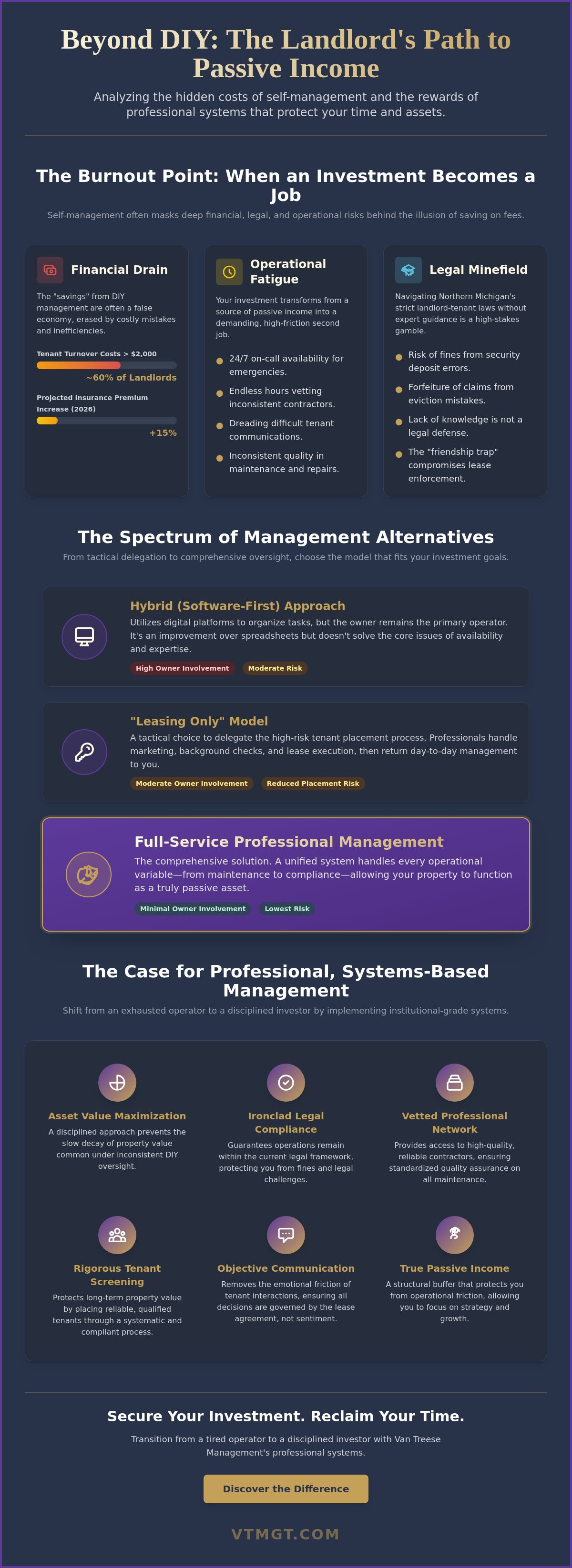
The burnout point typically arrives when the friction of daily operations begins to erode your long-term strategy. When maintenance requests are handled with inconsistent quality or tenant communication becomes a source of dread, the investment has transitioned from passive income to a demanding second job. Professional property management provides the structural buffer necessary to protect the owner from high-frequency operational friction. In 2026, landlords must also navigate a 15% average increase in insurance premiums, which requires optimized efficiency just to maintain current profit margins.
Shifting your mindset from saving fees to maximizing asset value is essential for growth. A professional system ensures that every component of the property, from the HVAC system to the lease agreement, is treated as a critical part of a larger machine. This disciplined approach prevents the slow decay of property value that often occurs under the inconsistent oversight of a tired DIY owner. Precision in management isn't just about convenience; it's about the long-term viability of your capital.
The Emotional Toll of Tenant Interaction
Maintaining professional distance is vital for objective decision-making. The friendship trap occurs when personal rapport with a tenant compromises the enforcement of lease terms. This often results in delayed rent increases or the overlooking of property damage, leading to significant financial loss. Third-party alternatives remove this emotional friction. They ensure that every interaction, from late payment notices to lease violations, is governed by the contract rather than personal sentiment. This clarity benefits both the owner and the tenant.
The Legal Minefield in Northern Michigan
The regulatory environment in 2026 is increasingly precise and unforgiving. Recent updates to Michigan landlord laws have introduced stricter protocols for security deposit handling and eviction procedures. Small administrative errors in Northern Michigan can now result in substantial fines or the forfeiture of legal claims. A self-managing owner often lacks the technical infrastructure to track these changes in real-time. In the eyes of the court, a lack of specialized knowledge isn't a valid defense against non-compliance. Professional systems guarantee that your operations remain within the current legal framework.
Exploring the Spectrum: 4 Key Alternatives to DIY Management
Self-management isn't a binary choice; it's a spectrum of operational involvement. Selecting the right alternatives to self-managing rental property depends on your portfolio's complexity and your personal capacity for technical oversight. Some owners prefer a fragmented approach, delegating specific tasks, while others seek a unified system that handles everything from tenant screening to financial reporting. Navigating these options requires a clear understanding of the burnout point where an investment's demands exceed its returns.
The "Leasing Only" model serves as a tactical alternative for those who prefer to handle ongoing maintenance but want to avoid the legal risks of tenant placement. In this scenario, professionals manage the marketing, background checks, and lease execution before handing the day-to-day operations back to the owner. Conversely, full-service professional management, such as the systems implemented by Van Treese Management, provides a comprehensive framework that handles every operational variable. This model removes the owner from the operational loop entirely, allowing the property to function as a truly passive asset.
The Software-First (Hybrid) Approach
Digital management platforms offer a significant improvement over manual spreadsheets. These tools provide a centralized database for lease documents, automated rent collection, and organized payment histories. While software lowers the cost compared to full-service management, it's merely a tool rather than a comprehensive solution. It lacks the human judgment required for complex tenant disputes or physical on-site inspections. It's most effective for local owners with high technical literacy who are comfortable remaining the primary point of contact for emergencies.
Individual Contractor Networks
Building a team of plumbers, electricians, and cleaners is a common strategy for delegating physical labor. However, rental property maintenance in Northern Michigan presents unique seasonal challenges. During peak summer or winter months, vetted contractors are often at full capacity, and the average handyman rate has reached approximately $65 per hour. Managing multiple independent vendors often becomes as time-consuming as managing the tenants themselves. Without a centralized coordination system, quality control remains inconsistent and expensive. Transitioning to a structured system for maintenance coordination ensures that your property receives high-quality repairs without the administrative burden of vendor management.
Evaluating the 'Maintenance Coordination' Alternative
Professional maintenance coordination represents a shift from reactive repairs to a structured asset preservation strategy. It's a foundational alternative to self-managing rental property that addresses the physical integrity of the investment through disciplined technical oversight. Unlike the DIY approach, where an owner might struggle to find an available plumber during a holiday weekend, professional coordination utilizes a dedicated workflow to ensure every repair is executed to code and within budget. This system functions as an engineering protocol for your real estate, ensuring that components are serviced before they reach a point of catastrophic failure.
A vetted vendor network is the backbone of this model. By consolidating maintenance volume, professional coordinators secure reliable service from contractors who prioritize these accounts over one-off residential calls. This eliminates the "landlord markup" often applied to inexperienced owners and ensures quality assurance through standardized inspection criteria. With data showing that 54.97% of landlords faced a single repair exceeding $2,000 in the past year, having a technical partner to verify the necessity and quality of such work is essential for protecting your ROI.
Seasonal Challenges in Petoskey and Beyond
In Northern Michigan, the technical requirements for property upkeep are dictated by the environment. Winterization and snow removal aren't merely chores; they're critical preventative measures to avoid burst pipes and structural damage from ice damming. Professional maintenance systems in Petoskey implement rigid seasonal schedules that national software platforms cannot replicate. Spring inspections are equally vital, focusing on the exterior envelope and drainage systems to identify small issues before they escalate into the expensive turnovers that cost 59.64% of landlords more than $2,000 per instance.
Cost Control and Transparency
Effective maintenance coordination provides a level of financial reporting that DIY owners often lack. By utilizing standardized billing and repair protocols, every dollar spent on the property is accounted for and categorized for tax purposes. This transparency allows owners to budget accurately using industry benchmarks, such as the 1% annual maintenance rule for properties aged 10-20 years or allocating 10-15% of gross rent for upkeep. These systems ensure that the average handyman rate of $65 per hour is utilized efficiently, focusing on tasks that directly preserve or improve the property's long-term market value.
The Case for Professional Systems-Based Management
Professional systems-based management represents the most comprehensive of all alternatives to self-managing rental property. It transitions the property from a manual, high-friction operation to an automated, resilient asset. Standardized systems matter because they eliminate the variability of human emotion and memory. When every operational step, from move-in inspections to emergency maintenance, is documented and repeatable, the results become predictable. This structural approach is particularly critical in 2026, where the margin for error in property oversight has narrowed due to rising insurance costs and more complex regulatory requirements.
Professional managers maintain a clear distinction between tenant placement and long-term management. Placement is a technical acquisition process involving strategic marketing and rigorous vetting. Management, however, is the continuous oversight of the lease agreement and the physical asset's integrity. By implementing these high-level structures, we mitigate the risk of "worst-case" scenarios. Evictions or significant property damage are handled with disciplined protocols that prioritize the owner's legal and financial standing. This level of oversight ensures that the investment remains a source of stability rather than a liability.
Tenant Screening and Placement Systems
Rigorous screening goes beyond a basic credit score check. It involves a multi-layered verification process including employment history, previous landlord references, and comprehensive criminal background checks. This structured approach significantly reduces the probability of late payments or property neglect. Professional marketing strategies ensure that properties are visible to high-quality applicants, minimizing the expensive vacancy periods that erode annual returns. A professionally drafted lease agreement provides the final layer of legal insulation, ensuring all Michigan-specific requirements are met without exception.
Standardized Financial Oversight
Financial transparency is a hallmark of professional management. Automated rent collection ensures consistency in cash flow and allows for the immediate, objective enforcement of late fees. Owners receive detailed monthly statements that provide a clear view of the property's performance, along with year-end 1099 reporting that simplifies the tax preparation process. These systems allow for the optimization of cash flow through expert investing in rental property strategies tailored to the Northern Michigan market. If you're looking to transition your portfolio to a more resilient framework, consider the advantages of our Residential Property Management services.
How Van Treese Management Transforms the Landlord Experience
Van Treese Management operates as a strategic partner for investors, providing the technical infrastructure necessary to scale real estate portfolios with precision. Our mission is built on the intersection of technological innovation and meaningful human interaction, recognizing that thriving local communities are the byproduct of stable, well-managed housing environments. By selecting us among the alternatives to self-managing rental property, you aren't just offloading tasks; you're adopting a disciplined operational framework designed to maximize asset performance. We replace the reactive nature of DIY management with a proactive, systems-based approach that ensures long-term stability.
The transition from DIY management to our professional oversight is engineered to be seamless and professional. We handle the complex transfer of tenant records, security deposits, and maintenance histories, ensuring no loss of operational continuity. This structured process removes the emotional friction of the "handover" and replaces it with a rigorous onboarding sequence. Our clients choose our systems over the stress of self-management because they recognize that peace of mind is a measurable component of their total ROI. When the technical details are handled by experts, the owner is free to focus on high-level investment strategy.
A Local Approach with Professional Standards
Serving the Northern Michigan corridor, including Petoskey, Traverse City, and Grand Rapids, requires deep regional expertise. We conduct granular market research specifically for Emmet and Charlevoix counties to ensure property valuations are technically accurate and competitive. This personalized service allows us to set rent levels that reflect current regional demand, a level of precision that national firms often fail to replicate. Our commitment to professional standards ensures your property remains a high-performing asset within the local legal and economic landscape.
Getting Started with Van Treese
Our onboarding process is designed to be logical and transparent, following a three-step sequence to ensure full alignment with your investment goals:
- Step 1: Initial Consultation – We perform a comprehensive property audit and market analysis to identify specific optimization opportunities and establish a baseline for performance.
- Step 2: System Implementation – We integrate your asset into our standardized management framework, covering everything from professional accounting to maintenance coordination.
- Step 3: Passive Income Growth – With the operational burden removed and our systems in place, you can enjoy the benefits of truly passive real estate income while we manage the daily complexities.
Discover how our systems can protect your investment and transform your approach to rental property ownership in Northern Michigan.
Securing Your Investment Future in Northern Michigan
Transitioning your real estate portfolio from a manual operation to a structured asset requires a commitment to professional standards. We've explored how standardized systems mitigate the legal risks of 2026 regulations and how professional maintenance coordination prevents the slow decay of property value. By evaluating the most effective alternatives to self-managing rental property, you've taken the first step toward reclaiming your time and ensuring the technical integrity of your investment.
Van Treese Management has specialized in Emmet and Charlevoix Counties since 2018, providing the local expertise and disciplined oversight necessary for long-term success. Our standardized management systems offer the 24/7 peace of mind that comes from knowing every operational detail is under control. It's time to move beyond the friction of DIY landlordship and embrace a model that prioritizes asset preservation and predictable cash flow. Schedule Your Professional Property Consultation today to secure your investment's performance and long-term stability.
Frequently Asked Questions
Is hiring a property manager worth the cost compared to self-management?
Professional management is a strategic investment in asset preservation and risk mitigation. The value is found in the technical oversight that prevents expensive turnovers and legal liabilities, which often cost more than the management fees themselves. By ensuring maintenance is performed to code and tenant interactions follow strict legal protocols, professional systems protect the long-term ROI of the property in a way that inconsistent DIY management cannot.
What is the most common alternative to full-service property management?
Hybrid models are the most frequent alternatives to self-managing rental property for owners who aren't ready for full delegation. This approach utilizes specialized digital platforms for automated rent collection and financial reporting while the owner retains responsibility for physical maintenance and tenant disputes. It provides a higher level of organization than manual spreadsheets but still requires the owner to remain the primary operational point of contact for emergencies.
How do I transition from self-managing to a professional management firm?
The process begins with a comprehensive property audit and the formal transfer of all tenant documentation and security deposits. A professional firm establishes a technical baseline for the asset and implements standardized communication channels for existing tenants. This structured handover ensures operational continuity while immediately shifting the administrative and legal burdens away from the owner to a disciplined management framework.
Can I still be involved in major decisions if I hire a property manager?
Yes, professional management agreements are designed to keep the owner informed of high-level strategy and major capital expenditures. While the manager handles the daily technical execution, such as minor repairs and routine tenant inquiries, the owner is consulted on significant investments or structural changes. This balance allows for a passive investment experience while the owner maintains full control over the asset's long-term direction.
What are the legal risks of self-managing rental property in Michigan?
Michigan law is precise regarding security deposit timelines, eviction procedures, and habitability standards. Self-managing owners face significant financial liabilities if they fail to adhere to strict notice requirements or incorrectly process deposit returns. Administrative errors in these areas can lead to court-ordered fines or the forfeiture of legal claims, making professional compliance a vital component of modern property oversight.
How does professional management affect my property's vacancy rate?
Professional systems typically reduce vacancy rates through data-driven rental pricing and strategic marketing protocols. By utilizing professional listings and rigorous tenant placement systems, managers attract high-quality applicants more efficiently than most DIY owners. This disciplined approach minimizes the expensive downtime between leases and ensures the property remains occupied by qualified tenants who are more likely to renew.
What should I look for in a Northern Michigan property management company?
Prioritize a firm with deep technical expertise in regional maintenance and a proven track record in Emmet and Charlevoix Counties. A local partner must provide standardized financial reporting and have a vetted network of contractors capable of handling seasonal requirements like winterization and snow removal. Precision in local market analysis and a commitment to transparent, systems-based communication are essential for protecting Northern Michigan assets.