
Common Problems With Property Management Companies: A 2026 Landlord Guide

A property management failure is rarely an isolated incident; it's usually the predictable result of a low-margin business model that prioritizes reactive fixes over standardized processes. You might already suspect that your current oversight is lacking, especially when you encounter unresponsive communication or high tenant turnover rates that disrupt your cash flow. It's difficult to maintain a stable investment when you're constantly questioning the line items on your monthly statement. Identifying property management hidden fees Michigan agencies often bury in fine print is essential for any landlord who values precision and long-term stability.
We understand that your Northern Michigan real estate investment requires a disciplined, quality-centered approach to remain profitable in 2026. This guide will teach you how to identify systemic flaws and hidden surcharges that erode your equity, allowing you to protect your assets through more rigorous financial standards. We'll examine the structural causes of management friction, from maintenance markups to legal liability gaps. By the end of this analysis, you'll have a clear roadmap for achieving transparent financial reporting and a truly hands-off investment strategy that operates with engineering-grade reliability.
Key Takeaways
- Understand how low-margin management models prioritize high unit volume over service quality, leading to the communication gaps and reactive maintenance that threaten your ROI.
- Learn to identify property management hidden fees Michigan agencies often bury in contracts, including maintenance markups and undisclosed vendor kickbacks.
- Recognize the financial impact of weak tenant screening systems and why prioritizing placement speed over quality leads to higher long-term turnover costs.
- Establish a rigorous vetting protocol by verifying local operational presence and requiring transparent, standardized financial owner statements.
- Discover how a systems-based approach to maintenance coordination and reporting creates a scalable, hands-off investment environment.
Why the Property Management Industry Often Fails Landlords
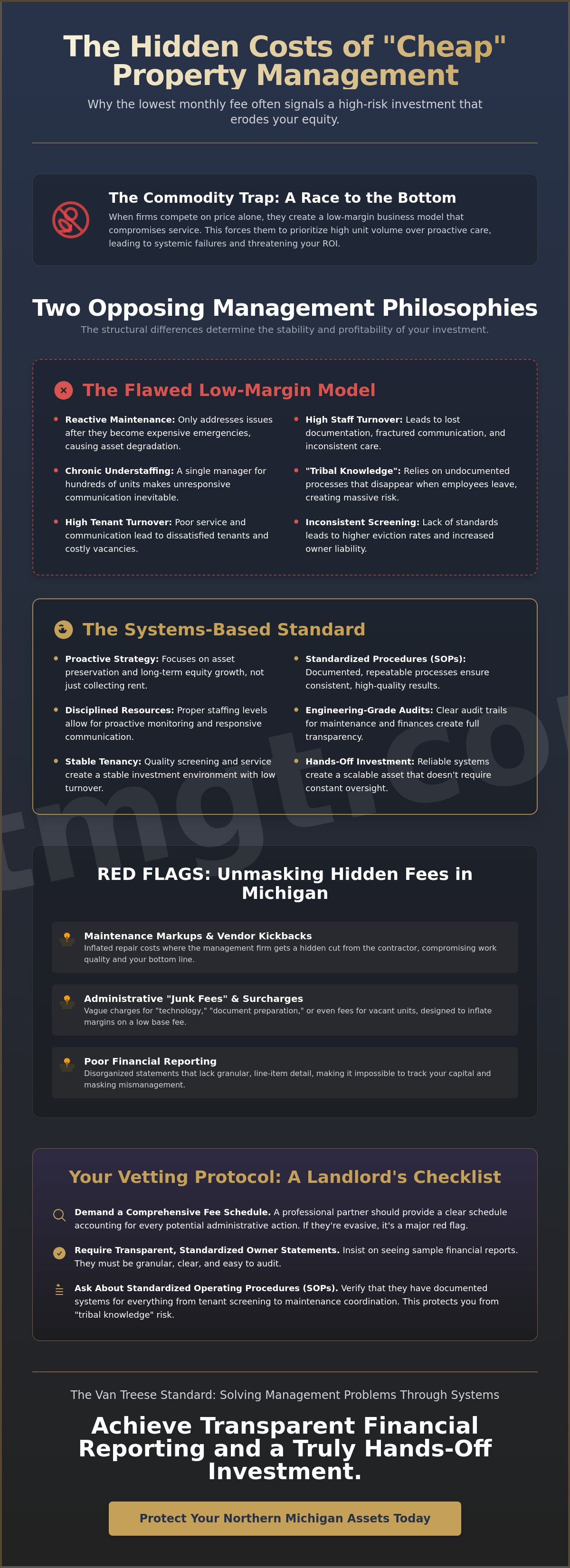
The property management industry is currently trapped in a cycle of commoditization. When firms compete primarily on having the lowest monthly percentage, they create a structural deficit that compromises the quality of service. This "Commodity Trap" forces agencies to adopt low-margin business models where a single manager might oversee hundreds of units simultaneously. In such an environment, proactive maintenance and strategic planning are impossible. Owners often find themselves working with reactive operations that only address issues once they've escalated into expensive emergencies. This lack of foresight directly impacts the long-term preservation of the asset and the stability of the landlord's equity.
High staff turnover further exacerbates these systemic failures. When a firm lacks a stable workforce, the continuity of care for both the property and the tenant is broken. Frequent personnel changes lead to lost documentation and fractured communication, which often results in increased tenant dissatisfaction. A tenant who feels ignored is far more likely to vacate, leading to the high turnover rates that erode an investor's bottom line. Industry failure isn't usually the result of bad intentions; it's the result of flawed business structures that prioritize volume over precision.
The Economic Reality of Cheap Management
A low-fee structure is often a facade. To maintain profitability, many firms rely on property management hidden fees Michigan landlords don't see until the first few statements arrive. These can include maintenance markups, technology surcharges, or administrative fees that effectively raise the cost of service while keeping the "sticker price" low. Beyond the financial impact, these models lead to chronic understaffing. When a manager is overwhelmed by sheer volume, responsiveness becomes the first casualty. A lack of communication isn't just an inconvenience; it's a sign that the firm lacks the resources to monitor the technical health of your property or maintain the standards required for long-term growth.
Lack of Standardized Operating Procedures (SOPs)
Most management failures stem from a reliance on "tribal knowledge" rather than documented systems. When an experienced employee leaves a firm, their specific understanding of a property's quirks often vanishes with them. This creates a massive risk for owners who expect consistent results. To understand the baseline of the industry, one can look at What is Property Management? and see the breadth of responsibilities required. Without engineering-grade audit trails for maintenance and financial reporting, errors become systemic. A lack of SOPs also results in inconsistent tenant screening. When placement processes aren't standardized, the criteria for selecting residents can fluctuate, leading to higher eviction rates and increased liability for the investor. Precision in management requires a departure from these disorganized methods in favor of a disciplined, systems-oriented framework.
Identifying Red Flags: Property Management Hidden Fees in Michigan
Identifying property management hidden fees Michigan investors encounter requires a technical audit of the management contract before signing. Many low-cost firms utilize "junk fees" to inflate their margins while maintaining an attractive base percentage. These often include technology surcharges, administrative fees for document preparation, and even fees for units that are currently vacant. If a management company is evasive about these specific line items during the onboarding process, it's a clear indicator of a non-transparent financial structure. A professional partner should provide a comprehensive fee schedule that accounts for every potential administrative action.
Poor financial reporting is a tool often used to mask mismanagement. When monthly statements are disorganized or lack granular line-item detail, tracking the movement of your capital becomes nearly impossible. Precise reporting must provide a clear view of every transaction, including direct vendor payments and management deductions. A lack of detail frequently hides undisclosed vendor kickbacks. In these arrangements, contractors pay the management company a percentage of the job cost in exchange for being hired. This practice artificially inflates repair costs and compromises the quality of the work performed on your investment asset.
The Maintenance Markup Problem
A significant conflict of interest arises when a management firm profits from the frequency of repairs. Some companies apply a percentage-based markup on contractor invoices, which incentivizes reactive fixes over preventative maintenance. This practice erodes your long-term ROI by prioritizing short-term revenue for the manager. Professional oversight requires transparent, third-party vendor invoicing for every repair action. Without an engineering-grade audit trail, landlords have no way to verify if they're paying market rates for labor and materials. We believe that standardized maintenance coordination should focus on asset preservation, not administrative profit.
Legal Risks and Michigan Compliance
Operational disorganization often leads to significant legal exposure under state statutes. Inconsistent handling of security deposits or failing to provide required disclosures can result in costly litigation and statutory penalties. The Michigan landlord-tenant guide outlines strict parameters for these processes. Management failures in this area are often linked to broader risks described in our overview of Michigan landlord laws. Improper document storage and disorganized screening records also create vulnerabilities regarding the Fair Housing Act. A firm that lacks a structured system for compliance isn't just inefficient; it's a liability to your entire real estate portfolio.
The True Cost of Poor Tenant Screening and Placement
Placing a "warm body" in a unit is almost always more expensive than enduring a brief vacancy. While an empty property represents a temporary pause in cash flow, a poorly screened tenant represents a long-term threat to the asset's structural and financial integrity. Weak screening systems correlate directly with high eviction rates. These evictions don't just cost money in legal fees; they lead to months of lost rent and potential property damage. When marketing efforts are unprofessional or narrow, they attract a lower-quality applicant pool. This forces landlords into a high-risk scenario where they must choose between a bad tenant or no tenant. The resulting damage to the property erodes investment equity and disrupts the stability of the entire portfolio.
Incentive Misalignment in Leasing
High leasing fees often create a fundamental conflict of interest between the manager and the owner. If a firm collects a full month's rent every time they place a new resident, they have a financial incentive to ignore red flags. This leads to a "Churn and Burn" cycle. The management company profits from frequent move-outs, while the landlord bears the burden of cleaning, repair, and marketing costs. This hidden cost of turnover is one of the most significant property management hidden fees Michigan owners must navigate. A professional partner should prioritize retention and long-term stability, proving that their systems are designed to protect the owner's interest rather than generate recurring placement fees.
Modern Screening Standards for 2026
A disciplined approach to management requires modern, data-driven screening standards. Professional firms must verify credit history, criminal backgrounds, and prior eviction records with absolute precision. This process must be consistent and non-discriminatory to maintain compliance with the Fair Housing Act. The Michigan Legislature's guide for tenants and landlords offers a technical foundation for these legal requirements. Beyond background checks, accurate market research is vital. Over-pricing a unit often narrows the applicant pool to high-risk individuals who are willing to pay a premium because they can't qualify elsewhere. A systematized firm uses comparative market analysis to ensure the rent is optimized for attracting stable, high-quality tenants. This precision-based placement is the only way to safeguard your Northern Michigan real estate investment against the volatility of poor oversight.
How to Vet a Property Manager in Northern Michigan
Selecting a management partner requires the same level of due diligence as selecting a precision manufacturing vendor. You must verify a physical, local presence in key markets such as Petoskey, Traverse City, or Grand Rapids. A manager who operates primarily through remote call centers cannot effectively respond to the physical realities of a property. Reviewing a sample monthly financial owner statement is a critical step in this process. This allows you to identify property management hidden fees Michigan firms might exclude from their initial sales presentations. Transparency in reporting is the only way to ensure your capital is being managed with integrity.
Maintenance coordination is another area that requires deep scrutiny. Inquire about their vendor network and how they handle service requests. A professional firm uses a technology stack that includes dedicated owner and tenant portals to streamline communication and provide real-time updates. If your portfolio includes more complex assets, ensure the firm has documented expertise in commercial property management. Managing industrial or retail spaces requires a higher degree of technical knowledge regarding mechanical systems and lease compliance than standard residential units.
Regional Expertise and Seasonal Readiness
Northern Michigan presents unique logistical challenges that demand seasonal readiness. Your manager needs a specific, documented plan for Northern Michigan winter maintenance to prevent catastrophic issues like burst pipes or structural snow damage. Local market nuances in Emmet and Charlevoix counties often dictate different rental cycles and pricing strategies compared to other regions. It's essential to ask how they handle emergency responses in remote areas like Indian River or Gaylord. Distances in the North are significant, and a lack of localized vendor relationships can lead to long delays in critical repairs.
Critical Questions for Your Next Interview
Ask the firm about their staff-to-unit ratio to determine if their team has the bandwidth to handle your assets with precision. Inquire about their average vacancy time and lease renewal rates over the last year to measure their operational efficiency and tenant satisfaction levels. You should also request a detailed breakdown of all potential extra fees that exist beyond the base management percentage. Understanding these costs upfront prevents the financial friction that often occurs when hidden charges begin to erode your monthly cash flow. If you require a partner that prioritizes standardized processes over reactive fixes, explore our management solutions today.
The Van Treese Standard: Solving Management Problems Through Systems
Van Treese Management operates on the foundational principle that property oversight is a technical discipline requiring rigorous, standardized systems. We've moved away from the reactive models that characterize much of the industry; instead, we've implemented engineering-grade processes designed specifically for Northern Michigan owners. Our framework ensures that every operational phase, from initial marketing to final financial closeouts, follows a repeatable and auditable path. This structural clarity is the most effective defense against property management hidden fees Michigan investors often encounter in less disciplined firms. By prioritizing efficiency and stability, we provide a management environment where performance is measured by data rather than anecdotes.
Asset protection requires constant vigilance and technical readiness. Our 24/7 emergency response and maintenance coordination systems ensure that your property is never left vulnerable to the environmental extremes of the North. We utilize market-driven research and precise property valuations to ensure your investment remains competitive and profitable. Our research isn't limited to setting rent; it involves identifying the technical lifecycle of your property's mechanical systems and structural components. This data-centered approach allows for human interaction to be more meaningful, as our team is backed by the efficiency of modern technology rather than being overwhelmed by administrative chaos.
Professionalism and Accountability
Our systemic approach to investing in rental property focuses on long-term asset preservation and the creation of thriving local communities. We believe that quality housing is the direct result of professional oversight and mutual accountability between the manager, the owner, and the resident. Our detailed financial reporting provides owners with absolute transparency, effectively eliminating the anxiety associated with undisclosed surcharges or "junk fees." This level of precision ensures that our partners always have a clear, real-time view of their portfolio's performance and capital movement.
Next Steps for Frustrated Owners
Transitioning from a failing management model to a systems-based approach doesn't have to be a disruptive experience for you or your tenants. We handle the seamless transition from your previous provider, ensuring all documentation, lease histories, and security deposit records are integrated into our secure portals with minimal friction. If you're ready for a comprehensive property analysis for your Petoskey or Charlevoix rental, our team is prepared to conduct a technical audit of your asset's current state and future potential. Contact Van Treese Management for a transparent management consultation to secure the stability and growth of your Northern Michigan real estate investment.
Securing Your Investment with Systemic Precision
Protecting the structural and financial integrity of your real estate portfolio requires a departure from the low-margin, reactive models that currently dominate the market. As we've explored, the cumulative impact of poor tenant screening and property management hidden fees Michigan owners often face can significantly erode long-term equity. Achieving a truly hands-off investment environment is only possible when your assets are managed through standardized maintenance systems and rigorous, transparent financial reporting. By prioritizing technical oversight and local expertise, you can transform your property from a source of administrative friction into a stable, high-performing asset.
Our team provides the engineering-grade efficiency and regional knowledge necessary to maintain your properties in Northern Michigan's unique climate. We invite you to schedule your professional management consultation with Van Treese to see how our disciplined coordination can protect your capital. Transitioning to a systems-oriented partner is the first step toward reclaiming your time and ensuring the long-term viability of your investments. We're ready to assist you in building a more secure and profitable future for your rental portfolio.
Frequently Asked Questions
What are the most common complaints about property management companies?
The most frequent grievances involve a lack of responsiveness, delayed maintenance coordination, and unexpected financial deductions. These issues usually originate from a structural failure in the management firm's business model. When a manager is responsible for too many units, they lose the capacity for proactive oversight, resulting in the communication gaps and reactive fixes that frustrate most investment owners.
How can I tell if my property manager is overcharging for maintenance?
Landlords should request original, third-party vendor invoices for every repair action to verify the actual costs. Comparing these documents against your monthly owner statement allows you to identify property management hidden fees Michigan firms may apply through undisclosed markups. A transparent partner will provide these records as part of their standard reporting package without requiring a formal audit request.
Is it possible to switch property management companies with a tenant in place?
Yes, transitioning to a new management partner with an existing tenant is a routine professional procedure. The incoming firm handles the transfer of security deposits, lease agreements, and keys while providing the tenant with new contact information and payment portal access. This process is designed to be seamless, ensuring that rent collection and maintenance requests continue without interruption during the transition phase.
What should be included in a standard property management contract in Michigan?
A professional contract must include a detailed fee schedule, specific termination clauses, and a clear definition of maintenance authority. It should also outline the procedures for handling security deposits in accordance with state statutes. Ensuring these technical parameters are documented upfront prevents future disputes and establishes a framework for accountability between the landlord and the management firm.
How much should I expect to pay for professional management in Northern Michigan?
Management costs vary based on the complexity of the asset and the specific scope of services required. Landlords should evaluate the total cost of ownership rather than focusing solely on the base management percentage. A firm that provides comprehensive reporting and standardized systems often delivers a higher long-term ROI by reducing tenant turnover and preserving property equity through better maintenance.
Can a property management company be held liable for illegal tenant actions?
A management company is generally not liable for a tenant's illegal acts unless their own negligence directly contributed to the situation. Their primary responsibility is to perform diligent screening and enforce the terms of the lease agreement. While they cannot control every tenant action, maintaining rigorous screening standards is the most effective way to mitigate these risks for the property owner.
What is the average staff-to-unit ratio for a healthy management firm?
A sustainable staff-to-unit ratio typically ranges from one dedicated team member for every 40 to 60 units. When this ratio increases significantly, the quality of oversight often declines. Firms operating with higher ratios are frequently forced into the reactive, low-margin models that lead to the communication failures and maintenance delays discussed throughout this guide.
How does a manager ensure compliance with Michigan’s Fair Housing Act?
Compliance is maintained through the application of objective, standardized screening criteria for every applicant. By documenting each step of the placement process, a manager creates a technical audit trail that demonstrates non-discriminatory practices. This systematic approach protects the landlord from legal liability and ensures that every tenant is evaluated based on their financial and rental history rather than subjective factors.