

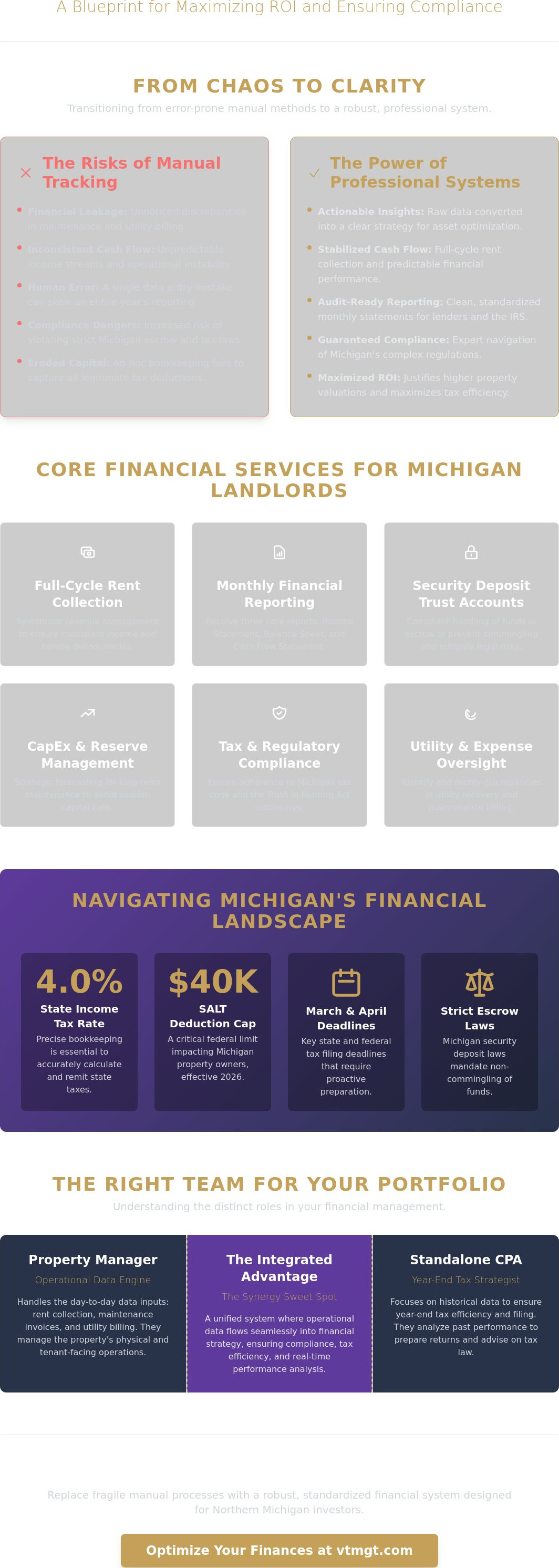
A rental property in Michigan is not just a piece of real estate; it's a complex financial engine that requires precise calibration to maintain a steady return on investment. Many investors find that manual bookkeeping and inconsistent cash flow tracking create significant operational risks, particularly when navigating the 4.0% state income tax rate or the strict requirements of Michigan security deposit laws. It's a challenge to maintain the necessary technical precision while managing property maintenance and tenant relations simultaneously.
By integrating professional rental property accounting services Michigan landlords can establish a disciplined system that converts raw financial data into actionable insights. This article provides a structured overview of how to master your property finances, ensuring you maximize tax deductions and remain fully compliant with state escrow regulations. We'll examine the impact of the $40,000 SALT deduction cap for 2026, the critical March and April filing deadlines, and the methods used to produce clean monthly financial statements that withstand the scrutiny of any audit.
Key Takeaways
- Learn why proactive accounting serves as a critical management tool to prevent financial leakage in maintenance and utility billing.
- Discover how professional rental property accounting services Michigan providers use full-cycle rent collection and monthly financial reporting to stabilize cash flow.
- Understand the distinct roles of property managers and CPAs in maintaining operational data and ensuring year-end tax efficiency.
- Gain insights into navigating Michigan-specific regulations, including security deposit escrow accounts and Truth in Renting Act disclosures.
- See how standardized financial systems provide the structural stability required for successful residential and commercial property management.
Beyond Bookkeeping: Why Professional Rental Accounting is Your Best ROI Strategy
For many property owners, accounting is viewed as a seasonal burden associated with tax deadlines. However, viewing financial management through a purely reactive lens ignores its potential as a precision instrument for asset optimization. Effective rental property accounting services Michigan investors utilize are not merely about tracking historical data; they represent a proactive management strategy designed to eliminate financial leakage. In the engineering of a profitable portfolio, every dollar must be accounted for to ensure the structural integrity of the investment.
Standardized financial systems identify discrepancies in maintenance billing and utility recovery that often go unnoticed in manual logs. When these processes are codified, investors gain a level of transparency that fosters long-term partnerships. This clarity is particularly vital in Northern Michigan, where seasonal fluctuations require rigorous cash flow oversight to maintain stability throughout the fiscal year. Market research-backed valuations further allow for strategic financial planning, ensuring that rent rates are calibrated to the local economy rather than based on guesswork.
The Impact of Precision on Property Valuation
Precision in financial reporting is the foundation for understanding property valuation and its trajectory. Lenders don't provide financing based on estimates; they require verified Profit and Loss (P&L) statements that demonstrate consistent performance. Detailed expense tracking ensures that every legitimate deduction is captured, preventing the erosion of capital that occurs with ad-hoc bookkeeping. This level of detail doesn't just satisfy the IRS; it provides the data necessary to justify higher valuations during asset appreciation cycles and future refinancing negotiations.
Standardized Systems vs. Manual Spreadsheets
Manual spreadsheets are inherently prone to human error, especially as a portfolio scales into multi-unit territory. A single data entry mistake can ripple through a year's worth of reporting, leading to skewed ROI projections and potential compliance issues. Automation in rent collection and expense categorization provides the stability required for consistent monthly cash flow. At Van Treese, we prioritize innovation in financial oversight, replacing fragile manual processes with robust, standardized systems. This commitment to technical excellence ensures that our clients receive a clear, undistorted view of their property's financial health without the risks associated with manual data entry.
Essential Rental Property Accounting Services for Michigan Landlords
While many owners focus on the physical upkeep of their assets, the financial infrastructure is what determines long-term viability. Comprehensive rental property accounting services Michigan providers offer go beyond simple ledger entries. They encompass a full-cycle approach to revenue management, ensuring that rent collection is consistent and delinquency is handled through established legal frameworks. This systematic approach stabilizes the income stream, allowing for more predictable reinvestment strategies.
A critical component of this infrastructure is trust accounting for security deposits. Michigan law requires specific handling of these funds to prevent commingling with operational capital. Adhering to Michigan landlord-tenant laws is not optional; it is a regulatory requirement that protects both the owner and the tenant. Professional oversight ensures these funds are held in compliant escrow accounts, significantly mitigating legal exposure during lease terminations.
Strategic planning also includes Capital Expenditure (CapEx) management and reserve fund oversight. By maintaining dedicated reserves and forecasting long-term maintenance needs, owners can avoid sudden capital calls that disrupt monthly cash flow. This forward-looking approach ensures the property remains competitive in the local market without compromising liquidity.
Monthly Financial Reporting and Transparency
Every owner should receive three fundamental reports monthly: the Income Statement, the Balance Sheet, and the Cash Flow Statement. These documents provide the raw data necessary to evaluate performance. The Operating Statement is particularly valuable for identifying hidden costs, such as utility spikes or recurring minor repairs that signal a need for larger systemic upgrades. Modern management provides 24/7 owner portal access, allowing for real-time financial oversight and data-driven decision-making from any location.
Vendor Management and Year-End Compliance
Managing local contractors in Northern Michigan, specifically in areas like Petoskey and Traverse City, requires diligent insurance verification and payment tracking. Automating the 1099-MISC and 1099-NEC process is essential to avoid IRS penalties and ensure year-end tax readiness. Professional firms handle maintenance billing with higher accuracy than DIY methods, ensuring every expense is correctly categorized for maximum tax benefit. This level of financial reporting and accounting provides the transparency and structural stability required for institutional-grade management.
Property Manager vs. Standalone CPA: Who Should Handle Your Books?
Distinguishing between operational accounting and annual tax preparation is essential for maintaining a high-performance real estate portfolio. A standalone Certified Public Accountant (CPA) typically specializes in high-level tax strategy, structural compliance, and the final filing of annual returns. However, a CPA relies entirely on the quality of the data provided to them. Without the daily oversight inherent in professional rental property accounting services Michigan, that data is often fragmented or incomplete. A property manager acts as the primary data engine, capturing every transaction in real-time to ensure the CPA has a clean, audit-ready ledger at year-end.
This relationship is symbiotic rather than redundant. The property manager handles the technical execution of rent collection, vendor disbursements, and escrow management. These daily operations generate the "raw data" required for tax efficiency. By maintaining a continuous ledger, managers reduce the "accounting gap" that typically occurs during the transition to tax season. This ensures that adhering to IRS guidelines for rental property is a seamless process rather than a frantic cleanup exercise. Choosing a fiduciary partner who understands the nuances of investing in rental property Northern Michigan ensures that your financial strategy aligns with regional market conditions and long-term asset goals.
Real-Time Oversight vs. Rear-View Reporting
Waiting until April to evaluate the financial health of your portfolio is a significant operational risk. Northern Michigan landlords face unique seasonal challenges, from fluctuating utility costs to varied maintenance demands. Real-time oversight allows for immediate adjustments to property operations based on monthly data. If a specific unit shows a trend of late payments or rising repair costs, integrated systems catch these patterns before they escalate into vacancies or major capital losses. This proactive stance is the primary difference between managing an investment and simply reacting to its costs.
Cost-Benefit Analysis of Integrated Services
While some owners hesitate at management fees, a cost-benefit analysis often reveals significant savings through integrated accounting. Standalone CPAs often charge high hourly rates for "cleanup" work if they receive disorganized receipts or incomplete ledgers. Professional management includes robust financial reporting within the standard service scope, which drastically reduces the billable hours a CPA spends on basic data entry. For most sophisticated investors, the optimal strategy involves using a property manager for daily rental property accounting services Michigan and a specialized real estate CPA for final tax optimization and structural planning.
Navigating Michigan-Specific Financial Regulations and Tax Compliance
Adhering to the specific financial regulations of the Great Lakes State requires a structured approach to compliance. Utilizing professional rental property accounting services Michigan landlords trust ensures that every transaction meets the rigorous standards set by state statutes. The process is not merely administrative; it's a defensive strategy against legal exposure. It begins with establishing a Michigan-compliant security deposit escrow account, which must be held in a regulated financial institution. Following this, owners must ensure all lease agreements contain the mandatory financial disclosures required by the Truth in Renting Act.
Calculating property tax assessments is a critical third step, particularly regarding the "uncapping" of taxable values upon property transfer. For 2026, the inflation cap for taxable property values is set at 2.7%, but this protection only applies to existing owners. Step four involves ensuring lease agreements meet the financial notice requirements specific to Northern Michigan municipalities. Finally, managing the 45-day final accounting rule for tenant move-outs is essential to avoid statutory penalties. This comprehensive cycle ensures that the property's financial foundation remains sound and audit-ready.
Security Deposit Escrow: The 2026 Rules
Michigan law is explicit: security deposits remain the tenant's property until a claim is legally established. In Emmet and Charlevoix counties, mishandling these funds can lead to severe financial penalties. Owners must choose between holding funds in a dedicated escrow account or securing a cash bond with the Secretary of State. Professional Michigan landlord laws guidance provides the structural oversight necessary to prevent litigation. It ensures that funds are handled with fiduciary care and that all interest-bearing requirements are met according to regional standards.
Tax Deductions for Michigan Rental Owners
Strategic tax planning involves identifying all deductible expenses, including rental property maintenance Northern Michigan climates necessitate, such as snow removal and winterization. With Michigan's flat 4.0% state income tax and the 2026 SALT deduction cap of $40,000, precise record-keeping is vital. Standardized financial reporting simplifies the preparation of Schedule E (Form 1040). It ensures that "uncapping" costs and local school district taxes are accurately reported to maximize ROI. By capturing every technical expense, owners can significantly reduce their taxable income while maintaining property standards.
Ensure your portfolio remains compliant with all state financial regulations by partnering with a team that specializes in Financial Reporting and Accounting.
The Van Treese Advantage: Standardized Financial Systems for Northern Michigan
At Van Treese Management, we transform the traditional management model by integrating technological innovation with disciplined human oversight. We don't view accounting as a secondary administrative task; it's the central nervous system of your investment. Our rental property accounting services Michigan landlords utilize provide a structured framework where every transaction is verified and every report is calibrated for technical accuracy. This approach ensures that residential and commercial owners experience a level of operational stability that manual processes simply cannot replicate.
Managing mixed-use assets requires a specialized understanding of both residential and commercial property management financial reporting. These complex portfolios demand high-level coordination to ensure that maintenance costs and common area expenses are allocated with surgical precision. Our systems are built to handle these complexities, providing clear visibility into the performance of each asset class within your portfolio. Local expertise in Petoskey, Boyne City, and Traverse City allows us to provide market-accurate reporting that reflects the unique seasonal economic conditions of Northern Michigan.
Precision in Every Statement
Our commitment to GAAP-aligned reporting ensures that your financial statements meet the highest professional standards, regardless of property size. This technical rigor extends to our maintenance coordination billing. We provide total transparency by linking every work order to its corresponding financial transaction, eliminating the financial leakage that often occurs in less structured environments. By prioritizing financial stability, we contribute to thriving local communities where both owners and tenants can operate with confidence. This disciplined approach ensures that your assets are not just managed but optimized for long-term durability.
Ready to Modernize Your Rental Finances?
Professional rental property accounting services Michigan investors trust offer more than just clean books; they provide the peace of mind necessary to scale a portfolio effectively. By removing the burden of manual bookkeeping and regulatory compliance, we allow you to focus on high-level investment strategy. You don't have to worry about the complexities of Michigan escrow laws or year-end 1099 processing when your systems are standardized and overseen by specialists. We invite you to Optimize your rental property finances with Van Treese Management and establish a more resilient financial future through professional oversight and technical excellence.
Securing the Future of Your Michigan Investment
Maintaining a high-performance real estate portfolio requires a technical commitment to financial accuracy that goes beyond simple record-keeping. By implementing standardized systems and maintaining rigorous compliance with state regulations, owners can transform their accounting from a reactive burden into a proactive ROI strategy. Professional oversight ensures that your data is always audit-ready while mitigating the risks associated with Michigan’s specific escrow requirements and property tax assessments.
Since 2018, we've provided the structural stability residential and commercial owners need to succeed in Northern Michigan. Our deep expertise in Michigan landlord-tenant law ensures your assets remain protected while our financial systems provide the transparency required for institutional-grade management. Transitioning to professional rental property accounting services Michigan providers offer is the most effective way to ensure your cash flow remains predictable and your investment stays secure.
Get Professional Financial Reporting with Van Treese and establish the precision your investment deserves. Your portfolio's long-term success depends on the structural integrity of its financial foundation.
Frequently Asked Questions
Do I need a separate bank account for my Michigan rental property?
Yes, Michigan law requires that security deposits be held in a regulated financial institution. Maintaining a separate operating account prevents the commingling of personal and business funds, which is a fundamental requirement for audit protection. Utilizing professional rental property accounting services Michigan landlords trust ensures that these accounts remain structurally compliant with state escrow regulations and the Landlord-Tenant Relationship Act.
What is the most common accounting mistake Michigan landlords make?
The most frequent error is failing to account for the "uncapping" of property taxes following a title transfer. Many owners project their return on investment based on the previous owner's tax rate, only to see a significant spike in operating costs once the local assessor updates the taxable value. Inaccurate categorization of repairs versus capital improvements is another technical oversight that leads to errors on Schedule E filings.
How does Michigan handle security deposit interest?
Michigan residential landlords aren't generally required to pay interest on security deposits to tenants under standard lease agreements. However, the funds must be held in a secure escrow account or protected by a sufficient cash bond filed with the Secretary of State. It's standard practice for professional management firms to use non-interest-bearing accounts to simplify the 45-day final accounting process required during tenant move-outs.
Are property management fees tax-deductible in Michigan?
Yes, all professional property management fees are fully deductible as a business expense on both federal and state tax returns. This includes costs associated with financial reporting, tenant placement, and maintenance coordination. These deductions are essential for offsetting the 4.0% Michigan state income tax rate, effectively reducing your overall taxable liability and improving the net performance of your portfolio.
How often should I receive financial reports from my property manager?
You should receive a comprehensive financial package every month to maintain real-time oversight of your assets. This package must include an Income Statement, Balance Sheet, and a detailed Cash Flow Statement. Standardized systems allow for this regular cadence, ensuring that any operational variances are identified and corrected before they impact your annual ROI or year-end tax preparation.
What is the difference between cash and accrual accounting for rentals?
Cash accounting records income and expenses only when the funds actually change hands. Accrual accounting records transactions when they're earned or incurred, regardless of when the cash moves. While most individual landlords use cash accounting for its simplicity, larger commercial portfolios often require accrual methods to provide a more precise view of long-term liabilities and upcoming capital expenditures.
How do I handle 1099s for maintenance contractors in Petoskey?
You must issue a Form 1099-NEC to any unincorporated contractor in Petoskey or the surrounding region whom you've paid $600 or more during the tax year. This includes local plumbers, electricians, and snow removal services. Professional management firms automate this process to ensure all filings are completed by the January 31 deadline, which protects you from IRS non-compliance penalties.
What financial records should I keep for an IRS audit?
Maintain a structured archive of all lease agreements, bank statements, and itemized receipts for at least seven years. You should also keep records of property tax assessments, insurance policies, and all 1099 forms issued to vendors. Digital records are preferred for their durability and ease of retrieval during a technical audit or a property valuation review, ensuring you can justify every deduction claimed.