
How to Reduce Vacancy Rates in Northern Michigan: A 2026 Strategic Guide

What if the high vacancy rates you're experiencing aren't a result of the market, but a failure of your management systems? Many owners in Emmet and Charlevoix counties believe that seasonal turnover and off-season lulls are simply the cost of doing business in a tourist-heavy region. We understand the frustration of watching cash flow stall due to poor tenant placement or the high costs of finding new residents during the winter. It's a common struggle, but relying on the summer peak to carry your investment isn't a sustainable strategy. Effective tenant retention strategies Northern Michigan landlords can implement aren't based on luck; they're built on shifting from reactive fixes to proactive, standardized processes.
This guide reveals the data-driven frameworks used by professional managers to eliminate downtime and maximize rental income. You'll discover how to implement a hands-off management system that ensures zero-gap transitions and secures qualified, year-round tenants even as the 2026 market continues to normalize. We'll examine the specific impact of localized market research on competitive rental rates, the necessity of rigorous background screening, and the technical maintenance protocols that keep long-term residents satisfied and in place.
Key Takeaways
- Learn how to navigate the specific seasonal demand cycles of the Northern Michigan market to mitigate vacancy during the November and April shoulder seasons.
- Discover how data-driven rental valuations and precise price positioning can significantly increase lead volume compared to generic automated estimates.
- Implement professional tenant retention strategies Northern Michigan managers use to secure long-term residents through standardized screening and placement systems.
- Understand the direct correlation between maintenance response times and lease renewal rates to prevent the emergency-driven move-outs that disrupt cash flow.
- Master the transition from reactive DIY management to a structured system that facilitates zero-day vacancy during tenant transitions.
Analyzing the Northern Michigan Rental Market Dynamics
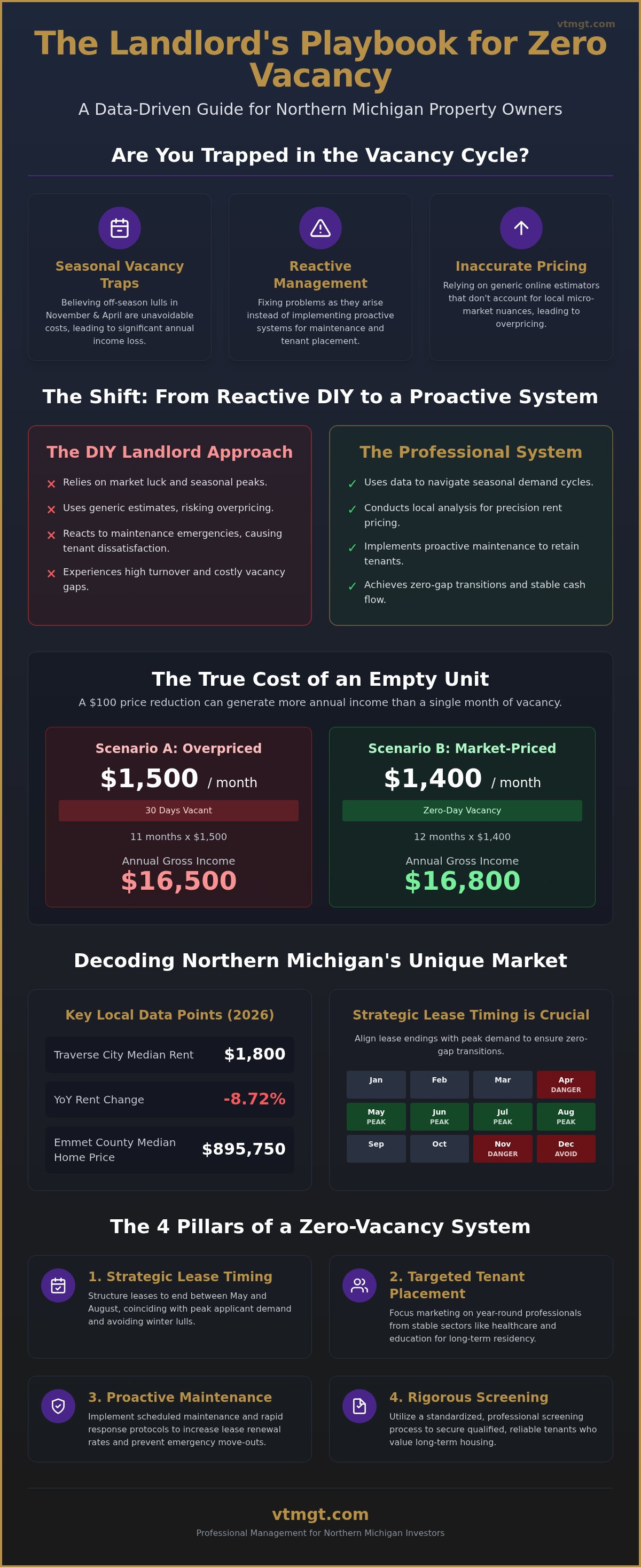
State-wide averages often provide a misleading picture of the rental landscape in Petoskey, Boyne City, and Traverse City. While general Michigan data might suggest steady growth, the Northern Michigan market operates on distinct, high-variance cycles. In Traverse City, the median rent reached $1,800 in August 2026, representing an 8.72% decrease from the previous year. This normalization proves that owners can't rely on general market momentum to sustain high occupancy. The primary risk factor in this region is the "Shoulder Season." Units that hit the market in November or April face a significantly smaller pool of qualified applicants, often leading to extended downtime that erodes annual ROI. Successful Professional Property Management requires a shift from reactive listing to a system-oriented approach that accounts for these local demand gaps.
Seasonal vs. Year-Round Demand Patterns
A common error among independent owners is failing to distinguish between the influx of seasonal workers and the needs of long-term residents. High-turnover seasonal rentals create logistical strain and inconsistent cash flow. To stabilize your portfolio, your turnover schedule must align with peak relocation months. We recommend that you never allow a lease to terminate in December. The logistical challenges of Northern Michigan winters combined with low holiday-season demand make finding qualified replacements nearly impossible. Instead, we structure agreements to end between May and August. This ensures that if a resident moves, the unit is marketed when demand is at its peak. These types of tenant retention strategies Northern Michigan landlords utilize are built on technical scheduling rather than hope.
Key Economic Indicators in Emmet and Charlevoix Counties
The stability of the long-term rental market in Emmet and Charlevoix counties is driven by core employment hubs like McLaren Northern Michigan and the regional education sector. These institutions provide a steady stream of professionals who require year-round housing. We also monitor the "guest-to-owner" pipeline, where high listing prices (reaching a median of $895,750 in Emmet County in June 2026) often force potential buyers to remain in the rental market longer. Staying compliant with Michigan landlord laws regarding occupancy limits and safety standards is essential as local municipalities increase oversight. By focusing on properties that appeal to the healthcare and professional sectors, you can secure a demographic that prioritizes stability and long-term residency.
Data-Driven Rent Pricing and Market Positioning
Precision in rent pricing is the primary lever for controlling vacancy rates. Automated online estimates often rely on broad algorithms that fail to account for the micro-market nuances of Emmet and Charlevoix counties. A $50 price discrepancy can disproportionately impact lead volume due to the search filters utilized by modern tenants. Most digital platforms use $50 or $100 increments; pricing a unit at $1,550 instead of $1,500 may inadvertently hide the listing from a significant percentage of the qualified applicant pool. Professional rental valuations must prioritize local absorption rates over optimistic projections to ensure the asset remains competitive from day one.
Quantifying the impact of an empty unit is essential for maintaining a high annual ROI. We utilize the Vacancy Cost formula to help owners understand the real-time financial erosion caused by downtime. In a market like Traverse City, where the median rent was $1,800 as of August 2026, a single month of vacancy represents a loss that is rarely recovered through marginal rent increases. Effective tenant retention strategies Northern Michigan owners employ start with setting a price that encourages long-term residency while reflecting the property's technical value. For a detailed analysis of your asset's potential, you can request a professional rental valuation to align your pricing with current market realities.
The True Cost of Overpricing: A Mathematical Breakdown
The financial risk of overpricing is best illustrated through a direct comparison. Consider a property priced at $1,500 per month that remains vacant for 30 days during the search for a tenant. The total annual gross income is $16,500. Conversely, a unit priced at $1,400 per month with zero vacancy generates $16,800 annually. It takes 14 months of higher rent to recover the loss of just one month of vacancy. Market Equilibrium Rent for Northern Michigan properties is defined as the specific price point where supply and demand intersect to yield the highest net annual income with minimal turnover risk.
Competitive Positioning in the 2026 Market
Attracting stable residents requires balancing high-end amenities with local affordability thresholds. In Northern Michigan, certain features are non-negotiable for year-round tenants. Covered parking and high-efficiency heating systems are prioritized over cosmetic upgrades due to the regional climate. We recommend using specific local market research to identify which features are currently underrepresented in adjacent listings. Aligning your property's strengths with the goals of investing in rental property Northern Michigan ensures that your asset doesn't just attract interest, but secures a signed lease. This structured approach to positioning mitigates the risk of the unit sitting idle during the critical shoulder seasons.
Implementing Standardized Tenant Placement Systems
Vacancy is rarely a product of low demand; it's often a failure of the response system. In a competitive market like Northern Michigan, speed-to-lead is the primary metric that determines whether a unit sits empty or secures a lease. High-intent leads often inquire about multiple properties simultaneously. If your response time exceeds a few hours, you've likely already lost the prospect to a more responsive listing. A standardized tenant placement system replaces manual, fragmented communication with a structured funnel designed to capture and convert interest immediately. This architecture ensures that every inquiry is logged, screened, and scheduled for a showing without the delays inherent in traditional DIY management.
Implementing tenant retention strategies Northern Michigan owners can rely on starts with this initial placement phase. By automating the inquiry-to-showing transition, we eliminate the administrative bottlenecks that lead to lead decay. This systematic approach doesn't just fill units faster; it ensures that the pool of applicants is large enough to allow for rigorous selection rather than settling for the first available person out of desperation. Securing a stable resident from the start is the most effective way to prevent the high costs of off-season turnover.
High-Efficiency Marketing Protocols
Maximum market reach requires more than a single online listing. We utilize high-efficiency marketing protocols that include professional photography and virtual tours as a technical standard. This visual data allows prospective tenants to conduct an initial digital walkthrough, which filters out those whose needs don't align with the property's layout. We simultaneously syndicate listings across local and national platforms to ensure the highest possible visibility. Listing descriptions are engineered to be informative and exclusionary; by clearly stating requirements for income, credit, and occupancy, we pre-screen unqualified leads before they ever reach our communication funnel.
The Van Treese Tenant Screening Framework
Long-term stability is built on the foundation of comprehensive data verification. Our screening framework utilizes standardized criteria for income-to-rent ratios and credit history to remove subjectivity from the placement process. While automated background checks provide the raw data, we maintain a layer of human interaction to verify professional references and employment history. This dual-layered approach ensures that every placement adheres to the high property management Petoskey MI standards our clients expect. By selecting residents who possess the financial capacity and historical stability to maintain a long-term lease, we significantly reduce the risk of mid-term turnover and the associated costs of off-season vacancy.
Maintenance as a Tenant Retention Strategy
Maintenance operations represent more than a technical obligation; they are a critical component of asset preservation and resident satisfaction. Data indicates a direct correlation between repair response times and lease renewal rates. When a resident experiences a delay in essential repairs, their trust in the management system erodes, often leading to a move-out decision at the end of the term. By standardizing a 24/7 emergency response coordination system, owners demonstrate a commitment to property standards that residents value. This reliability is one of the most effective tenant retention strategies Northern Michigan investors can employ to secure year-round stability.
Preventative maintenance acts as a safeguard against the emergency failures that cause sudden vacancies. We treat every maintenance visit as a property wellness check. This allows technicians to identify early signs of wear, such as slow leaks or HVAC inefficiencies, before they escalate into catastrophic failures. A proactive approach reduces the total volume of emergency calls and reinforces the resident's perception of a well-managed home. It's a disciplined way to manage an asset that prioritizes long-term health over short-term cost-cutting.
Seasonal Maintenance Checklists for Retention
The Northern Michigan climate necessitates a structured approach to seasonal upkeep. Pre-winter furnace inspections and weatherization are mandatory to ensure resident comfort and mitigate high utility costs during the peak of winter. These technical interventions prevent mid-season heating failures that often lead to resident frustration and emergency relocation. In the spring, exterior maintenance and landscaping improvements enhance curb appeal, fostering a sense of pride of place for the resident. For a comprehensive breakdown of these technical requirements, consult our full rental property maintenance Northern Michigan guide.
The ROI of Tenant Satisfaction
Quantifying the cost of a tenant turn reveals the financial logic behind high maintenance standards. A typical turn involves deep cleaning, interior painting, and marketing expenses, which often exceed the cumulative cost of multiple minor repairs. Centralized maintenance coordination reduces the friction between owners and residents, ensuring that service is delivered with professional precision. Building community through reliable service is a strategic investment in long-term cash flow. It's a method of risk mitigation that protects the asset while ensuring the resident remains satisfied with their environment. If you're looking to optimize your asset's performance through professional oversight, you can explore our maintenance coordination services to streamline your operations.
Professional Management for Zero-Gap Transitions
Transitioning from a DIY landlord to a property investor requires a fundamental shift from reactive task management to professional delegation. Many owners in Emmet County treat property oversight as a series of isolated events rather than a continuous technical process. A professional approach reframes the management of your asset as a structured lifecycle where every phase is governed by standardized systems. By implementing tenant retention strategies Northern Michigan experts utilize, you move beyond the limitations of manual oversight. This transition allows for the deployment of specialized frameworks that ensure a unit never sits idle. We leverage established local networks to identify prospective residents before a property even reaches the public market, frequently securing a new lease agreement before the current tenancy concludes.
The leasing lifecycle begins the moment a resident provides a notice of non-renewal. Instead of waiting for the move-out date to initiate repairs and marketing, professional management starts a parallel workflow. We coordinate vetted local contractors to perform wellness checks and minor updates during the final weeks of a tenancy. This level of precision ensures that the unit is prepared for the next resident within 24 to 48 hours of the previous move-out. This zero-gap transition is only possible through a fegyelmezett (disciplined) management framework that treats every turnover as a high-stakes project requiring technical accuracy. It's the most effective way to protect your ROI from the erosion caused by unnecessary downtime.
Van Treese’s Standardized Management Systems
Consistency in rental income depends on the technical reliability of rent collection and financial reporting. Our systems provide owners with consistent liquidity and detailed accounting, which removes the administrative burden of manual tracking and reconciliation. We maintain a network of specialized vendors to ensure that rental management Charlevoix properties receive priority service, even during the peak summer months. This technical oversight keeps your portfolio stable year-round, regardless of the seasonal fluctuations that often disrupt independent owners. By centralizing maintenance and financial processes, we create a stable environment that encourages residents to remain in place for multiple terms.
The Path to Consistent Rental Income
Professional management is a strategic investment that pays for itself by minimizing vacancy and turnover expenses. In the normalizing 2026 market, the difference between a 90% and 98% occupancy rate represents a significant delta in your total annual ROI. The next step for any owner looking to stabilize their cash flow is a professional rental analysis to identify specific inefficiencies in their current management model. You can contact Van Treese Management for a custom strategy to reduce your vacancy rates and implement the technical systems required for the long-term growth of your Northern Michigan portfolio.
Optimizing Your Asset for Long-Term Stability
Eliminating vacancy in a normalizing market requires a shift from manual oversight to technical, standardized systems. We've examined how precise rent positioning and rigorous tenant screening create the foundation for a stable portfolio. Success in this region depends on your ability to bypass the "Shoulder Season" trap by scheduling lease ends during peak relocation months. Implementing these tenant retention strategies Northern Michigan owners need ensures that your cash flow remains consistent regardless of seasonal shifts. Our specialized approach in Petoskey, Boyne City, and Charlevoix leverages 24/7 maintenance coordination and localized research to keep your residents satisfied and your units filled.
Professional management isn't just about handling daily tasks; it's about engineering a resilient investment. By delegating the complexities of the leasing lifecycle to a partner with a disciplined framework, you protect your ROI from the high costs of turnover. It's time to move beyond the uncertainty of DIY management and secure your property's future. Take the first step toward a more efficient, hands-off investment today. Request Your Free Northern Michigan Rental Analysis to see how our systems can stabilize your income and eliminate downtime.
Frequently Asked Questions
What is a good vacancy rate for Northern Michigan rentals?
A vacancy rate between 3% and 5% is generally considered the technical benchmark for a healthy rental market in Northern Michigan. While state-wide averages fluctuate, our localized research in Petoskey and Traverse City indicates that maintaining this range requires proactive management systems. In 2026, as the market continues to normalize, owners shouldn't rely on general demand. Rates higher than 5% usually suggest that a property's pricing or maintenance protocols need professional adjustment.
How can I find year-round tenants in a resort town like Petoskey?
Finding year-round tenants in Petoskey requires targeting regional employment hubs like McLaren Northern Michigan or the local education sector. These professionals prioritize stability and long-term residency over seasonal convenience. We utilize standardized tenant placement systems to filter for applicants with verified local employment history. Marketing should emphasize property features that support a four-season lifestyle, such as efficient heating and covered parking, to attract stable, non-seasonal residents who contribute to long-term cash flow.
Does offering pet-friendly rentals actually reduce vacancy rates?
Yes, offering pet-friendly units significantly expands your applicant pool and can reduce vacancy downtime across your portfolio. Many long-term residents in Northern Michigan own pets as part of their lifestyle. By implementing standardized screening and clear pet policies, you mitigate risks while securing a demographic that often stays longer in their rentals. This is one of the practical tenant retention strategies Northern Michigan landlords use to ensure consistent occupancy and reduced turnover expenses.
What are the most common reasons tenants leave Northern Michigan rentals?
Slow maintenance response times and high winter utility costs are the most common reasons residents leave Northern Michigan rentals. Tenants often move when they feel the property isn't being technically maintained to preserve their comfort. Other factors include lifestyle shifts or entering the "guest-to-owner" pipeline by purchasing a local home. Proactive maintenance coordination and transparent communication are essential to preventing these voluntary move-outs and maintaining a high lease renewal rate for your asset.
How much does a month of vacancy actually cost a landlord in Emmet County?
The cost of one month of vacancy includes lost gross rent plus the technical expenses of a tenant turnover. In Traverse City, where the median rent reached $1,800 in August 2026, a 30-day vacancy represents a direct loss of that income. When you factor in the additional costs for professional cleaning, marketing, and background checks for a new placement, the total erosion of annual ROI can exceed $3,000 for a single unit.
Can professional property management guarantee zero vacancy?
No professional management firm can guarantee zero vacancy, but we use standardized systems to minimize downtime during transitions. We initiate the leasing lifecycle as soon as a notice of non-renewal is received. This allows for parallel workflows where marketing and maintenance coordination begin before the current resident moves out. Our goal is to facilitate zero-gap transitions by leveraging local networks and high-efficiency placement protocols to secure a new lease agreement with professional precision.
Is it better to lower the rent or offer a move-in incentive to fill a unit?
Lowering the rent to market equilibrium is generally more effective for long-term ROI than offering a one-time move-in incentive. A lower monthly rate attracts a wider pool of qualified leads and encourages long-term retention. Move-in incentives often attract "incentive-chasers" who may move out once the initial benefit expires. Setting a price based on localized market research ensures your asset remains competitive and attracts residents who are financially stable for the duration of the lease.
How do I handle maintenance during the winter to ensure tenant retention?
Winter maintenance requires a fegyelmezett approach to preventative inspections to ensure long-term resident satisfaction. We recommend conducting furnace wellness checks and weatherization before the first snowfall to prevent catastrophic heating failures. Our 24/7 emergency response coordination ensures that if a technical issue arises during a blizzard, it's addressed with professional precision. Keeping a property comfortable and efficient during Northern Michigan winters is a core component of a successful tenant retention strategy.