
How to Handle Tenant Complaints in Petoskey: A Landlord’s Guide

A midnight emergency call shouldn't be the standard metric for a landlord's success; yet many property owners in Emmet County find themselves reacting to crises rather than managing assets. We recognize the high stress that comes from repetitive maintenance requests and the persistent fear of inadvertently violating Michigan's specific landlord-tenant laws. Understanding how to handle tenant complaints Petoskey residents present is more than a courtesy. It's a technical necessity for protecting the long-term viability of your investment.
By implementing a disciplined, professional framework, you can transform these high-stress interactions into structured data points that stabilize your property's reputation and financial performance. We'll show you how to resolve disputes with a repeatable process that ensures legal compliance, from security deposit limits to source of income protections. This article outlines the exact steps to foster a thriving rental community while providing the legal protection you need through documented, professional communication. You'll learn to transition from a reactive state to a controlled, systems-based approach that preserves your time and your property's value.
Key Takeaways
- Understand your statutory obligations under Michigan law, including the duty of habitability and the strict timelines required for essential service repairs.
- Recognize how Petoskey’s seasonal climate shifts maintenance priorities and creates unique grievances during the harsh winter months.
- Implement a standardized, three-step framework for how to handle tenant complaints Petoskey landlords face to ensure every issue is acknowledged and documented.
- Transition from reactive management to a systems-based approach that uses centralized technology to track and archive all tenant communications.
- Leverage professional 24/7 emergency response coordination to eliminate after-hours calls and protect the long-term value of your real estate investment.
The Landscape of Tenant Complaints in Petoskey, MI
The Petoskey rental market operates within a specific set of environmental and social parameters. Understanding these variables is the first step in creating a resilient management strategy. Landlords often face a mix of municipal code requirements and private contractual obligations. While the city handles public safety and zoning through its own reporting systems, the private relationship between an owner and a resident is governed by Landlord-tenant law. Efficiently managing this dynamic is essential for maintaining a high-performing property in Emmet County.
Learning how to handle tenant complaints Petoskey tenants submit involves more than just addressing a physical repair. It requires a deep understanding of local seasonal pressures. In a region where reputation spreads quickly through local networks, a single unresolved grievance can lead to prolonged vacancies or negative digital footprints that are difficult to erase. A disciplined approach to resolution transforms potential conflict into a tool for property stabilization.
Seasonal Complaint Triggers in Northern Michigan
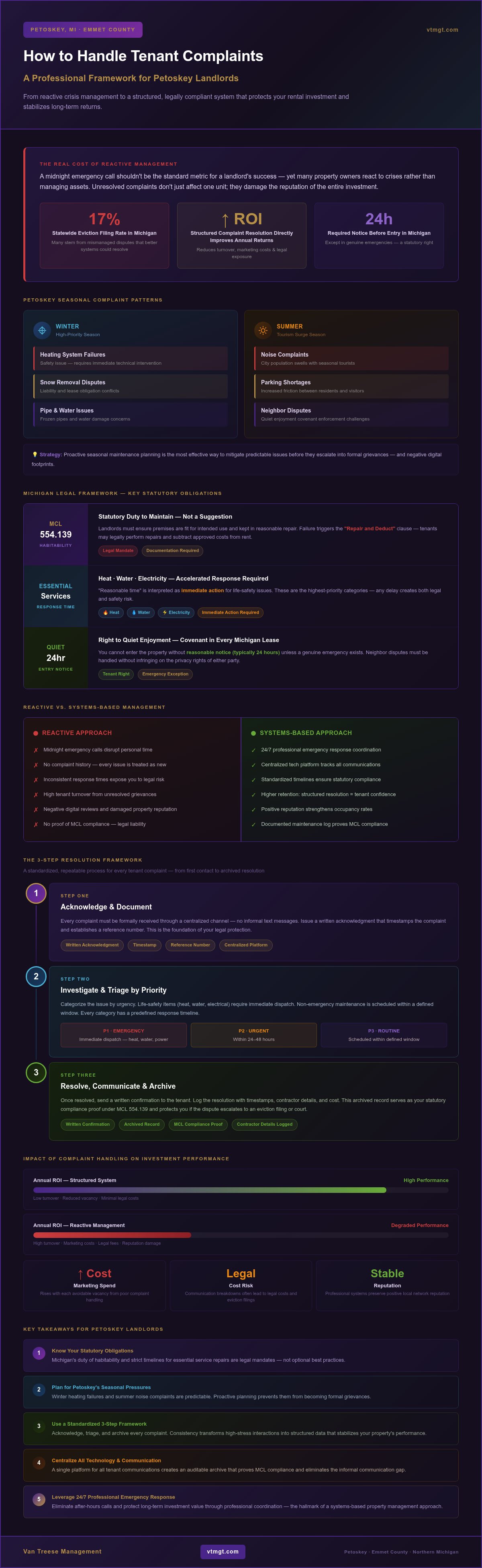
Our climate dictates the rhythm of operational friction. During the winter months, snow removal disputes and heating system failures dominate communication logs. These aren't just inconveniences; they're safety issues that require immediate technical intervention. Conversely, the summer tourism surge in Petoskey introduces noise complaints and parking shortages as the city's population swells. Proactive planning for rental property maintenance in Northern Michigan is the most effective way to mitigate these predictable issues before they escalate into formal grievances.
The Economic Cost of Unresolved Complaints
Friction in the tenant-landlord relationship has a direct impact on annual ROI. High turnover rates in Petoskey lead to increased marketing expenses and lost rental income. When communication breaks down, legal costs often follow. A University of Michigan study noted a 17% statewide eviction filing rate; many of these cases stem from mismanaged disputes that could've been resolved through better systems. Maintaining a structured approach to resolution protects your capital and ensures your property remains a preferred choice in the local market. Poorly handled complaints don't just affect one unit; they damage the reputation of the entire investment.
Michigan Landlord-Tenant Law: The Legal Framework
Michigan law establishes a rigid baseline for property maintenance that every owner must respect. Under MCL 554.139, landlords have a statutory duty to ensure the premises are fit for the use intended and kept in reasonable repair. This isn't a suggestion; it's a legal mandate. When considering how to handle tenant complaints Petoskey residents submit, you must first verify that your response aligns with the Michigan Landlord Laws. Failure to meet these standards can trigger the "Repair and Deduct" clause, where tenants may legally perform repairs themselves and subtract the approved cost from their rent payment.
Essential service repairs, specifically those involving heat, water, and electricity, require an accelerated response timeline. While Michigan statutes don't always provide a fixed hour count for every scenario, "reasonable time" is usually interpreted as immediate action for life safety issues. For more detailed information on these obligations, you can consult Michigan's official guidance on renter's rights. Maintaining a structured maintenance log is the best way to prove you’ve met these statutory requirements. If you find the legal complexities of these requirements overwhelming, seeking professional residential property management can help clarify these duties through standardized operating procedures.
The Right to Quiet Enjoyment
Quiet enjoyment is a fundamental covenant in every Michigan lease agreement. It guarantees that the tenant's possession won't be disturbed by the landlord or others with superior title. For Petoskey landlords, this means you can't enter the property without reasonable notice, typically 24 hours, unless there's a genuine emergency. Handling neighbor disputes, such as noise or parking friction, requires a delicate balance; you must enforce lease terms without infringing on the privacy rights of either party. Documentation of every notice provided is essential for your legal protection.
Fair Housing and Complaint Handling
Consistency is the primary defense against Fair Housing Act claims. When you decide how to handle tenant complaints Petoskey properties generate, the process must be identical for every resident regardless of their background. Prioritizing one tenant's request over another's without a technical, objective reason can create the appearance of a discriminatory pattern. The Fair Housing Act serves as a mandatory framework for all tenant interactions. We recommend using standardized intake forms to ensure every complaint is categorized by its technical urgency rather than the person submitting it.
Standardized Systems vs. Reactive Management
Many property owners in Emmet County fall into the "DIY trap," where each resident request is treated as an isolated, manual task. This reactive management style is the primary driver of landlord burnout. When you lack a structured framework, every phone call feels like a crisis that demands immediate emotional and physical energy. Transitioning to a systems-based approach allows you to treat property management like an engineering process: predictable, documented, and scalable. By utilizing professional property management in Petoskey, owners can remove the emotional friction from the resolution process, ensuring that decisions are based on technical necessity and lease obligations rather than personal stress.
Standardized systems act as a disciplined buffer between the owner and the tenant. Instead of a chaotic exchange of text messages or unrecorded phone calls, a professional system centralizes all data. This transition is essential for anyone looking to improve landlord-tenant relationships through transparency and reliability. When a resident knows exactly how their issue is being tracked, their anxiety decreases, even if the repair isn't instantaneous. This structural clarity is the foundation of a thriving rental community.
Innovation in Tenant Communication
Modern management relies on technology to eliminate the "midnight call" pain point. A 24/7 tenant portal allows residents to submit non-emergency requests at their convenience, providing a clear description and photos of the issue. These systems can automate follow-up messages, ensuring the tenant feels heard while the landlord remains focused on higher-level asset management. Most importantly, these platforms create a digital paper trail. This archive is invaluable during financial audits or if a dispute ever reaches the 90th District Court, as it provides objective proof of the landlord's responsiveness and diligence.
Standardized Maintenance Coordination
Efficiency in maintenance requires more than just a toolbox; it requires a vetted network of Northern Michigan contractors who understand the local climate's demands. A standardized system categorizes every submission into three distinct tiers:
- Emergency: Immediate threats to life safety or property integrity (e.g., burst pipes, no heat in winter).
- Urgent: Issues affecting comfort or potential long-term damage (e.g., failing appliances, minor leaks).
- Routine: Cosmetic or non-essential repairs (e.g., cabinet hardware, interior paint touch-ups).
A Step-by-Step Resolution Process for Petoskey Landlords
Resolving property issues requires a technical sequence that balances speed with accuracy. When determining how to handle tenant complaints Petoskey residents submit, landlords must move beyond emotional reactions to a structured four-step protocol. This sequence ensures that every grievance is processed through the same filter, reducing the risk of legal exposure or damaged property reputation. A disciplined approach transforms a potentially volatile situation into a manageable maintenance task.
- Step 1: Acknowledge and Validate. Respond to the initial contact within 24 hours. Validation isn't an admission of liability; it's a confirmation that the resident's concern has been recorded in your system.
- Step 2: Investigation and Documentation. Gather the facts before committing to a solution. This includes inspecting the physical site, reviewing lease terms, and taking photographs to establish a baseline of the issue.
- Step 3: Action and Timeline. Provide the tenant with a specific window for resolution. If a furnace part is backordered during a Petoskey winter, communicate that delay immediately rather than leaving the tenant in uncertainty.
- Step 4: Follow-up and Feedback. Once the repair or dispute is settled, confirm satisfaction. Closing the loop prevents the same complaint from resurfacing and reinforces your status as a professional provider.
If you find that coordinating these steps across multiple units is consuming too much of your operational capacity, consider partnering with a specialist in maintenance coordination to streamline your response times.
Effective Communication Strategies
De-escalating an angry tenant requires active listening. Let the resident finish their explanation without interruption. It's often helpful to repeat their main points back to them to ensure total alignment on the facts. Maintain a professional, disciplined tone in all written correspondence; avoid defensive language or informal slang. While digital portals are excellent for tracking, don't hesitate to transition to a phone call if a text exchange becomes repetitive or circular. A three-minute conversation can often resolve a misunderstanding that ten emails cannot.
Resolving Inter-Tenant Conflicts
Conflicts between neighbors, such as noise disputes or common area friction, require a mediation-first mindset. Your role is to apply lease terms consistently across all parties involved. Avoid taking sides based on tenant longevity or personal rapport. Use objective data, like decibel logs or dated witness accounts, to make decisions. If a situation involves threats of violence or illegal activity, it's time to transition the matter to law enforcement or legal counsel. Professional management keeps you out of the middle of these personal disputes while ensuring the rental community remains stable.
The Van Treese Approach to Tenant Relations
Van Treese Management operates on the principle that property stability is a product of technical precision and consistent human interaction. We don't view grievances as disruptions; we view them as operational data that informs better asset management. Our framework for how to handle tenant complaints Petoskey owners face relies on a synthesis of advanced property technology and local expertise. By acting as a disciplined buffer between the owner and the resident, we ensure that every interaction remains professional, objective, and aligned with the lease agreement.
Our 24/7 emergency response coordination serves as the primary solution to the "midnight call" stressor that affects so many independent landlords. We manage the logistics of immediate repairs in Emmet and Charlevoix counties, utilizing a vetted network of contractors to secure the property and protect your capital. This systematic approach extends to our financial and operational reporting. Owners receive clear, standardized documentation of all maintenance activities and communication logs, providing total transparency into the health of their investment. We focus on building thriving local communities in Petoskey, Boyne City, and the surrounding areas by maintaining high standards for every unit we manage.
The Value of Professional Oversight
Out-of-state investors frequently choose our team because we provide the local oversight necessary for high-stakes assets. We understand the specific nuances of the Petoskey market, from seasonal maintenance cycles to local ordinance compliance. Professional management is a critical component for those investing in rental property in Northern Michigan. By stabilizing the tenant relationship, we've successfully turned high-conflict properties into predictable, high-performing assets with low turnover rates and a strong local reputation. Our team provides the stability required to scale your portfolio without increasing your personal stress.
Getting Started with Professional Management
Transitioning to a structured management environment is a straightforward process. We begin with a comprehensive property analysis and a management consultation to define your specific operational goals. Our team handles the integration of your current tenants into our standardized systems, ensuring they understand the new protocols for how to handle tenant complaints Petoskey residents might have. This transition minimizes friction and sets a clear standard for future communication. If you're ready to secure your investment with a partner that prioritizes stability and precision, contact Van Treese Management for Petoskey property solutions today.
Stabilizing Your Investment Through Systematic Management
Moving from a reactive posture to a disciplined management framework is the primary method for preserving property value and resident satisfaction. By internalizing the legal requirements of Michigan law and deploying standardized communication protocols, you remove the emotional friction that frequently leads to landlord burnout. Mastering how to handle tenant complaints Petoskey properties present requires a synthesis of technical precision and specific local market awareness. This structural approach ensures that every grievance is treated as a manageable data point rather than an operational crisis.
You don't have to navigate these complexities in isolation. Our team provides the Standardized Management Systems and 24/7 Emergency Coordination required to protect your assets while fostering a stable rental community. With deep Northern Michigan Local Expertise, we serve as the professional buffer your investment requires to thrive. Transform Your Rental Management with Van Treese Management today to regain control of your operational schedule and your property's financial performance. We look forward to helping you build a more resilient and professional real estate portfolio.
Frequently Asked Questions
What is the legal timeframe for a landlord to respond to a complaint in Michigan?
Michigan statutes require landlords to address repairs within a reasonable timeframe, though specific hours aren't always codified for every scenario. Essential services like heat, water, and electricity demand an accelerated response; this is often interpreted as 24 hours in emergency conditions. For non-essential repairs, a 30 day window is the standard benchmark. Maintaining a disciplined log of communication helps prove compliance if a dispute reaches the 90th District Court in Emmet County.
Can a tenant withhold rent in Petoskey if a repair isn’t made?
Tenants in Michigan have the right to withhold rent or use the "repair and deduct" method if a landlord fails to maintain a habitable property. However, they must first provide written notice and allow a reasonable time for the repair. This process is technically complex and often leads to eviction filings if handled incorrectly. We recommend using standardized maintenance systems to resolve issues before they escalate to this level of financial friction.
How should I handle a noise complaint between two of my tenants?
Managing noise disputes requires a neutral, evidence-based approach. You should first verify the claim by reviewing decibel logs or witness accounts. Once confirmed, issue a formal notice citing the specific quiet enjoyment clause in the lease agreement. Applying these terms consistently across all parties prevents claims of favoritism or discrimination. If the behavior persists, it may require legal intervention or law enforcement involvement to maintain the stability of the rental community.
What are the most common tenant complaints in Northern Michigan?
Common grievances often mirror the region's environmental shifts. In winter, snow removal delays and furnace failures are the primary triggers for communication. During the summer tourism peak, noise and parking friction become more prevalent. Understanding how to handle tenant complaints Petoskey residents present involves preparing for these predictable cycles. Proactive maintenance and clear seasonal protocols are the most effective ways to reduce the volume of these requests and preserve your property's reputation.
Do I need to document every minor tenant complaint?
Documenting every interaction is a technical necessity for professional risk management. Even a minor request for cabinet hardware can become relevant if a tenant later claims a pattern of neglect. A digital paper trail provides objective proof of your responsiveness and diligence during financial audits or legal disputes. Centralizing this data through a 24/7 tenant portal ensures that no detail is lost and every action is timestamped for future reference.
Is a landlord responsible for snow removal for a single-family rental in Petoskey?
Responsibility for snow removal typically depends on the specific terms of the lease agreement. While landlords are generally responsible for common areas in multi-family units, single-family home residents often handle their own driveways. However, this must be clearly defined in writing to avoid municipal code violations. Given Petoskey's heavy snowfall, clear communication regarding equipment and timing is essential to prevent safety hazards and maintain the property's structural integrity.
How can property management software help with tenant complaints?
Property management software transforms a reactive approach into a disciplined, automated process. It centralizes all communication into a single dashboard, allowing you to track the lifecycle of a complaint from submission to resolution. These systems can automate follow-up messages and coordinate with vetted local contractors, significantly reducing the time-to-resolution. Using technology to handle tenant complaints Petoskey residents submit removes the emotional friction and ensures that no maintenance task is overlooked.
When does a tenant complaint become a legal liability?
A complaint transitions into a legal liability when it involves a breach of the statutory duty of habitability or a violation of the Fair Housing Act. Ignoring essential service repairs or prioritizing requests based on protected characteristics creates significant exposure. Documentation is your primary defense; if you can't prove a timely response, you're vulnerable in court. Professional oversight ensures that every grievance is handled within the mandatory legal framework to protect your investment.