
Understanding CAM Charges in Northern Michigan: A 2026 Commercial Lease Guide

Imagine opening your year-end reconciliation statement to find a surprise five-figure charge that wasn't in your annual budget. For many business owners, this "CAM shock" is a recurring source of friction that undermines the stability of their operations. We recognize that Common Area Maintenance charges often feel like a moving target, particularly when you're trying to account for the unique demands of commercial property maintenance in Petoskey. It's frustrating to face a lack of transparency in line items or confusion over how your pro-rata share is calculated.
This guide will empower you to master these complexities to ensure transparency and long-term cost-efficiency. You'll gain a clear understanding of what should be included in your CAM fees, from seasonal snow management to the 2.7% property tax inflationary increase capped for 2026. We'll also provide the technical knowledge you need to negotiate caps or conduct audits with confidence. By the end of this article, you'll know how to verify that your property manager is utilizing disciplined, structured systems to protect your bottom line while maintaining the highest standards for your facility.
Key Takeaways
- Distinguish between base rent and additional rent by understanding how your pro-rata share is calculated using leasable square footage.
- Identify standard regional inclusions such as property taxes and insurance, while accounting for the significant impact of winter commercial property maintenance Petoskey.
- Master the annual reconciliation process to effectively manage the variance between estimated monthly payments and actual year-end operating expenses.
- Develop the technical expertise required to negotiate expense caps or conduct audits to ensure full transparency in all maintenance line items.
- Leverage standardized management systems and detailed financial reporting to achieve the predictability and stability necessary for commercial investment success.
What are Common Area Maintenance (CAM) Charges?
In a commercial lease agreement, the financial structure is typically divided into two distinct categories: base rent and additional rent. What are Common Area Maintenance (CAM) Charges? Simply put, these fees represent the tenant's proportional share of the costs required to operate and maintain shared spaces within a property. While base rent covers the right to occupy a specific suite, CAM charges ensure the infrastructure supporting that suite remains functional and professional. This distinction is vital for accurate budgeting and long-term financial planning in the Northern Michigan market.
Shared areas include any part of the facility that isn't exclusively leased to a single tenant. Common examples include lobbies, parking lots, sidewalks, landscaped areas, and shared restrooms. In our region, commercial property maintenance Petoskey requires a rigorous approach due to extreme weather variability. Maintaining these spaces isn't just about aesthetics; it's about protecting the underlying asset's value and ensuring the property remains competitive for high-quality tenants and their customers.
The Purpose of CAM in Commercial Real Estate
CAM charges function as a dedicated fund to ensure the property remains safe, accessible, and attractive. Without these contributions, shared infrastructure like parking lot lighting or entry vestibules would quickly fall into disrepair, creating liability risks and diminishing the customer experience. We act as the administrator of these funds, managing complex accounting processes to ensure every dollar is allocated toward the property's operational integrity. Professional management is essential because these accounts require precise reconciliation to maintain transparency between the landlord and the tenant group.
CAM vs. Operating Expenses: What’s the Difference?
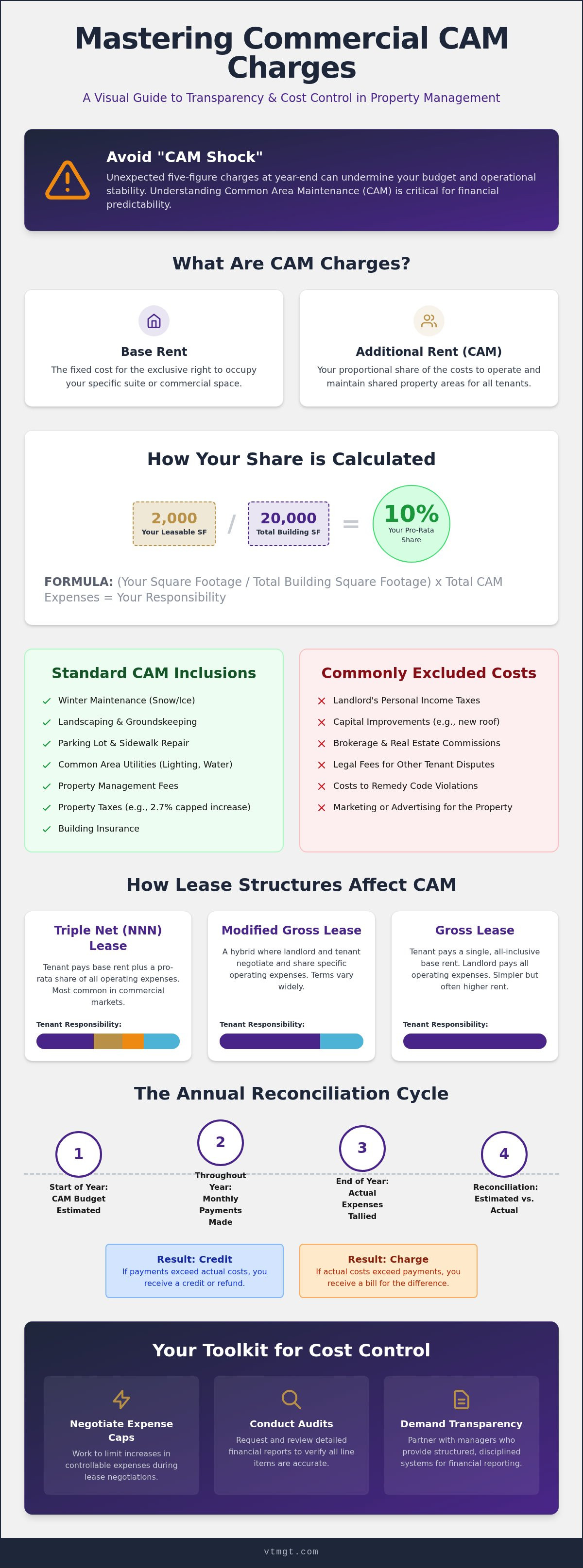
While often used interchangeably, it's technically accurate to distinguish between general operating expenses and specific CAM items. General expenses might include broad administrative overhead, whereas CAM focuses strictly on the shared physical environment. Standard leases typically exclude certain costs from CAM, such as the landlord's personal income taxes, legal fees related to other tenants, or major capital improvements that add permanent value to the building's structure. CAM is strictly a pass-through expense for the landlord, meaning the owner receives no profit from these collections; they're used entirely to reimburse the costs of maintaining a high-performance business environment.
How CAM Charges are Calculated in Northern Michigan
Precision is the foundation of commercial real estate finance. To understand your financial obligations, you must first grasp the concept of the pro-rata share. This figure represents the percentage of the building you occupy relative to the total leasable area. Understanding how CAM charges are calculated requires a simple but rigid formula: (Tenant Square Footage / Total Building Square Footage) x Total CAM Expenses. If you occupy 2,000 square feet in a 20,000 square foot facility, your share is exactly 10% of the shared operating costs.
Load factors add a layer of complexity to this calculation. These factors account for common areas like hallways and lobbies by applying a percentage to your usable square footage to determine your rentable square footage. Building occupancy levels also play a significant role. In some leases, "gross-up" clauses allow landlords to estimate variable expenses as if the building were 95% or 100% occupied. This ensures that the costs of commercial property maintenance Petoskey are distributed fairly, preventing a single tenant from bearing the entire burden of shared services during periods of high vacancy.
Common Lease Structures and CAM
The specific lease structure dictates how much of the CAM total you're responsible for paying. Triple Net (NNN) leases are the most prevalent structure in the Petoskey and Traverse City commercial markets. In an NNN agreement, the tenant pays a base rent plus their pro-rata share of all operating expenses, including taxes and insurance. Conversely, Gross leases include these costs in the base rent, often utilizing a "Base Year" to protect tenants from future spikes in maintenance costs. Modified Gross leases offer a middle ground, where parties negotiate which specific expenses are shared. If you're evaluating a new site, we recommend a thorough review of these terms to avoid unexpected budget variances.
The Importance of Square Footage Accuracy
Errors in building measurement can lead to significant overpayment over the life of a lease. It's essential to distinguish between Usable Square Footage (the space you actually occupy) and Rentable Square Footage (usable space plus your share of common areas). Professional commercial property management Northern Michigan relies on accurate audits of these figures to ensure billing integrity. We utilize standardized systems to verify these dimensions, providing both owners and tenants with the data necessary to maintain a fair and transparent partnership. If you're unsure about your current calculations, reviewing your lease's measurement standards is a logical first step toward financial transparency.
The Northern Michigan Factor: What is Included in CAM?
The Northern Michigan climate necessitates a specific set of inclusions within CAM budgets that differ significantly from southern markets. Standard operating expenses typically encompass property taxes, which for 2026 are levied at a state average of 54.14 mills for commercial properties, while taxable value increases are capped at 2.7% for assets that haven't recently changed ownership. For buildings in Emmet County, commercial property maintenance Petoskey involves structured financial reporting to ensure every line item is accounted for with engineering-grade precision. Additionally, insurance premiums and common area utilities, such as exterior lighting and shared corridor climate control, are foundational components of these charges.
Winter operations represent the most volatile portion of the CAM budget. In Petoskey, snow management isn't merely an aesthetic concern; it's a critical safety requirement. This includes continuous plowing, salt application, and sidewalk clearing to maintain accessibility during heavy lake-effect snow cycles. Seasonal landscaping and parking lot striping are also integrated into the CAM framework to preserve the structural integrity of the asphalt and the property's curb appeal. Administrative and management fees are included to cover the professional oversight required to coordinate these multi-faceted services and manage the associated financial accounts.
Snow Removal and Winterization Costs
Snow removal in Northern Michigan is a variable expense that demands a disciplined approach to budgeting. Beyond the parking lot, roof snow load management and ice dam prevention are essential CAM items to prevent structural damage. We prioritize a network of vetted local contractors who provide 24/7 emergency response during severe weather events. This proactive stance ensures that properties remain operational even when accumulation exceeds several feet. By treating these as structured maintenance tasks, we minimize the risk of budget shocks at the end of the fiscal year.
Routine vs. Emergency Maintenance
Routine maintenance focuses on the lifecycle of shared infrastructure, such as HVAC systems for common areas and specialized lighting arrays. These systems require regular inspections to maintain efficiency and comply with safety standards. Emergency repairs are handled within the CAM framework through established protocols that ensure rapid resolution without disrupting business continuity. For a broader look at upkeep standards in the region, including residential comparisons, see our guide on rental property maintenance Northern Michigan. This comprehensive approach to commercial property maintenance Petoskey ensures that every facility under our management operates at peak performance throughout the year.
Navigating CAM Audits and Reconciliations
Financial transparency in a commercial lease is maintained through the annual reconciliation process. This cycle begins with the landlord providing an estimate of operating expenses at the start of the fiscal year. Tenants pay their pro-rata share based on these projections throughout the months. At the end of the year, the landlord calculates the actual costs incurred. If the actual expenses for commercial property maintenance Petoskey exceed the estimates, the tenant is responsible for a reconciliation payment. If costs were lower than projected, the tenant receives a credit toward future rent.
The audit right is a critical contractual protection that allows tenants to verify these expenses. We recommend that tenants look for red flags such as capital expenditures disguised as routine maintenance. For instance, while sealing a parking lot is a maintenance item, a full structural replacement is typically a capital improvement that shouldn't be passed through in a single year. Reviewing the detailed general ledger ensures that every line item aligns with the lease's definitions of recoverable expenses and prevents the misallocation of owner-specific overhead.
Understanding the Year-End Adjustment
Reconciliation statements are typically issued in the first quarter of the following year. This timing allows for the finalization of utility bills and property tax assessments, such as the 2026 commercial property tax rate of 54.14 mills. We utilize standardized financial reporting systems to provide clear, line-item breakdowns of all costs. This level of detail helps tenants prepare for potential catch-up payments and ensures that owners maintain accurate records for their annual tax filings. If you need assistance verifying your current lease compliance, our team can provide expert Financial Reporting and Accounting services to ensure every calculation is accurate.
Negotiating CAM Caps and Exclusions
Negotiating a CAM cap is one of the most effective ways to ensure long-term budget stability. A cap limits the amount that certain controllable expenses can increase year over year, often set at a fixed percentage like 5%. It's essential to distinguish between cumulative and non-cumulative caps. A cumulative cap allows a landlord to bank unused increases from previous years, while a non-cumulative cap strictly limits the increase for the current period only. Standard Northern Michigan leases should also clearly list exclusions, such as structural repairs, executive salaries, and marketing costs for vacant spaces, to protect the tenant's bottom line.
Transparent Commercial Management with Van Treese
Effective management of commercial assets requires more than just reactive repairs. We utilize standardized systems to ensure that CAM costs remain predictable throughout the entire fiscal cycle. We don't rely on guesswork; our team analyzes historical data and current vendor rates to ensure that every CAM estimate is grounded in technical reality. By applying this detailed market research to our initial projections, we set fair estimates that reflect the real-world costs of commercial property maintenance Petoskey. This data-driven approach allows us to act as a neutral bridge between owner ROI and tenant satisfaction, ensuring that lease administration remains equitable for all stakeholders.
Our commitment to building thriving local communities is reflected in our disciplined lease administration processes. We recognize that transparency is the primary tool for reducing disputes between landlords and tenants. When financial reporting is accurate and maintenance line items are clearly defined, it creates a stable environment where businesses can focus on growth rather than unexpected billing variances. This professional oversight is essential for maintaining the long-term stability of the commercial and service sectors in Northern Michigan.
Standardized Systems for Lower Costs
We maintain a rigorous selection process for our network of vetted local contractors to ensure competitive pricing and high-quality execution. Our maintenance coordination protocols include regular facility audits and lifecycle assessments for major building systems. By treating a commercial property as a complex engineering asset, we can forecast future needs with high accuracy. Proactive maintenance is a core component of our strategy, as identifying minor issues before they escalate prevents the expensive emergency spikes that often disrupt CAM budgets. This structured oversight ensures that the facility's operational parameters are always met without unnecessary waste or administrative friction.
Expert Management in Emmet and Charlevoix Counties
Our local presence in Emmet and Charlevoix counties provides a distinct advantage in managing the regional commercial landscape. We understand the specific environmental stressors that impact commercial property maintenance Petoskey, allowing us to implement expert seasonal planning for lake-effect snow cycles and freeze-thaw asphalt degradation. Whether your assets are located in Petoskey, Traverse City, or the surrounding areas, we provide the technical expertise required to manage complex commercial facilities within disciplined frameworks. This localized knowledge ensures that your property remains a community cornerstone while maintaining its maximum asset value through every season.
Contact Van Treese Management for a Commercial Consultation
Achieving Operational Stability in Northern Michigan Commercial Leases
Mastering the nuances of Common Area Maintenance charges is essential for any business operating in the Northern Michigan region. By identifying the specific inclusions within your lease and verifying the accuracy of pro-rata calculations, you can eliminate the financial friction often caused by year-end reconciliations. Effective commercial property maintenance Petoskey requires a proactive approach that accounts for extreme seasonal variables while maintaining strict fiscal transparency. This disciplined oversight ensures that your facility remains a high-performance environment for both employees and customers without compromising your annual budget.
We provide the professional framework necessary to bridge the gap between complex lease compliance and daily operational efficiency. Specializing in Emmet and Charlevoix county commercial assets, our team utilizes standardized management systems for maximum efficiency and provides 24/7 emergency maintenance coordination to protect your investment. We invite you to Optimize Your Commercial Property with Van Treese Management to ensure your facility operates with the precision and predictability your business deserves. We look forward to supporting your long-term success in the regional market.
Frequently Asked Questions
What are the most common CAM charges in Northern Michigan?
Standard charges include property taxes, insurance, and utilities for shared spaces like lobbies or parking lots. In this region, snow management and roof ice dam prevention are critical components of commercial property maintenance Petoskey. Landscaping and parking lot upkeep also feature prominently in annual budgets. We manage these through structured systems to ensure every line item is documented and necessary for the asset's long-term operational integrity and safety.
How often are CAM charges adjusted in a commercial lease?
CAM charges are typically adjusted on an annual basis to reflect the actual operating costs of the facility. At the start of the fiscal year, a monthly estimate is set based on historical data and projected vendor rates. Once the year concludes, a reconciliation process determines the variance between these estimates and the actual expenditures. This structured timeline allows both landlords and tenants to maintain accurate financial planning and operational stability.
Can I negotiate my CAM charges before signing a lease?
Commercial leases are highly negotiable, and tenants should advocate for specific protections before execution. You can negotiate CAM caps to limit annual increases, often targeted at 5% for controllable expenses. It's also possible to define specific exclusions, such as capital improvements or landlord income taxes. Our management approach prioritizes transparency, ensuring that these negotiated terms are strictly followed through detailed financial reporting and disciplined administrative oversight of shared funds.
What is a CAM reconciliation and when does it happen?
Reconciliation is the formal accounting process that compares the estimated monthly CAM payments made by a tenant against the actual costs incurred during the year. This typically occurs in the first quarter of the following year once all utility and tax data is finalized. If the tenant overpaid, they receive a credit; if they underpaid, a catch-up payment is required. We provide detailed statements to ensure this process remains transparent and fair.
Are property taxes and insurance always included in CAM?
Property taxes and insurance are standard inclusions in Triple Net leases, which are the most prevalent structure in the Petoskey and Traverse City markets. In these agreements, the tenant pays their pro-rata share of the building's total tax bill and insurance premiums. For 2026, the Michigan state average tax rate for commercial property is 54.14 mills. We recommend reviewing your specific lease document to confirm if these costs are treated as additional rent or base rent.
What happens if the building is half-empty; do my CAM charges go up?
A half-empty building doesn't necessarily mean your charges will increase if your lease contains a gross-up clause. This provision allows the landlord to estimate variable expenses, such as janitorial services or utilities, as if the building were 95% or 100% occupied. This ensures that the costs of commercial property maintenance Petoskey are distributed fairly. Without this clause, a single tenant could unfairly bear the entire burden of fixed costs for shared infrastructure.
How does snow removal affect my monthly CAM payment?
Snow removal is a significant variable cost that can lead to reconciliation spikes if not budgeted correctly. Because accumulation in Northern Michigan is unpredictable, monthly CAM estimates often include a buffer for winter services. This includes plowing, salting, and sidewalk clearing. We utilize a network of vetted local contractors to ensure competitive pricing, but a particularly harsh winter will inevitably result in higher actual costs that are captured during the year-end reconciliation process.