
How to Be a Successful Landlord in Michigan: The 2026 Professional Guide

Did you know that while the average rent in Michigan has climbed to $1,156 as of May 2026, a single oversight in the Truth in Renting Act can jeopardize your entire annual profit? You've likely realized that property ownership is merely the foundation of your investment; the real complexity lies in the rigorous operational systems required to sustain it. Learning how to be a successful landlord in Michigan is no longer about intuition. It's about transitioning from a passive owner to a precise asset manager who understands the technical nuances of the local market.
We've designed this professional guide to help you master the legal, financial, and maintenance systems essential for a high-ROI rental business. You'll gain a clear understanding of Michigan's strict 1.5-times rent security deposit limit and the mandatory 30-day itemization deadline. We'll also detail the 7-day notice protocols for non-payment and the specific maintenance coordination strategies needed to handle Northern Michigan winters. This article provides a comprehensive blueprint for achieving full legal compliance and long-term property appreciation in 2026.
Key Takeaways
- Master the essential operational frameworks for how to be a successful landlord in Michigan by aligning your asset management with 2026 market demand and legal requirements.
- Navigate the complexities of the Michigan Truth in Renting Act to ensure your lease agreements provide maximum legal protection and full compliance with MCL 554.631.
- Implement a standardized tenant screening and placement system that balances modern technology with professional human interaction to minimize vacancy rates and improve retention.
- Protect your asset's long-term value by designing a preventative maintenance schedule tailored to Michigan’s four seasons, ensuring your property consistently meets statutory habitable standards.
- Conduct a rigorous cost-benefit analysis of your current management processes to determine if transitioning to professional systems is necessary for scaling your rental portfolio.
Navigating the Michigan Rental Market Landscape in 2026
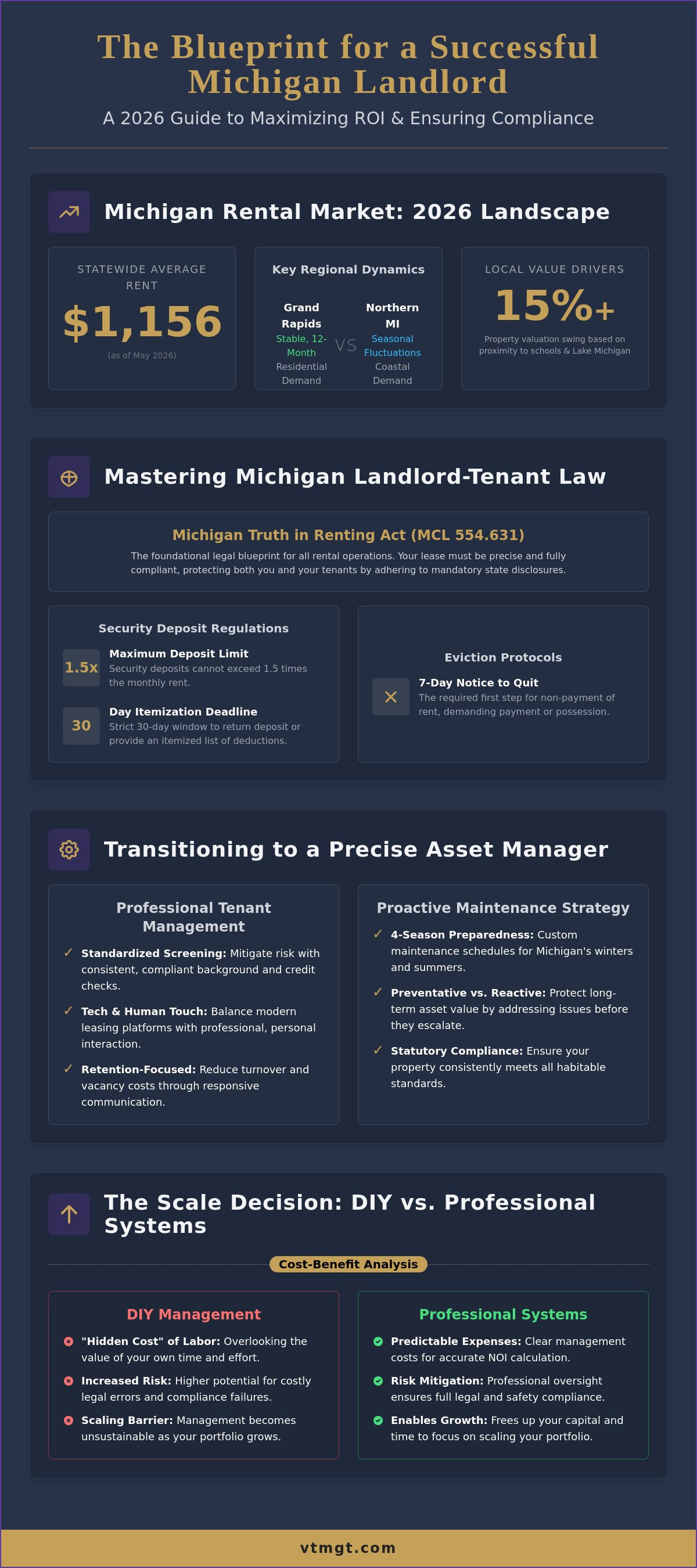
The Michigan rental market in 2026 demonstrates a bifurcated demand structure that requires a disciplined, analytical approach. While the statewide average rent has stabilized at $1,156 per month, high-growth corridors like Grand Rapids and the Petoskey-Bay Harbor region show significantly tighter inventory levels. Understanding these regional discrepancies is the primary step in learning how to be a successful landlord in Michigan. Our analysis indicates that demand in the Lower Peninsula is increasingly driven by "quality of life" migration and the expansion of specialized manufacturing sectors. This shift necessitates a move away from speculative ownership toward systems-driven asset management.
Investors must distinguish between the 12-month residential stability found in Grand Rapids and the seasonal fluctuations prevalent in coastal communities. While seasonal demand can drive higher gross figures, it often introduces increased wear and tear and higher vacancy risks. Integrating investing in rental property Northern Michigan strategies allows owners to prioritize long-term appreciation and consistent cash flow. In Emmet and Charlevoix counties, setting competitive rates requires granular data. You can't rely on broad averages when local school district quality or proximity to Lake Michigan can swing property valuations by 15% or more.
Setting Realistic ROI Expectations
Calculating Net Operating Income (NOI) requires a rigorous accounting of Michigan-specific variables. We recommend factoring in the state's unique property tax structures and the 2026 insurance premiums, which reflect recent climate and construction cost adjustments. A frequent error in the DIY sector is overlooking the "hidden cost" of personal labor. Professional management systems provide a predictable expense ratio that mitigates the risks of human error. This systematic approach is rooted in landlord-tenant law fundamentals, ensuring that every financial projection accounts for the cost of full legal and safety compliance.
The Importance of Local Market Knowledge
A one-size-fits-all management model fails in Northern Michigan’s unique micro-markets. While Grand Rapids offers urban revitalization and higher unit volume, markets like Petoskey rely on scarcity and specific community amenities. Identifying "up-and-coming" neighborhoods requires looking at infrastructure investments and municipal zoning changes. For example, a property's proximity to Traverse City’s healthcare corridor or Petoskey’s downtown district significantly impacts its long-term tenant retention rates. Mastering how to be a successful landlord in Michigan involves evaluating these localized drivers to ensure your property remains a high-performing asset regardless of broader economic shifts.
Mastering Michigan Landlord-Tenant Laws & Compliance
Compliance represents the structural integrity of any rental operation. To understand how to be a successful landlord in Michigan, owners must align their daily operations with the Michigan Truth in Renting Act (MCL 554.631). This statute serves as a technical blueprint, prohibiting lease clauses that attempt to circumvent established tenant rights. In the 2026 market, where litigation risks are elevated, your lease agreements must be precise and free of unnecessary frills. We've developed a specialized guide on Michigan landlord laws that details the mandatory disclosures required by state statutes, including the specific name and address of the property manager or owner. Mastering these legal parameters is the first step in learning how to be a successful landlord in Michigan while maintaining a high-ROI portfolio.
Security Deposit Regulations: Avoiding the 45-Day Trap
The Michigan Landlord-Tenant Relationship Act of 1972 defines the strict parameters for deposit management. A landlord's security deposit cannot exceed 1.5 times the monthly rent. These funds must be secured in a regulated financial institution or through a surety bond filed with the Secretary of State. Accuracy in the inventory process is non-negotiable. You must provide tenants with two blank inventory checklists at the start of the lease and conduct a documented inspection upon termination. Accuracy here is a matter of professional humility and precision.
The timeline for returning deposits is a common point of failure for unmanaged properties. You're legally obligated to provide an itemized list of damages within 30 days of the tenant vacating. If a dispute arises over these deductions, you have exactly 45 days from the move-out date to file a suit for the disputed amount. Failing this deadline can lead to treble damages. For a definitive source on these procedures, consult the Michigan Legislature's Landlord-Tenant Guide. This technical oversight is a risk we help our clients avoid through rigorous accounting systems.
Fair Housing Act Compliance in Northern Michigan
A quality-centered management strategy requires strict adherence to the Federal Fair Housing Act and the Elliott-Larsen Civil Rights Act. These frameworks protect classes based on race, national origin, and familial status, while Michigan law adds specific protections for age and marital status. We advocate for a standardized screening system that uses objective data points to evaluate every applicant. This disciplined approach ensures that every decision is based on technical merit rather than subjective bias.
Establishing fixed thresholds for credit scores and income-to-rent ratios eliminates human error from the selection process. This methodology is particularly important when managing reasonable accommodation requests for service or emotional support animals. Since these regulations are subject to frequent updates, our property management solutions are designed to keep your assets within full legal compliance at all times. We don't just manage properties; we provide controlled frameworks for long-term investment stability.
Implementing Professional Systems for Tenant Management
Most property owners approach tenant management as a series of isolated tasks. This fragmented method often leads to operational fatigue and inconsistent cash flow. To understand how to be a successful landlord in Michigan, you must shift your perspective toward systems-driven asset management. A truly professional operation functions like a precision-engineered machine; every component, from marketing to move-out, must operate within tight tolerance thresholds. By establishing a standardized tenant placement system, you reduce vacancy periods and eliminate the variability that typically compromises ROI. Automated rent collection is a critical component of this framework, as 2026 market data suggests that digital payment systems reduce delinquency rates by 18% compared to manual collection methods.
Our "Van Treese" approach balances high-level technology with essential human interaction. While automated portals handle the logistics of financial reporting and maintenance requests, professional human oversight ensures that the unique nuances of the Michigan market are never overlooked. This methodology relies on the RPOA Landlord-Tenant Handbook as a foundational reference for operational best practices. By integrating these industry standards into your daily workflow, you create a scalable model that doesn't rely on your constant physical presence. Precision in the early stages of the tenant relationship dictates the stability of the entire lease term.
The 5-Step Professional Screening Process
Success in rental management is determined by the quality of the tenant. Our multi-point screening process removes subjective bias and replaces it with technical data. To learn how to be a successful landlord in Michigan, you must implement these five steps with absolute consistency:
- Step 1: Income Verification. We require standardized documentation to confirm a gross income of at least 3x the monthly rent.
- Step 2: History Review. Conduct comprehensive criminal and eviction history checks through 2026-compliant databases.
- Step 3: Behavioral Verification. Perform direct landlord reference checks to identify patterns in payment and property care.
- Step 4: Credit Analysis. Evaluate credit scores within the context of current economic conditions, looking for fiscal responsibility rather than just a raw number.
- Step 5: Professional Orientation. Finalize the lease with a structured session to ensure the tenant understands all operational protocols and property rules.
Effective Communication and Conflict Resolution
Maintaining a professional distance is essential for objective management. We utilize standardized communication systems to track every interaction, creating a transparent audit trail for both parties. This fegyelmezett (disciplined) approach prevents misunderstandings and ensures that all requests are handled according to established priority levels. A 24/7 emergency response protocol is non-negotiable; it protects the asset from catastrophic damage during Michigan's harsh winters and provides tenants with the security they expect from a high-quality rental. By treating communication as a technical requirement rather than a social obligation, you foster a stable community atmosphere that supports long-term tenant retention.
Optimizing ROI Through Northern Michigan Maintenance
Maintenance coordination is the primary mechanism for preserving the structural integrity and financial performance of a rental asset. To master how to be a successful landlord in Michigan, owners must recognize that maintenance is a systematic requirement, not a series of reactive events. Under MCL 554.139, landlords have a strict legal obligation to ensure the premises are fit for the intended use and kept in reasonable repair. Failing to meet these habitable standards can lead to severe legal penalties and rent withholding. By implementing a fegyelmezett (disciplined) preventative schedule, you mitigate these risks while optimizing long-term ROI. For a deeper analysis of specific seasonal requirements, consult our rental property maintenance Northern Michigan guide.
Leveraging a network of vetted local contractors is a critical component of this system. In 2026, labor shortages in specialized trades have increased repair costs by 12% across the Lower Peninsula. Our established relationships with technicians in Charlevoix and Emmet counties allow us to bypass these market pressures, ensuring that repairs are completed within tight tolerance levels and at competitive rates. This network provides the stability needed to maintain high-quality housing without compromising the bottom line. This professional approach ensures that your properties remain competitive in a market that increasingly values well-maintained, energy-efficient units.
Winterization and Emergency Preparedness
Petoskey and Boyne City present unique climatic challenges that demand technical precision. Standard snow removal protocols aren't sufficient; you must coordinate roof raking to prevent ice damming and ensure pipe insulation meets the thermal requirements of -20°F temperatures. We coordinate furnace inspections every October to identify potential failures before they become catastrophic emergencies in January. Maintaining a digital paper trail of these actions provides essential evidence for both legal compliance and tax deductions. It's not just about comfort; it's about protecting the building's envelope from Michigan's harsh seasonal shifts.
Capital Improvements vs. Routine Repairs
Distinguishing between routine repairs and capital improvements is essential for strategic financial reporting. While routine tasks keep the property habitable, capital improvements like roof replacements or high-efficiency HVAC systems increase the underlying valuation of the asset. We recommend a 10-year reserve plan that allocates a fixed percentage of monthly revenue to these long-term replacements. This structured approach ensures that the property's valuation is preserved for future resale or refinancing. Learning how to be a successful landlord in Michigan involves balancing these immediate costs with the long-term appreciation of the property. If you require a professional framework to manage these technical complexities, our maintenance coordination services provide the technical oversight your portfolio needs.
The Scale Decision: DIY vs. Professional Property Management
Every real estate investor eventually reaches a critical threshold where personal labor becomes a bottleneck for portfolio growth. To understand how to be a successful landlord in Michigan, you must objectively evaluate the opportunity cost of self-management. DIY operations often lack the technical redundancy and standardized protocols required to manage complex legal and maintenance requirements at scale. When an owner's time is diverted toward coordinating emergency repairs or chasing late payments, the strategic oversight of the asset suffers. Professional management isn't merely an expense; it's a technical upgrade that replaces variable human effort with controlled, repeatable systems.
Our data-driven approach indicates that professional oversight significantly reduces vacancy rates and legal exposure. By implementing a standardized framework, we eliminate the common points of failure that lead to costly litigation or extended turnover periods. Transitioning to professional management allows you to move from a reactive ownership mindset to a proactive investment role. This shift is essential for those seeking to build a stable, high-ROI rental business that functions independently of the owner’s physical presence. Precision in management is the final component in learning how to be a successful landlord in Michigan.
When to Hire a Professional Manager
Identifying the signs of outgrowing DIY management is a matter of operational efficiency. If you've acquired multiple units, moved out of the immediate region, or find yourself overwhelmed by 24/7 emergency coordination, your current system is likely prone to human error. Peace of mind is achieved through the implementation of fegyelmezett (disciplined) protocols that protect your asset around the clock. The complexity of commercial property management Northern Michigan requirements, involving intricate lease structures and specialized maintenance, often necessitates professional intervention earlier than residential portfolios. In both sectors, the goal remains the same: maintain the highest standards of property performance while minimizing the owner's operational burden.
The Van Treese Advantage: Innovation and Interaction
Van Treese Management transforms the industry by applying engineering-level precision to property relations. We don't just execute tasks; we provide comprehensive solutions that integrate the latest technology with professional human oversight. This approach ensures that your property isn't just a building, but a thriving community managed within a controlled framework. By standardizing excellence across our entire portfolio, we provide Northern Michigan owners with the stability and transparency they need to scale their investments. We invite you to transform your property management experience with Van Treese Management and secure the long-term success of your Michigan rental business.
Transitioning to Systems-Driven Asset Management
Mastering the technical foundations of how to be a successful landlord in Michigan requires a shift from reactive tasks to standardized operational frameworks. By aligning your portfolio with the 2026 legal requirements of MCL 554.631 and implementing rigorous seasonal maintenance protocols, you secure both the structural integrity and the financial performance of your investment. Success in the current market isn't a result of chance; it's the outcome of controlled processes and professional oversight.
Our team brings over 8 years of Northern Michigan expertise to your asset management strategy. We utilize standardized management systems designed for predictable results, supported by 24/7 emergency maintenance coordination that protects your property during extreme weather events. This fegyelmezett (disciplined) approach eliminates the risks of human error and ensures long-term tenant retention. We're committed to providing the technical precision your portfolio demands.
Maximize your rental ROI with Van Treese Management’s professional systems. We look forward to helping you achieve a stable, high-performance rental business in the Michigan market.
Frequently Asked Questions
Do I need a license to be a landlord in Michigan?
No statewide landlord license exists in Michigan, but many local municipalities mandate rental registration and inspections. Cities like Detroit and Grand Rapids require owners to obtain a certificate of compliance before a property can be legally occupied. You must verify the specific ordinances in your municipality to ensure your asset meets local safety and zoning standards. Failure to comply with these local registrations can result in significant fines or the inability to collect rent through the court system.
How much can a landlord charge for a security deposit in Michigan?
A landlord in Michigan can charge a maximum of 1.5 times the monthly rent for a security deposit. This limit is strictly defined under the Landlord and Tenant Relationship Act of 1972 and cannot be exceeded for any reason. These funds must be held in a regulated financial institution or secured by a surety bond filed with the Secretary of State. Understanding these technical limits is a fundamental step in learning how to be a successful landlord in Michigan while maintaining legal compliance.
Can a Michigan landlord enter without notice in 2026?
Michigan law does not specify a mandatory notice period for entry, though professional lease agreements typically require 24 to 48 hours for non-emergencies. Landlords may enter without notice only in cases of a bona fide emergency that threatens the safety of occupants or the structural integrity of the property. For routine maintenance or inspections, providing a structured notice period is a professional necessity that maintains tenant relations and respects privacy rights. Our systems ensure all entries are documented and communicated effectively.
What are the rules for evicting a tenant in Emmet County?
Evictions in Emmet County are processed through the 90th District Court and must adhere to state statutory timelines. You must provide a 7-day written notice for non-payment of rent or a 30-day notice for general lease violations before filing a summons. In cases involving documented illegal drug activity, a 24-hour notice is permitted. These legal procedures require absolute precision; any procedural error can lead to a dismissal of the case and extended vacancy periods for your property.
Is a written lease agreement required for all Michigan rentals?
A written lease isn't legally required for tenancies lasting less than one year, but it's a technical necessity for professional asset management. Written contracts provide the only reliable framework for enforcing property rules, defining maintenance responsibilities, and ensuring compliance with the Truth in Renting Act. Without a written document, your ability to prove specific terms or recover damages in a court of law is severely compromised. Every professional operation should utilize a standardized, legally vetted lease agreement.
How does the Michigan Truth in Renting Act protect landlords?
The Michigan Truth in Renting Act protects landlords by clearly defining which lease provisions are legally void, which prevents the inclusion of unenforceable terms. By adhering to this act, you ensure your lease is structurally sound and free from clauses that could lead to costly litigation or the invalidation of the entire contract. This legal clarity allows for more predictable asset management and reduces the risk of judicial penalties. It's a critical tool for anyone mastering how to be a successful landlord in Michigan.
What is the maximum late fee a landlord can charge in Michigan?
Michigan does not have a statewide statute that sets a specific dollar limit on late fees, but they must be "reasonable" and compensatory. Courts generally interpret this to mean the fee should reflect the actual administrative costs incurred by the landlord due to the late payment. Excessive fees that appear punitive rather than related to actual damages may be challenged and struck down in court. Most professional systems implement a flat fee based on documented administrative overhead and local market standards.
Who is responsible for snow removal at a Michigan rental property?
Responsibility for snow removal is typically determined by the specific terms of the lease agreement. In multi-family properties, the landlord generally coordinates snow removal for common areas and parking lots to ensure the property remains habitable and safe. In single-family rentals, this duty is often transferred to the tenant through a clear lease provision. Regardless of the private agreement, local ordinances in cities like Petoskey may hold the property owner ultimately responsible for keeping public sidewalks clear of ice and snow.