
Understanding My Landlord Financial Statement: A 2026 Guide for Michigan Owners

Your monthly owner statement is a high-precision diagnostic tool for your portfolio's health, not a simple receipt for rent collected. For many Michigan owners, understanding my landlord financial statement is a source of friction, particularly when trying to distinguish between routine repairs and long-term capital improvements while facing the February 15, 2026, LLC annual statement deadline. We recognize that confusion over management fee calculations, which typically range from 8% to 12% across diverse Michigan markets, can lead to unnecessary anxiety as tax season approaches.
This guide provides the technical framework you need to master these complexities, allowing you to track ROI with precision and optimize cash flow effectively. We'll examine how to audit your monthly ledger, prepare for the 2026 SALT deduction cap of $40,000, and streamline communication with your property management team through better data literacy. By the end of this analysis, you'll possess the clarity required to identify hidden costs early and ensure your 2026 tax filings are both accurate and efficient.
Key Takeaways
- Transition from intuitive guesses to structured asset management by mastering the precise anatomy of your monthly property ledger.
- Gain clarity on your 2026 tax obligations and expense tracking by understanding my landlord financial statement and its specific income categories.
- Evaluate your portfolio's performance with precision by calculating Net Operating Income (NOI) and Cash-on-Cash returns directly from your reporting data.
- Synchronize your financial planning with Michigan’s specific tax cycles and seasonal maintenance requirements in regions like Traverse City and Petoskey.
- Utilize integrated technology and owner portals to ensure real-time visibility and eliminate human error in your property accounting.
The Anatomy of a Landlord Financial Statement
A landlord financial statement is a comprehensive technical ledger that documents every financial transaction associated with a rental asset. For Michigan property owners, understanding my landlord financial statement is the primary mechanism for transitioning from speculative management to a disciplined, data-driven strategy. This document serves as the official record of an asset's performance, providing the transparency required to verify that every dollar is accounted for. It replaces the "gut feeling" approach with a rigorous audit trail that is essential for long-term wealth preservation.
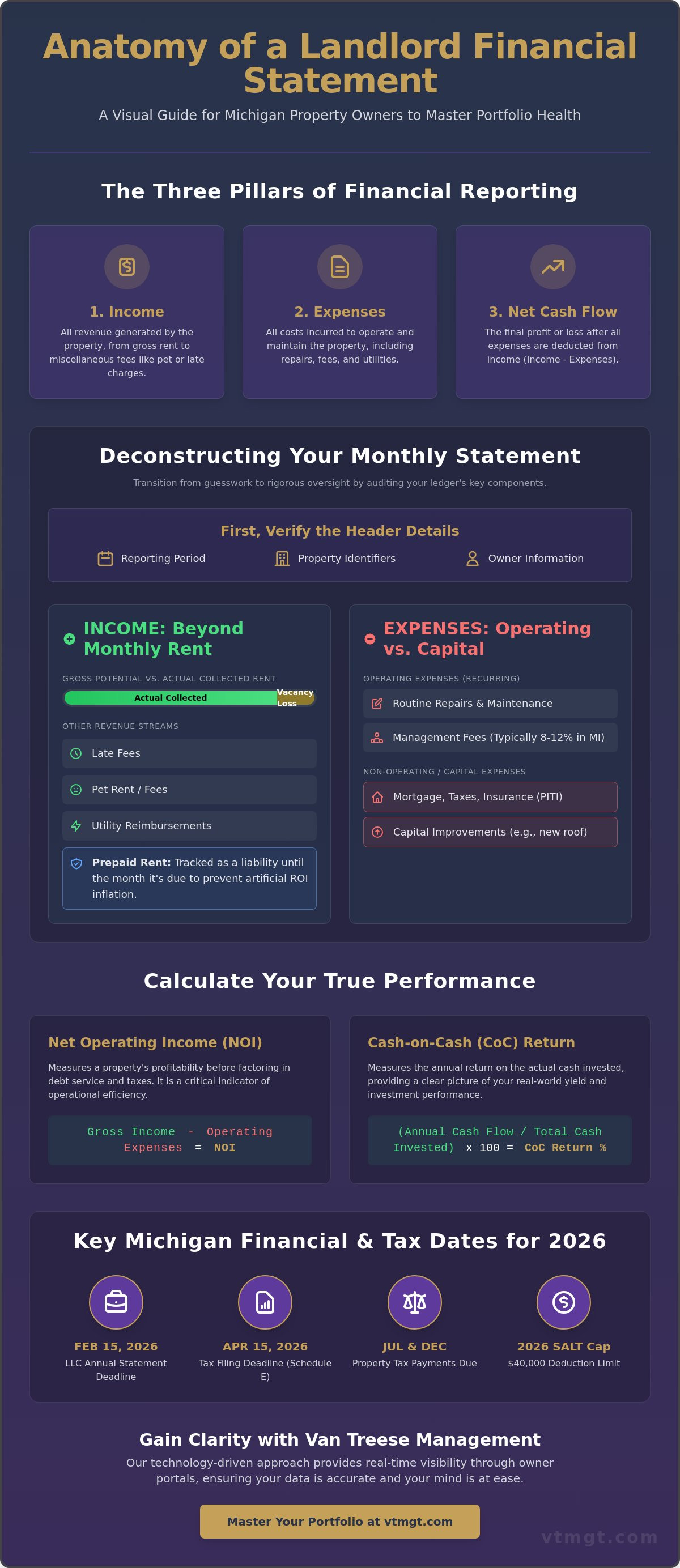
In the Northern Michigan market, monthly reporting has become the industry standard. This frequency is necessary to manage the region's unique financial cycles, including the July and December property tax payments and fluctuating seasonal maintenance costs. The report follows a rigid three-pillar structure: income, expenses, and net cash flow. To fully grasp the revenue side, one must define What is Property Income?, which includes gross rent, pet fees, and late charges. By tracking these pillars monthly, owners can identify if their management fees, which typically range from 8% to 12% in Michigan, are effectively yielding the expected service levels.
The Statement Header and Period Specifics
The header contains critical metadata that defines the scope of the data. You should first verify the reporting period to ensure it aligns with your expectations, whether it's a standard calendar month or a specific mid-month cycle. Accurate property identifiers and owner contact information are non-negotiable, as these details directly impact the accuracy of 1099 filings and LLC annual statements due by February 15, 2026. For investors with multiple assets, a "Portfolio" view is essential for assessing aggregate health, while individual property statements allow for granular troubleshooting of specific units.
Summary vs. Detail Ledgers
Summary ledgers provide a high-level snapshot of profitability, which is useful for rapid ROI assessments and monitoring cash-on-cash returns. However, the detail ledger is the most important component for rigorous oversight. It contains the full audit trail, itemizing every maintenance coordination fee and repair cost. This level of detail is vital for distinguishing between routine repairs and capital improvements, a distinction that is critical for the 2026 tax year. Standardized accounting systems, like those implemented by Van Treese Management, ensure that these ledgers maintain a consistent structure, eliminating the confusion often caused by fragmented or manual reporting methods. Having a clear audit trail also helps owners document compliance with proposed Michigan laws regarding repair timelines.
Deciphering Income and Expense Line Items
Precise asset management requires a granular breakdown of every dollar that enters and exits your account. When understanding my landlord financial statement, you must first distinguish between gross potential rent and actual collected rent. Gross potential rent represents the maximum theoretical revenue if your property achieved 100% occupancy at market rates. The actual collected rent, however, is the realized cash flow after accounting for vacancies and non-payment. This distinction is vital for calculating your real-world yield and identifying performance gaps in your portfolio.
Operating expenses encompass the recurring costs necessary to maintain the asset's functional status. These differ significantly from non-operating expenses, such as mortgage interest, property taxes, and insurance (PITI). For the 2026 tax year, Michigan landlords should track these carefully, especially since the SALT deduction cap has increased to $40,000. Implementing professional accounting tips for landlords ensures that you categorize these items correctly, which simplifies the preparation of your Schedule E before the April 15, 2026, deadline.
Income: Beyond the Monthly Rent
Your revenue stream often includes more than just the base lease amount. Statements should itemize late fees, pet rent, and utility reimbursements to provide a complete financial picture. It's also essential to identify "Prepaid Rent" correctly. If a tenant pays for future months in advance, that capital sits in a liability account on your ledger until the month it's actually due. This prevents an artificial inflation of your monthly ROI. Additionally, analyzing vacancy loss as a specific line item allows you to quantify the exact cost of turnover periods.
Operating Expenses and Management Fees
Management fees in the Michigan market typically range from 8% to 12% of collected monthly rent. You should verify whether your fee is calculated against "Collected" rent or "Scheduled" rent, as this impacts your net margins. Maintenance coordination fees are another standard line item, covering the administrative cost of vetting vendors and overseeing repairs. High-quality financial reporting and accounting services ensure these costs are transparent and tied to specific work orders. Look for recurring utility bills for common areas or vacant units to ensure you aren't paying for tenant-responsible services.
Commercial vs. Residential Financial Nuances
Residential reporting focuses heavily on tenant-paid utilities and the strict management of security deposit escrow accounts. In contrast, commercial statements require a higher level of technical complexity. You'll often encounter CAM (Common Area Maintenance) reconciliations, where tenants pay a pro-rata share of building expenses. Professional commercial property management Northern Michigan utilizes triple-net (NNN) reporting to ensure that taxes, insurance, and maintenance costs are accurately passed through to the tenant. This level of precision is necessary to maintain the valuation of high-capacity commercial assets.
Repairs vs. Capital Improvements
Distinguishing between a repair and a capital improvement is critical for tax efficiency. A repair, such as fixing a leaky faucet, is a current expense that you can deduct in the year it occurs. A capital improvement, like replacing a roof, adds long-term value and must be depreciated over several years. Correctly identifying these on your statement ensures you maximize your 4.25% Michigan individual income tax benefits while remaining compliant with IRS regulations.
Advanced Metrics: Calculating True ROI and Cash Flow
Moving beyond basic ledger oversight requires a technical understanding of how specific metrics influence your asset's long-term valuation. When understanding my landlord financial statement, the most critical figure you'll encounter is the Net Operating Income (NOI). This number represents your total income minus all operating expenses, excluding mortgage payments and income taxes. It serves as the primary benchmark for lenders and appraisers to determine the market value of your property. A stable or increasing NOI indicates a well-managed asset where operational efficiencies are being successfully captured.
While NOI measures the property's output, the Cash-on-Cash Return measures your performance as an investor. This ratio compares your annual pre-tax cash flow to the total amount of actual cash you've deployed into the asset. It's the most transparent way to determine if your capital is performing better here than in alternative investments. To track these figures with precision, you should regularly review a comprehensive rental property profit and loss statement. This document provides the raw data needed to calculate your Debt Service Coverage Ratio (DSCR), a metric lenders use to verify that the property generates sufficient income to cover its debt obligations comfortably.
The Reserve Account and CapEx Planning
Professional management systems prioritize the maintenance of an owner reserve account to prevent sudden out-of-pocket liquidity crises. We typically recommend maintaining a minimum reserve balance to cover immediate maintenance coordination needs or emergency repairs. This fund is distinct from your Capital Expenditure (CapEx) planning, which involves budgeting for large-scale structural requirements like roof replacements or HVAC system upgrades. CapEx is an investment in the property’s long-term value. By setting aside a percentage of monthly revenue for these future costs, you ensure the asset remains competitive in the Northern Michigan market without compromising your monthly cash distributions.
Cash Flow vs. Taxable Income
It's a common point of confusion when your bank account balance doesn't align with the "Net Income" line on your report. This discrepancy often stems from non-cash expenses, most notably depreciation. Depreciation allows you to deduct the cost of the building's physical structure over 27.5 years, reducing your taxable income without requiring an actual cash outlay. This is a primary driver of the rental property tax benefits Michigan investors leverage to build multi-generational wealth. By understanding my landlord financial statement through this lens, you can differentiate between realized cash flow and the strategic tax advantages that protect your bottom line during the 2026 filing season.
Northern Michigan Specific Financial Signals
Operational success in Northern Michigan requires a localized approach to fiscal oversight. When understanding my landlord financial statement, you must account for Michigan’s unique dual property tax cycle. Unlike states with a single annual bill, Michigan utilizes a Summer (July) and Winter (December) payment structure. For 2026, the inflation rate multiplier for calculating taxable value is 1.027, representing a 2.7% increase. Failing to anticipate these semi-annual outflows can create significant liquidity gaps if your reserve strategy isn't calibrated to the local tax environment.
Utility billing also presents regional complexities. In municipalities like Traverse City or Petoskey, the transition of water and sewer accounts between tenants often results in "gap" bills that appear on your statement during turnover. You should also monitor your ledger for the effects of property tax uncapping. When a property is sold in Michigan, its taxable value resets to the State Equalized Value, which often leads to a sharp increase in tax liability that your statement must accurately reflect for 2026 projections. Comparing your internal data to Petoskey rental market trends allows you to see if your current revenue and expenses align with regional benchmarks.
Managing the "Winter Slump" in Cash Flow
The climate in Emmet and Grand Traverse counties dictates specific expense patterns. Between November and March, heating costs for common areas and snow removal fees become dominant line items. Snow removal contracts in Petoskey are particularly critical; they must be executed with precision to maintain safety and tenant satisfaction. Vacancy costs also tend to rise during these months. Finding qualified tenants is statistically more difficult during the winter, often leading to longer days on market. We recommend maintaining a higher reserve balance during the third and fourth quarters to absorb these seasonal spikes without disrupting your monthly distributions.
Michigan Legal Compliance on Statements
Your financial report is more than a tracking tool; it's a legal defense mechanism. Understanding my landlord financial statement involves verifying that security deposits are handled according to Michigan landlord laws. This includes documenting any interest earned and maintaining a rigorous itemized list of damages for any deductions made. Proposed legislation in 2026 may require even stricter documentation for repairs, with mandated timelines for life-threatening or pest-related issues. Ensuring your manager provides a clear audit trail for every maintenance coordination event is essential to withstand legal scrutiny and protect your professional reputation.
If you're looking to optimize your portfolio's performance against these regional variables, consider our professional residential property management services to ensure your reporting remains compliant and transparent.
The VTMG Approach: Transparency Through Technology
Our methodology is built on the principle that precision in accounting leads to stability in ownership. In an industry where manual entry often leads to costly discrepancies, we utilize standardized management systems to eliminate human error. Understanding my landlord financial statement becomes a seamless process when every transaction is mapped within a high-precision digital framework. We provide 24/7 Owner Portal access, offering you real-time financial visibility into your portfolio's performance from any location. This level of technological integration ensures that you aren't waiting for a monthly mailer to assess the health of your Michigan assets.
While automation provides the structural framework, we believe human interaction is the catalyst for effective asset management. A dedicated account manager oversees your portfolio, providing the context and professional judgment that software alone cannot replicate. This human-centric oversight is paired with our vetted vendor network. By centralizing maintenance coordination, we leverage volume-based relationships to reduce line-item costs. This systematic approach ensures that every repair is performed to professional standards, providing a level of quality control that mirrors the rigors of the engineering sector.
Audit-Ready Financial Records
Preparation for the 2026 tax season begins with disciplined record-keeping throughout the year. We handle all year-end 1099-MISC preparation and provide consolidated annual reports that align with the April 15, 2026, federal filing deadline. Our digital document storage system links digital receipts directly to expense line items, creating a transparent audit trail for every dollar spent. This is particularly vital when managing rental property maintenance Northern Michigan, as it ensures all work orders are documented without hidden markups or administrative ambiguity. This level of detail protects you during both tax season and potential legal inquiries.
Strategic Consultation Based on Your Reports
We believe in moving from simply reading statements to active strategic planning. At Van Treese Management, we use your financial data as a diagnostic tool to identify opportunities for growth. If your statement shows a consistent trend of rising maintenance costs on a specific unit, we might suggest targeted capital upgrades to improve long-term ROI. We also analyze your "Gross Potential Rent" against current Traverse City market data to recommend timely rent increases that keep your property competitive. This data-driven approach ensures your investment isn't just surviving the 2026 market but is actively modernizing to meet future demands.
Ready for transparent, professional reporting? Contact Van Treese Management today.
Mastering Your Portfolio’s Financial Future
Effective asset management in 2026 requires more than a casual glance at a bank balance. It demands a rigorous approach to understanding my landlord financial statement as a technical blueprint for ROI. We've explored how to decipher complex line items, navigate Michigan's dual tax cycles, and leverage advanced metrics like Net Operating Income to drive valuation. By integrating standardized accounting systems with real-time data, you eliminate the ambiguity that often plagues residential and commercial ownership. This disciplined oversight ensures your asset remains competitive in an evolving economic landscape.
Stability is achieved through a combination of technological precision and local expertise. Our framework provides 24/7 Owner Portal Access and a Vetted Local Vendor Network to ensure every repair is documented and every dollar is optimized. This structured oversight allows you to focus on long-term growth while we manage the granular details of maintenance coordination and financial reporting. We're committed to providing the transparency you need to make informed, data-driven decisions for your Michigan properties.
Request a Free Rental Analysis and Sample Financial Report to see how our precision-engineered reporting can transform your investment strategy. We're ready to help you build a more resilient and transparent portfolio.
Frequently Asked Questions
Why does my "Net Income" not match the cash deposited in my bank account?
Net income is an accounting metric that calculates profitability, while your bank deposit reflects actual cash flow. Discrepancies often arise from non-cash expenses like depreciation or cash-outlays that aren't considered operating expenses, such as mortgage principal payments and owner draws. Understanding my landlord financial statement requires looking at the "Cash Flow" section to see the reconciled liquid capital available for distribution.
What is the difference between a Management Fee and a Maintenance Coordination Fee?
Management fees, which typically range from 8% to 12% in the Michigan market, cover administrative services like tenant screening and lease preparation. Maintenance coordination fees are specific technical charges for the professional oversight of vetted vendors and the execution of work orders. These ensure that repairs meet rigorous quality standards and comply with proposed 2026 Michigan repair timelines without requiring your direct logistical involvement.
How often should I receive a financial statement from my property manager?
You should receive a comprehensive technical ledger every 30 days to maintain accurate oversight of your asset. Professional firms also provide 24/7 digital portal access, allowing for real-time monitoring of income and expenses. This frequency is necessary to track seasonal variables in Northern Michigan, such as the 2.7% property tax inflation increase expected for the 2026 tax year.
Can I use my monthly owner statement for filing my Michigan property taxes?
Monthly statements provide the foundational data for your tax filings, but you'll need the consolidated year-end report for final submissions. These records are essential for calculating your Schedule E and maximizing the 2026 SALT deduction cap of $40,000. Always verify your monthly ledgers against the 1099-MISC form provided by your manager before the April 15, 2026, federal deadline.
What happens to the security deposit on the financial statement?
Security deposits are classified as liabilities on your ledger rather than property income. They're held in a dedicated escrow account and don't impact your monthly ROI or cash flow metrics. This accounting structure ensures compliance with Michigan law, which requires a strict separation of tenant deposits from the property's operating capital to protect both parties during the move-out inspection.
Why is there a "Reserve" or "Minimum Balance" held on my statement?
A reserve balance acts as a liquidity buffer for immediate operational requirements. It ensures there's sufficient capital to cover emergency repairs or utility bills during tenant transitions without requiring an out-of-pocket contribution from the owner. Maintaining this minimum balance is a standard risk-management practice that prevents disruptions in maintenance coordination and keeps the asset in functional status.
How do I identify if a tenant has a past-due balance from the report?
Unpaid rent and late fees are itemized in the "Aged Receivables" or "Delinquency" section of your report. This area of the statement provides a granular view of outstanding balances by unit and duration. By understanding my landlord financial statement through these specific modules, you can identify collection trends early and make data-driven decisions regarding lease enforcement or tenant retention.
Is an owner statement the same as a Profit and Loss (P&L) statement?
An owner statement is a broader document that includes the data found in a P&L plus all cash movements. While a P&L focuses strictly on revenue and operating expenses to show profitability, the owner statement tracks "Below the Line" items like owner contributions, draws, and reserve adjustments. This provides a complete technical audit trail of how cash entered and exited the property's accounts during the period.