
Building a Rental Portfolio in Northern Michigan: 2026 Strategic Guide
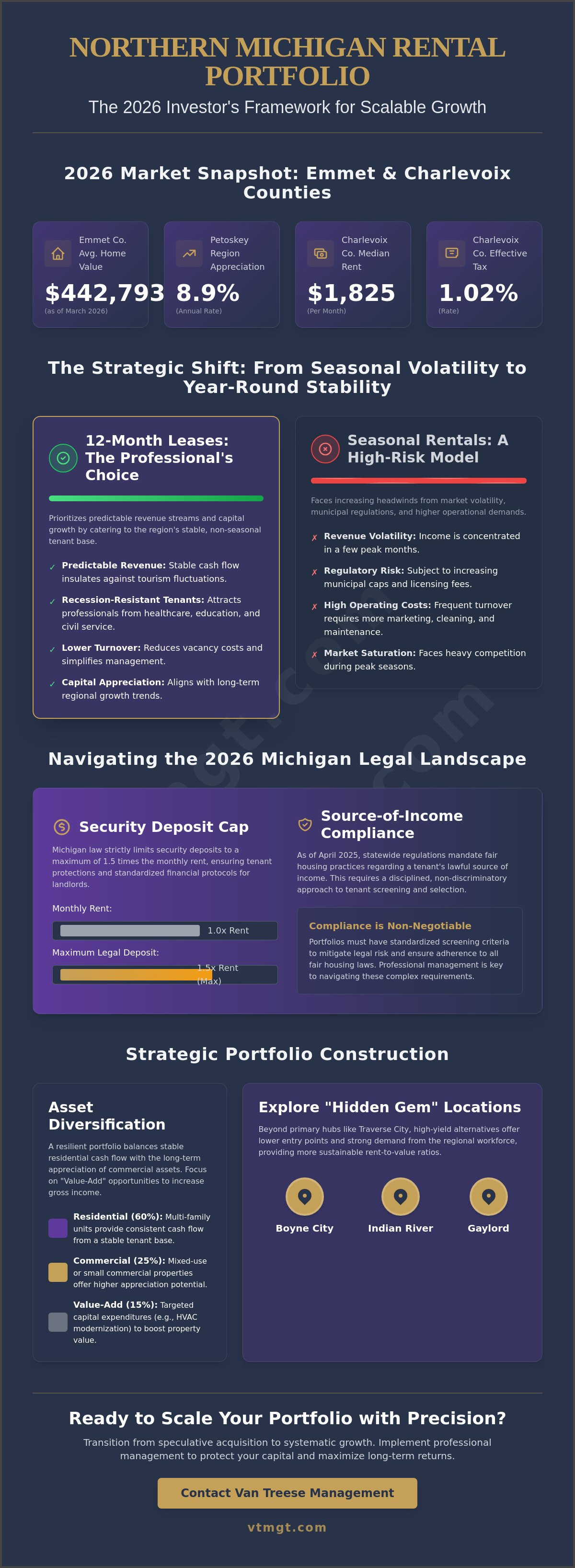
The transition from speculative property acquisition to building a rental portfolio in Northern Michigan requires a shift from seasonal intuition to systematic precision. With average home values in Emmet County reaching $442,793 as of March 2026, the margin for error in asset selection has narrowed significantly. You likely understand that managing multiple units across different counties often leads to fragmented maintenance schedules and inconsistent tenant quality. It's a complex environment where statewide regulations, such as the source-of-income protections enacted in April 2025, demand a disciplined approach to compliance and risk mitigation.
This guide provides a professional framework for investors to scale residential and commercial portfolios with the technical rigor required for long-term stability. You'll learn how to standardize your tenant placement and maintenance coordination to capitalize on the 8.9% annual appreciation currently seen in the Petoskey region. We'll examine the specific data points and legal requirements, from the 1.5 times monthly rent security deposit cap to the 1.02% effective tax rate in Charlevoix County, to ensure your assets deliver stable cash flow and capital growth.
Key Takeaways
- Understand why 12-month residential occupancy offers superior financial stability compared to seasonal peaks in the 2026 Northern Michigan market.
- Learn a precision framework for building a rental portfolio in Northern Michigan by strategically balancing residential and commercial assets across Emmet and Charlevoix counties.
- Navigate the latest 2026 Michigan landlord-tenant regulations, including updated security deposit protocols and source-of-income compliance requirements.
- Discover how to implement standardized management systems that replace reactive repairs with predictive maintenance cycles to protect your long-term capital appreciation.
- Identify the critical operational "break-even" point where transitioning to professional oversight becomes essential for scaling asset valuation and portfolio health.
The Economic Case for Long-Term Portfolios in Northern Michigan
Building a rental portfolio in Northern Michigan requires a disciplined departure from the traditional tourism-centric model. In 2026, a stable portfolio prioritizes 12-month occupancy over the volatile peaks of the seasonal market. While vacation rentals often face increasing municipal caps and licensing fees, long-term residential and commercial assets provide a predictable revenue stream. This shift is largely driven by the persistent "Zoom Town" effect, where remote professionals seek high-quality housing in regions with established natural amenities. These tenants aren't looking for a weekend stay; they're looking for a permanent base, creating a structural demand that far outlasts the summer months.
Economic stability in the Petoskey and Traverse City corridors is anchored by robust healthcare hubs and educational institutions. Facilities like McLaren Northern Michigan and Munson Healthcare, alongside North Central Michigan College, provide a steady influx of specialized professionals. These sectors create a base of "recession-resistant" tenants who prioritize proximity to their workplaces. By applying fundamental real estate investing principles, sophisticated investors can mitigate risk by diversifying away from the discretionary spending habits that drive the short-term rental market. Long-term leases act as a hedge against economic fluctuations, ensuring that debt service and operating expenses remain covered regardless of the tourism climate.
Beyond Tourism: Year-Round Rental Demand
Identifying the right tenant profile is essential for maintaining low turnover rates in Emmet and Charlevoix counties. We see the highest retention among healthcare workers, educators, and civil service employees who require stable, year-round housing. The impact of limited housing inventory in 2026 has pushed median rents in Charlevoix to $1,825 per month, a figure supported by the area's 5.2% annual appreciation in home values. This supply-demand imbalance ensures that well-maintained properties don't sit vacant. Portfolio stability is the balance between residential cash flow and commercial appreciation.
Northern Michigan's 2026 Market Resilience
Population shifts toward the Grand Rapids and Traverse City corridors indicate a broader regional growth trend that benefits the entire Northern Michigan landscape. Investors are moving away from speculative flips and toward the systematic accumulation of assets. Because of this, investing in rental property in Northern Michigan remains a top-tier Midwest strategy for 2026. The combination of appreciating home values, which reached $442,793 in Emmet County this March, and a disciplined management approach allows for scalable growth. It's a market that rewards those who view property not just as a building, but as a precision-managed financial instrument.
Strategic Asset Selection in Emmet and Charlevoix Counties
Building a rental portfolio in Northern Michigan requires a shift from emotional acquisition toward a "Precision Selection" framework. While retail investors often overpay for lakefront views that carry high maintenance loads, professional investors prioritize assets based on standardized management metrics. This involves evaluating the structural integrity of multi-family units and the long-term yield potential of mixed-use properties. With the median listing price in Emmet County reaching $895,800 in April 2026, finding value necessitates looking at "Value-Add" opportunities. These are properties where targeted capital expenditures, such as HVAC modernization or unit reconfiguration, can significantly increase the effective gross income without the volatility of the seasonal tourism market.
We recommend a balanced approach that blends residential stability with commercial appreciation. Diversifying across different municipalities helps mitigate the risk of localized ordinance changes. While Traverse City remains a primary hub, high-yield alternatives in Boyne City, Indian River, and Gaylord offer lower entry points and strong demand from the regional workforce. These "Hidden Gem" locations benefit from the same natural amenities as the lakefront corridors but provide more sustainable rent-to-value ratios for those focused on building a rental portfolio in Northern Michigan.
Residential Hotspots for Long-Term Growth
Petoskey continues to serve as the region's operational anchor due to its proximity to McLaren Northern Michigan and North Central Michigan College. However, Boyne City has emerged as a primary residence choice for remote professionals, driving a 75.1% increase in median sale prices in Charlevoix County as of February 2026. When evaluating residential assets, we utilize a tenant-readiness checklist to ensure compliance and marketability:
- Energy Efficiency: Verification of insulation and window seals to withstand Michigan's winter climate.
- Legal Compliance: Alignment with Michigan landlord-tenant laws, specifically regarding the 1.5 times monthly rent security deposit cap.
- Functional Modernization: Upgrading flooring and fixtures to meet the expectations of high-income professional renters.
Integrating Commercial Real Estate
Small-scale commercial units provide a critical buffer against residential turnover. Integrating 1,000 to 3,000 square foot professional suites or retail spaces allows investors to utilize NNN (Triple Net) lease structures, where tenants handle a portion of taxes, insurance, and maintenance. Understanding the nuances of commercial property management in Northern Michigan is vital when handling mixed-use assets. These properties require precise accounting of Common Area Maintenance (CAM) charges to maintain transparency and profitability. For investors looking to refine their selection process, our team can provide a detailed analysis of local market trends to identify assets with the highest appreciation potential.
Navigating the Regulatory and Legal Landscape in 2026
Building a rental portfolio in Northern Michigan requires more than just capital; it demands a rigorous understanding of an increasingly granular legal framework. In 2026, the regulatory environment has shifted toward greater protection for long-term tenants and stricter oversight of housing providers. While municipalities like the City of Charlevoix have implemented caps and a $300 annual license fee for short-term rentals, these restrictions create a distinct competitive advantage for long-term investors. By focusing on 12-month residencies, you bypass the escalating costs and compliance burdens associated with the vacation market. This strategic shift is supported by data from the Northern Michigan Housing Needs Assessment, which highlights a critical shortage of year-round housing supply across the 10-county region.
Standardizing lease agreements is a fundamental requirement for ensuring compliance across multiple jurisdictions, such as Petoskey and Traverse City. We emphasize that a single error in a lease document can lead to significant legal exposure. For example, Michigan law is precise regarding security deposits: they cannot exceed 1.5 times the monthly rent, and an itemized list of deductions must be returned within 30 days of a tenant moving out. Professional tenant screening has transitioned from a best practice to a mandatory risk management protocol. It's the only reliable way to navigate the 2025 source-of-income protections while ensuring your assets are occupied by qualified, stable residents.
Compliance as a Scalability Factor
A deep technical understanding of Michigan landlord laws is essential for protecting the valuation of your growing portfolio. Since April 2, 2025, it's illegal to discriminate against tenants based on their source of income, including government assistance or Section 8 vouchers. Our firm conducts proactive legal audits to ensure all lease disclosures and operational procedures align with these statewide mandates. Standardized systems for lease termination, such as the required 30-day notice for month-to-month agreements, provide the structural stability needed to scale without administrative friction.
Emmet and Charlevoix County Specifics
Local ordinances in Emmet and Charlevoix counties often impose additional layers of complexity, such as specific rental registration programs and safety inspections. Charlevoix Township, for instance, requires a license for any dwelling rented for less than 30 days, a regulation that reinforces the stability of the long-term sector. Addressing Fair Housing challenges in rural Northern Michigan requires a disciplined approach to documentation and tenant placement. We maintain rigorous standards for every unit, ensuring that local inspection requirements are met well before a tenant ever receives a key. This level of precision protects your reputation and your capital appreciation.
Standardized Management Systems: The Key to Scalability
Building a rental portfolio in Northern Michigan successfully requires moving beyond the "hobbyist" mindset. While human interaction remains a component of property management, it must be supported by rigid, standardized systems to ensure portfolio health. Without these protocols, an investor with 10 units faces the same administrative burden as one with 50. We utilize professional accounting and financial reporting to track portfolio-wide ROI, allowing owners to identify underperforming assets with surgical precision. Our technology stack automates rent collection and initial tenant inquiries, ensuring that financial data is captured in real-time. This level of technical preparedness is what allows for the expansion of a residential or commercial footprint without a linear increase in stress.
Effective management isn't about reacting to problems; it's about controlling the environment in which your assets operate. By implementing standardized maintenance and tenant placement systems, we ensure that every property follows the same high-performance trajectory. This systematic approach is the only way to achieve long-term capital appreciation and stable cash flow in a market as diverse as Northern Michigan. Standardized systems eliminate the landlord fatigue that typically kills portfolio growth by removing the emotional friction of daily operations.
Efficient Maintenance Coordination
Effective maintenance is the difference between capital appreciation and asset devaluation. We've moved away from reactive repairs, which are costly and disruptive, toward predictive maintenance cycles. This is particularly critical because rental property maintenance in Northern Michigan requires a specific seasonal strategy to account for extreme temperature fluctuations and heavy snowfall. Predictive maintenance involves scheduled inspections of roofing systems, HVAC units, and plumbing before the winter season begins. By identifying a failing water heater in October, we prevent an emergency call in January. Our network of vetted local contractors in Petoskey and Gaylord is integrated into our dispatch system, providing a 24/7 emergency response that requires zero owner intervention.
Tenant Placement and Retention Systems
High-quality tenant placement is the foundation of long-term stability. The "VTMG Standard" involves a multi-layered screening process that includes comprehensive background checks, credit analysis, and verification of local references. By standardizing our marketing and showing procedures, we significantly reduce vacancy rates, which averaged 9% across Michigan in May 2026. This process ensures that we only place tenants who respect the property and fulfill their financial obligations. If you're ready to transition from manual oversight to a scalable, automated model, you can view our full suite of management services to see how we protect your investments.
Scaling Your Portfolio with Van Treese Management
Transitioning from self-management to professional oversight is a calculated decision based on operational efficiency. For many investors, the "Break-Even" point occurs when the time required for maintenance coordination and tenant placement begins to detract from capital acquisition activities. Building a rental portfolio in Northern Michigan requires a level of precision that individual owners often struggle to maintain as they scale toward 10 or more units. Our team at Van Treese Management provides the structural framework necessary to manage this complexity, ensuring that every asset in Petoskey or Traverse City is treated with the same technical rigor as a precision manufacturing facility.
We approach property management as a solution-delivery process. By utilizing localized expertise, we drive asset valuation through disciplined maintenance and rigorous financial reporting. This allows our partners to focus on the strategic expansion of their residential and commercial holdings while we handle the daily administrative and technical requirements. It's a partnership built on the principles of stability and long-term capital appreciation.
The VTMG Advantage: Local Roots, Professional Systems
Our focus on long-term stability represents a deliberate rejection of the vacation rental hype that often leads to high turnover and regulatory risk. We prioritize the fundamentals of property management to drive consistent asset valuation. For example, we recently transformed a struggling multi-family unit in Emmet County by implementing our standardized management protocols. By auditing the existing lease structures and shifting to a predictive maintenance cycle, we reduced emergency repair costs by 22% within the first six months. This results-oriented approach ensures that your portfolio remains a high-performance financial instrument rather than an administrative burden. Review our residential management services to understand our methodology.
Getting Started: Portfolio Analysis
The path to building a rental portfolio in Northern Michigan begins with a comprehensive audit of your current or target holdings. We don't rely on generic market estimates; we provide a detailed market research report that accounts for specific 2026 data points in Charlevoix and Emmet counties, such as the 1.02% effective tax rate. Our onboarding process is designed to identify and rectify operational weaknesses immediately. We conduct a thorough audit of your current leases, financial reporting systems, and maintenance schedules to ensure they meet the VTMG standard for compliance and efficiency.
Scaling to a 10+ unit portfolio requires a partner who understands the local landscape and the technical requirements of property oversight. Whether you're managing residential units in Boyne City or commercial suites in Petoskey, our localized expertise ensures your assets are positioned for maximum growth. Contact Van Treese Management for a professional consultation to begin your portfolio analysis and secure your long-term position in the Northern Michigan market.
Securing Your Position in Northern Michigan's 2026 Market
The shift toward year-round residential and commercial assets is now a technical requirement for those building a rental portfolio in Northern Michigan. By prioritizing 12-month occupancy and adhering to the 2025 source-of-income protections, you insulate your capital from the volatility of seasonal tourism and the escalating licensing fees found in municipalities like Charlevoix. Success in this market depends on the implementation of predictive maintenance cycles and rigorous financial oversight that treats each property as a high-performance asset. Professional management replaces the friction of landlord fatigue with a scalable, data-driven framework.
Van Treese Management has been anchored in Petoskey since 2018, combining deep local roots with the industrial-grade systems required for scaling complex portfolios. Our expertise across both residential and commercial sectors provides the structural stability needed to navigate evolving Michigan landlord-tenant laws with precision. We invite you to move beyond the limitations of self-management and embrace a system designed for long-term capital appreciation and operational excellence. The Northern Michigan market remains a top-tier Midwest strategy for investors who value stability and precision.
Scale your portfolio with professional management in Northern Michigan
Frequently Asked Questions
Is Northern Michigan a good place for long-term rental investment in 2026?
Northern Michigan remains a strong investment hub in 2026 due to the structural housing shortage and consistent capital appreciation. With Emmet County home values increasing 8.9% as of March 31, 2026, the region offers a stable alternative to more volatile urban markets. The persistent demand from professional sectors ensures that building a rental portfolio in Northern Michigan delivers reliable 12-month occupancy rather than the unpredictable peaks associated with the vacation market.
What are the typical property management fees in Petoskey and Traverse City?
Property management fees in Northern Michigan typically follow industry standards based on the level of service required. While we don't publish a single flat rate, professional oversight generally includes a percentage of monthly gross rent or a fixed fee for specialized services like tenant placement and maintenance coordination. These costs are often offset by the reduction in vacancy rates and the prevention of costly legal disputes through standardized screening and lease preparation.
How do I choose between residential and commercial rentals in Northern Michigan?
The choice between residential and commercial assets should be based on your specific risk tolerance and cash flow requirements. Residential units currently face high demand from the healthcare and education sectors, providing immediate occupancy. Commercial assets, particularly mixed-use properties in Petoskey, allow for Triple Net (NNN) leases where tenants cover taxes and insurance. A balanced approach often yields the highest stability for those building a rental portfolio in Northern Michigan.
What are the latest changes to Michigan landlord-tenant law for 2026?
The most significant recent change is the April 2, 2025, legislation prohibiting discrimination based on a tenant's source of income. Landlords must now accept Section 8 vouchers and other forms of government assistance. Additionally, Michigan law remains strict regarding security deposits; they're capped at 1.5 times the monthly rent and must be processed within 30 days of lease termination to avoid legal penalties and potential litigation.
Do I need a local property manager if I live out of state?
Local property management is critical for out-of-state investors to ensure compliance with localized ordinances and to manage physical asset maintenance. Michigan's climate demands immediate response for heating failures or snow-related structural issues. A local manager provides the necessary presence to handle 24/7 emergencies and conduct regular inspections, which are often required by municipal registration programs in counties like Charlevoix and Emmet.
How does seasonal weather in Northern Michigan affect rental maintenance costs?
Seasonal weather significantly increases maintenance costs if a predictive strategy isn't in place. Heavy snowfall and sub-zero temperatures require regular roofing inspections and HVAC servicing before the winter season begins. By implementing standardized maintenance cycles, owners can avoid the high costs of emergency repairs. Addressing a minor boiler issue in October is far more cost-effective than a full system replacement during a January freeze.
Can I convert a short-term rental into a long-term rental portfolio?
Converting short-term rentals into a long-term portfolio is a viable strategy to bypass the increasing regulatory burden in Northern Michigan. Cities like Charlevoix have already implemented caps on the number of STR licenses and require a $300 annual fee. While specialized suite hotels like Pointes North Inn continue to serve the downtown hospitality market, shifting to long-term leases provides a more predictable revenue stream and eliminates the high turnover and hospitality-related expenses that often erode the profits of vacation properties.
What is the average vacancy rate for long-term rentals in Emmet County?
The average vacancy rate for long-term rentals in Emmet County typically aligns with the statewide average of approximately 9% as of May 2026. However, properties located near major employment hubs like Petoskey often see lower vacancy due to the critical shortage of workforce housing. High demand in these corridors ensures that well-maintained assets with standardized tenant placement systems maintain near-constant occupancy throughout the year.