
Eviction Process in Charlevoix County, MI: A 2026 Landlord’s Guide
A single administrative error at the 90th District Court in Charlevoix can instantly reset your legal timeline, resulting in weeks of additional lost revenue and mounting frustration. For property owners, the eviction process Charlevoix County MI is not a matter of intuition but a high-precision procedural exercise where local court familiarity is your only defense against costly delays. We recognize that the fear of "self-help" legal repercussions and the complexity of Northern Michigan law can make the recovery of your property feel like an insurmountable task. It's a stressful position that requires a disciplined, professional response to protect your investment.
You deserve a structured, reliable framework to secure your assets and maintain the stability of your rental portfolio. This guide promises to navigate the technical requirements of the Charlevoix courthouse, ensuring every filing meets the rigorous standards of 2026 Michigan law. We'll provide a comprehensive overview of the necessary SCAO forms, filing logistics at 301 State Street, and the standardized systems required to secure a lawful judgment. By following this technical roadmap, you can regain possession of your property while minimizing the risk of procedural dismissal.
Key Takeaways
- Identify the specific legal grounds that the 90th District Court requires to authorize a lawful repossession of your real estate.
- Execute the eviction process Charlevoix County MI with technical precision by mastering the mandatory seven-day notice window and SCAO documentation.
- Learn the procedural steps for filing at the Charlevoix courthouse to ensure your summons is served correctly and your court date is secured.
- Coordinate effectively with the Charlevoix County Sheriff to manage the physical set-out process once the 10-day post-judgment window has closed.
- Discover how rigorous tenant screening and standardized lease enforcement act as a primary defense against future legal complications.
Understanding Legal Grounds for Eviction in Charlevoix County
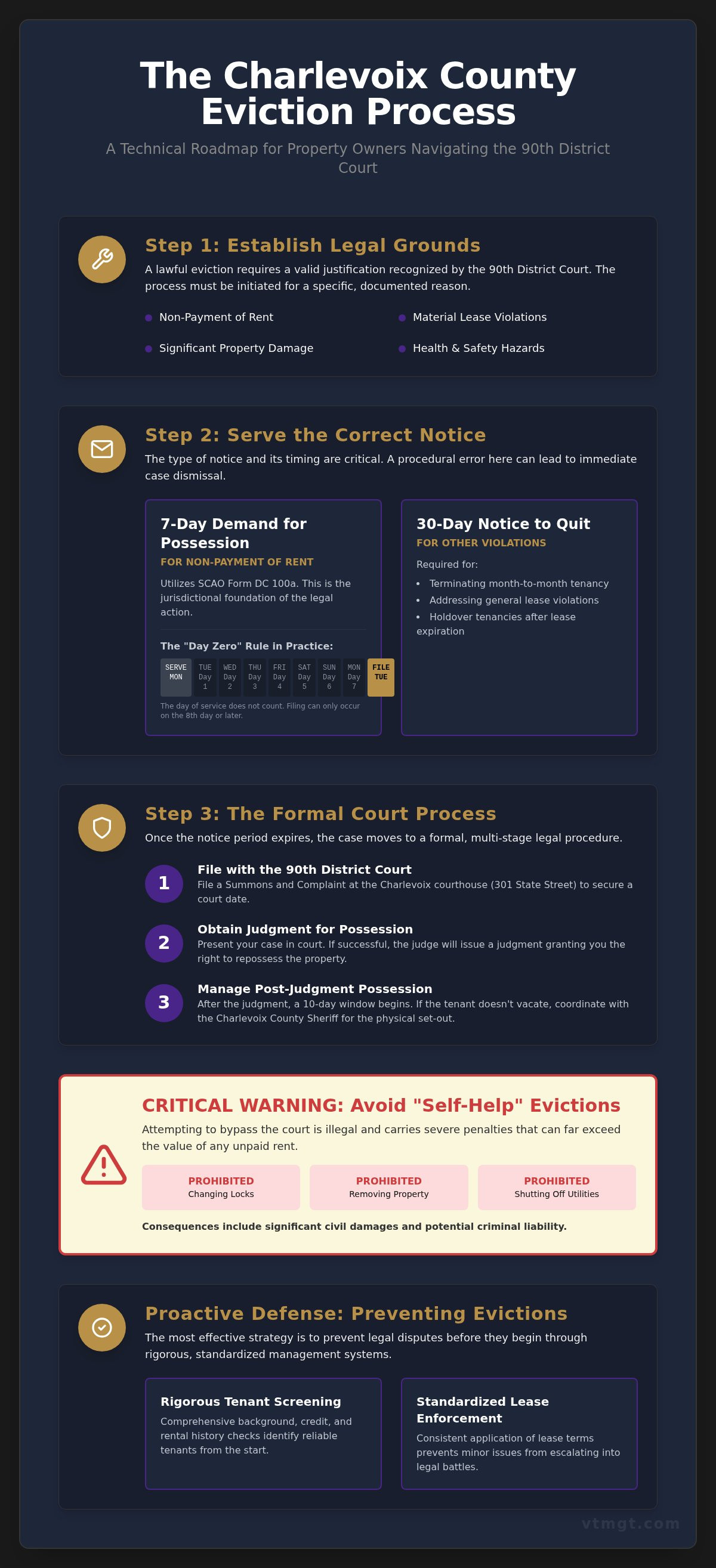
A lawful eviction is defined as a court-ordered process for repossessing real property. It isn't a private action but a formal legal sequence overseen by the judiciary. In the 90th District Court, established legal grounds for eviction serve as the only valid justification for removing a tenant. While nonpayment of rent is the most frequent trigger for these cases, landlords must also manage other technical breaches. Material lease violations, such as the presence of unauthorized occupants or undisclosed pets, represent significant contractual failures. Additionally, significant property damage that exceeds standard wear and tear provides a basis for possession. Health and safety hazards, often resulting from structural risks or tenant negligence, are also prioritized by the court to prevent property devaluation and community risk.
Termination of Tenancy vs. Nonpayment
Success within the eviction process Charlevoix County MI depends on selecting the correct notice period based on the specific violation. Michigan law distinguishes between immediate financial defaults and broader tenancy issues. The following parameters define these timelines:
- 7-Day Demand for Possession: Exclusively utilized for nonpayment of rent.
- 30-Day Notice to Quit: Required for terminating month-to-month agreements or addressing general lease violations.
- Holdover Tenancy: When a lease expires but the tenant remains, a specific legal strategy is necessary to prevent the creation of a "tenancy at will."
Adhering to Michigan landlord laws ensures that these timelines are calculated with technical precision. A single day's error in service can result in the 90th District Court dismissing the case, forcing the landlord to restart the entire sequence from day zero.
The High Cost of "Self-Help" Evictions
Attempting to bypass the court through "self-help" methods is a high-risk error that leads to severe civil and criminal liability. Actions such as changing locks, removing tenant property, or disconnecting essential utilities are strictly prohibited. Michigan statutes allow tenants to seek significant damages, which often total thousands of dollars. These penalties can far exceed the value of the original unpaid rent. Professional oversight replaces emotional, impulsive decisions with a disciplined procedural approach. By utilizing standardized management systems, property owners maintain full control over the asset while avoiding the legal "loopholes" that tenants often exploit in court during unmanaged disputes.
Serving the Correct Notice: The Procedural Foundation
The eviction process Charlevoix County MI begins with the technical issuance of a Demand for Possession, specifically SCAO Form DC 100a for nonpayment of rent cases. This document is the jurisdictional foundation of your legal action. Without it, the 90th District Court lacks the authority to hear your case. Precision in calculating the seven-day window is paramount. Judges in Northern Michigan observe the day zero rule; the day of service does not count toward the notice period. If a landlord serves notice on a Monday, the tenant has until the end of the following Monday to resolve the debt. Filing on day seven rather than day eight is a common procedural error that leads to immediate case dismissal.
Proof of Service acts as the evidentiary link between the landlord's demand and the court's authority. This document must specify the identity of the server, the exact time of delivery, and the specific method utilized. Northern Michigan judges frequently reject notices that lack clear documentation of service or contain mathematical errors in the amount of rent owed. Aligning these steps with Michigan landlord-tenant law ensures your filing remains resilient against tenant challenges during the summary proceedings.
Methods of Lawful Service in Northern Michigan
Service in rural areas like Charlevoix County presents unique logistical hurdles. While personal service is the gold standard, substituted service is permissible if the document is left with a resident of suitable age and discretion at the property. The mail and post method is a frequent choice for rural properties where direct contact is difficult. This requires both first-class mail delivery and the physical attachment of the notice to the main entrance of the dwelling. Don't rely solely on certified mail. Tenants often refuse to sign for these packages, which can stall the legal timeline indefinitely.
Documentation and Evidence Files
A successful possession case depends on the strength of your evidence file. Maintain a meticulous communication log that records every interaction with the non-compliant tenant. This record prevents conflicting testimonies during a hearing. Integrating rigorous Petoskey tenant screening processes early on helps establish the tenant's original intent and compliance history. Organize your financial records to clearly distinguish between base rent and late fees. Michigan courts focus primarily on the base rent during summary proceedings. If you find the technicalities of notice delivery overwhelming, professional Residential Property Management can ensure every step is handled with engineering-level precision.
Filing with the 90th District Court: Charlevoix and Petoskey
Once the notice period expires without a resolution, the eviction process Charlevoix County MI transitions into the judicial phase. This stage begins with the formal filing of the Summons (DC 104) and the Complaint (DC 102a for nonpayment or DC 102c for general possession). These documents must be filed with the 90th District Court clerk to initiate summary proceedings. The court then assigns a hearing date, which typically occurs within 10 to 30 days of the filing. It's a technical requirement that a court officer or professional process server delivers these documents to the tenant; a landlord cannot legally serve their own summons. This ensures that the service is documented by a neutral third party, preventing the tenant from claiming they never received notice of the hearing.
Accuracy during this filing stage is non-negotiable. The complaint must match the details provided in the original notice exactly, including the names of all occupants and the precise amount of rent in arrears. Any discrepancy between the notice and the court filing can result in the judge dismissing the case on a technicality. Utilizing a Michigan Legal Help guide to eviction can provide additional perspective on how these filings are structured at the state level, though local court preferences in Charlevoix often dictate the specific flow of the day's docket.
Navigating Local Courthouse Logistics
The 90th District Court serves both Charlevoix and Emmet counties, but the physical location of your filing depends on the property's specific township. The Charlevoix County courthouse is situated at 301 State St, Charlevoix, MI. For properties located near the county line, cases may be heard at the Emmet County courthouse at 200 Division St, Petoskey, MI. Identifying the correct clerk is vital because filing in the wrong jurisdiction will lead to immediate rejection. Clerks are responsible for verifying that the SCAO-approved forms are complete before they accept the filing fee and schedule the hearing on the judge's calendar.
The Hearing: What Northern Michigan Landlords Should Expect
Landlords should enter the courtroom prepared for a disciplined, evidence-based environment. In many Northern Michigan disputes, the presiding judge may mandate court-ordered mediation. This is a structured attempt to reach a settlement, such as a payment plan, before a formal judgment is entered. If mediation doesn't resolve the issue, the case proceeds to a hearing where objective evidence is the primary factor. Detailed financial ledgers and date-stamped photographs of lease violations are far more effective than verbal testimony. If the court rules in your favor, you'll receive a Judgment of Possession. It's important to remember that a 10-day appeal period follows this judgment, during which the tenant has a final opportunity to comply or vacate before further enforcement actions are taken.
Post-Judgment Possession and the Sheriff’s Role
Obtaining a Judgment of Possession does not automatically result in the physical removal of a non-compliant tenant. If the occupant refuses to vacate after the 10-day compliance window, the eviction process Charlevoix County MI enters its final enforcement phase. Landlords must then apply for an Order of Eviction, utilizing SCAO Form DC 107. This document, once signed by a judge, authorizes the Charlevoix County Sheriff to physically remove the tenant and their belongings from the premises. It's a technical transition from a legal declaration to a logistical operation. Only a court officer or sheriff has the legal authority to execute this order; any attempt by a property owner to intervene personally at this stage remains a significant liability risk.
Coordinating the physical "set-out" requires precise planning with local law enforcement. On the scheduled day, a locksmith should be present to immediately re-secure the property once the sheriff has cleared the interior. Handling abandoned property requires a disciplined approach to avoid claims of conversion or theft. While Michigan law provides specific frameworks for belongings left behind, the best practice involves documenting every item moved to the curb. Professional Residential Property Management ensures these high-tension events are handled with structured protocols, protecting the owner from unnecessary conflict.
The Order of Eviction (Writ) Timeline
Timing is a critical variable in the post-judgment phase. An Order of Eviction must be issued within 56 days of the original judgment date. If this window closes, the judgment may expire, necessitating a complete restart of the legal sequence. The administrative process within the Charlevoix County Sheriff’s office involves a queue based on available personnel and current caseloads. Managing this high-tension environment requires patience and a focus on procedural compliance. A successful set-out is the result of clear communication between the court, the sheriff, and your designated property representative.
Restoring the Property for Re-Leasing
Once possession is restored, the focus shifts toward protecting the asset's marketability. Immediate rental property maintenance is essential to reverse any neglect or damage that occurred during the dispute. Landlords must meticulously document the condition of the unit through date-stamped photography and itemized repair logs. This documentation is the primary evidence required for justifying security deposit deductions or pursuing a separate money judgment for damages. Restoring the unit through professional cleaning and repair coordination ensures the property returns to the market as a high-performing asset without unnecessary downtime.
How Standardized Management Systems Prevent Evictions
Prevention is the most efficient method of asset protection. While understanding the eviction process Charlevoix County MI is necessary for crisis management, implementing standardized systems significantly reduces the probability of legal disputes. By applying a rigorous, multi-layered screening process, we identify high-risk applicants before a lease is ever signed. This proactive filter effectively neutralizes potential defaults at the source. Professional screening evaluates more than just credit scores; it assesses the applicant's long-term stability and compatibility with the specific requirements of Northern Michigan real estate.
Standardized lease enforcement serves as a secondary layer of defense. When property rules are applied with technical consistency, tenants understand that compliance is non-negotiable. This eliminates the ambiguity that often leads to "repair-and-deduct" excuses or unauthorized occupants. Our 24/7 maintenance coordination plays a vital role here. By addressing structural or mechanical issues immediately, we remove the legal loopholes tenants often use to justify nonpayment in the 90th District Court. Additionally, precise market research ensures that rental valuations remain aligned with local economic realities, confirming that tenants can comfortably afford the Northern Michigan lifestyle.
The ROI of Professional Oversight
The financial impact of a three-month vacancy combined with legal fees far outweighs the cost of professional management. A single failed eviction attempt can result in thousands of dollars in lost revenue and property devaluation. Systematized management protects your cash flow by maintaining high occupancy rates and minimizing legal exposure. For those investing in rental property, scaling a portfolio requires these professional systems to handle the complexities of the seasonal market. Local expertise allows us to adjust strategies based on regional demand, ensuring your investment remains a high-performing asset throughout the year.
Building Thriving Communities Through Professionalism
Professional management fosters a culture of mutual respect and accountability. Van Treese Management utilizes standardized systems to create a predictable environment for both landlords and tenants. This structured approach leads to higher tenant retention and fewer administrative frictions. When expectations are clear and property standards are maintained with engineering-level precision, the need for judicial intervention becomes a rarity. We prioritize the stability of your investment by treating every property as a complex system that requires constant, expert calibration. You can protect your investment with Van Treese Management and shift your focus from legal battles to long-term portfolio growth.
Securing Your Real Estate Assets Through Procedural Excellence
The eviction process Charlevoix County MI demands a level of technical precision that leaves no room for administrative error. Success depends on the rigorous application of SCAO-approved documentation and a deep understanding of the 90th District Court's specific operational protocols. By prioritizing standardized notice delivery and maintaining meticulous financial ledgers, you protect your property from the risks of "self-help" liabilities and procedural dismissals. It's clear that a structured, disciplined approach is the only way to maintain total control over your real estate investment.
Transitioning from a reactive legal stance to a proactive management strategy is the most effective way to ensure long-term portfolio stability. Our standardized management systems and 24/7 emergency response coordination provide the structural support necessary to prevent defaults before they ever escalate into court cases. Leveraging local Charlevoix and Emmet County expertise allows you to navigate these complex legal landscapes with confidence. Don't leave your asset's performance to chance. Secure your rental income with Van Treese Management and ensure your properties are managed with the precision they deserve. We're ready to provide the professional stability your portfolio requires.
Frequently Asked Questions
How long does the eviction process take in Charlevoix County?
The total duration of the eviction process Charlevoix County MI typically spans four to eight weeks from the initial notice to physical possession. This timeline includes the mandatory notice period, the court's scheduling window of 10 to 30 days, and the 10-day post-judgment appeal window. Any procedural errors in documentation will reset this entire sequence. This results in extended vacancies and mounting financial losses for the property owner.
Can I evict a tenant in Boyne City without a written lease?
Yes, you can evict a tenant without a written lease, as Michigan law classifies these arrangements as tenancies at will. In Boyne City, you must first serve a 30-day Notice to Quit to terminate the oral agreement. If the occupant remains after this period, you proceed with the standard judicial filing. Maintaining a standardized system for lease preparation is recommended to avoid the evidentiary complications associated with verbal contracts.
What is the difference between a 7-day and 30-day notice in Michigan?
The primary distinction lies in the nature of the breach. A 7-day notice is utilized exclusively for nonpayment of rent, giving the tenant a week to pay or vacate. Conversely, a 30-day notice is required for terminating month-to-month tenancies or addressing general lease violations. Selecting the incorrect form will cause the 90th District Court to dismiss your case. This necessitates a complete and costly restart of the legal process.
How much does it cost to file an eviction in the 90th District Court?
Filing costs at the 90th District Court are determined by the specific nature of your claim. Possession-only cases carry a standard base fee, while cases seeking a money judgment for unpaid rent involve graduated fees based on the total amount claimed. Additional expenses include service of process and writ issuance fees. Because these rates are subject to periodic administrative adjustments, landlords should consult the current SCAO fee schedule or contact the court clerk directly.
Do I need a lawyer for a residential eviction in Charlevoix?
Michigan law allows individual landlords to represent themselves in summary proceedings, but corporations and LLCs are generally required to be represented by a licensed attorney. Even when not legally mandated, professional oversight is beneficial for navigating the technicalities of the eviction process Charlevoix County MI. Utilizing a management firm with local expertise ensures that all filings meet the rigorous standards of the 90th District Court without the high cost of litigation.
What happens if a tenant leaves belongings after an eviction?
Michigan does not have a specific statute requiring the long-term storage of abandoned property after an eviction. Once the sheriff executes the Order of Eviction, the property is typically moved to a designated area, such as the curb. It's essential to document the condition and removal of these items to prevent future claims of property damage. Professional cleaning and maintenance coordination should follow immediately to restore the unit's marketability and value.
Can a tenant stop an eviction by paying the rent after a court filing?
In cases triggered by nonpayment, a tenant has the legal right to cure the default. If they pay the full amount of rent owed, plus court-ordered costs, before the judgment is issued or within the 10-day stay of execution, the eviction is halted. This is why meticulous financial reporting is vital. Landlords must provide the court with an accurate ledger to ensure the judgment reflects the true balance of the delinquency.
Where is the Charlevoix County courthouse located for eviction filings?
Eviction filings for properties within the county are handled at the Charlevoix County courthouse, located at 301 State St, Charlevoix, MI 49720. The Civil Division clerk's office manages the intake of Summons and Complaint forms during their standard operational hours. For properties located in certain townships near the border, cases may occasionally be routed through the Petoskey location. Confirming the correct jurisdiction before filing prevents the immediate rejection of your legal documents.