

Is your rental contract a mere document, or is it a precision-engineered management system designed to withstand the unique pressures of the Emmet County climate? For property owners in Petoskey and Boyne City, a standard template often fails to address the structural complexities of Michigan Landlord-Tenant law. Relying on outdated or generic lease agreements Northern Michigan requires more than just a signature; it demands a rigorous compliance framework that protects your assets from legal volatility. We recognize that managing remote properties or navigating seasonal maintenance responsibilities creates significant operational strain without a standardized process in place.
We understand the necessity of stability and technical accuracy in your rental operations. This guide serves as a comprehensive manual to help you master the 2026 regulatory landscape, ensuring your contracts meet the 1.5 times monthly rent security deposit limit and mandatory snow removal duties. You'll learn how to implement a bulletproof lease that clarifies tenant responsibilities and minimizes vacancy through professional systems. By following this structured approach, you can achieve long-term tenant stability while maintaining full control over your property's performance and legal standing.
Key Takeaways
- Align your contracts with the Truth in Renting Act to establish a robust legal foundation for your residential or commercial investments.
- Identify mandatory federal and state disclosures required for lease agreements Northern Michigan, particularly for properties in historic districts like Petoskey.
- Specify precise maintenance protocols for snow and ice removal to address the unique geographic challenges of Emmet and Charlevoix counties.
- Adopt a standardized system for lease execution that prioritizes thorough tenant screening and comprehensive clause reviews to ensure mutual understanding.
- Evaluate the advantages of professional management over generic templates in maintaining regulatory compliance and optimizing long-term property performance.
Understanding the Legal Framework for Michigan Lease Agreements
A Michigan Residential Lease Agreement operates as a legally binding management contract that defines the technical parameters of the landlord-tenant relationship. For property owners, these documents are not merely administrative formalities; they are the primary control mechanisms for asset protection and risk mitigation. Under Michigan law, any tenancy exceeding a duration of one year must be established through a written instrument to remain enforceable. By adopting a standardized system, landlords can ensure that their lease agreements Northern Michigan maintain consistent adherence to evolving state statutes, reducing the risk of operational failure during legal disputes. This systematic approach allows for the precise replication of successful management practices across multiple units in Petoskey or Boyne City.
The Truth in Renting Act Compliance
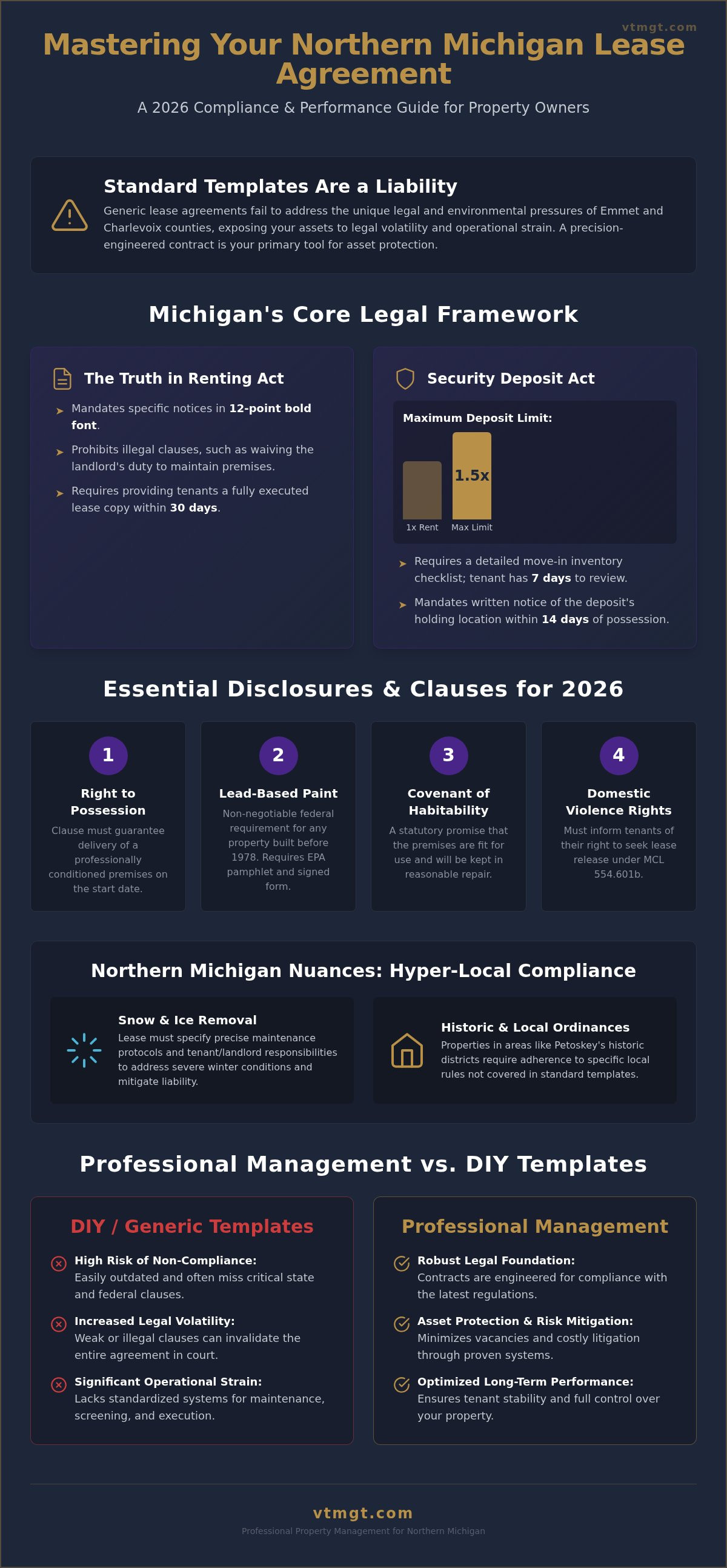
The Truth in Renting Act (Act 454 of 1978) serves as the regulatory pillar for all residential contracts in the state. This legislation mandates that specific notices be displayed in a clear, 12-point bold font to ensure tenant awareness of their legal rights. Failure to include these precise disclosures or the inclusion of prohibited clauses, such as those waiving a landlord's duty to maintain the premises or permitting the seizure of personal property without a court order, can invalidate the entire agreement in a Michigan court. Additionally, the landlord maintains a statutory duty to provide the tenant with a fully executed copy of the lease within 30 days of commencement. Understanding these lease agreement fundamentals is essential for maintaining a compliant and professional operation that respects the technical boundaries of the law.
Security Deposit Act Regulations
Financial stability in property management depends heavily on the correct handling of security deposits. Michigan law establishes a strict 1.5-month maximum limit for these funds, a threshold that remains unchanged as of August 2026. Beyond the monetary cap, the process requires a rigorous inventory checklist to be completed at move-in, detailing the condition of the property to prevent future friction regarding damages. Tenants have seven days to review and return this document to ensure all existing defects are recorded. Landlords must also provide a specific written notice within 14 days of the tenant taking possession, disclosing the financial institution where the deposit is held and the intended use of the funds. This structured approach ensures transparency and minimizes the potential for costly litigation during the move-out phase. By adhering to these technical specifications, property owners demonstrate professional humility and a commitment to quality-driven management.
Mandatory Disclosures and Essential Clauses for 2026
Operational integrity in property management requires a disciplined approach to statutory disclosures. These documents serve as the technical specifications of the rental relationship. In 2026, compliance for lease agreements Northern Michigan demands more than a generic signature page. It requires a structured verification of federal and state mandates. The Right to Possession clause must clearly state that the landlord will deliver the premises in a professional condition on the commencement date. For property owners in historic districts like Petoskey, the Lead-Based Paint Disclosure is a non-negotiable requirement for any structure built before 1978. This involves distributing the EPA-approved pamphlet and obtaining a signed acknowledgment. Neglecting this protocol doesn't just create a legal loophole; it exposes the landlord to severe federal oversight and financial liability.
Federal and State Disclosure Requirements
Michigan law mandates specific language regarding the Truth in Renting Act. This notice must inform tenants that the lease complies with state law and provide the contact information for the property owner or authorized agent. Landlords must also acknowledge the Covenant of Habitability. This is a statutory promise that the premises are fit for the use intended by the parties and kept in reasonable repair. Additionally, landlords must integrate a domestic violence victim rights notice. Under MCL 554.601b, tenants must be informed of their right to seek a release from rental obligations if they meet specific criteria as victims of domestic violence or stalking. Providing clear information on Michigan renters' rights demonstrates professional transparency and protects the landlord from claims of non-compliance.
Financial and Operational Clauses
Establishing standardized financial clauses is vital for long-term stability. Late fee provisions must be structured as reasonable liquidated damages rather than punitive fines. Courts typically scrutinize fees that exceed the actual administrative cost of processing late payments. Precision in utility definitions is equally vital. In Northern Michigan, where heating costs fluctuate significantly, explicitly defining who pays for fuel oil or electric prevents Common Area Maintenance (CAM) disputes. These details are critical when drafting lease agreements Northern Michigan. We also emphasize the importance of access protocols. While routine maintenance typically requires a 24-hour notice, your lease must establish 24/7 emergency access rights to mitigate damage from mechanical failures. Utilizing professional lease agreement preparation ensures these operational details are standardized and enforceable.
Northern Michigan Nuances: Snow, Seasonality, and Local Ordinances
Geography dictates the technical requirements of a successful management contract. In Emmet and Charlevoix counties, the environmental load on a property is significantly higher than in southern regions of the state. Standardized lease agreements Northern Michigan must account for these variables to prevent structural damage and legal friction. Managing a residential or commercial asset in Petoskey or Boyne City requires a proactive approach to winterization that generic templates often ignore. A precise lease acts as a technical manual for the property's seasonal operation, ensuring all parties understand their specific maintenance duties before the first frost.
Snow Removal and Winter Maintenance
Clear division of labor is essential for safety and liability management. While Michigan law requires landlords to keep common areas safe and fit for use, specific lease language should define the boundary between professional plowing and tenant shoveling. For instance, a landlord might manage the driveway plowing via a third-party contractor while the tenant remains responsible for clearing the porch and primary walkways. This distinction reduces ambiguity and ensures compliance with the Michigan Attorney General's Guide to Renters' Rights regarding premises safety. Failure to define these roles can lead to costly slip-and-fall litigation or municipal fines for uncleared sidewalks.
Thermal regulation is a technical necessity in the North. We recommend mandatory "heat-on" clauses that require tenants to maintain a minimum temperature of 55 degrees Fahrenheit, even during extended absences. This prevents the catastrophic failure of plumbing systems due to frozen pipes, a common risk in older Petoskey homes. Highlighting these duties in the lease protects the owner's investment and clarifies the tenant's role in asset preservation during extreme weather events.
Local Ordinances in Emmet and Charlevoix Counties
Municipal regulations add another layer of complexity to property oversight. Boyne City and Gaylord enforce strict blight and noise ordinances that can result in fines for the property owner if not properly delegated within the contract. Winter parking restrictions are also critical; many Northern Michigan towns prohibit street parking during late-night snow removal hours to allow for municipal plowing. Your contracts must explicitly require tenants to adhere to these local schedules to avoid towing or citations. Integrating these regional specifics with broader Michigan landlord laws ensures a comprehensive compliance strategy. This level of detail transforms a basic agreement into a robust management tool that functions effectively within the local legal ecosystem.
A Standardized System for Lease Execution and Tenant Placement
Operational excellence in property management is achieved through the implementation of standardized management systems. A contract is only as effective as the protocol used to execute it. When finalizing lease agreements Northern Michigan, we follow a rigorous five-step sequence to ensure technical compliance and tenant accountability. This structured onboarding process reduces operational friction and establishes clear expectations from the first day of the tenancy. By treating the lease execution as a precision-engineered workflow, property owners can mitigate risks associated with miscommunication or administrative oversight.
- Step 1: Conduct comprehensive tenant screening, including credit, criminal, and rental history verification, before presenting the lease.
- Step 2: Review all clauses in person or via video conference to verify the tenant’s understanding of their specific obligations.
- Step 3: Execute the mandatory inventory checklist simultaneously with the lease signing to establish a technical baseline for the property's condition.
- Step 4: Collect the security deposit and first month’s rent through a secure digital portal to maintain a clear audit trail.
- Step 5: Provide the tenant with a professional Tenant Handbook that outlines standard operating procedures for the residence.
The Importance of the Inventory Checklist
The inventory checklist is the primary legal defense for a landlord when documenting security deposit deductions. Without this technical record, proving the origin of damages in a Michigan court is nearly impossible. We recommend supplementing the written list with high-resolution photo and video documentation of all surfaces and mechanical systems. Under Michigan law, the tenant has a seven-day window to review and return the completed list. This timeline is a critical constraint; if the tenant fails to return the document, the landlord's original assessment stands as the verified condition of the asset. This level of detail ensures that move-out inspections are based on objective data rather than subjective memory.
Digital Execution and Standardized Management
Utilizing e-signature platforms provides an efficient audit trail and ensures that no mandatory fields are left blank. Standardized systems eliminate the human error often found in manual lease preparation, such as missing the 12-point bold font requirements for specific notices. This digital approach also allows for the seamless integration of rental property maintenance in Northern Michigan into the onboarding phase, as tenants can be introduced to maintenance request portals during the signing process. Establishing these technical frameworks early creates a stable foundation for the entire rental term. To ensure your properties are protected by these rigorous standards, consider our professional tenant screening and placement services.
Why Professional Management Outperforms DIY Templates
Relying on generic digital templates to govern high-value assets introduces significant technical risk into your operations. While many property owners attempt to utilize standardized forms, these static documents lack the dynamic oversight required to adapt to the 2026 legislative environment. Van Treese Management transforms property oversight by treating lease agreements Northern Michigan as active components of a larger, integrated management system. Our approach moves beyond the initial signing phase, focusing on consistent enforcement and professional human interaction. This methodology ensures that tenant relations are managed with professional humility while maintaining strict adherence to the contractual parameters established at move-in. By utilizing a professional firm, you ensure that the structural integrity of your legal protection remains intact throughout the tenancy.
Mitigating Risk through Professional Oversight
Staying current with Michigan legislative changes requires constant monitoring of state and federal statutes. Professional oversight ensures that your contracts are updated in real-time as new regulations emerge, such as adjustments to disclosure requirements or habitability standards. We leverage detailed market research to establish rent prices that reflect the technical reality of the Petoskey and Traverse City markets, ensuring your asset remains competitive without sacrificing profitability. For those looking to scale their portfolio, understanding these nuances is a prerequisite for successfully investing in Northern Michigan real estate. This data-driven approach provides a level of precision that DIY templates simply cannot replicate, shielding you from the financial repercussions of undervalued rentals or non-compliant clauses.
Building Thriving Local Communities
A clear, professionally drafted lease serves as the foundation for long-term tenant retention. When responsibilities are articulated with technical clarity, friction is minimized, and community standards in Emmet and Charlevoix counties are upheld. We prioritize the stability of the local housing ecosystem by ensuring every resident understands their role in maintaining the property’s integrity. Our maintenance coordination provides the necessary infrastructure to handle mechanical failures or environmental emergencies without delay, offering 24/7 response coordination that protects the asset from neglect. This comprehensive oversight transforms property ownership from a reactive burden into a structured, high-performing investment. Contact us today to implement professional lease agreement preparation and standardized management for your residential or commercial assets.
Future-Proofing Your Northern Michigan Property Assets
Establishing a robust legal and operational framework is the primary requirement for long-term rental success. By integrating the technical specifications of the Truth in Renting Act and accounting for regional environmental loads, you transform a simple document into a high-performing asset protection tool. Precise lease agreements Northern Michigan serve as the blueprint for this stability; they ensure all parties adhere to standardized maintenance and financial protocols. This systematic approach reduces the risk of operational failure and protects your capital from legal volatility.
Managing residential or commercial properties in Petoskey and surrounding counties requires a level of precision that generic forms don't provide. Our team leverages local Petoskey expertise and 24/7 emergency coordination to maintain the structural and legal integrity of your investments. We invite you to Secure Your Investment with Professional Lease Management from Van Treese through our proven standardized management systems. We look forward to partnering with you to achieve a disciplined, professional, and profitable rental operation. Your success is built on the foundation of quality-driven management and professional humility.
Frequently Asked Questions
Is a written lease agreement required for all rentals in Michigan?
Yes, for any tenancy exceeding a duration of one year, a written instrument is legally mandatory under the Michigan Statute of Frauds. While oral agreements for shorter terms might be technically enforceable, they lack the precision required to manage complex lease agreements Northern Michigan effectively. We recommend written contracts for all residential and commercial tenancies to establish a clear audit trail and define specific maintenance duties for properties in Emmet County.
How much can a landlord charge for a security deposit in Northern Michigan?
Michigan law strictly limits security deposits to a maximum of 1.5 times the monthly rent under MCL 554.602. This cap applies to all residential units, including those in Petoskey and Boyne City. Landlords must also provide an itemized inventory checklist at the start of the tenancy. Charging beyond this limit constitutes a regulatory violation that could invalidate the financial protections within your management contract and lead to judicial penalties.
Who is legally responsible for snow removal in a Michigan rental property?
Landlords maintain a statutory duty to keep common areas safe, which includes the removal of snow and ice. While a lease can delegate responsibility for areas under a tenant's exclusive control, such as a private porch, the landlord remains liable for shared sidewalks and parking lots. A 2023 Michigan Supreme Court ruling confirmed that the "open and obvious" nature of ice doesn't eliminate the landlord's duty to maintain safe premises for residents.
What happens if a lease clause violates the Michigan Truth in Renting Act?
Any clause that violates the Truth in Renting Act is legally unenforceable and can be struck down in court. If a landlord fails to correct a prohibited provision within 20 days of receiving a written notice from the tenant, they may face legal action and be liable for damages. Utilizing standardized systems for lease agreements Northern Michigan ensures that all required 12-point bold notices are present to maintain full regulatory compliance.
Can a landlord enter a rental property without notice in Northern Michigan?
Landlords may only enter without notice during a bona fide emergency that threatens the structural integrity of the asset or tenant safety. For routine inspections or maintenance coordination, Michigan law requires entry to be at reasonable times. Although the state doesn't mandate a specific hour-based notice, providing 24 hours of advance warning is the professional standard used to maintain stability and respect the tenant's right to quiet enjoyment of the premises.
Are there specific disclosures required for properties in Petoskey or Boyne City?
Yes, landlords must provide several mandatory disclosures, including the Lead-Based Paint Disclosure for any structure built before 1978. Residential contracts must also include a notice regarding the Truth in Renting Act and the statutory rights of domestic violence victims. In Northern Michigan, we also suggest integrating specific local ordinance disclosures related to seasonal parking restrictions and municipal blight regulations to ensure full operational transparency for all parties involved in the contract.
What is the mandatory timeframe for returning a security deposit in Michigan?
Landlords have exactly 30 days from the date of move-out to return the security deposit or provide an itemized list of deductions. The tenant is required to provide a forwarding address within four days of vacating the premises to facilitate this process. Failure to meet this 30-day technical constraint waives the landlord's right to retain any portion of the deposit for damages, regardless of the property's condition at the end of the term.
Does a Michigan lease need to be notarized to be legally binding?
Notarization isn't a legal requirement for a residential or commercial lease to be binding in Michigan. The contract becomes enforceable once it's signed by both the lessor and the lessee. However, utilizing secure digital platforms for execution provides a verifiable audit trail and timestamp. This serves as a more reliable technical defense in court than a simple handwritten signature or a standard paper template without the benefit of standardized verification systems.