
Property Management Financial Reporting in Traverse City: The 2026 Owner’s Guide

Your property's financial statement isn't just a record of the past; it's the only reliable blueprint for your future ROI. Most owners in Northern Michigan understand the frustration of staring at inconsistent monthly statements while wondering if hidden management fees are eroding their net cash flow. It's exhausting to face the July summer tax bill or the 18-mill non-PRE surcharge without a clear picture of your actual reserves. Effective property management financial reporting Traverse City requires more than just a basic spreadsheet. It demands a standardized, engineering-level approach to data that accounts for the region's unique seasonal shifts and specific tax cycles.
You deserve complete transparency into your property expenses and tax-ready documents that eliminate stress during the busy season. This guide will show you how to master these accounting complexities, ensuring you have the data-driven insights needed to improve your rental returns. We'll explore the four essential financial statements every landlord needs and explain how professional reporting turns raw numbers into a strategy for long-term investment stability in 2026. By aligning your financial oversight with local market realities, you can move from uncertainty to total control over your portfolio.
Key Takeaways
- Professional financial reporting provides a structured overview of income and expenses, moving beyond simple bank statements to offer a precise technical analysis of your asset's performance.
- Investors must track the "Big Three" documents—the Income Statement, Balance Sheet, and Cash Flow Statement—to maintain full control over operational reserves and tax liabilities.
- Modern digital portals for property management financial reporting Traverse City offer real-time transparency, allowing owners to monitor maintenance costs and rent collection efficiency instantly.
- Strategic reserve planning is essential in Northern Michigan to mitigate the impact of seasonal cash flow shifts, covering winter heating, snow removal, and bifurcated property tax cycles.
- Standardized accounting systems transform raw data into actionable ROI insights, ensuring that every financial transaction is recorded with engineering-level precision for year-end tax readiness.
Understanding Property Management Financial Reporting in Traverse City
Property management financial reporting in Traverse City is the systematic categorization and tracking of every dollar entering or leaving a real estate asset. It's not merely a record of rent received; it's a structured audit of an investment's operational integrity. Relying on a basic bank statement is insufficient for modern investors. A bank statement shows a balance, but it fails to categorize maintenance expenditures, track security deposit liabilities, or account for seasonal tax accruals. Professional property management financial reporting Traverse City provides the granular detail necessary to evaluate whether a property is actually meeting its performance benchmarks.
Accurate reporting is fundamental for maintaining compliance with Michigan landlord laws, specifically regarding the handling of security deposits and escrow requirements. When financial data is transparent and accessible, it builds a foundation of trust between the owner and the management team. This transparency ensures that all stakeholders have a single source of truth for the property's fiscal health.
The Difference Between Bookkeeping and Financial Management
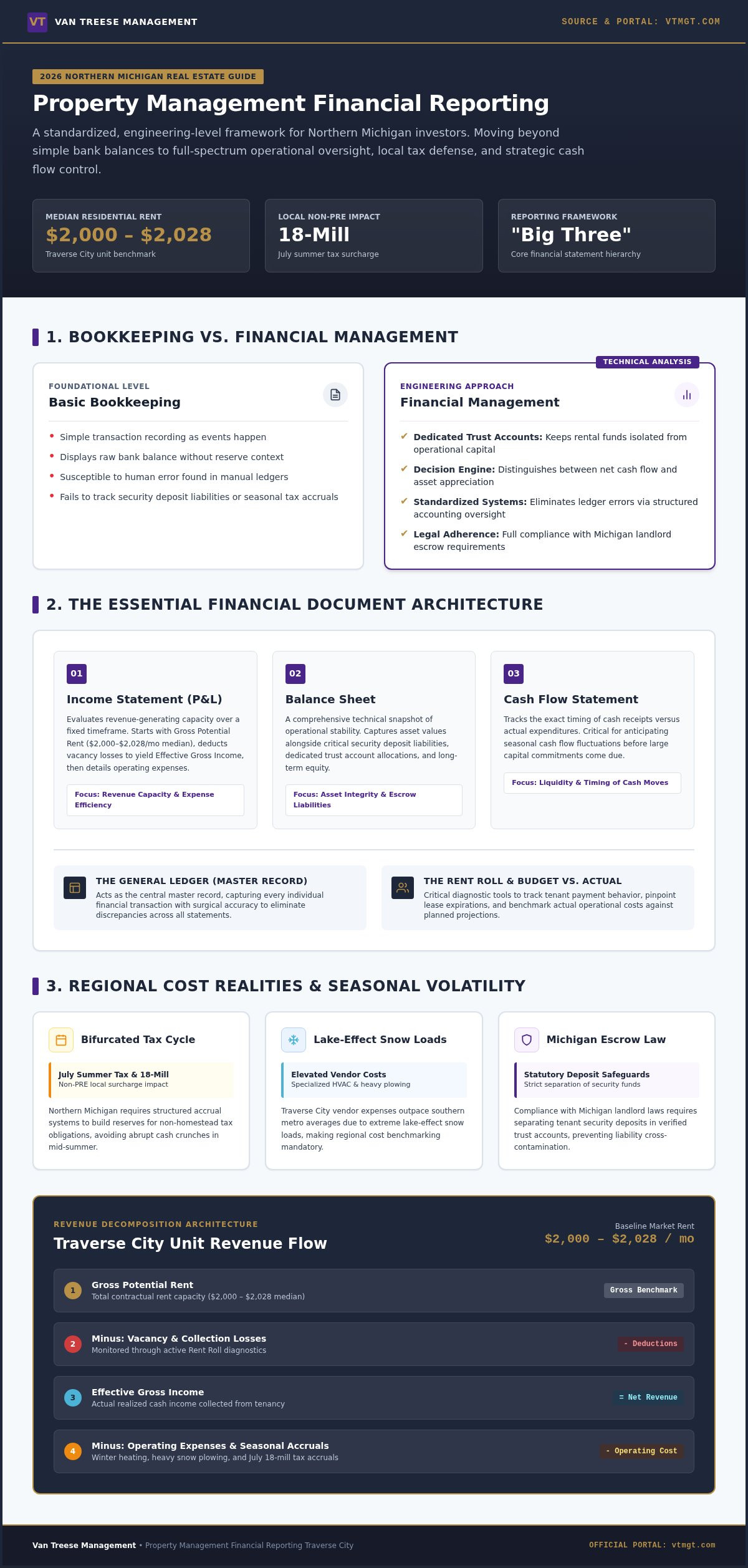
Bookkeeping is the foundational data entry process where transactions are recorded as they occur. Financial management, however, involves the technical analysis of these records to drive decision-making. We utilize standardized management systems to ensure every entry is precise and consistent. This includes the rigorous use of dedicated trust accounts. These accounts ensure rental funds stay separate from operational capital. By reviewing core financial statements, owners can distinguish between simple cash flow and long-term asset appreciation. Standardized systems eliminate the human error often found in manual ledgers, providing a stable platform for growth.
Why Local Context Matters for Your Bottom Line
Traverse City's economy is highly seasonal. This directly impacts financial projections and cash flow timing. When investing in rental property in Northern Michigan, clear data becomes the primary tool for navigating local market trends. Local vendor costs for specialized services like snow removal or HVAC winterization are often higher than in southern metros due to extreme lake-effect snow loads. A professional report will break these costs down. This allows owners to benchmark expenses against regional averages rather than arbitrary estimates. This level of detail ensures that maintenance reporting reflects the true cost of doing business in our specific climate, turning raw numbers into a strategic advantage.
Essential Financial Statements for Northern Michigan Real Estate Investors
Effective property management financial reporting Traverse City requires a structured hierarchy of documents to ensure operational precision. The "Big Three" reports; the Income Statement, Balance Sheet, and Cash Flow Statement; provide the technical framework for this oversight. At the center of these documents is the General Ledger. It acts as the master record, capturing every financial transaction with surgical accuracy. For investors, the Rent Roll serves as a critical diagnostic tool. It tracks tenant payment performance and lease expirations, allowing for proactive vacancy management. When these reports are compared through a Budget vs. Actual analysis, owners gain a clear view of where their asset is over-performing or where costs require immediate adjustment.
Deep Dive: The Income Statement (P&L)
The Income Statement evaluates the revenue-generating capacity of your asset over a specific period. It begins with Gross Potential Rent, which in Traverse City currently sits at a median of approximately $2,000 to $2,028 for residential units. After accounting for vacancies and collection losses, you arrive at the Effective Gross Income. Operating expenses are then meticulously categorized, including maintenance coordination, utilities, and management fees. It's vital to follow IRS rental property recordkeeping guidelines to ensure all allowable deductions are captured accurately. Net Operating Income (NOI) serves as the definitive metric for assessing the underlying financial health and operational efficiency of a rental asset.
The Role of the Balance Sheet in Asset Protection
While the P&L tracks performance, the Balance Sheet monitors the structural health of your investment. It provides a snapshot of property assets, total liabilities, and owner equity at a single point in time. A critical component of this report is the tracking of security deposits. Under Michigan law, these funds are held as liabilities rather than income; failing to categorize them correctly on the balance sheet can lead to significant legal and financial exposure. This report supports long-term wealth building by documenting the gradual reduction of debt and the growth of equity in your Traverse City portfolio. Maintaining these records with high precision ensures your asset remains attractive to lenders and future buyers alike. If you want to see how these documents look in practice, our team can show you the standardized reporting systems we use to protect our clients' equity.
The Impact of Modern Accounting Technology on Owner Transparency
Modern real estate accounting has evolved from manual ledger entry into integrated digital ecosystems that provide unprecedented oversight. These systems function as a technical bridge between complex operational data and actionable insights for investors. In the context of property management financial reporting Traverse City, technology serves as the primary tool for maintaining accountability. Digital systems ensure that every transaction is timestamped, categorized, and verifiable, eliminating the ambiguities often found in traditional paper based systems. This transition to digitized workflows allows for a level of precision that mirrors engineering standards, ensuring that your financial records are both accurate and accessible.
24/7 Access to Property Performance Data
Modern owner portals offer immediate access to monthly statements, real-time cash flow dashboards, and original digital invoices. This eliminates the delays associated with manual reporting cycles. Industry analysis suggests that transparent property management financial reporting is the most critical factor in building long term owner trust. We utilize encrypted security protocols to protect sensitive financial data, ensuring that your performance records remain confidential. This digital environment simplifies communication by providing a single, verifiable source of truth for all management activities. Owners can review maintenance work orders and corresponding invoices side by side, ensuring total clarity on where capital is being deployed.
Automation also significantly impacts the "days to pay" metric. By providing tenants with streamlined digital payment options, we reduce the time between rent due dates and owner disbursements. Similarly, paperless maintenance coordination ensures that every repair is linked to a digital invoice. This creates a clear audit trail that is easy to follow. We balance these technological innovations with disciplined personal oversight; an experienced manager reviews every report to ensure it meets our quality standards before it reaches your portal.
Simplifying Tax Season with Professional Reporting
The value of professional reporting is most evident during the first quarter of the year. Automated year-end 1099 generation and comprehensive summary reports save owners hours of manual calculation. Having organized digital records is essential for efficiency, especially when managing complex assets through commercial property management in Northern Michigan. If a potential audit occurs, having a chronological, digitized record of every expense and income item provides a robust defense. This structured approach ensures that tax preparation becomes a routine administrative task rather than a seasonal source of stress. By maintaining tax ready documents throughout the year, we ensure your investment remains compliant and your financial history remains impeccable.
Navigating Seasonal Cash Flow in the Traverse City Rental Market
Traverse City real estate operates within a bifurcated economic cycle. While summer months drive peak revenue, the winter season introduces significant operational stressors that can erode annual ROI if not managed with precision. Utilizing property management financial reporting Traverse City allows investors to visualize these patterns through multi-year historical data. This technical approach transforms reactive bookkeeping into proactive fiscal strategy, ensuring that the high yields of the tourism season are strategically allocated to cover the increased costs of the 45th parallel's winter months.
Strategic Budgeting for Winter Challenges
Operational costs in Northern Michigan don't remain static throughout the year. Snow removal and specialized HVAC services carry a 7% cost premium in this region compared to southern Michigan metros. Additionally, the December winter tax bill arrives precisely when heating expenses peak. We utilize historical reporting to establish robust maintenance reserves during the high-income summer months. This prevents owners from facing unexpected out of pocket contributions when cash flow naturally decelerates between November and April. A disciplined "Net Cash Flow" strategy involves smoothing these expenses over a twelve month period, providing a stable and predictable disbursement schedule. Effective budgeting for rental property maintenance in Northern Michigan requires this level of data driven foresight to maintain asset integrity without compromising liquidity.
Planning for Capital Improvements and Upgrades
Standardized financial reporting identifies the optimal windows for property reinvestment. By analyzing occupancy trends and cash reserves, we can determine when to execute multi year property enhancements. Leaner months often provide the best opportunity for interior capital improvements, such as kitchen or flooring upgrades, as these projects can be completed with minimal disruption to peak season revenue. It's essential to distinguish between standard repairs and capital improvements, as the latter offers different tax depreciation benefits that directly impact your long term wealth. Our systems track these expenditures separately, ensuring your balance sheet accurately reflects the increased value of your asset. This structured planning process turns a simple rental property into a high performing financial vehicle. If you're ready to stabilize your portfolio's cash flow through better data, consult with our accounting experts to review your asset's performance.
Transforming Data into ROI with Van Treese Management
Since 2018, we've utilized standardized management systems to ensure that every financial record meets a rigorous technical standard. Professional property management financial reporting Traverse City isn't just about recording numbers; it's about interpreting them to drive asset appreciation. While automated portals provide the foundation, our team adds the critical layer of professional analysis required to navigate Northern Michigan's specific market challenges. This approach ensures that your data isn't just accurate but actionable. By converting raw transaction data into structured financial intelligence, we provide the clarity needed to make informed decisions about property upgrades, lease renewals, and capital allocations.
The Van Treese Standard of Professionalism
We believe that every monthly statement should function as a transparent audit of your investment's performance. Our process involves a meticulous review of every ledger entry, ensuring that maintenance costs, utility spikes, and reserve withholdings are documented with total clarity. This technical precision is balanced with a commitment to human interaction. We don't just send a report; we're available to discuss how these figures impact your long-term goals. Our mission is to build thriving local communities, and we achieve this by ensuring that the properties we manage remain financially stable and well-maintained for the long term. This disciplined oversight reflects our professional humility and our dedication to being a stable partner in your industrial or residential real estate journey.
Next Steps: Professional Financial Oversight for Your Property
Transitioning your portfolio to our standardized reporting system is a structured and efficient process. During onboarding, our accounting team performs a comprehensive review of your existing financial records to ensure a seamless migration into our digital ecosystem. This transition provides immediate peace of mind, as you'll move from fragmented spreadsheets to a unified, transparent reporting structure. You'll gain access to real-time dashboards and tax-ready documents that simplify your administrative burden. We invite you to experience the difference that innovation-driven oversight makes for your Northern Michigan investments. Contact us today for a professional consultation on your financial reporting needs and discover how our structured framework can improve your property's ROI.
Securing Your Investment's Future with Data-Driven Oversight
Mastering the complexities of real estate accounting is the most effective way to ensure the long-term stability of your Northern Michigan portfolio. Professional property management financial reporting Traverse City transforms raw transactional data into a strategic tool for navigating seasonal cash flow shifts and localized tax requirements. By utilizing standardized systems and modern digital portals, you eliminate the uncertainty of hidden fees and ensure your documents are always tax-ready. This level of transparency is essential for maximizing ROI and maintaining rigorous compliance with regional regulations.
Since 2018, we've combined innovation-driven accounting with deep local expertise to support property owners across Traverse City and surrounding counties. We provide the technical precision required to protect your equity while maintaining the human interaction necessary for a true professional partnership. You don't have to face complex capital planning or seasonal budgeting without a structured framework. Ready for transparent financial reporting? Contact Van Treese Management today. Your property is a significant asset; managing its finances with precision is the first step toward building a resilient investment and a thriving community.
Frequently Asked Questions
What financial reports should I receive from my property manager every month?
At a minimum, you should receive an Income Statement, a Balance Sheet, and a Cash Flow Statement. These reports provide a comprehensive overview of your asset's performance. A detailed Rent Roll and a General Ledger are also essential for tracking tenant payments and individual transactions. Van Treese Management utilizes standardized systems to ensure these documents are delivered with technical precision every month, allowing for a clear audit of your property's fiscal health.
How does property management software improve financial transparency?
Modern software provides real-time access to performance data through dedicated owner portals. This technology eliminates the delays of manual reporting by offering immediate visibility into cash flow, digital invoices, and maintenance work orders. Automated rent collection reduces the time between due dates and disbursements, while encrypted security protocols protect sensitive records. This digital framework creates a verifiable source of truth, ensuring that every financial transaction is timestamped and categorized with engineering-level accuracy.
Can my property manager help me with tax preparation in Traverse City?
While property managers are not usually CPAs, they provide the essential documentation required for seamless tax filing. This includes generating year-end 1099 forms and comprehensive summary reports that categorize all income and deductible expenses. Professional property management financial reporting Traverse City ensures your records align with Michigan's specific tax cycles. By maintaining tax-ready documents throughout the year, our team simplifies the preparation process and provides a robust audit trail for your investments.
What is the difference between an income statement and a cash flow report?
An income statement measures profitability by comparing revenue against operating expenses over a specific timeframe. In contrast, a cash flow report tracks the actual movement of liquid capital into and out of your accounts. This distinction is vital in Northern Michigan because cash flow reports reflect operational reserve withholdings for winter maintenance. While your income statement might show a profit, the cash flow report indicates the actual liquidity available for disbursements or reinvestment.
How should a property manager handle tenant security deposits financially?
Under Michigan law, security deposits must be treated as a strict liability on the balance sheet rather than operational income. These funds are held in a regulated financial institution or secured by a bond, remaining separate from commingled operational cash. Financial transparency requires that these deposits are tracked individually by tenant. This ensures that funds are available for lawful returns or documented damages at the conclusion of a lease agreement.
Why is a budget vs. actual report important for rental property owners?
A budget vs. actual report serves as the primary diagnostic tool for evaluating property performance. It compares your projected revenue and expenses against the actual financial reality of the month. This comparison allows owners to identify maintenance spikes, utility surges, or revenue gaps before they impact annual ROI. For Traverse City investors, this report is critical for benchmarking seasonal costs like snow removal against the initial fiscal plan established at the start of the year.
How do management fees appear on my monthly financial statements?
Management fees are recorded as a standard operating expense on your monthly Profit and Loss statement. These charges are typically listed as a recurring line item, clearly separated from maintenance coordination or leasing fees. Standardized reporting ensures that every fee corresponds directly to the terms of your management agreement. This itemization prevents hidden costs and allows you to calculate your net operating income with total confidence in the accuracy of the underlying data.
What financial metrics indicate a high-performing Traverse City rental property?
Key indicators of a high-performing asset include a stable Net Operating Income (NOI) and a competitive capitalization rate. In the Traverse City market, a low "days to pay" metric and high occupancy rates also signal operational efficiency. Additionally, the presence of healthy maintenance reserves suggests a well-managed property capable of sustaining long-term growth. Tracking these technical metrics through professional property management financial reporting Traverse City allows you to benchmark your asset against regional performance standards.