
Petoskey Rental Market Analysis: 2026 Trends for Northern Michigan Investors

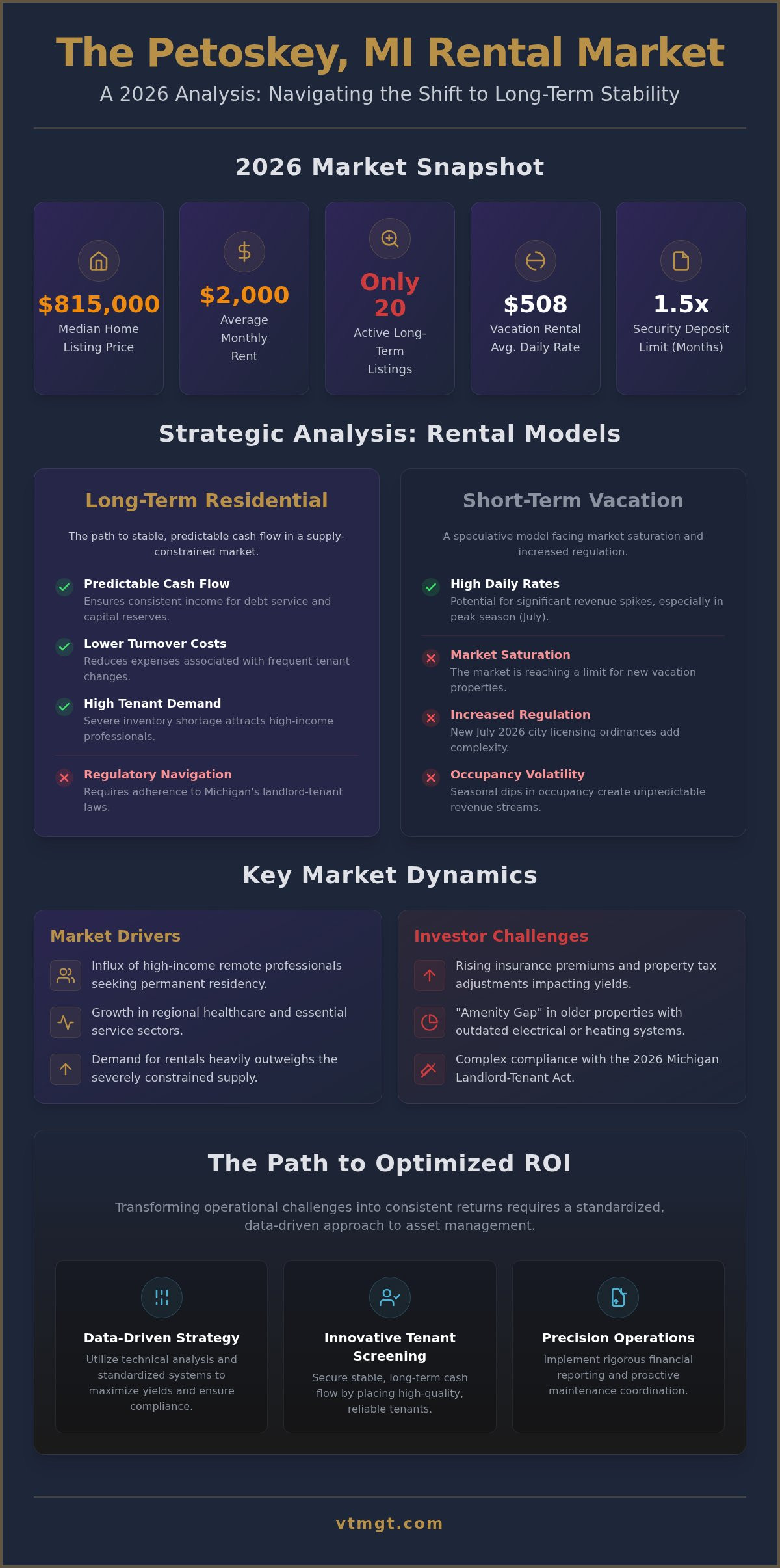
While the allure of $508 average daily rates often draws investors toward the vacation sector, the 2026 Petoskey rental market is currently rewarding the precision of long-term residential management over speculative short-term ventures. We recognize that the recent July 2026 amendments to the city’s licensing ordinances, combined with a slight dip in seasonal occupancy, have made the landscape increasingly difficult to navigate. You’re likely feeling the pressure of rising maintenance coordination costs and the rigorous demands of Michigan’s landlord-tenant regulations.
We agree that maintaining a profitable portfolio in Northern Michigan requires more than just a property; it demands a standardized, data-driven approach to asset management. This analysis provides the technical insights and strategic frameworks needed to optimize your ROI while ensuring full compliance with state laws, such as the 1.5-month security deposit limit. We’ll examine the shift toward long-term stability, provide a breakdown of current vacancy risks, and outline the systems necessary to transform complex operational challenges into consistent, predictable cash flow for your residential or commercial investments.
Key Takeaways
- Analyze the shift toward residential stability as the 2026 Petoskey rental market reaches a saturation point for short-term vacation properties.
- Identify the macroeconomic factors, including rising insurance premiums and property taxes, that are reshaping Northern Michigan investment yields.
- Ensure full compliance with the 2026 Michigan Landlord-Tenant Relationship Act by mastering security deposit limits and standardized lease execution.
- Evaluate the cost-efficiency of transitioning to professional management systems to mitigate rising maintenance and coordination expenses.
- Discover how innovation-driven tenant screening and financial reporting can secure stable cash flow in a complex regulatory environment.
The State of the Petoskey Rental Market in 2026
The Petoskey rental market in August 2026 reflects a complex phase of structural stabilization. While previous years were characterized by aggressive price surges, the current cycle shows a more disciplined alignment between property valuations and rental yields. As the primary economic and administrative hub for Emmet County, Petoskey, Michigan serves as the anchor for regional housing demand, providing a stable foundation for both residential and commercial assets. Local economic diversification, particularly in professional services and specialized engineering sectors, has moved the market beyond its traditional seasonal dependencies. We observe that even with a median home listing price of $815,000, the transition to a buyer's market for sales hasn't diminished the necessity for high-quality rental inventory.
Demographic Shifts and Housing Demand
The composition of the local tenant base has undergone a significant transformation. High-income professionals utilizing standardized remote work protocols have established permanent residency, seeking the specific infrastructure and quality-of-life parameters unique to Northern Michigan. This influx is complemented by steady growth in the regional healthcare sector and the essential service industries that support a growing year-round population. The 2026 demand-to-supply ratio in Petoskey remains heavily skewed toward landlords, as a severe shortage of long-term inventory meets a growing population of year-round residents. These shifting demographics require a more sophisticated, innovation-driven approach to tenant screening and placement to ensure the long-term stability of the investment.
Inventory Levels and Vacancy Rates
Data from August 2026 indicates a severely constrained supply of long-term housing options across all asset classes. With only 20 active long-term listings currently available, the competition for quality residential units is intense. Single-family homes continue to command a premium, with the average rent across all property types reaching $2,000 per month according to recent Zillow data. Multi-family units remain exceptionally scarce, which keeps vacancy rates for these assets near historic lows and minimizes the risk for established landlords. While new construction projects are in various stages of the development pipeline, their immediate impact on existing property valuations is mitigated by high material costs and labor constraints. We expect vacancy trends to remain tight through the end of 2026. This environment places a high value on precision maintenance coordination to preserve asset value while navigating a low-inventory landscape.
Key Drivers of Rental Pricing in Northern Michigan
Pricing in the Petoskey rental market depends on structural economic variables rather than simple list prices. Landlords must analyze assets through the lens of macroeconomic stability and operational overhead. According to a Northern Michigan economic conditions report by MSU Extension, workforce housing remains a critical challenge, which directly influences the floor for residential rates. In 2026, property owners face rising insurance premiums and property tax adjustments that often exceed general inflation. Many older properties in Petoskey suffer from an "amenity gap," where historic charm fails to compensate for outdated electrical systems or inefficient heating. Professional valuation provides a technical assessment of these variables, whereas automated online estimates often overlook local zoning nuances and specific neighborhood demand.
Seasonal Fluctuations vs. Annual Stability
Petoskey's economy is historically tied to the tourism cycle, but residential investors should prioritize annual stability to mitigate the high turnover costs associated with seasonal shifts. Short-term markets often see revenue spikes in July, yet long-term contracts provide the predictable cash flow required for debt service and capital reserves. Strategic lease timing, often targeting spring or early autumn, ensures that vacancies don't occur during the difficult winter months. For a deeper analysis of portfolio construction, consult our Investing in Rental Property in Northern Michigan: The 2026 Investor Guide. Maintaining these systems requires rigorous financial reporting and accounting to track net yields effectively.
Premium Features and ROI Boosters
Specific physical attributes significantly impact the yield of an asset within the Petoskey rental market. Off-street parking is a non-negotiable requirement for many year-round tenants due to municipal snow removal regulations. Pet-friendly policies, when managed with structured screening, expand the applicant pool and often permit higher monthly rates. Modern HVAC systems and energy-efficient upgrades, such as improved attic insulation, provide a measurable return by reducing utility burdens and increasing tenant retention. Cosmetic improvements, including high-durability flooring and neutral paint schemes, offer the highest ROI by shortening the marketing period and attracting stable occupants.
Strategic Analysis: Long-Term vs. Short-Term Rentals
The Petoskey rental market reached a critical saturation point for short-term vacation properties in mid-2026. Data from August 2026 shows 332 active short-term listings, yet occupancy rates have experienced a year-over-year decline of 1.6%. This cooling trend, combined with a 4.9% decrease in active inventory, indicates that the speculative phase of the vacation market is yielding to more stable, long-term residential models. Institutional investors are increasingly pivoting toward long-term lease structures to secure predictable yields and mitigate the volatility inherent in seasonal tourism. While the average daily rate for vacation rentals remains high at $508, the net ROI is often eroded by intensive operational overhead.
A technical comparison of operational costs reveals significant disparities between the two models. Short-term rentals require frequent cleaning cycles, higher utility consumption, and accelerated wear-and-tear on interior fixtures and appliances. Conversely, the long-term residential model utilizes standardized maintenance protocols and consistent tenant responsibility for minor upkeep. This stability allows for precise financial forecasting and the accumulation of capital reserves for systematic asset improvements. Professional investors prioritize these structured returns over the erratic cash flow of the hospitality sector, especially as macroeconomic conditions demand greater fiscal discipline.
Regulatory Risks in the Vacation Market
Zoning volatility remains a primary risk factor for short-term rental owners in Emmet County. On July 20, 2026, the Petoskey City Council adopted rigorous amendments to Chapter 15 of the city code, tightening the framework for short-term licensing and transfers. These regulations include annual license fees and mandatory waiting list fees, which add layers of administrative complexity and cost. Relying on third-party vacation platforms for 100% of revenue exposes an asset to platform-specific volatility and sudden policy shifts that can jeopardize annual yields. Investors must ensure their portfolios remain compliant with the broader Michigan landlord-tenant laws to avoid significant legal and financial liabilities.
The Long-Term Advantage
Transitioning to a long-term residential strategy minimizes turnover costs and provides a foundation for community stability. Stable tenancies reduce the marketing expenses and vacancy gaps that frequently disrupt short-term operations. By implementing a professional oversight system, owners can secure high-quality occupants who value the property as a primary residence. For a detailed look at how these systems operate in neighboring markets, see our guide on Professional Rental Management in Charlevoix, MI: Long-Term Stability & Systems. This approach transforms a property from a high-maintenance hospitality unit into a resilient, income-generating asset within the broader regional economy.
Navigating Michigan Landlord Laws and Compliance
Operating in the Petoskey rental market requires a rigorous understanding of the Michigan Landlord-Tenant Relationship Act. The 2026 regulatory environment emphasizes precise documentation and adherence to statutory timelines. Property owners in Northern Michigan must navigate these laws with the same level of discipline applied to industrial engineering processes. Standardized systems are essential for mitigating legal liability and ensuring that every lease execution meets state requirements. Local courts in Emmet County expect landlords to maintain high levels of professional conduct, particularly regarding tenant communications and financial transparency.
Lease Agreements and Security Deposits
The 2026 guidelines for security deposits remain a primary focal point for legal compliance. Michigan law limits security deposits to 1.5 months' rent, a threshold that cannot be exceeded regardless of property type. Landlords must return these funds or provide a detailed itemized list of damages within 30 days of the tenant vacating the property. Failure to adhere to this window can result in the forfeiture of the right to retain any portion of the deposit. For a comprehensive breakdown of these requirements, refer to our Michigan Landlord Laws: A 2026 Guide for Northern Michigan Property Owners. Additionally, the 7-day demand for possession remains the statutory standard for non-payment of rent, providing a structured mechanism for maintaining cash flow in the Petoskey rental market.
Maintenance Responsibilities and Habitability
Habitability in Northern Michigan is strictly defined by the region's extreme climate. In 2026, ensuring functional heating systems and structural integrity during the winter months is a primary legal obligation. While Michigan doesn't have a specific statute for notice to enter, "reasonable notice" is the expected standard in local jurisdictions to respect tenant privacy. Tenants possess specific rights regarding essential repairs; neglecting these can lead to rent withholding or the termination of the lease agreement. Our Rental Property Maintenance in Northern Michigan: The 2026 Landlord’s Guide outlines the technical requirements for maintaining winter-ready assets. Fair Housing Act compliance also requires objective tenant screening processes to avoid subjective bias. To protect your investment from these complex regulatory risks, utilize our professional tenant screening and lease agreement preparation services to ensure full legal alignment.
Optimizing Your Petoskey Portfolio with Professional Management
Transitioning from self-management to a professional, system-driven framework is a strategic necessity in the 2026 Petoskey rental market. The increasing complexity of regional compliance and the rising costs of maintenance coordination require a level of technical precision that traditional "DIY" approaches often lack. Van Treese Management utilizes innovation-driven systems to streamline oversight, transforming a property from a passive holding into a high-performing residential or commercial asset. By integrating comprehensive financial reporting and accounting, we translate raw operational data into actionable investment strategies that prioritize long-term ROI and fiscal transparency.
A critical component of our management framework is the 24/7 emergency response coordination and our established local contractor network. In Northern Michigan, weather-related risks, such as heavy snow loads and freeze cycles, are significant operational variables. Having a dedicated team ensures that structural integrity is maintained regardless of external conditions. This proactive maintenance coordination mitigates the risk of catastrophic emergency repairs and preserves the long-term valuation of your inventory. It's a hedge against the unpredictable elements of the region, ensuring your investment remains protected throughout the winter months.
Standardized Systems and Tenant Placement
High-quality tenant placement and screening is a technical process rooted in data, not a subjective decision. We utilize standardized management systems to evaluate every applicant against rigorous criteria, ensuring that placements align with the property’s specific operational parameters. Our property marketing and advertising strategies are equally targeted, utilizing multi-channel distribution to reach qualified professionals who seek stable, year-round housing. These standardized systems ensure consistency across multiple units, allowing investors to scale their portfolios in Emmet and Charlevoix counties without compromising on asset quality or legal compliance.
The Van Treese Difference in Northern Michigan
Our approach balances technological innovation with a deep commitment to human interaction and community thriving. We recognize that property management is a fundamental component of the local economic fabric. Professional maintenance coordination in 2026 is about more than just reactive repairs; it's about systematic, preventive asset preservation. We don't just manage buildings; we manage the complex relationships between owners, occupants, and the local environment. If you're ready to move beyond the limitations of self-management and secure your position in the Petoskey rental market, the next step is a professional rental analysis. We provide the structured oversight, comprehensive lease agreement preparation, and expert tenant placement needed to achieve superior investment results.
Securing Long-Term Yields in the 2026 Petoskey Market
The 2026 Petoskey rental market requires a transition from speculative vacation strategies to disciplined, long-term residential management. As we've analyzed, the saturation of short-term listings and the tightening of local ordinances necessitate a more structured approach to property oversight. Investors who prioritize compliance with Michigan's 1.5-month security deposit limit and maintain winter-ready habitability standards will be best positioned for stable ROI. We've seen that the shift toward year-round residency among professionals demands a higher level of asset maintenance and tenant service.
Managing these variables with technical precision is essential for maintaining asset value in Northern Michigan's unique climate. Van Treese Management provides the innovation-driven standardized management systems and local insight needed to navigate these complexities. Our 24/7 maintenance coordination network ensures your portfolio remains resilient against operational risks while leveraging deep expertise in Emmet and Charlevoix counties. We prioritize human interaction and community thriving to ensure your investment remains a cornerstone of the regional economy.
Partner with Van Treese Management for Professional Petoskey Oversight to secure the future of your residential or commercial assets. We look forward to helping your portfolio achieve consistent growth through professional integrity and proven systems.
Frequently Asked Questions
What is the average rent for a 3-bedroom home in Petoskey in 2026?
The average rent for a residential property in Petoskey is $2,000 per month as of August 2026, with 3-bedroom homes typically occupying the upper tier of the market. While the median rent across all property types is $1,500, houses currently range from $850 to $3,500. These figures reflect a significant $400 year-over-year increase, driven by a scarcity of long-term inventory in the Petoskey rental market.
How have short-term rental regulations changed in Emmet County recently?
On July 20, 2026, the Petoskey City Council adopted amendments to Chapter 15 of the city code to tighten short-term rental (STR) licensing and transfer rules. All STRs must now be licensed annually, with specific fees determined by council resolution. Property owners must also pay an annual fee by November 30 to remain on the STR license waiting list, signaling a more restrictive regulatory environment for vacation properties.
Is Petoskey a better market for residential or commercial rental property?
Petoskey remains a robust market for both sectors, though the current cycle shows extreme scarcity in residential inventory with only 20 active long-term listings. Residential assets offer higher stability due to the influx of remote professionals seeking year-round housing. Commercial properties benefit from Petoskey's status as the administrative hub of Emmet County. Both sectors require standardized management to mitigate the risks associated with seasonal economic shifts.
What are the typical management fees for property owners in Northern Michigan?
Management fees in Northern Michigan are typically structured as a percentage of the collected monthly rent, supplemented by fees for tenant placement and lease renewals. These costs cover the technical overhead of professional oversight, including financial reporting and standardized tenant screening. Owners should evaluate these structures based on the level of maintenance coordination and legal compliance provided to protect the asset’s long-term ROI.
How does the winter season impact rental demand in Petoskey?
The winter season in the Petoskey rental market shifts demand toward long-term residential stability while introducing significant environmental risks to the physical asset. Landlords must account for municipal snow removal regulations and the technical requirements of maintaining heating systems during extreme freeze cycles. Professional maintenance coordination is essential during these months to prevent structural damage and ensure compliance with habitability standards in Northern Michigan’s demanding winter climate.
What are the Michigan security deposit requirements for landlords in 2026?
Michigan state law in 2026 strictly limits security deposits to a maximum of 1.5 months' rent. Landlords are legally obligated to return the deposit or provide a detailed itemized list of damages within 30 days of the tenant vacating the property. Adhering to these statutory timelines is critical to avoid litigation, as the Michigan Landlord-Tenant Relationship Act provides clear protections for occupants regarding the professional handling of these funds.
Can I manage a Petoskey rental property remotely, or do I need a local firm?
Remote management is technically possible through digital tools, but the Petoskey market presents unique environmental and regulatory challenges that often require local oversight. Local firms provide 24/7 emergency response coordination, which is vital for managing Northern Michigan’s weather-related risks and maintenance needs. Local expertise also ensures that lease agreements and property marketing remain compliant with the specific ordinances of Emmet and Charlevoix counties.
How do I determine the right rent price for my Charlevoix County property?
Determining the optimal rent price requires a professional valuation that accounts for the "amenity gap" and current vacancy rates in Charlevoix County. While automated online estimates provide a baseline, they often fail to capture the value of premium features like off-street parking or modern HVAC systems. A technical analysis of comparable long-term listings ensures your pricing remains competitive while maximizing the net cash flow of the investment.