
Michigan Landlord Laws: 2026 Guide for Property Owners

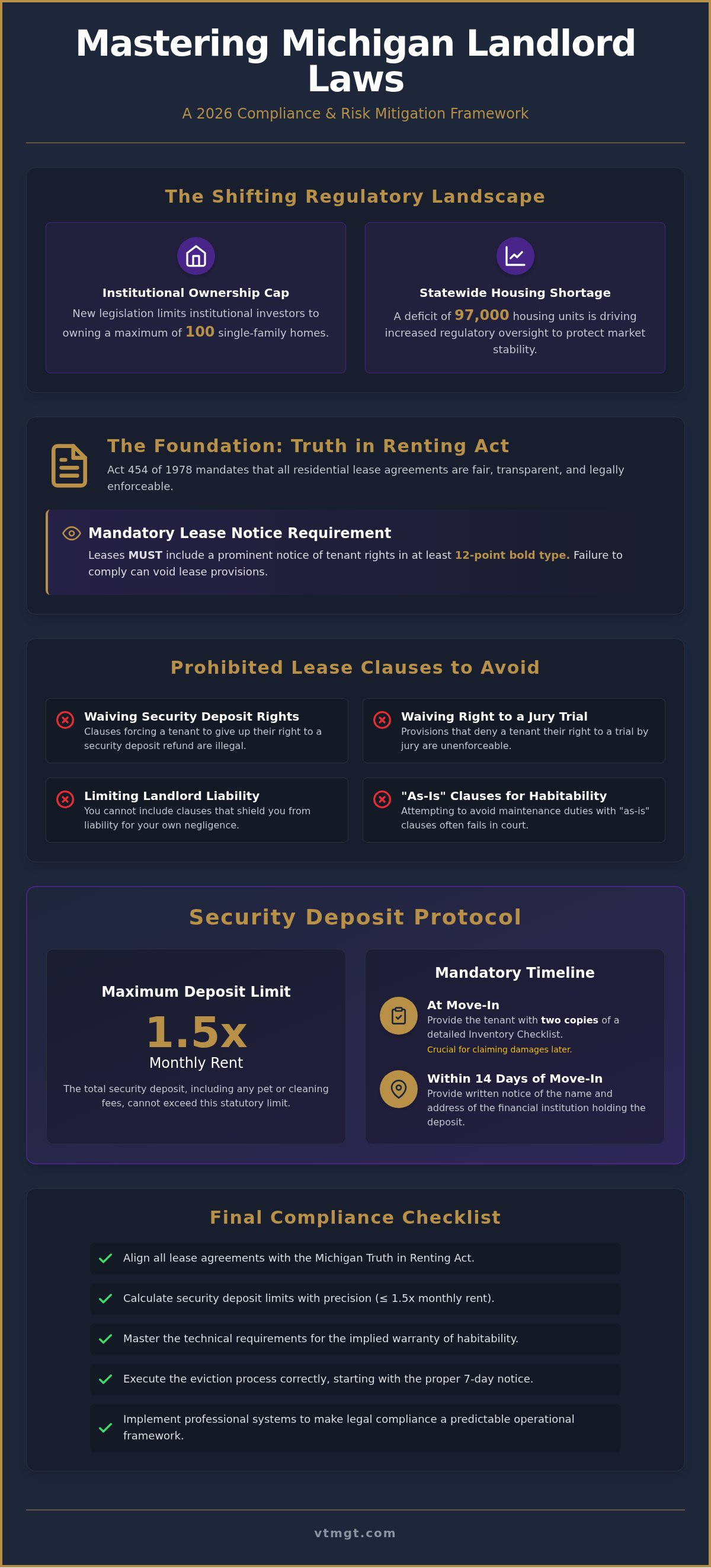
In 2026, a single oversight in your security deposit protocol isn't just a clerical error; it's a significant legal liability that can jeopardize your entire portfolio. Staying compliant with Michigan landlord laws requires more than a passing familiarity with the statutes. It demands a disciplined, systems-based approach to property management. With new legislation now prohibiting institutional investors from owning more than 100 single-family homes and a state shortage of 97,000 housing units, the regulatory environment has shifted toward increased oversight to protect market stability and individual property owners alike.
You likely recognize that managing residential assets involves balancing tenant satisfaction with strict adherence to the Truth in Renting Act. We understand that the fear of statutory penalties for security deposit errors or confusion over the 7-day eviction notice can create significant anxiety. This guide provides a professional framework to master these complexities and ensure your investment remains protected. You'll gain a systematic understanding of the 2026 updates, including new source of income protections and the standardized processes needed to reduce legal exposure and maintain high-quality operations in the Northern Michigan rental market.
Key Takeaways
- Establish a legally sound foundation by aligning your lease agreements with the specific requirements of the Michigan Truth in Renting Act.
- Calculate security deposit limits with precision to ensure compliance with Michigan landlord laws and avoid costly statutory penalties.
- Master the technical requirements of the implied warranty of habitability to maintain structural integrity and tenant safety in Northern Michigan.
- Execute the eviction process correctly using the standardized 7-day notice timeline while strictly avoiding prohibited self-help measures.
- Implement professional financial reporting and maintenance systems to transform legal compliance into a predictable, risk-mitigated operational framework.
The Foundation of Michigan Landlord Laws: The Truth in Renting Act
The Michigan Truth in Renting Act (Act 454 of 1978) serves as the primary regulatory framework for residential lease agreements in the state. The Foundation of Michigan Landlord Laws is built upon this statute, which mandates that all lease provisions remain fair, transparent, and enforceable. For property owners, this isn't just a legal suggestion; it's a technical requirement for asset protection. Utilizing standardized lease agreements acts as a critical safeguard against litigation. These documents must include a "prominent" notice, typically in at least 12-point bold type, informing tenants of their rights under the Act. Failing to include this notice or including prohibited language can lead to entire sections of your lease being voided in court, leaving your investment vulnerable to legal challenges.
Compliance is not a matter of intent but a matter of precision. When a lease contains illegal provisions, the tenant may have the right to terminate the lease or sue for damages. The court's priority is the protection of the tenant's statutory rights, and they won't hesitate to penalize landlords who use outdated or non-standardized templates. A structured management approach ensures that every contract aligns with current Michigan landlord laws, effectively mitigating risk before a tenant even signs the document.
Prohibited Lease Clauses in Michigan
Certain provisions are strictly forbidden under Act 454. You cannot include clauses that force a tenant to waive their right to a security deposit refund or their right to a jury trial. Similarly, provisions attempting to shield a landlord from liability for their own negligence are unenforceable. Many DIY landlords attempt to use "as-is" clauses to avoid maintenance costs or structural repairs. In Michigan residential courts, these clauses often fail because they conflict with the state's mandatory habitability requirements. If your lease includes these prohibited items, a court may order you to pay the tenant's legal fees or statutory penalties.
Oral vs. Written Lease Agreements
Michigan law recognizes oral leases for terms under one year, but this practice introduces unnecessary variables into your business model. Verbal agreements lack the structural integrity required for professional property management. Professional systems rely exclusively on written, standardized contracts to eliminate ambiguity and provide a clear audit trail. Every agreement must disclose the name and address of the property owner or the property manager. This transparency is a core requirement of Michigan landlord laws and ensures all parties have a verified point of contact for legal and operational matters. Without a written document, proving the terms of the tenancy during an eviction or deposit dispute becomes nearly impossible.
Security Deposit Rules: Avoiding Costly Statutory Penalties
Precision in financial management is paramount for property owners operating under Michigan's Landlord-Tenant Relationship Act (Act 348 of 1972). This statute establishes a rigid framework that leaves little room for administrative error. The most critical technical constraint is the security deposit limit, which cannot exceed 1.5 times the monthly rent. Collecting any amount beyond this threshold constitutes a statutory violation, regardless of whether the excess is labeled as a pet deposit or a cleaning fee. For a comprehensive overview of these obligations, property owners should consult the official Truth in Renting Act documentation provided by the state legislature.
Administrative compliance begins immediately upon tenant possession. Within 14 days of the tenant moving in, you must provide written notice of the name and address of the financial institution where the deposit is held. Simultaneously, the "Inventory Checklist" system must be initiated. This is a non-negotiable requirement for any future damage claims. You must provide the tenant with two copies of a detailed checklist describing the condition of the property. If this step is bypassed, the landlord essentially waives the right to claim damages against the security deposit at the end of the tenancy. Maintaining a standardized maintenance coordination system ensures these inspections are documented with engineering-level detail.
The 30-Day Move-Out Timeline
The reconciliation of a security deposit follows a strict chronological sequence. First, the tenant must provide a forwarding address in writing within four days of vacating. Second, the landlord has exactly 30 days to send an itemized list of damages, including the estimated cost of each repair. Finally, if the tenant disputes these charges, they must respond within seven days. Failure to meet the 30-day window for the itemized list typically results in the total forfeiture of the right to retain any portion of the deposit for physical damages.
Allowable Deductions and Escrow Rules
Distinguishing between "normal wear and tear" and actual damage is a common point of friction in residential management. Under Michigan landlord laws, wear and tear includes expected deterioration such as faded paint or carpet matting from foot traffic. Actual damage involves negligence or abuse, such as holes in drywall or broken fixtures. These funds must be held in a regulated financial institution or secured by a cash bond. Furthermore, Michigan landlord laws permit deductions for unpaid utility bills or rent, provided these costs are clearly itemized in the 30-day notice. Utilizing professional financial reporting and accounting systems ensures every deduction is backed by a verifiable audit trail.
Habitability and Maintenance Standards in Northern Michigan
The technical foundation of every residential lease is the implied warranty of habitability. Under Michigan landlord laws, property owners are strictly obligated to maintain premises that are fit for the use intended by the parties and kept in reasonable repair. This isn't a negotiable contract term; it's a statutory mandate. For a detailed breakdown of these standards, owners should reference A Practical Guide for Tenants and Landlords. This responsibility extends to the structural integrity of the building and the continuous functionality of essential mechanical systems, including plumbing, electrical, and heating components.
Operating in Emmet and Charlevoix counties introduces specific environmental variables that demand a more rigorous maintenance schedule. Unlike southern regions, Northern Michigan's climate necessitates proactive pipe freeze prevention and reliable snow removal to ensure safe ingress and egress. Heating systems must be capable of maintaining a minimum temperature of 68°F during the winter months. Failure to address these seasonal technical requirements doesn't just inconvenience the tenant; it constitutes a breach of the habitability warranty, which can lead to significant legal exposure and asset deterioration.
While the landlord maintains the property, they must also respect the tenant's right to "quiet enjoyment." This legal principle prohibits landlords from entering the property without a legitimate business reason, such as conducting repairs or showing the unit to prospective buyers. Although Michigan statutes don't explicitly define a notice period, professional management systems utilize a standardized 24-hour entry notice protocol. This creates a predictable environment for the tenant while protecting the owner's right to inspect and preserve their asset.
Standardized Maintenance Coordination
Maintaining compliance requires a 24/7 emergency response infrastructure. Essential services like water, heat, and electricity don't follow a standard business schedule. We utilize a network of vetted local contractors across Petoskey and Boyne City to ensure that all repairs meet local building codes and safety standards. Documentation is your primary defense in any legal dispute. Every maintenance request, contractor invoice, and completion date should be logged within a centralized system. This technical audit trail proves that you've met your obligations under Michigan landlord laws and acted with due diligence to resolve habitability issues.
The 'Repair and Deduct' Risk
When a landlord fails to provide essential repairs, tenants may attempt to withhold rent or use the "repair and deduct" method. While Michigan law only allows this under specific, narrow circumstances, it often leads to messy escrow disputes that can stall your cash flow. Implementing professional rental property maintenance in Northern Michigan prevents these conflicts by addressing issues before they escalate. A proactive inspection system allows you to identify structural or mechanical failures early, ensuring the property remains compliant and the rent remains payable without interruption.
Navigating the Eviction Process and Fair Housing
The transition from property maintenance to legal enforcement requires a shift toward judicial precision. Under Michigan landlord laws, the concept of "self-help" evictions is strictly prohibited. Property owners cannot bypass the court system by changing locks, removing a tenant's belongings, or terminating essential utility services to force a move-out. These actions, intended to circumvent the legal timeline, often result in the landlord paying triple damages or facing criminal charges. Instead, the process must follow a structured path, beginning with a formal notice. For non-payment of rent, a 7-Day Notice to Quit is the standard technical requirement. This document provides the tenant with seven days to either pay the arrears or vacate the premises before a court case is initiated.
For lease violations involving health or safety hazards, the timeline remains accelerated. However, general lease violations typically require a 30-day notice period. Maintaining a disciplined record of these notices is vital for asset protection. If the tenant fails to comply, the next step involves initiating Summary Proceedings in the local district court. This legal path ensures that the owner's rights are upheld while respecting the tenant's statutory protections.
The Judicial Process in Emmet and Charlevoix Counties
In Northern Michigan, eviction cases are handled through the 90th District Court, which serves both Emmet and Charlevoix counties. The process begins with filing a Complaint and Summons for Summary Proceedings. During the hearing, the landlord must present a technical audit trail, including the lease agreement, ledger of payments, and proof of the served notice. If the court rules in your favor, you obtain a Judgment of Possession. If the tenant remains after the judgment's stay period, which is typically 10 days, you must request an Order of Eviction for a court officer to execute the physical removal. To ensure your filings are technically accurate and compliant, utilize professional tenant screening and placement services to minimize these risks from the outset.
Fair Housing and Tenant Screening
Compliance also extends to the Elliott-Larsen Civil Rights Act, which protects against discrimination based on race, religion, sex, and familial status. As of April 2, 2025, Michigan landlord laws also prohibit discrimination based on source of income, including Section 8 vouchers and emergency rental assistance. To mitigate the risk of disparate impact claims, property owners must apply standardized screening criteria to every applicant without exception. This includes following 2026 regulations regarding reasonable accommodations for assistance animals, which require a verified nexus between the disability and the animal. A disciplined, systems-based approach to screening is the only way to defend against litigation in the current regulatory environment.
Standardized Management Systems as a Legal Safeguard
DIY management often relies on fragmented processes, which creates gaps where unintentional legal violations occur. A single missed deadline in a security deposit reconciliation or a non-compliant screening question can lead to costly litigation. Successful investing in rental property in Northern Michigan requires a move away from ad-hoc decision making toward a standardized management system. This technical approach treats property management like a precision manufacturing process; every step is documented, measured, and repeatable to ensure total control over the asset's lifecycle.
Financial reporting and accounting serve as more than just tax preparation tools. In a legal dispute, your ledger is your primary evidence. A structured accounting system provides a verifiable audit trail that proves compliance with Michigan landlord laws, specifically regarding the handling of escrowed funds and the timing of itemized deductions. By integrating modern technology with human oversight, property owners can ensure that their operations remain both efficient and legally defensible, transforming property management from a source of anxiety into a predictable business function.
Risk Mitigation Through Professional Oversight
Standardized tenant placement is the first line of defense against operational instability. Our systems utilize comprehensive background checks that evaluate rental history and criminal records within the strict boundaries of 2026 fair housing standards. We prepare lease agreements that are engineered to reflect current Michigan landlord laws, ensuring that every clause is enforceable and every disclosure meets the "prominent notice" requirement. Ongoing compliance monitoring prevents small maintenance issues from becoming habitability breaches, maintaining the structural and legal integrity of your portfolio through disciplined oversight.
The Van Treese Advantage in Northern Michigan
Our team is committed to building thriving local communities through disciplined management practices and professional accountability. We don't guess at rental rates; we leverage detailed market research for Emmet and Charlevoix counties to ensure your property achieves fair market rent while remaining competitive. This balance of data-driven strategy and local expertise allows us to manage complex portfolios with the same precision found in high-stakes engineering. If you're looking to stabilize your operations and reduce legal exposure, contact us for a professional consultation on your Northern Michigan portfolio. We provide the structural framework necessary to protect your investment in an increasingly complex regulatory environment.
Securing Your Northern Michigan Portfolio Through Legal Precision
Compliance with 2026 Michigan landlord laws requires more than occasional attention; it necessitates a structured, professional framework that eliminates administrative variability. By aligning your operations with the Truth in Renting Act and implementing rigorous security deposit protocols, you transform legal risk into a manageable business parameter. The specific environmental demands of Emmet and Charlevoix counties further emphasize the need for technical accuracy in maintenance and tenant relations to prevent habitability disputes before they escalate.
True asset protection is achieved through the integration of human expertise and standardized technology. Our approach ensures that every lease agreement and maintenance request follows a verified audit trail, protecting both your cash flow and your professional reputation. Protect your investment with Van Treese Management's professional systems. We provide the stability of standardized 24/7 maintenance coordination, a vetted local contractor network, and comprehensive tenant screening systems tailored specifically to the Northern Michigan market. We look forward to helping you build a more resilient and compliant property portfolio.
Frequently Asked Questions
What is the maximum security deposit a landlord can charge in Michigan?
A landlord can charge a maximum of 1.5 times the monthly rent for a security deposit under the Landlord-Tenant Relationship Act. This cap is a strict limit that includes any additional fees such as pet deposits or cleaning prepayments. Collecting any amount beyond this threshold is a violation of Michigan landlord laws and can lead to statutory penalties if challenged in court.
How many days does a landlord have to return a security deposit in Michigan?
Landlords have exactly 30 days from the date the tenant vacates the property to return the security deposit. This period includes the time required to send a full refund or a detailed, itemized list of damages and estimated repair costs. If a landlord fails to provide this list within the 30-day window, they typically forfeit their right to retain any portion of the deposit for physical damages.
Can a Michigan landlord enter a property without notice?
Michigan law doesn't specify a mandatory notice period for entry, but landlords can't enter without a legitimate business purpose or in an emergency. Professional management systems utilize a standardized 24-hour notice protocol to respect the tenant's right to quiet enjoyment. Entering without notice or a valid reason can be interpreted as harassment, which may jeopardize the landlord's standing in future legal proceedings.
What are the requirements for a legal 'Notice to Quit' in Michigan?
A legal 'Notice to Quit' must be a written document that identifies the tenant, the property address, the reason for the notice, and the date the tenancy will terminate. For non-payment of rent, a 7-day notice is required, while most other lease violations or terminations of month-to-month agreements require a 30-day notice. This document must be served properly to serve as a technical foundation for any subsequent eviction filings.
Is a written lease required for all Michigan rental properties?
A written lease isn't legally required for tenancies with a term of less than one year, but oral agreements are highly vulnerable to disputes. Professional property owners exclusively use written, standardized contracts to ensure all disclosures and Michigan landlord laws are clearly addressed. Without a written document, proving the specific terms of a tenancy or maintenance responsibilities in a judicial setting becomes nearly impossible.
What is the Michigan Truth in Renting Act and why does it matter?
The Michigan Truth in Renting Act (Act 454 of 1978) is a statute that prohibits landlords from including illegal or unenforceable clauses in residential leases. It matters because it mandates transparency and requires specific notices regarding tenant rights to be prominently displayed in the contract. If a lease contains prohibited language, a court may void those sections and order the landlord to pay the tenant's legal fees.
Can a tenant withhold rent for repairs in Michigan?
Tenants can only withhold rent under narrow circumstances where a landlord has failed to maintain essential services that affect habitability, such as heat or water. In these cases, the tenant is usually required to place the withheld rent into an escrow account until the repairs are completed. Implementing a 24/7 maintenance coordination system is the most effective way for owners to prevent these types of escrow disputes and ensure consistent revenue.
What are the landlord's responsibilities for snow removal in Northern Michigan?
Landlords are responsible for snow removal on common walkways and parking areas to maintain safe access to the property, particularly in multi-family units. While the duty for a single-family home can be assigned to the tenant within the lease agreement, the landlord must still ensure the property meets general safety standards. Utilizing a vetted local contractor network in Emmet and Charlevoix counties ensures these seasonal habitability requirements are met during heavy winter cycles.