
Landlord Responsibilities in Michigan 2026: A Comprehensive Compliance Guide
With 898,830 people currently renting across the state, the margin for error in property management has effectively disappeared. Michigan landlords are no longer operating in a handshake environment; they're managing complex assets within a rigid, technical framework. Mastering landlord responsibilities Michigan 2026 requires more than just good intentions. It demands an industrial-grade, systems-based approach to ensure your operations remain stable and your investments stay protected.
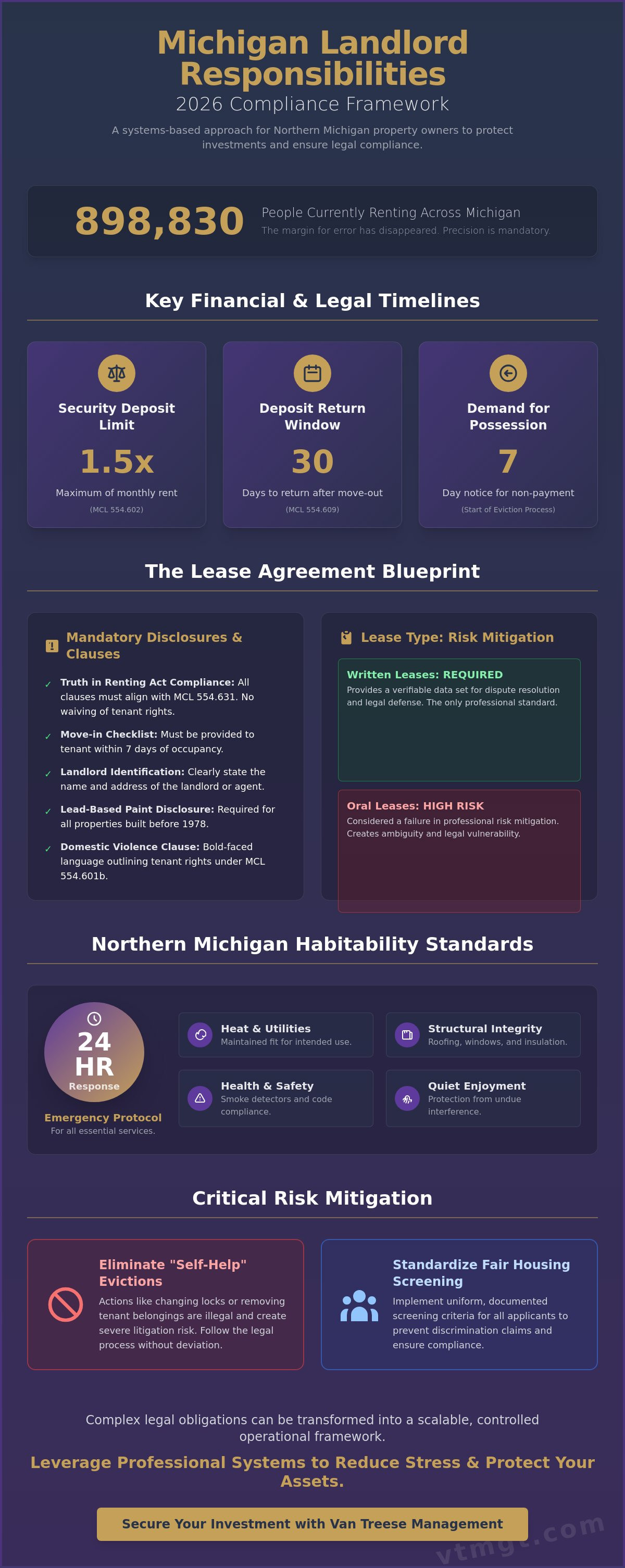
You've likely encountered the complexities of shifting statutes or the logistical difficulty of managing maintenance in Northern Michigan's climate. It's a significant risk when legal requirements, such as the 1.5 times rent security deposit limit under MCL 554.602, are not applied with technical accuracy. This guide provides the professional framework you need to achieve full legal compliance while implementing standardized systems that minimize vacancy. We'll analyze the mandatory 30-day deposit return window under MCL 554.609, the 7-day demand for possession for non-payment, and the specific maintenance protocols required to meet the warranty of habitability under MCL 554.139.
Key Takeaways
- Standardize your lease agreements to align with the Truth in Renting Act, ensuring all legal definitions meet the updated 2026 statutory requirements.
- Establish a technical 24-hour response protocol for essential service repairs to maintain habitability standards during Northern Michigan's extreme climate cycles.
- Execute the financial aspects of landlord responsibilities Michigan 2026 with precision, focusing on mandated security deposit limits and strict 30-day return protocols.
- Mitigate litigation risks by eliminating "self-help" eviction practices and implementing standardized Fair Housing screening processes in markets like Traverse City.
- Leverage professional management systems to transform complex legal obligations into a scalable, controlled operational framework that reduces owner stress.
Core Landlord Responsibilities under Michigan Law (MCL) 2026
Establishing a landlord-tenant relationship under the 2026 statutes requires more than a simple exchange of keys for currency. Legally, this relationship is defined as a contractual agreement where a property owner grants exclusive possession of a residential unit to a tenant in exchange for consideration, typically monthly rent. This foundational element of landlord-tenant law creates a series of non-negotiable duties that remain constant regardless of the specific lease terms. In 2026, the technical execution of these duties is the primary differentiator between professional asset management and high-risk property ownership.
The Truth in Renting Act (MCL 554.631 to 554.641) serves as the regulatory blueprint for all 2026 lease agreements. This act prohibits the inclusion of clauses that waive a tenant's rights or a landlord's legal liabilities. To maintain compliance with landlord responsibilities Michigan 2026, every lease must include specific mandatory disclosures. These include a lead-based paint disclosure for any property constructed prior to 1978, a comprehensive move-in checklist provided within seven days of occupancy, and the clearly stated name and address of the landlord or their authorized agent. Under the 2026 framework, the right to quiet enjoyment constitutes a contractual obligation ensuring the tenant's peaceful possession of the premises without unwarranted interference from the landlord or third parties.
Written vs. Oral Leases in 2026
While Michigan law technically recognizes oral leases for tenancies lasting less than 12 months, they're considered a failure in professional risk mitigation. Written agreements provide the only verifiable data set for dispute resolution and legal defense. Landlords don't have the authority to change lease terms mid-tenancy without the express written consent of both parties, unless the adjustment is mandated by a change in state or federal law. Furthermore, 2026 statutes require specific, bold-faced language regarding domestic violence and senior citizen protections. Tenants with a reasonable apprehension of danger from domestic violence or stalking have statutory rights to seek a release from rental obligations under MCL 554.601b, and these rights must be clearly outlined in the primary lease document.
Standardized Lease Compliance Systems
Managing diverse portfolios in Petoskey and Traverse City requires a uniform operational architecture to prevent clerical errors. Our firm implements standardized lease structures that ensure every residential unit adheres to the latest Michigan landlord laws. We utilize digital signature protocols and cloud-based record-keeping mandates to ensure that every disclosure, addendum, and inspection report is time-stamped and archived for a minimum of seven years. This systems-based approach eliminates the ambiguity of manual filing and ensures that landlord responsibilities Michigan 2026 are met with engineering-grade precision across all properties.
Maintaining Habitability: Northern Michigan’s Standards for 2026
In the 2026 regulatory environment, maintaining habitability isn't a subjective goal but a technical requirement defined by MCL 554.139. Landlords must ensure properties are fit for their intended use and kept in reasonable repair throughout the duration of the lease. For essential services such as heat, water, and electricity, a 24-hour emergency response protocol is the established standard for professional management. Failing to address a furnace failure during a January freeze in Northern Michigan doesn't just damage the physical asset; it creates immediate legal liability and potential for constructive eviction claims. For more detailed operational foundations, property owners should consult the Practical Guide for Tenants and Landlords, which outlines the specific statutory requirements for these essential services.
Structural integrity and weatherproofing are critical in regions where lake-effect snow and sub-zero temperatures are the seasonal norm. Landlords must verify that roofing, windows, and insulation meet 2026 safety codes to prevent ice damming and moisture infiltration. Health codes also mandate the installation and maintenance of interconnected smoke detectors and carbon monoxide alarms on every level and near sleeping areas. Egress windows must remain unobstructed and functional, especially in converted basement units. In Petoskey, landlords must maintain a minimum temperature of 68 degrees Fahrenheit within all habitable rooms from October 1 through May 1 to comply with local heating ordinances.
Maintenance Coordination and Vendor Management
Effective asset preservation requires a network of vetted local contractors who understand the unique demands of Indian River and Boyne City properties. Standardized rental property maintenance Northern Michigan systems allow for proactive inspections rather than reactive repairs. This approach prevents asset depreciation by identifying minor failures before they escalate into structural issues. Our maintenance coordination services ensure that every repair meets professional standards for durability and safety, reducing long-term capital expenditures.
Seasonal Responsibilities: Snow and Ice Management
Snow removal is a primary legal liability for landlords in Petoskey and Grand Rapids. While lease agreements may attempt to shift this burden to tenants, courts often hold the property owner responsible for common areas and walkways. Standardizing ice mitigation through consistent salting protocols is essential to prevent "slip and fall" litigation. Documenting these seasonal inspections and clearing activities provides a critical audit trail for insurance compliance. In 2026, precise record-keeping is the only way to demonstrate that landlord responsibilities Michigan 2026 were fulfilled during extreme weather events.
Financial Stewardship: Security Deposits and Rent Protocols
Financial stewardship in 2026 demands a rigorous, technical approach to capital management. Compliance with landlord responsibilities Michigan 2026 begins with the strict application of MCL 554.602, which mandates that security deposits never exceed 1.5 times the monthly rent. Precise adherence to this limit isn't optional; it's a foundational requirement for legal stability. Once a tenant vacates, the landlord must provide an itemized list of damages and return the remaining balance within 30 days. Failure to meet this 30-day threshold under MCL 554.609 results in a complete forfeiture of the right to retain the deposit for physical property damages. Professional management involves choosing between holding these funds in a regulated escrow account or posting a surety bond with the Secretary of State to satisfy statutory requirements. Detailed procedures for these financial protocols are outlined in the Michigan Legislature's Landlord-Tenant Guide, which serves as the primary technical reference for our accounting systems.
Standardized rent collection systems are essential to ensure cash flow stability across a portfolio. In 2026, relying on manual payments or informal tracking creates unacceptable margins for error. Implementing automated portals allows for real-time data entry and immediate identification of delinquencies. This technological framework ensures that every transaction is recorded with a clear audit trail, which is vital during any potential legal proceedings or financial audits. By treating rent collection as a controlled industrial process, landlords can eliminate the variability often found in residential property management.
The Move-In/Move-Out Checklist System
Digital checklists are the only professional standard for documenting property condition in 2026. These systems utilize photos with encrypted timestamps to provide the legal weight necessary to resolve security deposit disputes. Tenants have exactly 7 days from the start of occupancy to return their copy of the inventory checklist. If a landlord fails to provide this checklist at move-in, they're legally barred from claiming damages against the security deposit at the end of the tenancy. This technical documentation protects both the asset and the owner's financial interests.
Rent Increase Notices and Late Fee Limitations
Adjusting rent prices requires a 30-day written notice for month-to-month tenancies, while fixed-term leases cannot be adjusted until the contract concludes. Late fees must remain "reasonable" to avoid being classified as illegal penalties by Michigan courts; they should reflect actual administrative costs rather than serving as a profit center. Our automated financial reporting provides property owners with real-time visibility into these metrics, ensuring that all charges remain within the bounds of 2026 legal precedents while maintaining the property's yield.
Navigating Tenant Rights and the Eviction Process
The 2026 legal landscape for tenant rights requires a disciplined adherence to the Fair Housing Act and state-specific anti-discrimination statutes. In markets like Petoskey and Traverse City, landlords must ensure that marketing, screening, and management protocols don't inadvertently discriminate based on protected classes. A central pillar of landlord responsibilities Michigan 2026 is the absolute prohibition of "self-help" evictions. Attempting to remove a tenant by changing locks, terminating utility services, or removing personal belongings is a violation of MCL 600.2918 and can result in significant statutory damages. Retaliatory actions, such as increasing rent or decreasing services after a tenant has filed a legitimate complaint, are similarly prohibited and legally indefensible.
Legal possession must only be regained through the judicial system. For non-payment of rent, landlords must issue a 7-day written "Demand for Possession." For lease violations or the termination of a month-to-month tenancy, a 30-day "Notice to Quit" is generally required. The 90th District Court in Petoskey serves as the primary judicial venue for adjudicating landlord-tenant disputes and formal eviction proceedings within Emmet County. Accuracy in these notices is paramount; a single clerical error can result in a case dismissal, forcing the owner to restart the timeline and increasing the total period of non-performance.
Reasonable Accommodations and Modifications
Compliance with 2026 HUD standards involves a technical understanding of reasonable accommodations, particularly regarding assistance animals. Landlords can't apply "no-pet" policies or charge pet fees for verified service or emotional support animals under current federal and state guidelines. When a tenant with a disability requests physical modifications to the unit, the landlord must allow these changes if they're necessary for full use of the premises. We maintain rigorous documentation of these requests to provide a clear audit trail of Fair Housing compliance, ensuring every interaction is recorded with professional precision.
The Legal Eviction Process in Emmet and Charlevoix Counties
Filing for eviction in Emmet and Charlevoix counties requires a standardized approach to avoid administrative court delays. Precision in lease documentation and verifiable evidence of notice delivery are scrutinized during hearings. To mitigate these risks, property owners should focus on preventative measures rather than reactive litigation. Our professional tenant screening and placement services utilize an industrial-grade vetting process to ensure high-quality residency from the start, significantly reducing the statistical likelihood of ever needing the court system. By treating tenant selection as a critical engineering phase, we protect the long-term stability of your investment.
Scaling Compliance with Professional Management Systems
Van Treese Management operates on the principle that compliance isn't a burden but a measurable process. We transform the abstract requirements of landlord responsibilities Michigan 2026 into a series of repeatable, controlled operational systems. This engineering-grade approach ensures that every legal mandate, from habitability standards to financial disclosures, is executed with a high degree of precision. By removing the variability of individual decision-making, we provide property owners with a stable platform for long-term asset growth and litigation defense. Our firm functions as a technical partner, ensuring that your portfolio remains within the strict tolerance levels of 2026 state and federal laws.
Our 24/7 emergency response system is designed to protect both the tenant's rights and the owner's liability. We treat maintenance as a critical infrastructure task, ensuring that essential services are restored within the statutory windows defined by MCL 554.139. This systemized response isn't just about stress reduction; it's about maintaining the technical integrity of the property while ensuring that landlord responsibilities Michigan 2026 are met without failure. Standardized financial reporting further provides Northern Michigan real estate investors with the data necessary to evaluate performance objectively, ensuring that every dollar is accounted for with industrial-grade accuracy.
Innovation in Property Management
We apply a CAD/CAM-style precision to property maintenance planning. This involves mapping out lifecycle replacements and preventative service cycles to avoid the high costs of reactive repairs. Our standardized systems for tenant screening and placement in Grand Rapids and beyond utilize multi-point vetting protocols to ensure that only the most qualified residents occupy our managed units. For those currently investing in rental property Northern Michigan, these systems provide a critical layer of risk management that individual landlords often struggle to replicate. We leverage localized market research to maximize ROI, ensuring that rent structures remain competitive while adhering to the Truth in Renting Act and other 2026 regulations.
The Van Treese Advantage in Northern Michigan
Our deep community roots in Petoskey, Boyne City, and Indian River allow us to navigate local nuances that generic management firms often overlook. We're committed to thriving local communities through professional management that respects both the landlord's investment and the tenant's home. Our team functions as a solid, long-term partner in your wealth-building journey, providing the technological and human expertise required to manage complex manufacturing or residential assets. Contact Van Treese Management for a professional property analysis to see how our systems can stabilize your portfolio and ensure total compliance in the 2026 rental market.
Implementing Professional Management Standards for 2026
Mastering landlord responsibilities Michigan 2026 requires a transition from manual oversight to a systems-based operational model. Technical compliance with MCL 554.602 and MCL 554.139 is the only verifiable way to ensure asset stability in a more regulated environment. By prioritizing rigorous financial stewardship and maintaining 24/7 habitability standards, property owners can eliminate the high costs of legal disputes and excessive vacancy. Professional management isn't just a convenience; it's a risk mitigation strategy for the modern era.
Van Treese Management has provided standardized management systems since 2018, specifically tailored to the unique climate and legal landscape of Emmet and Charlevoix counties. Our framework includes 24/7 emergency maintenance coordination and industrial-grade tenant vetting to protect your yield. You don't have to manage these complexities alone. Secure your Northern Michigan investment with Van Treese Management's professional systems. Our team is ready to transform your property into a high-performing, fully compliant asset that stands the test of time.
Frequently Asked Questions
What is the maximum security deposit a Michigan landlord can charge in 2026?
Under MCL 554.602, the maximum security deposit is 1.5 times the monthly rent. This limit is a fixed statutory cap that applies to all residential leases across the state. Landlords can't circumvent this by labeling additional funds as non-refundable fees if the total exceeds this threshold. Precise financial tracking ensures these funds are handled according to 2026 escrow requirements.
Can a landlord enter a rental property without notice in Michigan?
No, landlords must provide reasonable notice before entering for non-emergency repairs or inspections. While state law doesn't define "reasonable" in a specific number of hours, the 24-hour notice period is the recognized professional standard in 2026. Entry without notice is only permitted in immediate emergencies, such as a burst pipe or fire, to prevent catastrophic asset damage.
How many days' notice is required for eviction due to non-payment in 2026?
A 7-day written "Demand for Possession" is required before filing an eviction for non-payment of rent. This notice gives the tenant exactly seven days to pay the balance or vacate the premises. If the deadline passes without resolution, the landlord may then initiate formal proceedings in the local district court to regain legal possession of the unit.
Who is responsible for snow removal at a rental property in Petoskey?
Landlords are generally responsible for maintaining safe ingress and egress, including snow and ice removal from common walkways. While a lease may attempt to delegate this to a tenant, Michigan courts often hold the property owner liable for slip and fall accidents in shared areas. In Petoskey's climate, a standardized vendor contract is the most effective way to manage this liability.
What are the mandatory habitability requirements for Michigan rentals?
Landlords must ensure properties are fit for their intended use and compliant with all health and safety laws under MCL 554.139. This includes providing functioning heat, potable water, and electricity. Fulfilling landlord responsibilities Michigan 2026 also requires maintaining structural integrity and ensuring that all smoke and carbon monoxide detectors are operational and meet current 2026 building codes.
How long does a landlord have to return a security deposit in Michigan?
Landlords have exactly 30 days from the date the tenant vacates to return the security deposit. This return must include an itemized list of any deductions for damages beyond normal wear and tear. Failure to meet this 30-day window under MCL 554.609 results in the forfeiture of the landlord's right to retain any portion of the deposit for physical property damage.
Are landlords required to provide a move-in checklist in 2026?
Yes, Michigan law requires landlords to provide an inventory checklist at the commencement of every tenancy. The tenant has 7 days to complete and return this document to record the property's initial condition. This checklist is a critical component of landlord responsibilities Michigan 2026, as it serves as the primary evidence in any future security deposit disputes or litigation.
Is Michigan considered a landlord-friendly state in 2026?
Michigan is considered a balanced jurisdiction because it lacks statewide rent control under MCL 123.411 but enforces strict procedural protections for tenants. Landlords have the flexibility to set market-rate rents based on demand in Traverse City or Grand Rapids. However, the legal system requires precise adherence to notice timelines and habitability standards to avoid costly administrative delays or court-ordered sanctions.