

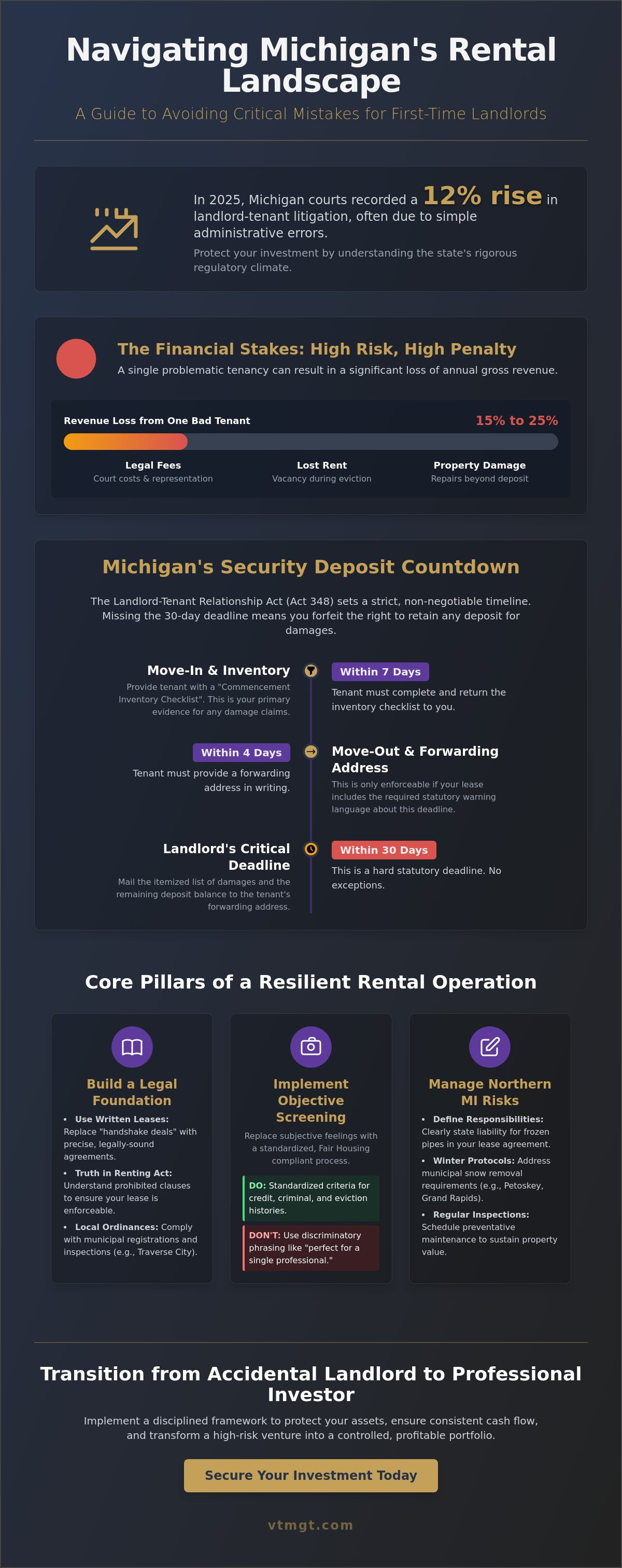
In 2025, Michigan courts recorded a 12% rise in landlord-tenant litigation, often triggered by minor administrative oversights rather than intentional malice. You likely invested in Northern Michigan real estate to secure a stable stream of passive income and protect your long-term capital. It's understandable if the prospect of a lawsuit or significant property damage causes you anxiety. Understanding the specific first time landlord mistakes Michigan owners frequently commit is the first step toward building a resilient, professional rental operation.
We've engineered this guide to provide you with a disciplined framework for risk mitigation and legal precision. You'll learn how to implement a structured approach to property management that ensures your assets remain protected and your cash flow stays consistent. We'll examine the critical 30 day window for security deposit itemization, the technical requirements of the Michigan Truth in Renting Act, and the maintenance protocols necessary to sustain property value through the 2026 fiscal year. This technical overview equips you with the exact tools needed to transform a high-risk venture into a controlled, profitable portfolio.
Key Takeaways
- Understand the strict 30-day statutory timeline for security deposit itemization to avoid the legal penalties associated with Michigan’s rigorous regulatory climate.
- Mitigate first time landlord mistakes Michigan owners frequently encounter by replacing subjective screening with standardized criteria for credit, criminal, and eviction histories.
- Define clear maintenance responsibilities for regional risks, such as frozen pipe liability and municipal snow removal requirements specific to Petoskey and Grand Rapids.
- Calculate the true cost of your operational time to identify the precise moment when professional management systems increase your ROI through reduced turnover.
The Transition from Homeowner to Michigan Landlord
The shift from occupying a property to managing it as a revenue-generating asset requires a fundamental change in operational logic. By 2026, the distinction between an accidental landlord and a professional investor has become a matter of financial survival in the Michigan market. Accidental landlords often inherit property or fail to sell a primary residence, while professional investors treat the unit as a high-precision machine requiring regular calibration. Failing to adopt this professional stance is one of the most common first time landlord mistakes Michigan property owners make during their first year of operation. Michigan's regulatory environment rewards those who implement rigorous systems. While the state provides a framework for property rights, the legal landscape is complex. Understanding U.S. Landlord-Tenant Law is essential for establishing a baseline of rights and responsibilities. In high-demand areas like Petoskey or Grand Rapids, a single bad tenant can result in a 15% to 25% loss of annual gross revenue through legal fees, lost rent, and physical property damage. You're no longer maintaining a home; you're managing a business asset where every variable impacts the bottom line.The Legal Framework of Michigan Rental Ownership
The Michigan Truth in Renting Act (Act 454 of 1978) strictly regulates the clauses you can include in a residential lease. Many new owners in Northern Michigan still rely on handshake deals, which remain the primary source of avoidable litigation in 2026. These informal agreements lack the technical precision needed to survive a court challenge. Additionally, cities like Traverse City require formal municipal registrations and periodic safety inspections. Skipping these administrative steps can render your lease unenforceable and expose your business to significant municipal fines.Financial Planning and the Hidden Costs of DIY
Critical Legal Pitfalls: Security Deposits and Fair Housing
Michigan's Landlord-Tenant Relationship Act, specifically Public Act 348 of 1972, dictates precise operational timelines that leave zero room for error. One of the most frequent first time landlord mistakes Michigan owners commit is violating the 30-day rule. Once a tenant vacates the property, you've got exactly 30 days to mail an itemized list of damages and any remaining deposit balance. If you miss this window by even 24 hours, you forfeit the legal right to retain any portion of the deposit for physical damages. This isn't a suggestion; it's a hard statutory deadline that courts enforce strictly.
Documentation serves as the foundation of your legal protection. You're required to provide a "Commencement and Termination Inventory Checklist" at the start of every lease. This document allows the tenant to record the property's condition within 7 days of moving in. According to Michigan's Practical Guide for Tenants & Landlords, this checklist is the primary evidence used in district court disputes. Without a signed checklist from both the start and end of the residency, your claims for repair costs will likely fail due to a lack of technical standing. It's also vital to remember that tenants must provide a "Notice of Forwarding Address" within 4 days of moving out, but you can only enforce this if you've included the required warning language in your lease agreement.
Mastering Michigan’s Security Deposit Laws
Michigan law requires you to hold deposits in a regulated financial institution or secure a "Surety Bond" to protect the funds. If you choose the bond option, it must be for the full amount of the deposits or $50,000, whichever is less. Your lease agreement must include specific statutory language, including your name, address, and the name of the financial institution holding the funds. For a deeper analysis of these technical requirements, read our guide on Michigan landlord laws. Managing these funds correctly prevents the 200% penalty often awarded to tenants in cases of mishandling.
Avoiding Discrimination Claims in Screening
Compliance with the Federal Fair Housing Act and Michigan’s Elliott-Larsen Civil Rights Act is a core requirement for risk mitigation. Another common first time landlord mistakes Michigan investors make is using "innocent" phrasing in ads, such as "perfect for a single professional," which can lead to lawsuits based on familial status discrimination. You've got to treat Emotional Support Animals (ESAs) as medical necessities rather than pets. This means you can't charge pet rent or a pet deposit for an ESA, regardless of your standard "no pets" policy. Standardizing your screening criteria ensures every applicant is evaluated on objective data like credit scores and verified income. If you're concerned about maintaining these rigid standards, partnering with a professional management firm can help you implement a compliant, technical screening process.
Operational Failures: Tenant Screening and Lease Execution
Treating property management as a social exercise rather than a technical process is one of the most common first time landlord mistakes Michigan owners commit. Relying on a "gut feeling" during a showing often leads to high turnover and avoidable legal friction. By 2026, professional risk mitigation requires a data-driven approach that replaces intuition with standardized metrics. A robust "Tenant Placement System" utilizes fixed benchmarks: a minimum credit score of 650, a clean eviction record for seven years, and a verified income-to-rent ratio of at least 3:1.
Operating without a precise legal framework exposes assets to unnecessary liability. Using a generic online template is a significant risk because these documents often fail to comply with the Michigan Truth in Renting Act. For comprehensive compliance, owners should consult the Michigan Legislature's Landlord-Tenant Guide to ensure their documentation covers security deposit inventory checklists and required statutory disclosures. Precision in the lease execution phase prevents the "occupancy at any cost" mentality that results in long-term financial loss.
The Anatomy of a Professional Tenant Screening
Income verification in 2026 has evolved beyond the traditional pay stub. With the expansion of the gig economy, landlords must analyze 24 months of 1099-NEC forms or tax returns to establish stability. Verifying previous landlord references requires cross-referencing the contact information against public property ownership records to detect "fake" references provided by friends or family. To avoid Fair Housing Act violations, provide a written "Adverse Action" notice whenever an applicant is rejected based on their consumer report, ensuring the process remains transparent and legally defensible.
Drafting Leases for Northern Michigan Realities
Properties in Petoskey and Boyne City require specific operational clauses that downstate contracts might overlook. Snow removal and lawn care responsibilities must be explicitly defined to prevent municipal fines or slip-and-fall litigation. A professional lease should specify who is responsible for clearing walkways within 24 hours of a snowfall exceeding two inches. Additionally, clear rules regarding guest stays and unauthorized occupants prevent "permanent guests" from establishing residency without a background check. For owners seeking long-term stability, integrating these local requirements is a core component of property management Petoskey MI strategies that prioritize asset protection over simple rent collection.
Implementing these systems reduces vacancy time by creating a predictable pipeline of qualified applicants. Efficiency in 2026 is defined by the ability to move from listing to lease execution in under 14 days without compromising on screening standards. This disciplined methodology ensures that first time landlord mistakes Michigan are mitigated through structural rigor rather than luck.
Northern Michigan Specifics: Seasonal Maintenance and Local Risks
Landlords operating in Northern Michigan face environmental and regulatory challenges that differ significantly from those in the southern parts of the state. One of the most common first time landlord mistakes Michigan investors make involves underestimating "Frozen Pipe" liability. When a property sits vacant during the winter transition, the legal and financial responsibility to maintain adequate heat stays with the owner. Michigan standards typically require a minimum interior temperature of 55 degrees Fahrenheit to prevent structural damage. A single burst pipe in an unheated unit can lead to flood damage and mold remediation costs exceeding $15,000, often while the landlord is held liable for tenant displacement costs.
Snow removal presents another critical regulatory hurdle. In Grand Rapids, municipal code requires property owners to clear sidewalks within 24 hours of a snow event. Petoskey enforces similar ordinances to ensure pedestrian safety in high-traffic tourist zones. If you don't have a reliable contractor on a seasonal retainer, you risk daily municipal fines and increased liability for slip-and-fall accidents. The labor market in Northern Michigan is notoriously tight. Waiting until the first blizzard to source a plow service is a tactical error that leads to service delays and inflated emergency rates.
Winterization and Emergency Response Systems
Northern Michigan winters require a 24/7 emergency response strategy. Owners must ensure that gutters are cleared of debris and furnaces are inspected by certified technicians before the first frost, which often occurs by mid-October. We recommend installing remote temperature monitoring systems to alert your management team if the interior heat drops below safe levels. These proactive measures are essential for protecting the asset's integrity. For a comprehensive list of seasonal tasks, consult our rental property maintenance Northern Michigan checklist.
Navigating the Tourism Impact on Long-Term Rentals
The Traverse City market creates a constant temptation for owners to pivot from long-term housing to short-term vacation rentals during peak summer months. This is a primary example of first time landlord mistakes Michigan owners commit when they ignore local zoning. In Emmet and Charlevoix counties, specific rental registration fees and strict occupancy limits apply to any property used for short-term stays. Attempting to "flip" a property type mid-season without the correct permits can result in immediate shutdowns and heavy litigation. Success in these hubs requires a stable, long-term strategy that accounts for the 12-month economic cycle rather than reacting to temporary price spikes. If you need help stabilizing your investment through these seasonal shifts, our team offers comprehensive Northern Michigan property management to mitigate your risk.
Scaling Your Investment: When to Outsource Management
Many new investors fall into the "Hourly Wage" trap. They assume performing manual repairs or handling every tenant call personally saves money. If a landlord spends five hours troubleshooting a furnace instead of focusing on portfolio growth or their primary career, the opportunity cost often exceeds the professional service fee. Michigan property owners must value their time as a finite resource. Failing to account for the cost of personal labor is one of the most frequent first time landlord mistakes Michigan investors encounter during their first year of operation.
The Van Treese approach treats property management as a technical discipline. We utilize standardized systems to eliminate the variability that leads to financial loss. By applying rigorous maintenance schedules and automated communication protocols, we transform a volatile asset into a predictable one. Professional management isn't an expense; it's a mechanism for scaling your portfolio without increasing your personal workload.
The ROI of Professional Systems
Standardized rent collection protocols ensure cash flow consistency. When payments are processed through a central system, the rate of on-time collection typically stabilizes at a higher percentage than manual methods. Our vetted vendor network provides access to specialized contractors who offer priority scheduling and lower repair costs due to our volume of business. Reducing tenant turnover by 15% through better management can save an owner thousands in vacancy losses. For those investing in rental property Northern Michigan, these systems are the foundation for sustainable long-term growth.
Getting Started with Van Treese Management
Our team provides localized expertise across Petoskey, Gaylord, and Grand Rapids. We facilitate a seamless transition process by auditing existing lease agreements and performing a comprehensive technical assessment of the property. We take the operational burden off new owners so they can focus on acquisition strategy. The VTMG Guarantee ensures every property receives professional oversight and human interaction, ensuring that technical efficiency never replaces personal accountability.
First-Time Landlord Final Checklist:
- Confirm all Michigan-specific lead-based paint disclosures are signed for pre-1978 properties.
- Establish a dedicated escrow account for security deposits to comply with state law.
- Verify that the lease includes specific language regarding Truth in Renting Act requirements.
- Set up a 24-hour emergency maintenance protocol to protect the physical structure.
- Audit the property for Michigan habitability standards before the first move-in date.
Managing a rental property requires precision and a commitment to high standards. Avoiding common first time landlord mistakes Michigan requires a shift from a "do-it-yourself" mindset to a "system-owner" mindset. By implementing professional management early, you secure your investment against the risks of 2026 and beyond.
Future-Proofing Your Michigan Real Estate Strategy
Navigating the rental market in 2026 demands a shift from a homeowner mindset to a structured business operation. Success hinges on rigorous compliance with the Michigan Landlord-Tenant Act and the implementation of standardized screening protocols. Avoiding common first time landlord mistakes Michigan owners often encounter requires precise attention to detail, especially regarding security deposit timelines and seasonal maintenance cycles in Northern Michigan. Our team has refined these processes through standardized management systems developed since 2018. We provide local expertise across Petoskey, Traverse City, and Grand Rapids, ensuring your assets remain protected against regional risks. Our infrastructure includes 24/7 emergency maintenance coordination to manage critical repairs before they escalate into structural failures. Transitioning to professional oversight allows you to scale your portfolio while maintaining the technical integrity of your investment. It's time to replace guesswork with proven operational systems. Protect your investment with professional Northern Michigan property management. We look forward to helping you build a resilient and profitable rental enterprise.
Frequently Asked Questions
What is the maximum security deposit a landlord can charge in Michigan?
Michigan law limits the maximum security deposit to 1.5 times the monthly rent amount. This cap is established under the Landlord-Tenant Relationship Act of 1972 and applies to all residential leases. If your monthly rent is $1,500, you can't legally collect more than $2,250 as a deposit. Many first time landlord mistakes Michigan residents make involve overcharging this fee, which can lead to legal penalties in small claims court.
Does a landlord in Michigan have to provide a written lease?
A written lease isn't legally required for tenancies lasting less than one year, but oral agreements are difficult to enforce. Under the Truth in Renting Act (Act 454 of 1978), any written agreement must avoid specific prohibited clauses to remain valid. We recommend using a structured, written document to define maintenance responsibilities and payment terms. This precision protects your investment and ensures both parties understand their technical obligations from the start.
How much notice must a Michigan landlord give before entering a property?
Michigan statutes don't define a specific number of hours for notice, but landlords must provide "reasonable" notice for non-emergencies. Most professional property managers adopt a 24-hour notice period as a standard operational protocol to maintain tenant privacy. You should clearly define this timeframe within your lease agreement to avoid disputes. Entry without notice is typically reserved for urgent repairs or documented emergencies that threaten the property's structural integrity.
Can a landlord in Petoskey charge a non-refundable cleaning fee?
Yes, you can charge a non-refundable cleaning fee in Petoskey if it's clearly stated in the lease agreement. Michigan courts, following the precedent in Stott v. Weadock, distinguish these fees from security deposits. The fee must be reasonable and used specifically for its stated purpose. It's vital to separate this from the security deposit in your accounting to avoid exceeding the 1.5-month legal limit for refundable deposits.
What happens if I miss the 30-day security deposit deadline in Michigan?
If you miss the 30-day deadline to provide an itemized list of damages, you forfeit your right to retain any portion of the security deposit. Under MCL 554.609, you must send this notice via mail within 30 days of the tenant vacating the premises. Failure to comply means you're legally obligated to return the full deposit immediately. This is one of the most common first time landlord mistakes Michigan owners encounter during the move-out process.
Are landlords responsible for snow removal in Grand Rapids rentals?
In Grand Rapids, property owners are legally responsible for clearing snow from public sidewalks within 24 hours of accumulation. While you can contractually delegate driveway snow removal to a tenant in a single-family home, the city holds the owner accountable for sidewalk compliance. Failure to clear snow can result in municipal fines starting at $95 plus the cost of contractor removal. It's best to hire a professional service to ensure consistent compliance.
Is a rental license required for properties in Traverse City?
Traverse City requires a rental license for all residential rental properties under Chapter 1440 of the City Code. You must register the property and pass a safety inspection before placing a tenant in the unit. The city currently limits the number of short-term rental licenses in specific zones to a total of 80 units. Always verify your property's zoning status with the planning department to ensure your operations align with local 2026 regulations.
How do I handle an emotional support animal if I have a "no pets" policy?
You must accommodate an emotional support animal even if you have a "no pets" policy because these animals aren't classified as pets under the Fair Housing Act. You can't charge a pet deposit or monthly pet rent for an ESA. However, you're entitled to request a reliable letter from a healthcare professional confirming the tenant's disability-related need for the animal. Denying a valid request can lead to federal discrimination charges and significant legal costs.