
Calculating the Real Tenant Turnover Costs in Petoskey: A 2026 Landlord Guide

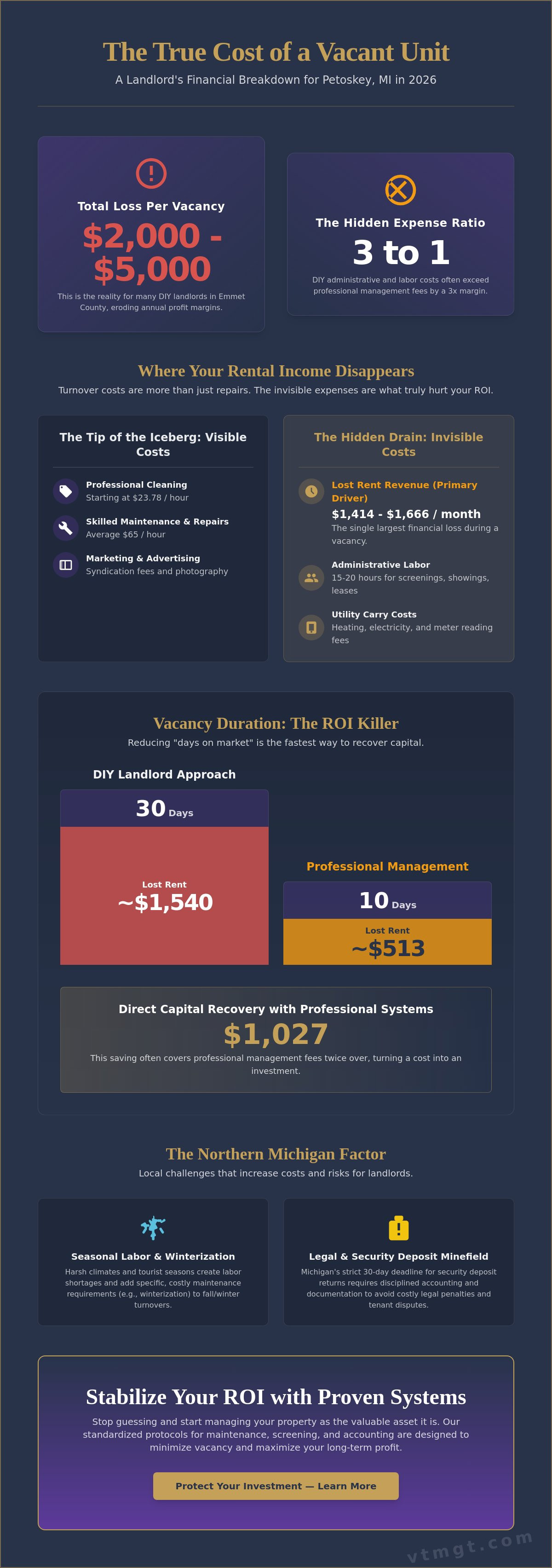
In 2026, the hidden labor and administrative expenses of a DIY vacancy in Northern Michigan often exceed professional management fees by a three-to-one margin. For many landlords in Emmet County, a single unit transition represents a loss between $2,000 and $5,000 when accounting for lost rent, marketing, and specialized labor. While the average rent in Petoskey has reached a range of $1,414 to $1,666, these margins quickly erode when you factor in local cleaning rates of $23.78 per hour and $65 per hour for technical maintenance. Accurately calculating tenant turnover costs Petoskey requires a disciplined, data-driven approach to property management rather than simple guesswork.
We recognize that managing the strict 30-day legal deadline for security deposit returns while coordinating seasonal winterization is a significant operational challenge. You'll discover how to identify the invisible leaks in your rental ROI and implement the systems needed to stabilize your portfolio. This guide provides a technical breakdown of move-out math, standardized maintenance protocols, and the professional strategies we use to keep vacancy rates low and profit margins predictable.
Key Takeaways
- Learn how to calculate the comprehensive financial impact of tenant turnover costs Petoskey landlords face, including administrative overhead and marketing expenses.
- Understand why Northern Michigan’s seasonal labor market and specific winterization requirements make fall and winter vacancies significantly more expensive than national averages.
- Identify the critical legal requirements for security deposit returns and inventory checklists to mitigate financial liability and protect your asset under Michigan law.
- Discover how implementing standardized maintenance protocols and professional tenant screening can shorten vacancy periods and stabilize your long-term rental ROI.
Understanding the Scope of Tenant Turnover in Northern Michigan
Effective property management requires a technical understanding of the turnover cycle. We define tenant turnover as the comprehensive period beginning the moment a lease agreement is terminated and concluding only when a new, qualified occupant takes possession of the unit. In our region, tenant turnover costs Petoskey owners more than simple repair bills; they represent a significant disruption in capital flow that must be managed with precision.
Petoskey's rental market operates on a different rhythm than national averages. While urban centers might see consistent demand throughout the year, our local cycle is influenced by seasonal tourism and harsh climate conditions. A vacancy that occurs in November carries different operational risks than one in May. In 2026, successful ownership has shifted from passive landlording to active asset management. We prioritize the "Total Turnover Impact" (TTI), a metric that quantifies the aggregate financial erosion on your annual ROI during the transition phase.
The Visible vs. Invisible Costs of a Vacant Unit
Most landlords focus on the visible line items: move-out cleaning, which currently starts at an average of $23.78 per hour in Petoskey, and basic painting or marketing fees. These are easy to track but only represent a fraction of the actual loss. The invisible costs are often far more damaging. Lost rent, which averages between $1,414 and $1,666 per month locally, is the primary driver of TTI. When you add utility carry costs, such as the $10.00 final meter reading fee and ongoing heating requirements, invisible expenses often exceed visible ones by 50%. Northern Michigan property owners frequently underestimate these factors because they fail to account for the "days on market" opportunity cost.
Why 2026 Is Different for Emmet County Landlords
The operational environment in Emmet County has grown more complex this year. Persistent labor shortages mean that "make-ready" tasks now require more lead time and higher capital. With handyman rates in Michigan averaging $65 per hour, inefficient scheduling can lead to cascading delays. Additionally, tenant expectations for modern amenities and high-performance building systems have increased. To maintain competitive profit margins, we utilize standardized management systems. These protocols mitigate rising vendor rates by ensuring that every maintenance hour is utilized with maximum efficiency, preventing the cost overruns common in unmanaged turnovers.
The Financial Breakdown: Where Your Rental Income Disappears
Analyzing the aggregate tenant turnover costs Petoskey landlords experience reveals that the largest financial leaks occur in the transition between tenants. A standard 2-bedroom home in Petoskey currently commands between $1,414 and $1,666 in monthly rent. When a unit sits vacant for 30 days, the owner loses approximately $1,540 in gross revenue alone. In contrast, a professional 10-day turnover reduces that loss to $513. This $1,027 difference represents a direct recovery of capital that often pays for professional management fees twice over.
Marketing efficiency plays a critical role in these numbers. While DIY smartphone photos might seem cost-effective, professional photography attracts higher-quality applicants and reduces the "days on market" metric. We also consider the administrative drain. A typical landlord spends 15 to 20 hours on screenings, showings, and lease preparation. At a professional labor rate, this time investment represents a hidden expense of nearly $1,000 per turnover. Our financial reporting and accounting systems help owners visualize these often-overlooked labor costs.
Hard Costs: Repairs and Maintenance
The tangible expenses of preparing a unit are rising. In May 2026, professional deep cleaning in Petoskey starts at $23.78 per hour, while specialized handyman services average $65 per hour across Michigan. A standard "make-ready" process includes painting, lock changes, and fixture updates. Executing rental property maintenance Northern Michigan owners can trust requires a vetted vendor network to avoid the premium pricing of emergency repairs. All deductions from security deposits must strictly adhere to Michigan landlord-tenant laws to avoid legal penalties that can triple the original cost.
Soft Costs: The Vacancy Factor
Every Petoskey owner should use a simple formula to track daily erosion: (Monthly Rent x 12) / 365. For a median Petoskey unit, this equals a daily loss of roughly $51. When a unit is empty, you're also responsible for utility carry costs, including a $10.00 final meter reading fee and significant seasonal heating expenses. Leaving a unit vacant during the peak summer move-in season is particularly costly, as you miss the window of highest demand. Professional maintenance coordination ensures these gaps are minimized through proactive scheduling and simultaneous vendor dispatching.
The Northern Michigan Factor: Seasonal Labor and Winterization
In Petoskey, the environment dictates the operational schedule for every rental property. While national models assume a steady availability of labor, tenant turnover costs Petoskey landlords face are heavily influenced by the local seasonal economy. During the peak summer months, Emmet County experiences a surge in construction and hospitality demand. This creates a supply-side constraint on skilled labor, making it difficult for independent owners to secure handymen or cleaners on short notice. When a vacancy occurs during this window, the inability to find a vendor can extend a unit's downtime by weeks, directly eroding the annual profit margin.
Winter turnovers present a different set of technical challenges. A vacancy in January requires immediate and rigorous winterization protocols to protect the asset. Beyond the standard $10.00 final meter reading fee, landlords must absorb the full cost of heating to prevent pipe bursts, a risk that's amplified by Northern Michigan’s sub-zero temperatures. We also account for the logistical friction of snow removal; a property must remain accessible and "showable" to prospective tenants, necessitating consistent plowing and salt application even when no rent is being collected. These climate-driven expenses often turn a standard turnover into a high-overhead event.
Navigating the Petoskey Vendor Gap
Independent landlords often pay a market-adjusted premium for emergency repairs because they lack a consistent volume of work to offer contractors. With Michigan handyman rates averaging $65 per hour, any inefficiency in scheduling becomes a liability. Our approach relies on year-round vendor relationships that prioritize our properties, ensuring that "make-ready" tasks are completed without the delays common in the DIY sector. By standardizing maintenance requirements, we avoid custom, expensive repair solutions that often arise when owners attempt to manage turnovers reactively during the busy season.
Climate Impacts on Turnover Speed
Snow and ice don't just increase utility bills; they slow down the entire move-in logistics chain. Potential tenants are less likely to tour properties during heavy lake-effect snow cycles, which naturally extends the "days on market" for any vacant unit. To maintain interest, we ensure vacant units are kept at a consistent, comfortable temperature, which is a non-negotiable carry cost for the owner. The Seasonal Vacancy Penalty in Northern Michigan is the quantified loss resulting from reduced applicant volume and increased utility overhead during the winter cycle.
Legal Compliance and the Security Deposit Minefield
Legal compliance serves as the structural foundation of a profitable rental operation. In Emmet County, failing to adhere to the strict timeline for security deposit returns often results in the immediate forfeiture of the right to claim damages. Michigan law mandates that landlords provide an itemized list of deductions or a full refund within 30 days of a tenant vacating the premises. If this window is missed, the resulting tenant turnover costs Petoskey landlords face can double as they lose the ability to offset repair expenses with the held deposit. We view legal adherence as a risk-mitigation strategy that protects the net income of the asset. Following Michigan landlord laws is a financial necessity, not just a legal one.
The financial risk extends beyond the deposit itself. Litigation in local courts over relatively small amounts can quickly escalate. A $500 dispute regarding cleaning or minor repairs can result in thousands of dollars in legal fees and court costs if the landlord’s documentation is found lacking. The Michigan-required "Inventory Checklist" isn't merely a formality; it's a critical defensive document. Without a signed, detailed record from both move-in and move-out, the burden of proof falls entirely on the owner, often leading to unfavorable judgments in Emmet County courtrooms.
Standardized Documentation to Protect ROI
We implement a rigorous inspection protocol that utilizes high-resolution photo evidence and standardized reporting. This process removes subjectivity from the turnover cycle. By clearly defining "normal wear and tear" versus "tenant damage" within our lease agreements, we prevent disputes before they reach a legal impasse. This technical clarity ensures that maintenance funds are allocated correctly and that owners aren't paying for damages caused by the outgoing resident. You can secure your portfolio today by utilizing our professional lease agreement preparation services.
Fair Housing and Tenant Screening
The most effective way to lower tenant turnover costs Petoskey owners encounter is to ensure high-quality placement from the start. Poorly screened tenants are significantly more likely to cause early lease terminations or physical damage to the property. Successful investing in rental property Northern Michigan depends on a screening process that is both thorough and compliant with Fair Housing regulations. Avoiding discriminatory language in marketing and applying consistent criteria to every applicant prevents costly fines and reduces the frequency of the turnover cycle itself. Our tenant screening and placement systems provide the necessary oversight to minimize these operational risks and stabilize your annual returns.
Stabilizing Your ROI with Van Treese Management Systems
Stabilizing a rental portfolio requires moving beyond reactive fixes and adopting a systematic approach to asset performance. Our Standardized Management System treats each property as a precision instrument within a larger financial framework. By integrating professional tenant placement, we focus on securing long-term residents who value the property, which naturally reduces the frequency of turnover events. This shift in strategy directly impacts tenant turnover costs Petoskey owners see on their year-end financial statements. We replace the uncertainty of DIY methods with a structured framework that prioritizes high occupancy and predictable cash flow.
Technical efficiency during the "make-ready" phase is the difference between a profitable year and a loss. Our 24/7 maintenance coordination ensures that specialized vendors are dispatched immediately upon a lease termination. This protocol reduces the transition period from the typical 30-day DIY average to a controlled 10-day cycle. By shortening this window, we recover nearly three weeks of rental income for our clients. Proactive portfolio management involves monitoring the lifecycle of every appliance and building system to prevent emergency failures that drive up turnover expenses.
The VTMG Advantage: Local Expertise, Global Standards
We combine deep local expertise with industrial-grade management standards. Our network of vetted Northern Michigan vendors provides preferred pricing and priority scheduling that's often unavailable to independent landlords. This helps mitigate the $65 per hour Michigan average for technical labor and the $23.78 per hour starting cost for Petoskey cleaning services. We utilize data-driven rent setting to ensure your units are positioned correctly within the current $1,414 to $1,666 Petoskey market range. This precision minimizes "days on market" and ensures the asset remains productive throughout the year. Our financial reporting and accounting systems provide the transparency needed to track every dollar, ensuring that every expense is justified by an increase in asset value.
Next Steps for Petoskey Property Owners
Transitioning to a professional system begins with a comprehensive audit of your current operations. We offer a detailed rental analysis designed to identify the specific turnover leaks that are eroding your profit margins. Our systems transform volatile rental properties into stable, high-performing assets that operate with minimal friction. You can optimize your Petoskey rental ROI with Van Treese Management to secure the long-term health of your investment portfolio and eliminate the administrative drain of unmanaged turnovers.
Securing the Long-Term Performance of Your Petoskey Assets
Managing rental assets in Northern Michigan is a technical discipline that requires operational precision. We've established that tenant turnover costs Petoskey landlords encounter are not merely repair bills; they're aggregate losses driven by vacancy periods, seasonal labor constraints, and strict legal risks. By implementing standardized systems and rigorous screening, you can mitigate these variables and secure the predictable cash flow your portfolio requires. Moving from a reactive DIY approach to a structured management model is the most effective way to protect your margins.
Since 2018, our firm has maintained deep local roots in Emmet and Charlevoix counties. We provide the technical expertise needed to manage both residential and commercial assets with industrial-grade efficiency. Our team is ready to help you transition from the volatility of unmanaged turnovers to a proactive, data-driven management model that prioritizes your ROI. We understand the unique challenges of the Northern Michigan market and have the systems in place to navigate them successfully.
Protect your Northern Michigan rental income—Contact Van Treese Management today. We're here to ensure your properties remain stable and profitable through every season.
Frequently Asked Questions
What is the average cost of tenant turnover in Petoskey, MI?
A single turnover in Petoskey typically costs between $2,000 and $5,000 per unit. This figure includes approximately $1,540 in lost rent for a 30-day vacancy, plus hard costs like cleaning and repairs. When administrative time and marketing are factored in, the aggregate tenant turnover costs Petoskey owners face often reach the higher end of that range.
How long does a typical rental turnover take in Northern Michigan?
A standard DIY turnover in Northern Michigan often takes 30 days or more due to vendor scheduling and administrative delays. Professional management systems can reduce this to approximately 10 days. The speed of the "make-ready" process depends heavily on the time of year, as winter conditions and summer labor shortages can extend timelines for unmanaged properties.
Can I charge a departing tenant for professional cleaning in Michigan?
You can only deduct cleaning costs from a security deposit if the unit's condition exceeds "normal wear and tear." Michigan law is strict about these deductions. Landlords must provide an itemized list of damages and costs within 30 days. Charging for routine cleaning that brings the unit back to its move-in state is generally prohibited unless specific, documented damage is present.
How does professional property management reduce turnover costs?
Professional management reduces costs by shortening vacancy periods through proactive maintenance coordination and vetted vendor networks. By utilizing established relationships, managers avoid the "emergency premiums" often charged to independent owners. Additionally, rigorous tenant screening reduces the frequency of turnovers, which is the most effective way to stabilize long-term rental ROI in the Petoskey market.
What are the most common "hidden" costs of a vacant rental unit?
The most common hidden costs include utility carry charges, such as the $10.00 final meter reading fee in Petoskey, and seasonal heating expenses during winter months. Owners also face opportunity costs from lost rental income and the administrative time spent on screenings and showings. These "soft costs" often represent over 50% of the total financial impact of a vacancy.
Is it better to have a short-term or long-term rental in Petoskey to avoid turnover?
Long-term rentals generally offer better stability and lower turnover costs in Petoskey due to strict local regulations. Vacation rentals are limited to specific business districts and require a city license. With the current moratorium on new short-term licenses in residential areas, long-term leasing provides a more predictable revenue stream with fewer transition events and lower seasonal overhead.
What legal documents are required for a move-out in Emmet County?
Michigan law requires an "Inventory Checklist" for both move-in and move-out to document the property's condition. You must also provide a written, itemized list of any security deposit deductions within 30 days of the tenant vacating. These documents are your primary defense in Emmet County courts if a dispute arises regarding repair costs or deposit returns.
How can I speed up the "make-ready" process for my rental property?
You can speed up the process by pre-scheduling inspections and vendors as soon as a notice to vacate is received. Standardizing paint colors, flooring, and fixtures across your portfolio allows for faster repairs and reduces the need for custom solutions. Maintaining a year-round relationship with local contractors ensures your property is prioritized even during Northern Michigan's peak construction season.