
How to Reduce Tenant Turnover in Traverse City: A Strategic 2026 Guide

With the average rent for a one-bedroom apartment in Traverse City reaching $1,513 as of May 2026, every month a unit sits vacant represents a measurable failure in asset performance. You understand that the high cost of vacancy prep and the difficulty of finding reliable contractors in Northern Michigan can quickly erode your rental ROI. Learning how to reduce tenant turnover Traverse City requires more than just a friendly approach; it demands a disciplined, systems-driven strategy that treats property management as a precise engineering challenge.
You've likely experienced the stress of constant tenant screening and the physical wear and tear that comes with frequent moving cycles. It's a common frustration for owners who want predictable monthly cash flow but find themselves caught in a loop of 30-day notices and expensive turnover repairs. We'll provide you with the exact technical framework needed to maximize resident retention and protect your capital in this competitive market. This guide previews the maintenance coordination protocols, legal compliance standards, and financial reporting structures required to secure stable, multi-year tenancies through 2026 and beyond.
Key Takeaways
- Analyze the specific seasonal risks of the Northern Michigan market, where winter vacancies incur significant overhead for heating and snow removal.
- Execute a precision onboarding process within the first 30 days to establish the professional standards that drive multi-year lease renewals.
- Transition from reactive repairs to a proactive, standardized maintenance system that builds resident loyalty through consistent asset care.
- Calculate the true cost of rent increases to avoid the vacancy trap and discover how to reduce tenant turnover Traverse City using localized market data.
- Integrate human interaction with structured management technology to create a stable, high-performing rental portfolio.
The Financial Impact of Tenant Turnover in the Traverse City Market
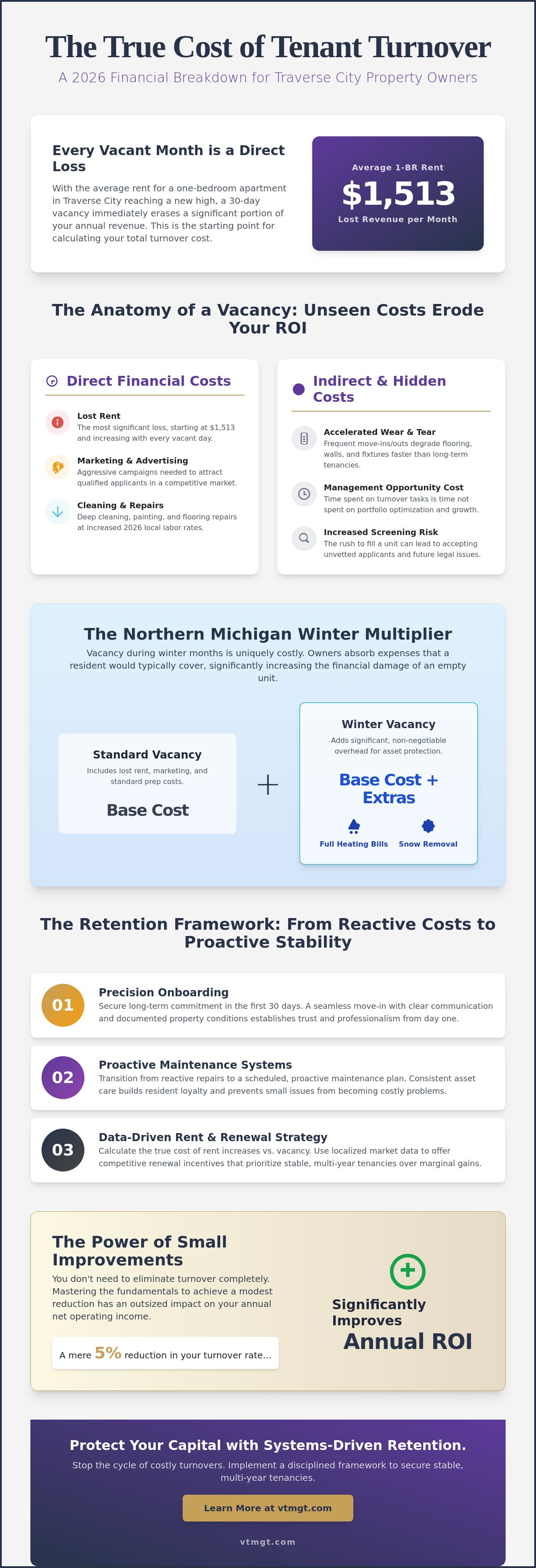
Tenant turnover represents the complete cycle of a resident vacating a unit and a new occupant taking possession. While it's a standard part of property management, the 2026 reality in Northern Michigan makes it a high-stakes financial event. Vacancy during our winter months is significantly more costly than in other regions. When a unit sits empty in January, the owner absorbs the full cost of high-efficiency heating and professional snow removal, expenses that a resident would typically cover. Understanding how to reduce tenant turnover Traverse City starts with recognizing these localized overhead spikes.
Direct expenses include aggressive marketing campaigns, professional deep cleaning, and the preparation of lease agreements that comply with Landlord-tenant law. Indirect costs are often harder to quantify but equally damaging. The opportunity cost of management time spent on administrative tasks instead of portfolio optimization is substantial. There's also the elevated risk of accepting unvetted applicants during a rush to fill a vacancy, which can lead to even more expensive legal complications later.
Calculating Your True Turnover Cost
Quantifying the loss begins with the base rent. In Grand Traverse County, the average monthly rent for a one-bedroom unit is $1,513. Losing just 30 days of occupancy wipes that entire amount from your annual revenue. Local labor rates in 2026 for painting and flooring repairs have also increased, reflecting the broader shortage of skilled trades in the Traverse City area. Frequent moving creates hidden wear and tear. Heavy furniture scraping across floors and accidental wall damage during move-ins degrade the asset's structural integrity faster than long-term stays. Our systems prioritize minimizing these physical impacts by stabilizing the resident base.
Traverse City Rental Climate in 2026
The current supply-demand ratio in Northern Michigan remains tight, but the local job market's shift toward workforce housing has changed resident behavior. Stability is now the primary goal for both parties. A mere 5% reduction in your turnover rate can significantly improve your annual ROI by preserving capital that would otherwise be spent on marketing and prep. Precision management is the only way to maintain this control. Mastering how to reduce tenant turnover Traverse City requires a disciplined look at these metrics to ensure your cash flow remains predictable throughout the year. We focus on the technical details of property performance to eliminate the variables that cause residents to leave.
Implementing a Precision Onboarding and Communication Framework
The renewal decision doesn't happen at month eleven. It begins at the moment of lease signing. We operate under the 'First 30 Days' Rule, which dictates that a resident's long-term commitment is forged during their initial interaction with our management systems. If the move-in process is chaotic or the property condition is undocumented, trust is compromised immediately. Learning how to reduce tenant turnover Traverse City requires a shift from passive management to an active, precision-based onboarding framework.
Establishing 24/7 emergency response protocols serves as a critical trust-building metric. In Northern Michigan, where a furnace failure in February is a life-safety issue, residents need to know that a technical solution is always accessible. We use integrated technology to ensure frictionless rent collection and clear communication channels. This removes the administrative friction that often leads to resident dissatisfaction and stabilizes the relationship from day one.
Standardized Move-In Protocols
Precision begins with a comprehensive digital property condition report. This document provides a baseline of the asset's state, utilizing high-resolution imagery and structured data points to eliminate future disputes over security deposits. We supplement this with a Resident Welcome Packet tailored to Traverse City utilities and services, ensuring the transition is seamless. Setting clear expectations regarding Michigan landlord laws at the outset prevents legal ambiguity and establishes a professional boundary that protects the owner's interests.
The Communication Cadence
Consistency is the bedrock of retention. We implement automated check-ins at the 3, 6, and 9-month marks to monitor resident satisfaction. These aren't casual inquiries. They're structured feedback loops designed to identify technical issues or dissatisfaction before a 'notice to quit' is ever drafted. When concerns arise, we handle them with professional, objective precision, treating every repair request as a maintenance coordination task rather than an inconvenience. This methodical approach ensures that residents feel their housing is managed by experts, which is the most effective way to secure a multi-year lease.
Maintaining this level of detail requires a dedicated partner to oversee the daily operations. Our team provides the professional management infrastructure necessary to stabilize your portfolio and reduce the stress of constant tenant screening. By using these data-driven feedback loops, we address minor friction points before they escalate into a vacancy, protecting your ROI through 2026 and beyond.
Proactive Maintenance: Transforming Repairs into Resident Loyalty
Maintenance coordination is the primary technical lever for long-term asset preservation. Strategic owners understand that learning how to reduce tenant turnover Traverse City involves viewing every service call as a retention opportunity rather than a line-item expense. Shifting from reactive fixing to a standardized maintenance system ensures that the property remains in peak operational condition while signaling to the resident that their housing stability is a priority. This professional approach eliminates the friction often caused by deferred maintenance, which is a leading driver of resident departures.
The psychological impact of 'invisible' maintenance shouldn't be underestimated. Routine tasks like replacing HVAC filters, testing smoke detectors, and cleaning gutters demonstrate a level of care that residents appreciate. These actions protect the structural integrity of the building and reduce the likelihood of catastrophic failures that displace occupants. We vet local Traverse City contractors for technical proficiency and professionalism, ensuring that every technician entering the property reflects our high standards. By making minor proactive adjustments now, we significantly reduce long-term capital expenditures and prevent the accelerated wear that occurs when systems are neglected.
Seasonal Preventative Maintenance in Northern Michigan
The climate in Grand Traverse County demands a disciplined seasonal schedule. Our winterization protocols focus on preventing pipe bursts and heating failures, which are the most common causes of emergency resident displacement in January. Spring inspections prioritize identifying moisture intrusion or foundation shifts before they escalate into mold problems or structural issues. Proactive maintenance is the primary hedge against structural depreciation.
Emergency Response Standards
We adhere to the 'VTMG Standard' for emergency resolution, which targets a 24-hour turnaround for critical failures. Professional coordination during a utility failure or appliance breakdown reduces resident anxiety and reinforces the value of the tenancy. We track maintenance metrics, including response times and resolution rates, to provide objective proof of value to the resident. This data-driven approach to how to reduce tenant turnover Traverse City ensures that residents feel secure in their homes, making them far more likely to renew their lease regardless of minor market fluctuations. Reliable technical support is often the deciding factor in a resident's choice to stay for another multi-year term.
Data-Driven Rent Strategies and Renewal Incentives
The 'Vacancy Trap' occurs when a marginal rent increase triggers a resident departure, resulting in a net loss that takes years to recover. If your current monthly rent is $1,513, losing just one month of occupancy costs you $1,513 in gross revenue immediately. When you add the $500 to $1,000 typically required for professional cleaning and technical repairs, the total cost of the turn exceeds $2,000. A $50 monthly rent hike would require 40 months of continuous occupancy just to break even on that single vacancy. Calculating these variables is a core component of how to reduce tenant turnover Traverse City.
We utilize local market research to justify fair market value adjustments with objective data. With median home prices in Traverse City reaching $470,000 as of March 2026, many residents are priced out of homeownership, which increases the demand for stable, high-quality rentals. We initiate renewal conversations exactly 90 days before lease expiration. This proactive window allows us to address resident concerns and secure a commitment before they begin investigating other options in the Northern Michigan market.
The ROI of Renewal vs. New Placement
New tenant acquisition involves marketing expenses and administrative overhead that are entirely avoided through successful retention. In 2026, the labor shortage across Petoskey and Traverse City has made turnover work significantly more expensive and difficult to schedule. Finding reliable contractors for quick painting or flooring turns often extends vacancy periods beyond 30 days. Maintaining a 95% occupancy rate with stable, multi-year residents is mathematically more profitable than chasing a 100% market-rate target that results in frequent churn. Precision management focuses on the net annual yield rather than the nominal monthly rent.
Strategic Renewal Incentives
Non-monetary incentives provide high perceived value to the resident while simultaneously improving the owner's asset. Offering professional carpet cleaning or installing technical upgrades like smart thermostats increases the property's long-term value and encourages a renewal. We also implement tiered lease terms, such as 18-month options, to align future move-outs with the high-demand spring cycles in Northern Michigan. This ensures that if a vacancy eventually occurs, it happens when the market is most active. Contact our team for a professional rent analysis to optimize your portfolio's performance and ensure your pricing strategy supports long-term retention.
The Van Treese Advantage: Systems-Based Retention in Traverse City
Our approach to professional rental management in Charlevoix and TC focuses on the technical stabilization of your real estate assets. We don't rely on generic marketing tactics to keep residents. Instead, we implement a disciplined framework that treats every property as a high-performance system. Understanding how to reduce tenant turnover Traverse City requires a departure from traditional, reactive management styles. We integrate human interaction with standardized management technology to create a controlled environment where variables are minimized and resident satisfaction is a measurable outcome of our operational precision.
The 'engineering aesthetic' we bring to property management ensures that every unit is maintained to a rigorous standard. This doesn't just protect the owner's capital; it creates a superior living environment that residents are reluctant to leave. By maintaining high-quality housing standards, we protect the broader Northern Michigan community and ensure that your portfolio remains competitive in a market where the median home price has risen to $470,000. Residents in 2026 value the reliability of a professionally managed home where technical issues are resolved with speed and accuracy.
Standardized Management Systems
Our methodology for tenant placement and screening uses objective data points to identify residents who value long-term stability. Once a lease is active, we coordinate with a network of vetted local vendors who understand our requirements for efficiency and professionalism. This coordination ensures that maintenance tasks are completed without the delays common in the current Northern Michigan labor market. Owners receive transparent financial reporting and accounting, providing a clear view of the property's performance and the effectiveness of our retention strategies. Every process is documented and repeatable, ensuring consistent results across your entire portfolio.
Partnering for Long-Term Success
Professional delegation reduces the stress associated with constant tenant screening and the high cost of vacancy prep. We handle the complexities of lease agreement preparation and financial reporting so you can focus on portfolio growth. If you're ready to optimize your asset's performance, you can request a rental analysis for your Traverse City property to see how our systems-driven approach compares to the current market. Professional management isn't a cost. It's a strategic investment in the stability and long-term ROI of your rental business. Mastering how to reduce tenant turnover Traverse City is the most effective way to ensure your cash flow remains predictable as the regional market continues to evolve through 2026.
Stabilizing Your Portfolio for Long-Term Performance
Mastering how to reduce tenant turnover Traverse City requires a shift from reactive management to a disciplined, systems-based approach. We have analyzed the true cost of vacancy in the 2026 market, where a single month of unoccupancy can erode over $1,513 in gross revenue. By implementing standardized onboarding protocols and proactive seasonal maintenance, you transform your properties into high-performance assets that residents are eager to keep. The technical precision of your operations is the most reliable predictor of your long-term rental ROI.
Van Treese Management has been deeply rooted in Northern Michigan since 2018, providing the professional infrastructure needed to manage Residential and Commercial properties with engineering-grade accuracy. Our team specializes in 24/7 maintenance coordination and data-driven financial reporting to ensure your portfolio remains stable. You don't have to navigate the complexities of tenant screening or the local labor shortage alone. It's time to replace the stress of constant turnover with the predictability of a professionally managed system.
Secure Your Rental ROI with Van Treese Management and ensure your real estate investments thrive in our unique regional climate.
Frequently Asked Questions
What is a normal tenant turnover rate in Traverse City?
A standard turnover rate for a healthy, professionally managed portfolio in Northern Michigan typically ranges between 20% and 30% annually. While national averages often fluctuate higher, the Traverse City market's high demand and low housing inventory create a "warm" environment where residents prefer to remain in stable housing. Portfolios that exceed a 35% turnover rate often indicate underlying technical issues with maintenance coordination or misaligned rent pricing.
How much does the average tenant turnover cost a Michigan landlord?
The total cost of a single turnover typically ranges from $2,500 to $5,000 when accounting for all direct and indirect variables. With the average rent for a one-bedroom apartment in Traverse City at $1,513, losing just one month of occupancy represents a significant revenue hit. When you add the rising costs of professional cleaning, paint, and flooring labor in 2026, the financial impact often exceeds two months of gross rent.
Should I allow pets to reduce turnover in Northern Michigan?
Allowing pets is a highly effective strategy for increasing resident retention because pet-friendly housing remains limited in Grand Traverse County. Residents with pets tend to sign longer leases and renew at higher rates due to the difficulty of finding alternative accommodations. Implementing a clear pet policy with a non-refundable fee and monthly pet rent protects your asset while expanding your pool of qualified, long-term applicants.
How early should I start lease renewal conversations with my tenants?
Initiate renewal discussions exactly 90 days before the lease expiration date to ensure operational stability. This proactive window allows you to address any technical concerns the resident might have and provides ample time to negotiate rent adjustments based on 2026 market data. Starting early prevents the resident from exploring other listings and is a core component of how to reduce tenant turnover Traverse City.
What are the most common reasons tenants leave rentals in Grand Traverse County?
Residents primarily leave due to housing affordability gaps, deferred maintenance, or lifestyle changes requiring more space. To live comfortably in Traverse City, a renter now needs to earn approximately $60,516 per year to afford the average rent of $1,513. When residents feel that the property's condition doesn't justify the cost, they're more likely to move. Professional management addresses this by ensuring every repair is handled with technical precision.
Can a property management company really reduce my turnover rate?
Professional management reduces turnover by implementing standardized systems that eliminate the friction points of traditional landlording. By providing 24/7 maintenance coordination and frictionless digital communication, a management firm creates a professional environment that residents value. These systems are essential for owners who want to understand how to reduce tenant turnover Traverse City while protecting their rental ROI from the high costs of frequent vacancies.
What are the best incentives to offer a tenant to renew their lease?
The most effective incentives are those that improve the resident's quality of life without permanently devaluing the monthly rent. Offer high-value technical upgrades like smart thermostats, professional carpet cleaning, or a partial paint refresh. You can also offer 18-month lease terms to lock in a stable rate, which provides the resident with long-term predictability while aligning your future vacancies with high-demand spring cycles.
How do Michigan's security deposit laws affect the turnover process?
Michigan law strictly limits security deposits to 1.5 times the monthly rent and requires landlords to return the deposit or an itemized list of damages within 30 days of move-out. Following these technical requirements is vital for maintaining a professional reputation. Using a standardized digital inspection process during turnover ensures that all deductions are documented with evidence, reducing the risk of legal disputes that can delay the re-leasing of the unit.