
A Landlord Guide to Reasonable Accommodations in 2026

What if a consistent process, rather than a quick yes or no, is the best way to handle an accommodation request fairly? This landlord guide to reasonable accommodations explains how Michigan housing providers can review requests without relying on assumptions or asking for more private information than necessary.
It’s reasonable to consider how a request affects property operations, lease policies, and other residents. But uncertainty about what qualifies, what information may be appropriate, and how to treat similar requests consistently can make decisions difficult. A clear process helps keep communication organized while allowing each request to receive an individual review.
This guide explains the difference between reasonable accommodations and physical modifications, then provides a practical framework for receiving, assessing, documenting, and responding to requests. It also covers how to handle sensitive information and recognize when a request calls for qualified Michigan legal review. These steps can support more consistent tenant communication and rental operations, but this overview is not legal advice.
Key Takeaways
- This landlord guide to reasonable accommodations offers a consistent way to consider requests while keeping the tenant’s stated needs and rental context central.
- Distinguish a change to a policy or service from a physical change to a dwelling or common area.
- Use a practical workflow to receive, review, document, and communicate about a request without assuming a diagnosis or motive.
- Separate operational considerations from personal assumptions, and identify when a request calls for individualized review or legal guidance.
- Apply organized tenant communication and property coordination practices across rentals in Petoskey, Emmet County, and Charlevoix County.
What Does a Reasonable Accommodation Mean for a Rental Property?
A reasonable accommodation is an adjustment to a housing provider’s rule, policy, practice, or service that may help a tenant with a disability have equal access to and use of housing. The request concerns how a housing process operates for that individual, rather than a general preference or a guarantee that every requested arrangement must be approved. For landlords, the first step is to identify the change being requested and how it relates to the tenant’s housing needs.
Each request deserves individual consideration, but that doesn’t mean every proposed change must be approved. The decision depends on the request, the stated need, the housing context, and applicable requirements. A rule that works for most residents may still create a barrier for one tenant. Applying a policy uniformly without considering a request can miss the central question: whether a reasonable adjustment would provide meaningful access in that person’s circumstances.
This landlord guide to reasonable accommodations focuses on a careful assessment rather than assumptions. A diagnosis, visible disability, or particular way of communicating shouldn’t serve as a shortcut for deciding what a tenant needs. Let the request guide the discussion. Keep the focus on understanding the connection to housing access, not making assumptions about someone’s abilities, credibility, or personal circumstances.
How the Fair Housing Act relates to rental housing
The federal Fair Housing Act is a central source of protections against disability discrimination in housing, including consideration of reasonable accommodation requests. Whether it applies to a particular landlord or property depends on the facts and the law’s coverage provisions. A general Reasonable Accommodation overview can provide context, but it isn’t a substitute for current authoritative guidance. Verify coverage and any exceptions before applying a rule to a specific rental situation.
Which housing decisions may involve an accommodation request?
Requests can relate to how a policy is applied, how a tenant accesses a building, how information is communicated, or how shared areas are used. For example, a resident might request an exception to a building rule, another way to receive notices, or an adjustment that supports access to a common area. These examples illustrate possible issues, not automatic legal conclusions or a complete list of qualifying requests.
Consider the specific barrier and requested change in context. A shared-area rule may serve a legitimate operational purpose, but an individual request may still call for careful review rather than an immediate, blanket refusal. Record the practical concern, clarify the adjustment being sought, and assess the circumstances on their own facts. Check current authoritative sources for applicable federal requirements and Michigan law before making a final decision.
Accommodation or Modification? Understand the Difference Before Responding
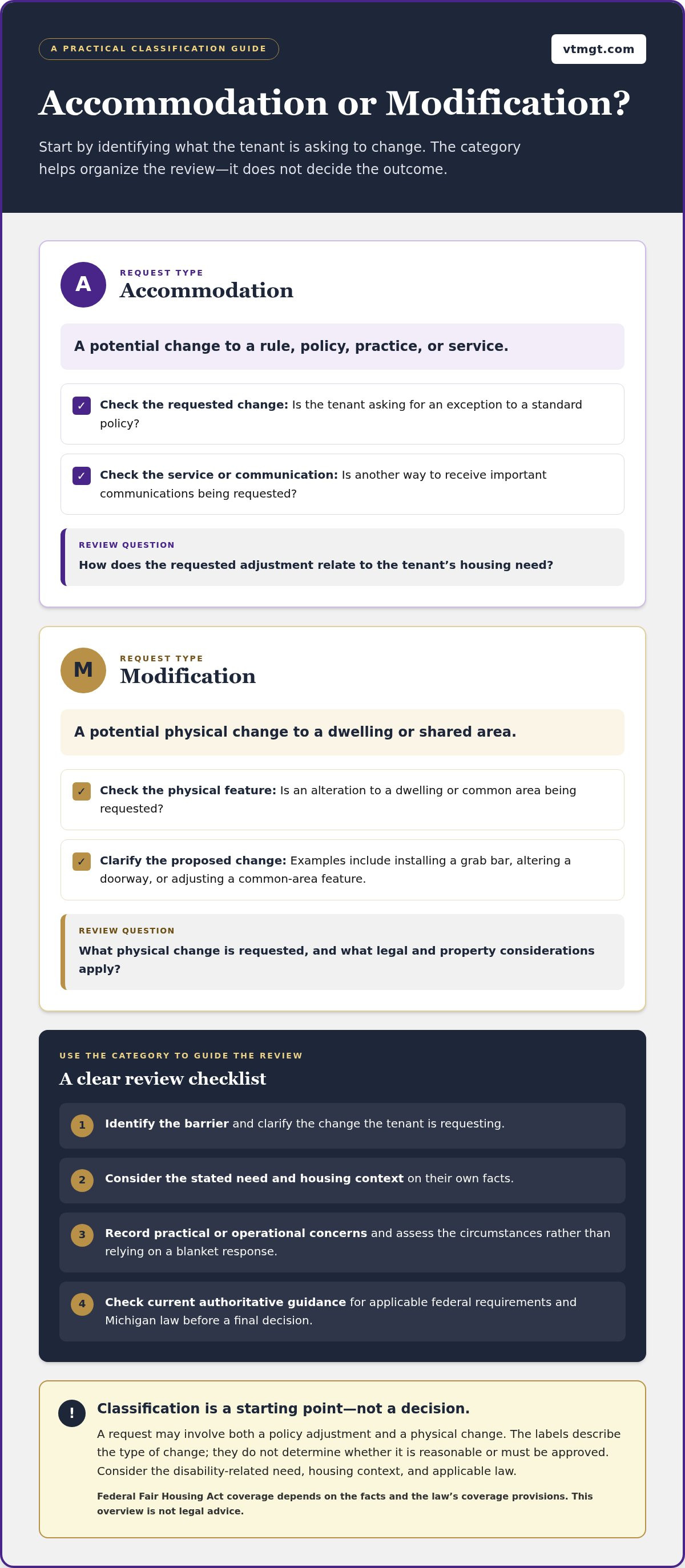
Start by identifying the type of change the tenant is requesting. A reasonable accommodation is a potential adjustment to a rule, policy, practice, or service. A reasonable modification is a potential physical alteration to a dwelling or shared area. The distinction helps clarify what needs review, but it doesn’t determine the outcome by itself.
The labels describe the type of change, not whether a request is reasonable or must be approved. A landlord still needs to consider the tenant’s disability-related need, the housing context, and applicable law. A request may include both categories. For instance, an adjustment to a policy might be discussed alongside a physical alteration intended to improve access.
| Request type | What changes | Illustrative example | Review question |
|---|---|---|---|
| Accommodation | A rule, policy, practice, or service | An exception to a standard policy or a different way to receive communications | How does the requested adjustment relate to the tenant’s housing need? |
| Modification | A physical feature of a dwelling or common area | Installing a grab bar or changing an entrance feature | What physical change is requested, and what legal and property considerations apply? |
Examples of policy and service accommodations
A tenant might request an exception to a standard building policy or an alternative format for important communications. These examples help identify the category, but they aren’t automatic approvals. Their relevance depends on the tenant’s disability-related need and the property’s circumstances. Focus on the specific barrier the tenant describes and the adjustment requested, rather than assuming a policy applies identically in every case.
Examples of physical modifications
A request to add a grab bar, alter a doorway, or adjust a common-area feature involves a physical change rather than a change to how a policy operates. Clarify the proposed alteration and the area it would affect. Questions about who pays, how work is arranged, or whether restoration may be required depend on applicable law and the facts. Verify current legal guidance before setting conditions or making a decision.
Keeping the categories clear helps make the review more orderly. It also directs practical questions to the right process: policy and communication issues may involve tenant communication, while physical changes may require coordination around the property. In this landlord guide to reasonable accommodations, the distinction is a starting point, not a substitute for individualized review or current legal guidance.
For owners seeking consistent tenant communication and organized property operations, residential property management support can help keep day-to-day coordination structured.
How Landlords Can Assess a Request Fairly and Consistently
A fair assessment starts with the request: what change is being sought, what disability-related need has been described, and how the request relates to the rental property. Use the same review framework for each request, but don’t assume similar wording means the circumstances are identical. Consistency means applying reliable criteria, not reaching the same result regardless of the facts.
A standard policy is a starting point, not an automatic reason to reject a request. A rule may serve a practical purpose and still need individual consideration. Separate operational questions, such as how a proposed change would affect access or property coordination, from assumptions about a tenant’s diagnosis, abilities, or credibility. A calm, documented review helps keep those issues distinct.
What information may be relevant to the request?
The information needed depends on what’s apparent from the request and circumstances. If the disability-related need or its connection to the request isn’t apparent, limited information may help explain how the requested change relates to the tenant’s use of housing. Keep inquiries focused on that connection. Don’t seek detailed medical records, a specific diagnosis, or sensitive information unrelated to evaluating the request. If it’s unclear what information is appropriate or sufficient, obtain qualified legal guidance before asking for more.
How to consider feasibility and operational impact
Assess the request in the context of the specific property and management arrangement. Identify practical details, such as how a change would interact with building operations, affect shared spaces, or require coordination. Record those concrete considerations and any workable alternatives discussed. Inconvenience alone doesn’t resolve whether a request is reasonable, and broad assumptions about cost or disruption shouldn’t replace a fact-specific assessment.
Use these questions to structure the review:
- What is requested? Describe the proposed adjustment in clear, neutral terms.
- What need has been stated? Consider the connection between the request and access to or use of the housing.
- What property facts matter? Identify relevant operational, physical, and coordination issues.
- What requires legal review? Flag uncertainty about applicable requirements, undue financial or administrative burden, or a change that may fundamentally alter operations.
Cost, feasibility, and whether a request would fundamentally alter a housing provider’s operations aren’t boxes to check by assumption. Their significance depends on the facts and applicable law. Avoid blanket rules, and consult a qualified Michigan housing attorney when these issues, the sufficiency of information, or the scope of a permissible inquiry is uncertain. This landlord guide to reasonable accommodations offers an operational framework, not a legal determination. Document the rationale and keep the review individualized.
A Step-by-Step Process for Handling Accommodation Requests
A documented workflow helps landlords respond respectfully and handle similar requests with consistent care. Use it to guide communication and recordkeeping without turning an individual assessment into a rigid checklist. Respond promptly, but don’t imply that a particular response deadline applies unless you’ve verified it under current law.
Receive, clarify, and document the request
A tenant doesn’t need to use legal terminology or submit a formal application for a request to merit consideration. They may raise it in conversation or through routine tenant communication. Begin by identifying the change requested. Ask focused questions only when clarification is needed to understand the request and assess it. Keep inquiries relevant and avoid collecting unnecessary medical details.
- Acknowledge receipt. Confirm that you’ve received the request and explain that you’ll review the information provided. This sample keeps the tone neutral: “Thank you for letting us know about your request. We’ve received it and will review the information. We may follow up if clarification is needed.” It confirms receipt without promising approval or a specific outcome.
- Clarify what is being requested. If a practical detail is unclear, ask a concise question about the change the tenant is seeking or the housing-related need it addresses. Don’t require the tenant to restate the request in legal language.
- Create a factual record. Note when the request was received, what change was requested, relevant communications, any clarification sought, and the next steps. Keep notes neutral: record what was said and considered rather than judgments about the tenant’s motives or credibility.
- Protect the information. Store request-related records securely and limit access to people who need the information for review or coordination. Share only the operational details needed for a task, such as arranging maintenance, rather than private details about the tenant.
- Assess and communicate the decision. Review the request in context, then explain the outcome clearly and respectfully. If you’re considering an alternative, describe it and invite relevant discussion rather than presenting it as an unexplained substitute.
Communicate the decision and implement agreed changes
Once the parties agree on a change, coordinate related property work or management steps with the people responsible for carrying them out. Give them the information needed to complete the task while preserving the tenant’s privacy. Record what was agreed, who is responsible for operational follow-up, and whether implementation is complete. If concerns arise later, document them and review them through the same consistent process rather than relying on informal assumptions.
A standardized system for tenant communication and property coordination can help keep requests, decisions, and follow-up records organized. Work with Van Treese Management to support structured residential property operations in Northern Michigan.
Managing Accommodation Requests Across Northern Michigan Rentals
Landlords in Northern Michigan should consider both federal fair-housing protections and applicable Michigan requirements when reviewing accommodation requests. The rules may overlap, but they aren’t interchangeable, and a statewide overview cannot resolve every property-specific question. Verify current law and authoritative guidance before relying on a legal interpretation, especially when a request raises questions about coverage, exceptions, or how requirements apply to a particular rental.
For broader state-law context, consult our Michigan landlord laws guide, while treating accommodation decisions as individualized reviews rather than routine lease administration.
Build a repeatable process for a rental portfolio
A repeatable system helps owners manage requests across properties in Petoskey, Emmet County, and Charlevoix County without relying on memory or informal handoffs. Use a consistent framework to receive requests, route them for review, maintain relevant records, communicate next steps, and track agreed operational follow-up. This makes it easier to see whether information has been recorded and whether a maintenance or property coordination task remains open.
Consistency doesn’t mean identical outcomes. Two tenants may request similar changes but have different needs, property conditions, or operational circumstances. Apply the same careful process, then assess each request on its own facts. Keep records focused on relevant communications, the decision process, and practical follow-through. Limit access to private information, and leave unnecessary personal details out of general property or maintenance records.
For example, a request at a Petoskey rental might involve communication or an adjustment connected to a shared area, while a request at another property in Emmet or Charlevoix County could involve different building features or coordination needs. These are operational illustrations, not local legal rules. Document the relevant property facts, coordinate any work through the appropriate maintenance process, and verify legal questions against current guidance.
When professional property management supports the process
Structured tenant communication can help keep a request from getting lost among routine messages. Organized maintenance coordination can connect an agreed change with the property tasks it requires, while standardized management systems support clear records and handoffs across a portfolio. These practices don’t replace individualized review or legal guidance, but they can help owners maintain an orderly operational process.
Owners managing rentals in Petoskey can explore this Petoskey property management guide for context on local rental operations. A reliable landlord guide to reasonable accommodations pairs careful, case-specific consideration with a process that keeps communication, records, and follow-up organized.
If a more structured approach would support your Northern Michigan rentals, explore residential property management with Van Treese Management.
Make Fair Housing Practices Part of Your Rental Operations
Review how accommodation requests move through your rental operations. A written process is most useful when the people handling tenant communication know how to preserve relevant information, coordinate property needs, and recognize when a decision requires legal review. Revisit the process as your portfolio or applicable guidance changes.
This landlord guide to reasonable accommodations is a starting point for building organized practices, not a substitute for current legal guidance. For questions about how federal or Michigan requirements apply to a specific situation, seek advice from a qualified Michigan housing attorney.
Consistent operations depend on clear communication and reliable follow-through. Van Treese Management provides residential property management in Northern Michigan, including tenant communication, maintenance coordination, and standardized management systems that support organized rental operations.
Explore residential property management with Van Treese Management and take a considered next step toward more structured rental operations.
Frequently Asked Questions
Can a tenant request a reasonable accommodation verbally?
Yes. A tenant may raise a request in conversation without using legal terminology or a particular form. Make a factual note of what was requested and when, then acknowledge it so both parties have a clear record. If a key detail is unclear, ask a focused follow-up question. Written confirmation can help prevent misunderstandings, but don’t treat a preferred form as a reason to disregard a verbal request.
Can a landlord ask for medical documentation to support a request?
Sometimes. If the disability or the connection between it and the requested change isn’t apparent, a landlord may need limited information to understand the request. Keep any inquiry focused on that connection. Don’t seek a diagnosis, detailed medical records, or unrelated private information. The appropriate inquiry depends on the circumstances. If you’re unsure whether supporting information is necessary or sufficient, get qualified legal guidance before requesting more.
Is an assistance animal request considered a reasonable accommodation?
An assistance animal request may be considered under fair-housing accommodation rules, and assistance animals aren’t simply pets subject to ordinary pet policies or fees. The details matter, including the tenant’s need and any permitted supporting information. As of October 2026, HUD had signaled a possible enforcement shift, but had not completed formal rulemaking on the issue. Check current authoritative guidance before evaluating documentation or relying on an exception.
Can a tenant request an assigned parking space as an accommodation?
Yes, a tenant may request an assigned parking space if it relates to a disability-related housing need. The request calls for individualized review, not an automatic guarantee of a particular space. Consider the requested location, the property’s parking arrangement, and the connection to the tenant’s need. If the exact request raises a practical concern, clarify whether another arrangement could address the stated need, and seek legal review if the applicable standards are uncertain.
What should a landlord do if a request is unclear?
Respond respectfully and ask only for the detail needed to understand what change the tenant is requesting and how it relates to housing access. For example, clarify whether a message about “help with parking” refers to a particular space or another parking adjustment. A clear, documented exchange supports a landlord guide to reasonable accommodations process without requiring unnecessary medical information. If uncertainty remains about what may be asked or how to assess the request, consult qualified counsel.
Can a landlord deny a reasonable accommodation request?
A landlord may deny a request only after an individualized review shows a legally supportable reason. The analysis can involve whether the request is reasonable in context, creates an undue financial or administrative burden, or would fundamentally alter operations. A landlord shouldn’t reject it solely because it departs from a standard policy. Assistance-animal requests may raise separate considerations, including a direct threat that can’t be mitigated. Seek qualified Michigan legal guidance before denying a request.
Does the Fair Housing Act apply to every rental property?
Not necessarily. The Fair Housing Act includes coverage provisions and exceptions, so its application can depend on the property and housing arrangement. Don’t assume every rental has identical obligations or that an exception settles every state or local question. Owners with rentals in Petoskey, Boyne City, Indian River, Gaylord, Traverse City, and Grand Rapids should verify current federal and Michigan requirements for their circumstances, using authoritative guidance or qualified legal advice.