
24/7 Emergency Maintenance Guide for Owners and Tenants

If a pipe bursts at midnight, what does “24/7” actually mean: an instant repair, or a clear process for coordinating a response? Owners and tenants need to know what happens after an urgent request, especially when safety, property damage, and repair vendors are involved. Effective 24/7 emergency maintenance for rental properties depends on prompt communication and organized coordination, not a promise that work will be completed immediately.
It can be difficult to distinguish an emergency from a routine repair or know whether a request has reached the right person. A property manager can coordinate tenant communication, local vendors, and repair follow-through. Van Treese Management’s residential management includes 24/7 emergency response coordination, and residents can submit online maintenance requests.
This guide explains which rental repair issues may need urgent attention, what information to include in a report, and how after-hours coordination works. It also explains the difference between an initial response and a completed repair, and what to look for in a maintenance process.
Key Takeaways
- Learn to distinguish an urgent property issue from a routine repair and provide useful details when reporting one.
- Understand the steps in 24/7 emergency maintenance for rental properties, from receiving a request to coordinating vendors and documenting follow-through.
- Compare owner-managed repairs with a property management process that coordinates tenant communication, vendors, and updates.
- Prepare property, access, and communication information so after-hours maintenance is easier to coordinate.
- See how Van Treese Management connects resident requests with local vendor coordination and repair follow-through in Northern Michigan.
What 24/7 Emergency Maintenance for Rental Properties Actually Means
24/7 emergency maintenance for rental properties is an around-the-clock process for receiving and coordinating urgent property concerns, not a guarantee that a vendor will arrive or complete a repair immediately. A request may be received, assessed, and passed to an appropriate vendor, while scheduling, access, parts, or the nature of the problem affect what happens next.
Urgent maintenance coordination involves several people and steps. A tenant reports the issue, management communicates about the conditions and next steps, and a vendor may be coordinated to assess or address the problem. Useful information in the initial report helps everyone understand what is happening. Coordination is active work, but it is not the same as a completed repair.
Which rental maintenance issues may need urgent attention?
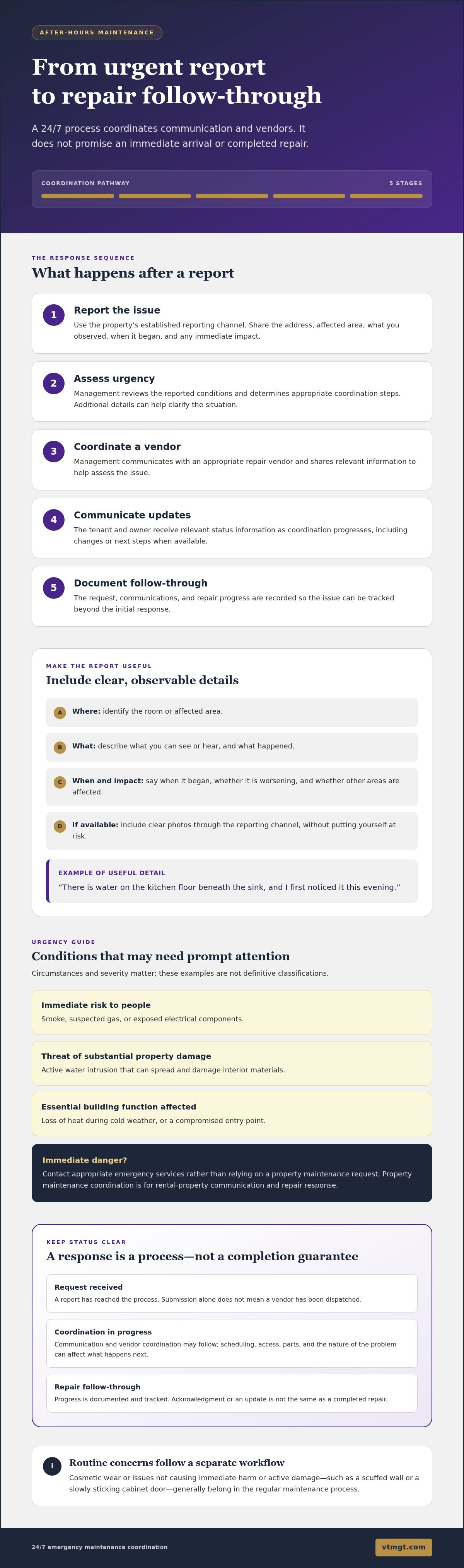
An issue may be time-sensitive when it creates an immediate risk to people, threatens substantial property damage, or affects an essential building function. Active water intrusion can spread and damage interior materials. A loss of heat during cold weather may affect the safe use of a home. Smoke, suspected gas, exposed electrical components, or a compromised entry point also call for prompt attention. The circumstances and severity matter, so these examples are not definitive classifications.
If people face immediate danger, contact appropriate emergency services rather than relying on a property maintenance request. The broad purpose of Emergency services is to respond to urgent threats to public safety and health. Property maintenance coordination has a different role: arranging communication and repair response for a rental property.
What does 24/7 response mean, and what does it not mean?
A 24/7 response process provides a way to receive and coordinate urgent reports at any hour. It does not specify how soon a vendor will arrive, how quickly a repair can be completed, or what the final outcome will be. Tenants provide the report, management communicates and coordinates, and vendors handle their part of the assessment or repair. Clear updates help owners and tenants understand the status, but acknowledgment is not the same as completion.
When reporting a problem, describe what you can observe: where it is, what happened, when it began, and whether it is worsening or affecting other areas. For example, identify the room where water is coming in and say whether it is still flowing. Do not attempt work that could put anyone at risk. Report immediate hazards through the appropriate emergency channel.
Routine wear, cosmetic concerns, and issues that are not causing immediate harm or active damage generally follow a separate maintenance workflow. A scuffed wall or a slowly sticking cabinet door may need attention, but usually does not call for the same urgent coordination as active flooding or the failure of an essential building function. Reporting non-urgent concerns through the regular process gives management a record to review and follow up.
A well-defined process makes the next steps clear: tenants know how to report a serious issue, owners know who coordinates communication and vendors, and everyone can distinguish a received request from completed work.
How 24/7 Emergency Maintenance Coordination Works From Report to Follow-Through
A clear process turns a tenant’s report into an organized maintenance response. In 24/7 emergency maintenance for rental properties, each step helps establish what is happening, who needs to act, and how progress will be communicated. A consistent record gives owners and managers a shared reference as the issue moves from the initial report toward follow-through.
- Report the issue. Use the reporting channel established for the property. Include its address, the affected area, what you observed, when it began, and any immediate impact.
- Assess urgency. Management reviews the reported conditions and determines the appropriate coordination steps. Additional details can help clarify the situation.
- Coordinate a vendor. Management communicates with an appropriate repair vendor and shares relevant information for assessing the issue.
- Communicate updates. The tenant and owner receive relevant status information as coordination progresses, including changes or next steps when available.
- Document follow-through. The request, communications, and repair progress are recorded so the issue can be tracked beyond the initial response.
How tenants can make an after-hours maintenance report useful
Keep the report concise and specific. Identify where the problem is, describe what you can see or hear, note when it started, and explain whether it is affecting another part of the property. If the reporting channel allows, include clear photos that show the issue without putting yourself at risk. Follow the property’s reporting instructions so the request reaches the right process and creates a useful record.
For example, “There is water on the kitchen floor beneath the sink, and I first noticed it this evening” gives more useful context than “There’s a plumbing problem.” If conditions change after you submit the report, share the update through the property’s reporting process. Do not assume that submitting a report means a vendor has already been dispatched; coordination follows from the information available.
How managers coordinate vendors and keep owners informed
Maintenance coordination involves more than passing along a repair request. Management can organize communication with the tenant and vendor, share relevant details, relay status updates, and track repair follow-through. Updates should distinguish what is known from what remains in progress, without implying a fixed arrival or completion time. Resources from the National Association of Residential Property Managers provide context on the property management field and structured service processes.
Van Treese Management coordinates maintenance through an insured network of local vendors and includes tenant communication in its residential management. That connects the report, vendor coordination, and follow-through within a managed process. Owners seeking support with rental maintenance can explore Van Treese Management’s property management in Northern Michigan.
Managed Emergency Maintenance vs. Handling Rental Repairs Yourself
Choosing how to handle urgent rental repairs comes down to who can reliably receive reports, coordinate vendors, communicate with tenants, and track progress. Owner-managed coordination can work well when the owner has time and local contacts. A property manager can provide a defined coordination process, which may help when rental responsibilities compete with other work. Either way, each issue still needs to be assessed and followed through.
Use this comparison to see how each arrangement handles an after-hours request. The exact process depends on the owner’s setup and the services included in a management arrangement.
| Reporting path | Coordination responsibility | Communication | Documentation |
|---|---|---|---|
| Owner-managed: tenant follows instructions set by the owner and reports directly to them. | The owner assesses the report, contacts a suitable vendor, and tracks progress. | The owner updates the tenant and manages vendor communication. | The owner keeps the request, messages, and repair progress organized. |
| Property-managed: tenant reports through the management process established for the property. | The manager coordinates tenant communication, vendors, and repair follow-through. | The manager relays relevant status information to the tenant and owner. | The manager tracks the request and its progress as part of maintenance coordination. |
When self-management may be practical
Direct owner coordination may suit someone who can consistently receive tenant reports, respond to changing circumstances, and manage vendor communication outside ordinary work hours. Established local vendor relationships and clear reporting instructions can make the process more organized. Owners should also account for the ongoing responsibility: self-management still requires after-hours coordination, and a vendor list alone does not handle tenant updates or repair follow-through.
When professional coordination may reduce operational friction
A defined management point of contact can help organize incoming requests and connect tenant communication with vendor coordination. This can reduce the number of separate conversations an owner must manage, particularly when several properties or other responsibilities need attention. Van Treese Management’s residential management includes tenant communication, maintenance coordination, and coordination through an insured network of local vendors, with maintenance project follow-through.
Consider the operating demands, not just the number of properties. An owner with flexible availability and established contacts may prefer direct control; an owner with limited time may value having a manager coordinate reports and updates. A useful process clearly assigns the reporting path, vendor coordination, owner updates, and record keeping. These points help determine whether 24/7 emergency maintenance for rental properties fits the property and the people responsible for it.
Managed coordination organizes communication and repair follow-through; it does not guarantee when a vendor will arrive or when a repair will be completed. That distinction helps owners compare arrangements realistically and set clear expectations with tenants.
How to Prepare a Rental Property for After-Hours Maintenance Requests
Preparation helps tenants report an issue through the right channel and gives the responsible team useful context for coordinating next steps. For owners in Petoskey and across Northern Michigan, a readiness plan makes property information easier to locate when a maintenance concern arises. Preparation cannot determine how quickly a repair will be completed, but it can reduce uncertainty about who receives a report and what information is available.
What owners should organize before a maintenance emergency
Keep essential property records current and accessible to the people authorized to coordinate maintenance. Make unit and building details easy to identify, especially if you oversee more than one rental. Set out the reporting channel, who communicates with tenants and owners, and how status updates are shared. Organized records support a clear handoff when a request needs attention.
- Property identification: Maintain accurate addresses, unit numbers, and relevant building details.
- Contact information: Keep current tenant, owner, management, and vendor contacts available to the responsible team.
- Reporting instructions: State where routine and urgent maintenance requests should be submitted and how tenants receive updates.
- Authorized access details: Organize relevant entry and building information for authorized coordination, keeping it current and appropriately controlled.
- Property condition records: Retain useful notes about known issues, prior maintenance, and planned work.
Routine property oversight and documented condition provide a baseline for understanding a new report. Notes about a recurring concern, for example, can help distinguish a new change from a previously observed condition. Planned maintenance records also provide context without assuming that an earlier issue explains a current one. Keep records factual and update them as conditions or completed work change.
What tenants should know before submitting an urgent request
Residents should know how to access the property’s maintenance-request channel before a problem occurs. Van Treese Management supports online maintenance requests through resident services. Tenants can make a report easier to assess by identifying the unit and affected area, describing what they observe, and noting any change after submission. Follow the property-specific instructions for reporting and updates.
Preparing for 24/7 emergency maintenance is partly about making the process understandable in advance: tenants know where to submit a request, and owners know where property details and communication responsibilities are recorded. If conditions change after a report, tenants should share the update through the established channel. An online request supports communication; urgent danger should be directed to appropriate emergency services.
Owners who want maintenance coordination connected with tenant communication and property oversight can explore rental property maintenance in Northern Michigan with Van Treese Management.
How Van Treese Management Coordinates 24/7 Rental Maintenance in Northern Michigan
For rental owners, an urgent maintenance concern involves more than arranging a repair. Tenant communication, vendor coordination, and follow-through need to connect so owners and residents understand the request’s status. Van Treese Management’s residential management includes 24/7 emergency response coordination, providing a structured point of coordination without promising a vendor’s arrival time or repair completion.
A local coordination model for rental owners and residents
Based in Petoskey, Van Treese Management serves rental owners and residents in Petoskey and communities across Northern Michigan, including Boyne City, Indian River, Gaylord, Traverse City, and Grand Rapids. Residents can submit maintenance requests through online resident services, while tenant communication keeps requests connected to the management process. For repair work, the team coordinates through an insured network of local vendors and follows maintenance projects through.
These elements support a practical sequence: receive a resident’s concern, communicate about the issue, coordinate with a vendor, and track progress. Keeping property-specific details and updates connected helps the request move forward. Not every repair has the same requirements, and a vendor cannot necessarily arrive or complete work on a fixed schedule.
What owners can expect from the management relationship
Maintenance coordination sits within a broader residential management relationship that includes rent collection, tenant communication, and property oversight. For owners, maintenance requests are handled alongside other ongoing property responsibilities. For residents, it provides a management contact and an established route for submitting requests. The purpose is to organize communication and vendor coordination, not to guarantee immediate arrival, repair, or a particular outcome.
Owners evaluating 24/7 emergency maintenance for rental properties should distinguish response coordination from completed repairs. A useful management process connects reports with appropriate vendor coordination, communicates relevant updates, and follows the work through. The timing and outcome of a specific repair depend on the circumstances and vendor work involved.
For owners seeking a coordinated approach to rental operations in Northern Michigan, Van Treese Management brings maintenance coordination together with resident communication and property oversight. Discuss residential property management with Van Treese Management.
Build a More Prepared Rental Maintenance Process
A serious maintenance issue rarely arrives at a convenient time. Owners can prepare by defining how tenants report concerns, who coordinates next steps, and how updates and repair records are handled. A clear process helps everyone know what to do when an issue arises, without creating expectations of instant arrival or repair completion.
Effective 24/7 emergency maintenance for rental properties depends on clear responsibilities and steady follow-through. Van Treese Management brings residential 24/7 emergency response coordination together with an insured local vendor network. Based in Petoskey, the team serves communities across Northern Michigan, providing owners with a local point of coordination for rental property operations.
Consider how maintenance coordination fits your property, tenants, and availability. Discuss residential property management and maintenance coordination with Van Treese Management to take a practical step toward a more organized approach to rental maintenance.
Frequently Asked Questions
What qualifies as an emergency maintenance issue in a rental property?
An issue may need urgent attention if it poses an immediate risk to people or property or disrupts an essential building function. A spreading leak, loss of heat during cold weather, or a damaged exterior door may be concerning examples, depending on the actual conditions. A loose handle or cosmetic damage will generally follow routine maintenance procedures. If anyone faces immediate danger, contact appropriate emergency services rather than relying only on a maintenance report.
Does 24/7 emergency maintenance mean a repair will happen immediately?
No. 24/7 emergency maintenance for rental properties means urgent reports can be received and coordinated at any time; it does not guarantee that a vendor will arrive or finish a repair immediately. The reported conditions may need assessment, and coordination can depend on vendor availability, property access, and the type of work involved. Acknowledgment confirms that a report entered the process, not that the repair is complete.
How should a tenant report an after-hours rental repair?
Use the reporting instructions provided for your rental, and describe the issue plainly rather than guessing at its cause. Include the building and unit, the affected area, when you first noticed the problem, and any change since then. If the reporting channel accepts images, a photo can provide helpful context. Keep the report factual, and contact appropriate emergency services separately if someone faces immediate danger.
What should a landlord look for in a 24/7 rental maintenance service?
Look for a defined reporting path, a process for assessing urgency, clear communication, vendor coordination, and a way to track follow-through. Consider how owners and tenants receive status information and how a request is distinguished from completed repair work. Coordination should be described accurately, without implying guaranteed arrival or completion. For Northern Michigan rentals, local operating knowledge and practical communication with residents can also help owners assess whether a process fits their properties.
Can a property manager coordinate emergency repairs for tenants?
Yes. A property manager can serve as a point of contact, coordinate maintenance vendors, communicate with residents and owners, and follow repair progress. Van Treese Management includes 24/7 emergency response coordination in its residential property management. That describes coordination, not a promise about when a vendor will arrive or when work will be completed. Tenants should use the reporting instructions for their property and provide clear information about the issue.
What information should tenants include in an emergency maintenance request?
Include the property address, unit, affected area, a concise description of what you observe, and when the issue began. Note visible effects, such as water reaching another room, and report any change after submitting the request. Use the property’s established reporting channel so the information reaches the responsible team. Accurate details help management understand the situation and coordinate next steps, but they cannot determine a specific response time or repair outcome.
Does Van Treese Management coordinate rental maintenance in Northern Michigan?
Yes. Based in Petoskey, Van Treese Management coordinates residential maintenance and tenant communication in Petoskey, Boyne City, Indian River, Gaylord, Traverse City, Grand Rapids, and surrounding Northern Michigan communities. Its maintenance process includes coordination through an insured network of local vendors and project follow-through. Residents can submit maintenance requests through online resident services. Coordination helps organize the process, but it does not guarantee a vendor’s arrival time or a particular repair outcome.