
How Property Managers Find Quality Tenants: A 2026 Guide

How property managers find quality tenants starts well before an application arrives. The process combines accurate marketing, responsive communication, consistent application review, and clear lease preparation. Together, these steps help owners assess whether an applicant’s information and rental needs fit a specific property, rather than relying on a single detail such as who applied first.
Finding a tenant involves coordinating several tasks, especially when you manage a rental from outside Northern Michigan. This guide explains how marketing, showings, applications, screening, and lease preparation work together, and what owners can do to keep each stage organized. At Van Treese Management, leasing and screening connect with ongoing residential property management and clear communication for owners and tenants.
Key Takeaways
- Finding a suitable tenant takes more than screening. Accurate marketing, prompt applicant communication, consistent assessment, and lease preparation all matter.
- A clear sequence, from assessing and preparing the property to reviewing applications and preparing the lease, keeps placement organized.
- Self-management gives owners direct involvement, while a property manager can coordinate inquiries, showings, applications, screening, and lease preparation.
- Before starting a search, organize accurate property details, condition information, rental priorities, and showing availability.
- Van Treese Management’s Assess, Prepare, Manage, Report process connects tenant placement with ongoing residential property oversight in Northern Michigan.
How Property Managers Find Quality Tenants for a Rental
How property managers find quality tenants isn’t a matter of collecting the most inquiries or selecting the first person who applies. A suitable tenant is an applicant whose documented information and stated rental needs align with the property, its rental terms, and the owner’s priorities. Assessing that fit takes several connected steps, from presenting the home accurately to reviewing applications and preparing the lease.
Tenant placement is a connected process, not a single test. Clear marketing helps prospective renters decide whether a property fits their needs. Responsive communication gives them a way to ask questions and understand how to apply. A consistent review process then helps compare applications against the same criteria, and lease preparation documents the agreed rental terms.
A high number of inquiries may show that a listing is reaching people, but volume alone doesn’t establish whether applicants are a suitable match. Incomplete details can attract interest from people whose expectations don’t align with the home. Accurate information and a consistent review process are more useful signs of an organized search than inquiry count by itself.
What does quality mean for a rental property?
Quality depends on the specific rental and the owner’s stated priorities. These might include the intended lease term, occupancy date, or other requirements relevant to the property. Define the criteria before reviewing applications, then compare the information applicants provide against those criteria. Avoid relying on personal impressions or treating a single application field as a complete assessment. Tenant Screening provides an overview of common screening practices and considerations.
Setting priorities in advance also makes it easier to compare applications consistently. If lease term and move-in timing matter for a property, for example, review the relevant information each applicant provides against those needs. The goal is to make a reasoned match based on the property and available information, not apply a subjective label.
Why the tenant-finding process starts before applications arrive
Preparation influences who responds. An accurate listing describes the home and rental terms, while a property that is ready to show lets applicants assess its condition and features. These details help people decide whether the rental fits their needs before they invest time in an inquiry or application.
Rental searches can differ by location. Whether a property is in Petoskey, Boyne City, Indian River, Gaylord, Traverse City, or Grand Rapids, use its specific location, access details, and rental terms to set expectations. Van Treese Management is based in Petoskey and coordinates leasing work that includes marketing, showings, applications, screening, and lease preparation. The next step is to look at how those stages fit together, from initial property assessment through placement.
How Property Managers Move from a Rental Listing to Tenant Placement
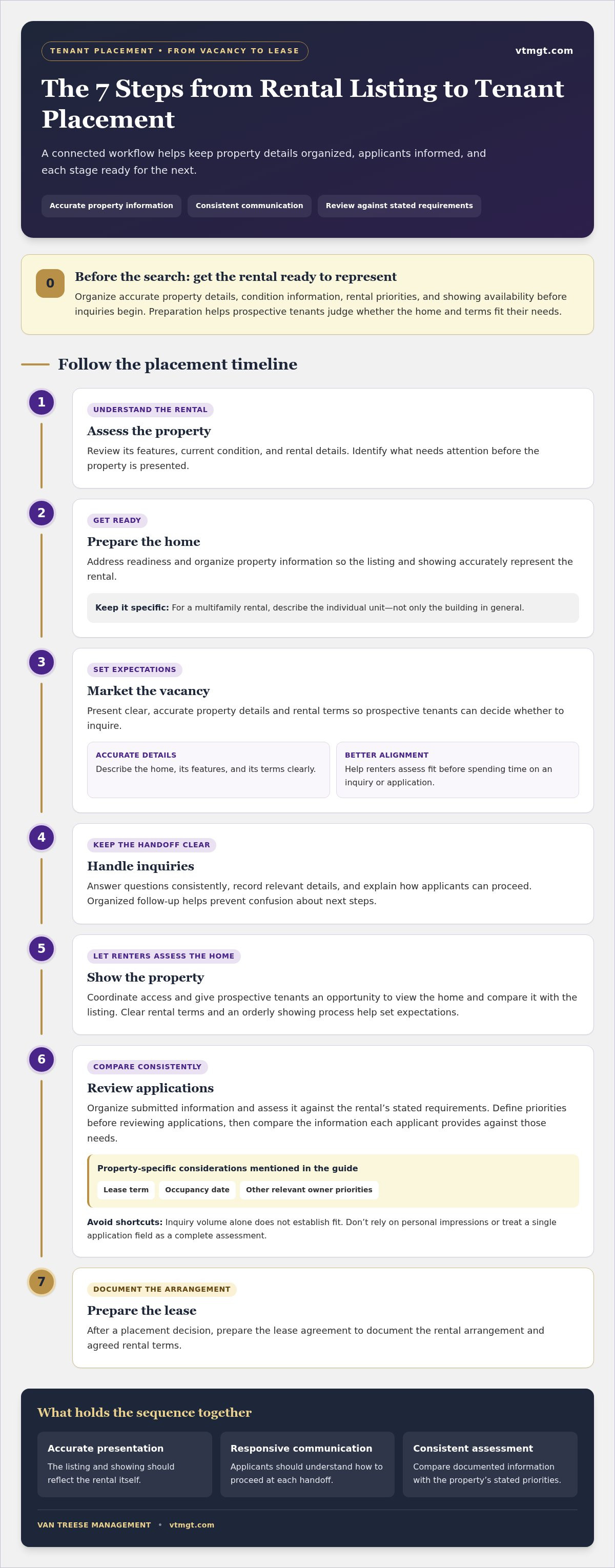
Finding a tenant involves a series of connected tasks, not just advertising. The work starts with understanding the property and continues through preparation, marketing, applicant communication, showings, application review, and lease preparation. Each stage supplies information or coordination needed for the next.
From vacancy preparation to lease preparation, tenant placement follows a clear sequence. A consistent workflow keeps property details organized and applicants informed, without relying on a listing or screening step alone to determine the result. This is one practical way to understand how property managers find quality tenants.
How property managers prepare and market a rental
Before marketing begins, the property’s condition and features help determine what needs attention and how the home should be presented. Be specific: a listing for a multifamily unit should describe that unit, rather than rely only on general building information. Clear rental terms and an orderly showing process help prospective tenants decide whether the property suits their needs.
- Assess the property. Review its features, current condition, and rental details to identify what needs attention before it is presented.
- Prepare the home. Address readiness and organize property information so the listing and showing accurately represent the rental.
- Market the vacancy. Present clear, accurate details about the property and rental terms so prospective tenants can decide whether to inquire.
- Handle inquiries. Answer questions consistently, record relevant details, and explain the next step in the process.
- Show the property. Coordinate access and give prospective tenants an opportunity to view the home and compare it with the listing.
- Review applications. Organize submitted information and assess it against the rental’s stated requirements.
- Prepare the lease. After a placement decision, prepare the lease agreement to document the rental arrangement.
How inquiries become applications and lease preparation
Clear handoffs reduce confusion. After an inquiry, applicants need to know how to proceed. After a showing, they need a straightforward way to submit an application. Keeping questions, showing activity, and application information organized makes it easier to follow up and explain next steps.
Screening and placement bring together communication, property information, and administrative coordination. The Virginia Tech Property Management Program reflects the broader scope of property management, which extends beyond a single leasing task. Lease preparation completes the placement workflow by recording the agreed rental terms.
For more on how leasing fits into property oversight, see this Northern Michigan property management guide. Van Treese Management coordinates leasing as part of residential property management in Petoskey and nearby Northern Michigan communities. Owners can explore residential property management in Northern Michigan.
Self-Managing vs. Using a Property Manager to Find Tenants
Owners can use a structured placement process whether they self-manage or hire a property manager. The main difference is who coordinates the work. A self-managing owner handles each stage directly; a property manager coordinates placement tasks while keeping the owner involved in property-level decisions.
The comparison below shows how responsibilities may be organized. Van Treese Management handles leasing and screening work, while owners retain decisions about their property and rental priorities.
| Placement task | Self-managed by owner | Coordinated by a property manager |
|---|---|---|
| Marketing | Prepares listing details and advertises the vacancy. | Coordinates property marketing and advertising. |
| Inquiries | Responds to questions and tracks prospective applicants. | Handles applicant communication and organizes inquiries. |
| Showings | Schedules and conducts property visits. | Coordinates showings and related applicant communication. |
| Applications | Collects and organizes application information. | Coordinates application handling and screening. |
| Screening | Reviews each application against the owner’s established criteria. | Conducts tenant screening as part of placement. |
| Lease preparation | Arranges preparation of the lease agreement. | Coordinates lease agreement preparation. |
What owners coordinate when they manage placement themselves
Self-management gives the owner direct control over the listing, conversations with prospective tenants, and showing arrangements. It also means keeping property details current, tracking questions and applications, and applying the same review criteria to each applicant. Follow-up and lease preparation need coordination too, so the work continues after advertising begins.
What a property manager coordinates during placement
A property manager centralizes operational steps such as marketing, showings, applications, screening, and lease preparation. Van Treese Management coordinates these services while owners make property-level decisions, including setting priorities for the rental. A shared point of coordination can also connect placement with tenant communication and ongoing property oversight.
After a tenant moves in, maintenance coordination becomes part of ongoing oversight, distinct from the earlier work of marketing and screening. The Northern Michigan rental property maintenance guide offers related context on that continuing responsibility.
To decide which arrangement fits, consider who will keep each placement task moving, maintain communication, and make property-level decisions. Your preferred level of involvement and capacity to coordinate the process can help guide the choice.
How Owners Can Prepare for a Strong Tenant Search
A prepared search starts with clear information and decisions. Before marketing a vacancy, gather the details prospective tenants need, note the property’s condition, define rental priorities, and decide when showings can be arranged. This groundwork helps keep the listing, applicant communication, and review process aligned, though it can’t determine who will apply or how quickly a suitable placement will occur.
Information to organize before marketing begins
Use this checklist to prepare the information and arrangements that support a clear, consistent search:
- Property details: Record the home’s features, layout, included items, location, and availability. Verify each detail before using it in advertising.
- Rental terms: Identify the intended lease term and other relevant terms so prospective tenants can assess the opportunity before applying.
- Property condition: Note the home’s current state and any preparation still needed. Distinguish what is ready to show from areas that need attention before a visit.
- Showing logistics: Decide how access will be arranged and what availability you can offer. Location and access details help prospective tenants plan a visit, whether the rental is in Petoskey, Boyne City, or another community.
- Owner priorities: Define the requirements that will guide application review for this specific property and intended tenancy.
Specific details help prospective tenants assess whether a home may suit their needs. Vague or incomplete information can leave basic questions unanswered. Owners considering coordinated local management can find broader context in this local rental management guide.
How to keep the applicant experience clear and consistent
When inquiries begin, use a simple system to track questions, replies, showings, applications, and next steps. Respond promptly when practical, provide the same property information to each prospective tenant, and explain what happens after a showing or application. Clear updates help applicants understand the process while a decision is underway.
Apply the same approach to application review. Compare submitted information against the priorities established before applications arrived, and keep a brief record of decisions and their basis. This makes it easier to use consistent criteria throughout the search instead of relying on memory or changing expectations between applicants.
Plan for the time and attention each stage requires, and make decisions as information becomes available. If you want support coordinating marketing, showings, applications, screening, and lease preparation, explore tenant placement and residential management with Van Treese Management.
How Van Treese Management Handles Tenant Placement in Northern Michigan
Tenant placement is part of Van Treese Management’s residential property management process. Based in Petoskey, the company follows Assess, Prepare, Manage, Report, connecting an initial understanding of the property with leasing coordination and ongoing oversight. The process shows how property managers find quality tenants through coordinated work, rather than treating screening as a stand-alone decision.
From property assessment to prepared listing
Assess and Prepare lay the groundwork for presenting a rental. Assessment brings the property’s condition and placement needs into focus. Preparation supports clear, accurate marketing that reflects the home and its rental details, giving prospective tenants a useful basis for deciding whether it suits them.
Van Treese Management’s leasing and screening work includes marketing, showings, applications, screening, and lease preparation. The steps connect: listing information introduces the rental, showings let applicants view it, and application handling and screening support the placement process. Accurate presentation helps set expectations, while each applicant and property remain distinct.
The company serves residential properties in Petoskey, Harbor Springs, Boyne City, Gaylord, Traverse City, and surrounding Northern Michigan communities. Local knowledge informs the management process, while the details of each rental guide how it is prepared and marketed.
From tenant placement to reporting and ongoing management
Manage and Report extend the work beyond lease preparation. After placement, tenant communication, rent collection and reporting, maintenance coordination, and property oversight connect leasing with ongoing management. This approach links applicant handling and lease preparation to the responsibilities that follow.
Owner statements and financial reporting provide visibility into property activity. Tenant communication and property oversight keep management connected to the rental itself. Placement establishes the tenancy; ongoing management supports the owner’s view of the property over time.
For Northern Michigan owners, Van Treese Management coordinates marketing, showings, applications, screening, and lease preparation alongside ongoing property management. If you’re considering support for a rental in the region, discuss residential property management with Van Treese Management.
Set a Clear Direction for Your Next Tenant Search
Start by deciding what a well-organized search should look like for your property. Clarify the priorities for the intended tenancy, consider how involved you want to be in applicant communication and decisions, and identify which tasks would benefit from coordination. These choices give you a practical basis for planning a search that suits the rental and your role as an owner.
Understanding how property managers find quality tenants means looking at how each stage connects to your expectations, not just who reviews applications. A clear process shows how placement is handled while keeping property-level decisions grounded in your priorities.
If you’re considering support for a Northern Michigan rental, discuss residential property management with Van Treese Management.
Frequently Asked Questions
How long does it take a property manager to find a tenant?
There’s no set timeframe for filling a vacancy. Timing depends on property readiness, listing accuracy, rental terms, inquiry flow, showing arrangements, and how long application review and decisions take. Owners can support an organized search by providing complete, accurate property information before marketing and responding promptly when a decision is needed. These steps help with coordination but don’t establish a predictable placement date.
Can a property manager find tenants for a seasonal rental?
Yes. Van Treese Management includes seasonal properties in its residential property management offering. The search depends on the property’s details, availability, preparation, and intended tenancy. Clarifying the rental period, for example, helps prospective applicants assess whether it fits their plans. These factors shape the search but don’t predict demand, occupancy, or a particular seasonal result.
Does a property manager guarantee that an applicant will be a good tenant?
No. Screening supports an informed placement decision, but it can’t guarantee a tenant’s future conduct or predict every circumstance during a tenancy. Application information helps assess an applicant at the time of review; it isn’t a promise about what will happen later. Treat screening as one structured part of placement, not assurance of a particular outcome.
Can applicants without a long rental history still be considered?
Yes. Limited rental history doesn’t, by itself, determine whether an applicant is a suitable match. Review the application in context and apply the same relevant criteria used for other applicants. Distinguish information the applicant has provided from details that aren’t available, rather than treating a short history as a complete picture. Each decision depends on the application and the property’s stated requirements, so approval can’t be promised in advance.
What should an owner do if the first applicants are not a suitable fit?
Review the listing’s accuracy, the property’s presentation, the rental terms, and the pattern of applicant interest before deciding what to adjust. If inquiries don’t lead to showings, clarify details that may be affecting prospective tenants’ expectations. If people view the property but don’t apply, consider whether its presentation or terms are clear. Base changes on the property and available feedback, not assumptions about when another applicant will appear.
Can an owner stay informed while a property manager handles tenant placement?
Yes. Owners can align with the manager on which placement updates they need and where they want to be involved in decisions. Van Treese Management emphasizes clear communication and provides owner statements and financial visibility as part of its services. Placement updates relate to leasing progress, while financial reporting provides visibility into property activity. Agreeing on information needs and decision points helps keep communication clear.