
Michigan Lead Paint Disclosure: 2026 Landlord Guide

A signed lead disclosure form isn’t the whole compliance process. For covered housing built before 1978, the lead-based paint disclosure rules Michigan applies to rentals and sales generally require more than a signature: the right notices, known hazard information, and available records must be provided before the lease or sale contract is signed.
It’s easy to confuse disclosure with other lead-related duties. Federal disclosure requirements apply in Michigan, while state law and local rules may create separate obligations involving hazardous conditions, inspections, or lead-safe renovation work. Treating these as one requirement can leave a gap in the transaction record.
This 2026 guide explains which rental and sale transactions are generally covered, what tenants must receive, when disclosures are due, and what records landlords should retain. It also outlines common exemptions and distinguishes disclosure from testing, remediation, and renovation requirements. Use the steps below to collect, deliver, and document each item consistently. Because exemptions and local rules can affect a particular property, seek legal guidance when the facts are uncertain.
Key Takeaways
- Use the lead-based paint disclosure rules Michigan applies to identify covered transactions, while accounting for federal exemptions and property-specific details.
- Prepare a complete disclosure packet with the required pamphlet, known lead information, available reports, and lease or contract acknowledgment.
- Build disclosure delivery into the leasing or sale timeline so required information is provided before the buyer or tenant becomes contractually obligated.
- Use a repeatable file process to record property age, disclosures delivered, tenant receipt, and lease execution.
- Keep disclosure duties separate from inspections, hazard control, and renovation requirements, which may involve distinct state or local rules.
What Michigan’s lead-based paint disclosure rules require from landlords
Lead-based paint disclosure means providing required notices and known information about lead-based paint or lead hazards during a covered housing transaction. Under federal rules that apply in Michigan, most housing built before January 1, 1978, is covered when it is sold or leased, unless an exemption applies. Disclosure gives buyers or tenants relevant information before they become contractually obligated. It does not certify that a property is lead-free or safe.
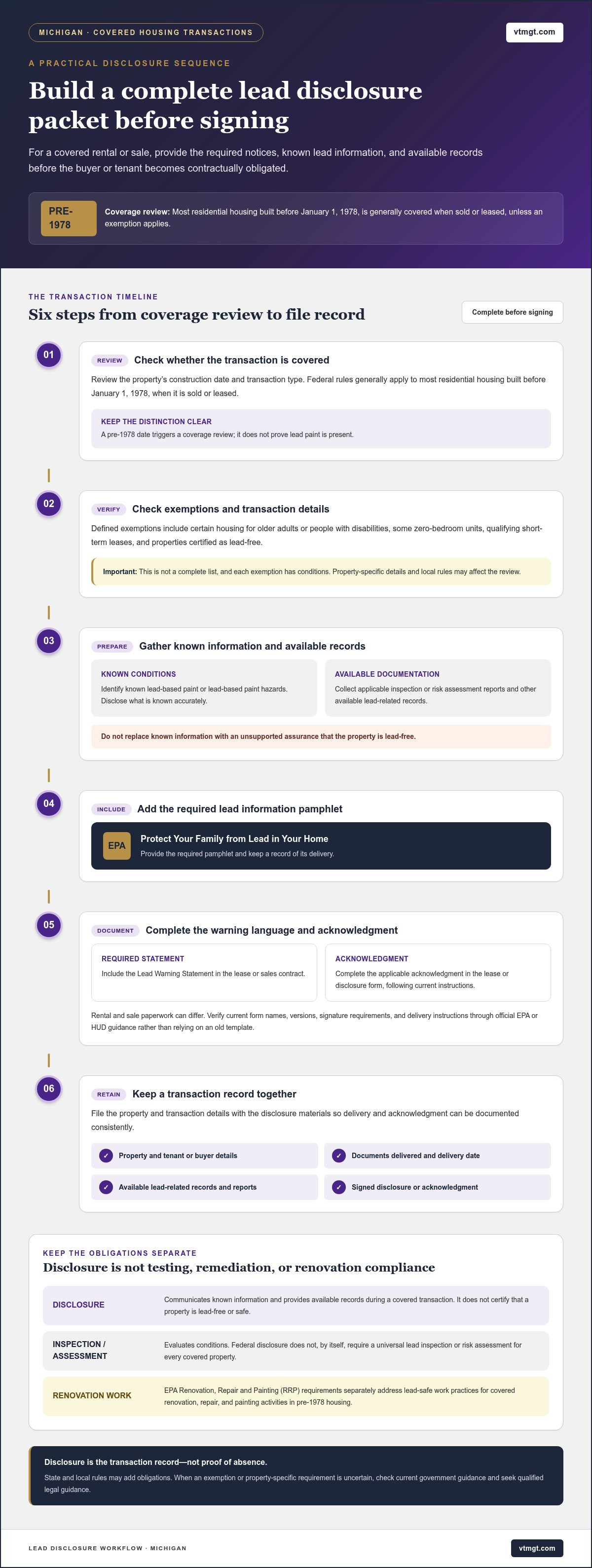
For a covered transaction, the federal baseline generally requires the responsible party to provide the EPA pamphlet Protect Your Family from Lead in Your Home, disclose known lead-based paint or hazards, share available records and reports, and include the required Lead Warning Statement in the lease or sales contract. The paperwork differs between rentals and sales. Michigan landlords should also consider whether local rules impose additional requirements. Federal disclosure does not replace checking other applicable obligations.
Which Michigan homes and transactions are generally covered?
The federal rule generally applies to most residential housing built before 1978, including rental housing and homes offered for sale. Defined exemptions include certain housing for older adults or people with disabilities, some zero-bedroom units, qualifying short-term leases, and properties certified as lead-free. This is not a complete list, and each exemption has conditions.
A pre-1978 construction date triggers a coverage review, but it does not prove lead paint is present. Paint history and condition vary by property. A landlord leasing a home and a seller transferring one may need different transaction documents, even though both must assess whether federal disclosure applies.
Disclosure is different from testing or lead-safe renovation
Disclosure concerns information the seller or landlord knows and records they have available. It does not, by itself, require a universal lead inspection or risk assessment for every covered property. Likewise, the absence of a report does not establish that lead paint is absent. For general background on the material and its history, see Lead-based paint.
Testing and renovation work raise separate questions. An inspection or risk assessment evaluates conditions; disclosure communicates known information. The federal EPA Renovation, Repair and Painting (RRP) requirements separately address lead-safe work practices for covered renovation, repair, and painting activities in pre-1978 housing. Disclosure does not replace an evaluation, work practice, hazard-control obligation, or professional advice that may apply.
In practice, treat these as separate tracks: determine whether the transaction is covered, assemble and deliver the required disclosure materials, and assess separately whether property conditions or planned work trigger other requirements. The lead-based paint disclosure rules Michigan landlords follow establish a federal transaction baseline, while state and local requirements may add obligations. For a specific property or uncertain exemption, consult current government guidance and qualified legal counsel.
What lead-based paint disclosures and records to provide in Michigan
A well-organized rental file makes it easier to identify what the tenant must receive and what the owner should retain. For a covered transaction, the packet generally includes the required EPA pamphlet, information about known lead-based paint or hazards, available records and reports, and the required warning language and acknowledgment in the lease or an accompanying form. The lead-based paint disclosure rules Michigan landlords follow call for accurate disclosure, not unsupported statements that a property is lead-free.
The core disclosure packet for a rental
Before lease execution, assemble the tenant-facing materials and check the current federal instructions. Provide the EPA pamphlet Protect Your Family from Lead in Your Home, disclose known lead-based paint or hazards, and give the tenant copies of available lead-related records and reports. Include the required Lead Warning Statement and applicable acknowledgment in the lease or disclosure form. Verify current form names, versions, signature requirements, and delivery instructions through official EPA or HUD guidance instead of relying on an old template.
Use this checklist to assemble the packet:
- Tenant information: Provide the required lead information pamphlet and keep a record of its delivery.
- Known conditions: Clearly disclose known lead-based paint or lead-based paint hazards. Don’t replace this information with a broad assurance about the property’s condition.
- Available documentation: Provide copies of applicable inspection or risk assessment reports and other available lead-related records.
- Lease acknowledgment: Include the required warning language and complete the acknowledgment according to current form instructions.
- Transaction record: File the property, tenant, document delivery date, and signed disclosure or acknowledgment together.
This checklist separates disclosure materials from technical records. An inspection or risk assessment report may need to be provided if available, but the disclosure packet is not a test, clearance certificate, or renovation plan.
Records to organize before marketing an older rental
Before advertising or preparing a lease, gather relevant documents already held for the property. These may include prior inspection or risk assessment reports, abatement documentation, and records of lead-related work. Keep copies of what was delivered and evidence of tenant receipt with the executed lease. Federal rules require landlords to retain signed disclosure forms for at least three years. Review broader Michigan landlord laws as part of the leasing process.
If there is no report in the file, don’t imply that the property was tested or that lead is absent. Record what information was available, what was disclosed, and when the tenant received it. A consistent file structure helps owners and management teams follow the same document-control steps across properties and reduces the chance of overlooking a report during tenant placement.
Standardized leasing procedures can help keep notices, acknowledgments, and supporting records organized. Residential property management support can provide operational structure for leasing and record coordination, while property-specific legal questions should be addressed with qualified counsel.
When Michigan sellers and landlords must deliver lead disclosures
Timing is part of the disclosure obligation, not an administrative detail to handle after the agreement is in place. Federal rules generally require the buyer or lessee to receive the required lead information before becoming contractually obligated. The rental lease and sales contract should document the applicable disclosures. For covered Michigan transactions, provide the pamphlet, known lead information, available records, and required warning language before the tenant or buyer signs or otherwise becomes obligated under the agreement.
- Rental leasing: Provide the required materials and lead disclosure statement during the leasing process, before the lease is signed. Record delivery and include the completed acknowledgment in the lease file.
- Residential sale: Disclose known lead-based paint and hazards, provide available records, and include the required warning statement before the buyer is contractually obligated. The buyer generally must also have an opportunity to conduct a lead inspection or risk assessment.
Rental disclosure timing and lease documentation
For a covered rental, build disclosure delivery into lease preparation rather than leaving it until move-in. Give the prospective tenant the required pamphlet and disclosures, provide available reports, and complete the warning statement and acknowledgment according to current federal form instructions before lease execution. A tenant’s signature documents receipt or acknowledgment; it does not fix information that was omitted, incomplete, or delivered late.
A consistent sequence helps prevent timing gaps: identify the transaction as potentially covered, assemble the packet, deliver it early enough for review, then execute the lease and retain the signed documents. If lease terms or transaction facts change, review whether the disclosure paperwork or timing must also change. Keep a record of the delivery date and form version, not just a signed page separated from its supporting documents.
Sale disclosures and the inspection opportunity
In a covered sale, the seller must make the required disclosures before the buyer becomes contractually obligated. Federal rules generally provide buyers with a 10-day opportunity to conduct a lead inspection or risk assessment, unless the parties agree in writing to a different period or the buyer waives the opportunity in writing. The agreement should document the arrangement rather than leave it to an informal conversation.
Transaction terms can affect the process. Verify current federal rule language, any applicable exception, and the written agreement’s inspection period, waiver, or other modification before setting deadlines. The disclosure and inspection opportunity are related but separate: delivering the packet does not establish that an inspection occurred, and an inspection decision does not replace the seller’s disclosure duties.
For landlords, the operational checkpoint is clear: disclosures belong in the file before lease execution, and the tenant acknowledgment should be preserved as evidence of the completed step. Owners using standardized lease preparation and tenant placement procedures can make this timing part of each tenancy file. Because timing and permitted changes depend on the transaction documents, seek qualified legal guidance when the applicable deadline or agreement language is uncertain.
Michigan lead disclosure exemptions and landlord mistakes to avoid
A pre-1978 construction date is a useful screening point, but it doesn’t mean every property and transaction follows an identical disclosure process. Federal rules contain specific exemptions, and eligibility depends on the facts and conditions in the governing rule. Apply the lead-based paint disclosure rules Michigan landlords follow through a documented coverage review, not a broad assumption based on a building’s age or type.
Examples of federal exemptions include certain zero-bedroom units, qualifying leases of 100 days or less, some housing for older adults or people with disabilities when no child under six will reside there, and housing certified as lead-free under applicable requirements. These examples are not exhaustive, and a property’s label alone does not establish eligibility. Confirm current EPA or HUD guidance and the governing rule before relying on an exemption or omitting disclosure materials.
How to approach exemptions without making assumptions
Compare the property’s use, occupancy, lease term, transaction structure, and supporting records with the exact exemption conditions. For example, a unit described as housing for older adults may not qualify if a child under six will live there. Keep the basis for any exemption decision in the property file, including the records reviewed and relevant transaction facts. Seek legal review for unusual housing types, nonstandard agreements, or disputed records.
Errors that can undermine an otherwise organized lease
Disclosure errors often happen during routine leasing, when teams rely on memory or assume a familiar lease template covers every compliance step. A general clause about lead paint does not replace required materials, disclosure statements, or available records. An unsigned form, or a form filed without evidence of delivery, may also leave the transaction record incomplete. A tenant’s signature does not cure information that was missing or provided too late.
- Relying on memory: Use a standard checklist for each potentially covered transaction instead of assuming the packet was handled during a prior lease.
- Leaving out available records: Check the property file for reports and other relevant lead documentation, then record what was provided.
- Making unsupported assurances: Don’t describe a property as lead-free unless appropriate documentation supports that statement.
- Mixing separate obligations: Disclosure paperwork does not establish that lead hazards were tested, repaired, or abated, or that applicable renovation requirements were followed.
Keep disclosure, evaluation, and work records distinct. A report may inform what must be disclosed, while inspection, hazard-control, or renovation duties are governed by separate requirements. Completing one track does not automatically satisfy another. Consult current government guidance and qualified legal counsel when the property’s condition or a proposed project raises questions.
Consistent lease preparation and tenant-placement procedures can help owners make document checks a repeatable part of each tenancy. Organize leasing and property management with a defined process for notices, acknowledgments, and property records.
A repeatable lead disclosure workflow for Northern Michigan rental owners
A consistent leasing procedure turns lead disclosure into a defined set of file steps rather than a last-minute form check. For each new tenancy, track the property’s age, the information available, the documents delivered, and the completed lease record. This supports organized administration, but it does not replace current government guidance or legal advice about a specific property or transaction.
A practical pre-lease document-control checklist
- Screen the property. Identify and record the home’s construction date using reliable property records. If it was built before 1978, flag it for a coverage review under the lead-based paint disclosure rules Michigan landlords follow. Don’t infer from age alone that lead paint is present.
- Gather information and forms. Collect known information about lead-based paint or hazards, along with available inspection, risk assessment, abatement, and lead-related work records. Confirm the current EPA or HUD pamphlet, disclosure form, warning language, and instructions before preparing the packet.
- Deliver and document. Provide the required materials at the appropriate point in the leasing process, before the tenant becomes contractually obligated. Record what was provided and when, and complete the tenant acknowledgment according to current instructions. The acknowledgment documents a step; it does not replace disclosure.
- Retain the file. Keep the signed disclosure, proof or record of delivery, relevant supporting documents, and executed lease together in the property file. Federal rules require landlords to retain signed disclosure forms for at least three years. Apply any longer retention period required by other applicable rules or a legal hold.
Use the same file structure for rentals in Petoskey, Boyne City, Indian River, Gaylord, Traverse City, and Grand Rapids. A clear record should let someone reviewing the file determine the property’s recorded age, what lead information and reports were available, which materials reached the tenant, and when the lease was executed.
How consistent management supports the process
Lease preparation and tenant placement can include defined checkpoints for collecting records, preparing disclosures, recording delivery, and completing the lease file. Standard steps help reduce missed administrative tasks, especially when owners manage multiple properties, but they do not guarantee legal compliance. Verify current federal instructions and applicable local requirements for the transaction. Seek qualified legal counsel when property records conflict, an exemption is uncertain, or the lease structure is unusual.
Owners seeking broader operational support can review professional property management in Petoskey. Van Treese Management provides residential property management and lease preparation in Northern Michigan, supporting owners with organized leasing processes without substituting for legal advice. To learn about Van Treese Management and its Northern Michigan services, explore the company’s property management information.
Make your next lease file easier to manage
Use the next vacancy to formalize your property’s document-control process. Set a consistent point in leasing to review the property record, gather available lead information, prepare required materials, and file delivery and lease records together. Revisit the process when forms or transaction details change, and use current government guidance or qualified legal counsel for questions about a specific property.
The lead-based paint disclosure rules Michigan landlords follow are one part of a broader leasing operation. A repeatable system can keep required notices and records visible as each tenancy moves from placement to lease execution, while keeping administrative support distinct from legal advice or a guarantee of compliance.
Van Treese Management supports Northern Michigan owners with residential property management, tenant placement, lease agreement preparation, and standardized management systems. Learn about Van Treese Management’s residential property management services and consider how structured leasing support can fit your next rental cycle.
Frequently Asked Questions
Does Michigan require lead-based paint disclosure for every rental property?
No. The federal disclosure rule generally covers most housing built before 1978, but defined exemptions apply, and homes built later are generally outside this rule. The lead-based paint disclosure rules Michigan landlords follow depend on the property and transaction details, so don’t rely on the construction date alone. Before each tenancy, document why the rule applies or identify the specific exemption and verify its conditions using current government guidance.
Can a Michigan landlord rent a pre-1978 home without testing it for lead?
Generally, federal disclosure rules don’t require landlords to test every pre-1978 rental before leasing it. They do require disclosure of known lead-based paint or hazards and delivery of available records when the transaction is covered. Not having a test report doesn’t establish that the home is lead-free. Separate obligations may apply if a hazard is identified or renovation work is planned, so evaluate those issues independently.
What happens if a landlord fails to provide the required lead disclosure?
Failure to comply can expose a landlord to federal enforcement and significant financial penalties, and the consequences depend on the facts and applicable law. Michigan also has a separate law addressing knowingly renting a property with a lead hazard to a family with a minor child who has an elevated blood lead level. Keep the disclosure issue distinct from any hazard-control duty, and seek legal advice promptly if a required document was missed.
Do lead-based paint disclosure rules apply to homes built after 1978?
Generally, no. The federal lead-based paint disclosure rule applies to most housing built before 1978, subject to exemptions; housing built after that threshold is outside its standard coverage. That doesn’t prove a particular home contains no lead or resolve every local or other legal requirement. If construction records are unclear, verify the completion date with reliable property documentation before deciding whether the federal disclosure packet is required.
Is a tenant allowed to waive the lead paint inspection period?
The federal 10-day opportunity for a lead inspection or risk assessment applies to covered home sales, not as a standard inspection period for rental tenants. A buyer may generally waive the sales inspection opportunity in writing, or the parties may agree in writing to a different period. For rentals, don’t treat a tenant’s acknowledgment or waiver as a substitute for required disclosures; verify the rules and documents applicable to the specific transaction.
Do Michigan landlords have to disclose lead paint in common areas?
Known lead-based paint or hazards in common areas can be relevant to a covered transaction, along with available records about those areas. For example, don’t overlook a report concerning a shared hallway or stairwell simply because it is outside the tenant’s unit. Owners in Petoskey, Boyne City, Indian River, Gaylord, Traverse City, and Grand Rapids should also check whether local requirements affect the property.
How long should a Michigan landlord keep signed lead disclosure records?
Federal rules require landlords to retain signed lead disclosure forms for at least three years. Keep the signed form with the related lease and a record showing when the tenant received the materials. This connects the paperwork to the specific tenancy if questions arise later. Store records in a consistent property file, and check whether another applicable rule, dispute, or legal hold calls for a longer retention period.