
The Commercial Lease Renewal Process: A 2026 Strategic Guide for Northern Michigan Landlords

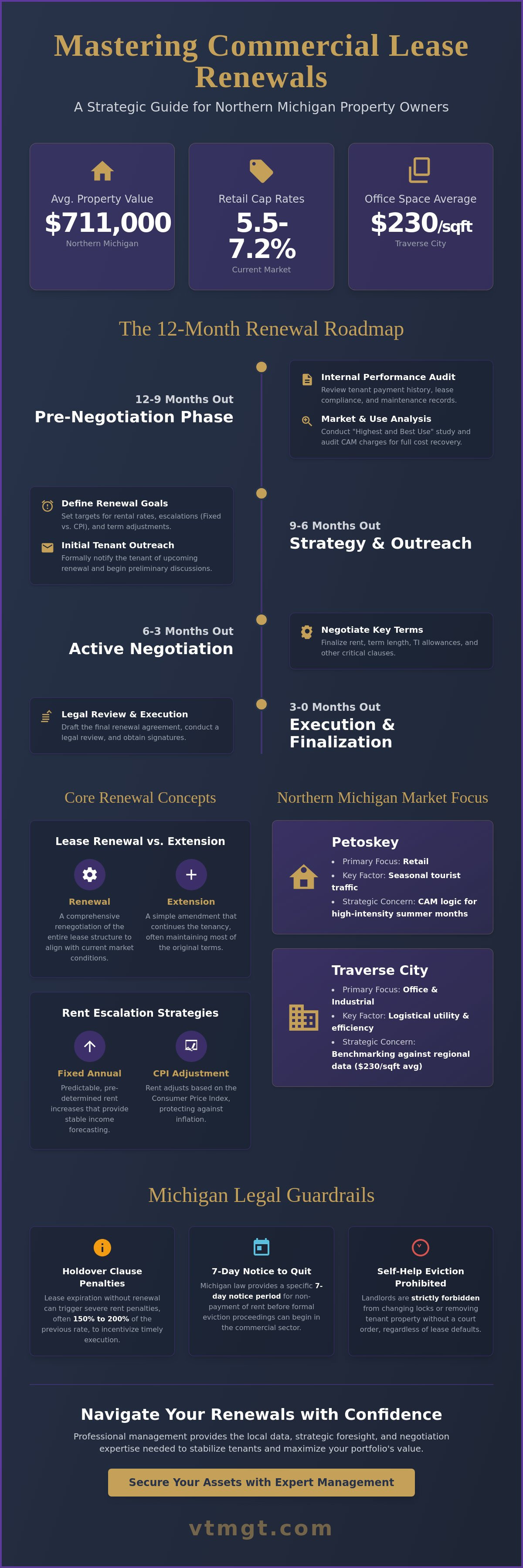
With commercial property values in Northern Michigan averaging $711,000 as of June 2026, treating a tenant's stay as a given is a high-risk gamble. Many landlords realize too late that an unoptimized commercial lease renewal process can lead to stagnant Net Operating Income or unexpected vacancies in a market where retail cap rates sit between 5.5% and 7.2%. You likely understand the pressure of balancing competitive market rates in Petoskey against the rapid growth seen in Traverse City, where office space now averages $230 per square foot. It's a complex landscape where Common Area Maintenance adjustments and precise timelines dictate your long-term portfolio stability.
This guide provides the technical framework you need to master negotiation strategies and market analysis required to secure high-value renewals. We'll examine the 9 to 12 month lead time necessary for structured negotiations and the specific Michigan legal requirements, such as the 7-day notice to quit. By the end of this analysis, you'll have a disciplined roadmap to increase property value and ensure tenant retention through 2026 and beyond.
Key Takeaways
- Understand why a formal commercial lease renewal process is a strategic financial audit rather than a simple paperwork exercise.
- Learn to conduct a "Highest and Best Use" analysis to ensure your rental rates reflect current Northern Michigan market values.
- Master the 12-month execution timeline to move from internal performance audits to formal outreach without the risk of high vacancy costs.
- Evaluate the structural advantages of fixed annual escalations versus CPI adjustments to maintain long-term property value and NOI.
- Discover how professional management systems provide the local data and human interaction needed to stabilize tenants in Petoskey and Traverse City.
Understanding the Commercial Lease Renewal Process in Northern Michigan
The commercial lease renewal process serves as a critical juncture for asset optimization. It isn't merely an administrative task; it's a formal negotiation to extend a tenancy while ensuring the financial parameters align with the 2026 market. We define this process as a strategic realignment of the landlord-tenant relationship, where the objective is to maintain high occupancy rates while adjusting terms to reflect current valuations. In a market where Northern Michigan commercial real estate prices average $711,000, precision in these negotiations is mandatory for long-term stability.
We distinguish between a lease extension, which often maintains existing terms via a simple amendment, and a full renewal. A renewal allows for a comprehensive renegotiation of the core lease structure. This distinction is vital for understanding lease agreements and how they serve as the foundation for property value. In the current landscape, the "flight to quality" means tenants are seeking modernized spaces, and landlords must use the renewal window to address these demands while securing competitive returns.
Key Legal Components in Michigan Commercial Leases
Michigan law treats commercial assets with a high degree of contractual freedom, differing significantly from residential protections. We must monitor "Right of First Refusal" clauses, which give tenants priority on adjacent spaces, versus "Option to Renew" clauses that dictate specific timeframes for notice. If the commercial lease renewal process stalls past the expiration date, holdover clauses become active. These clauses often trigger significant rent penalties, sometimes 150% to 200% of the previous rate, to encourage timely execution. It's also critical to remember that while Michigan requires a 7-day notice for non-payment, self-help evictions remain strictly prohibited in the commercial sector.
The Impact of Location: Petoskey to Traverse City
Geography dictates negotiation strategy. In downtown Petoskey, retail renewals often hinge on seasonal traffic patterns and pedestrian volume. Landlords here must account for the high-intensity summer months when setting Common Area Maintenance (CAM) logic. Conversely, industrial renewals in areas like Gaylord or Grand Traverse County focus on logistical utility and square footage efficiency. With Grand Traverse County office space sale prices averaging $230 per square foot, we use localized benchmarks from Emmet and Charlevoix counties to ensure our clients' properties remain competitive. This regional data allows us to set realistic rent escalations that reflect the 30% year-over-year increase in sales volume seen across the region.
The Pre-Negotiation Phase: Auditing Performance and Market Data
Before initiating the commercial lease renewal process, we must execute a rigorous internal audit. This phase eliminates guesswork and establishes a data-driven foundation for all future discussions. We examine the tenant's historical performance, specifically focusing on payment consistency and adherence to maintenance protocols. A tenant who consistently triggers repair requests due to negligence represents a higher risk profile than one maintaining the facility to professional standards. We also verify lease compliance, ensuring no unauthorized alterations have compromised the building's structural integrity.
Our analysis extends to a "Highest and Best Use" study. We determine if the current tenant's operation still represents the most efficient use of the square footage. If market demand has shifted toward medical office or specialized industrial use, renewing a low-yield retail tenant might be a strategic error. We also perform a meticulous review of Common Area Maintenance (CAM) charges. Ensuring full cost recovery is essential for protecting the property's Net Operating Income (NOI). If you find the data gathering process overwhelming, our specialists provide comprehensive financial reporting and accounting to clarify your asset's performance.
Evaluating Tenant Value and Risk
We assess the cost of tenant replacement with mathematical precision. High-value renewals avoid the heavy financial burden of brokerage fees, prolonged vacancy loss, and tenant improvement (TI) allowances. In the 2026 economic climate, we prioritize "Anchor Tenants" who provide stability, while applying stricter scrutiny to small businesses with volatile sales reports. If the lease agreement allows, we review certified financial statements to confirm the tenant's debt-to-income ratio remains within acceptable parameters. This fegyelmezett approach ensures that we don't just fill space, but maintain a high-quality tenant mix.
Northern Michigan Market Benchmarking
Data from early 2026 shows a 3.3% industrial vacancy rate in Greater Grand Rapids, a figure significantly lower than the 7.1% national average. While Traverse City and Petoskey maintain their own micro-climates, these regional benchmarks influence investor expectations across the state. The "Petoskey Premium" remains a factor for high-visibility retail on Mitchell Street, where demand often outstrips inventory. We factor in 2026 inflation rates and rising utility costs into the new base rent calculations. This ensures the property's valuation remains resilient against macroeconomic shifts and maintains its competitive edge in Emmet and Charlevoix counties.
Strategic Negotiation: Balancing Retention with Asset Growth
Landlords often hesitate to implement necessary rent adjustments due to the perceived risk of high-value vacancy. Within the commercial lease renewal process, we treat this not as an emotional hurdle, but as a calculation of market equilibrium. If the property's value has appreciated alongside the regional average of $201 per square foot, maintaining a below-market rate effectively devalues the asset's capitalization rate. We mitigate vacancy risk by presenting data-backed justifications that reflect the property's operational efficiency and current market standing. This disciplined approach ensures that the renewal strengthens the property’s financial health rather than merely postponing a turnover.
Structure annual rent escalations with precision. Fixed annual increases, often ranging between 3% and 5% in the Northern Michigan corridor, provide predictable cash flow for both parties. Alternatively, indexing adjustments to the Consumer Price Index (CPI) protects the landlord's purchasing power against 2026 inflationary pressures. We often recommend a hybrid approach, such as a fixed floor with a CPI-based cap, to ensure long-term stability. The lease length must also align with the owner's exit strategy or refinancing timeline. A five-year term might secure a better interest rate during a 2026 loan renewal, while a shorter three-year term offers flexibility if a sale is planned.
Tenant Improvement (TI) allowances shouldn't be viewed as a simple concession. They're a strategic reinvestment. By directing these funds toward permanent capital improvements, such as high-efficiency HVAC systems, the landlord increases the building's terminal value. This modernization reduces future maintenance liabilities and appeals to the "flight to quality" trend currently dominating the office sector.
Modernizing Lease Structures for 2026
We've observed a significant shift from Gross Leases to Triple Net (NNN) structures to mitigate landlord risk regarding fluctuating property taxes and insurance premiums. Implementing "green lease" clauses is also becoming standard, allowing owners to pass through the costs of energy-efficiency upgrades that directly benefit the tenant's utility bills. Refining maintenance coordination responsibilities within the renewal document further reduces landlord liability and ensures the asset is preserved according to professional engineering standards.
The Art of the Counter-Offer
Using standardized management systems allows us to present professional, non-emotional counter-offers. We balance rent abatements, such as one month of free rent, against maintaining a higher face rate. This tactic preserves the property’s valuation for future appraisal purposes while providing the tenant with immediate cash flow relief. All negotiations must remain compliant with Michigan landlord laws, particularly concerning the handling of security deposits and the legal framework for commercial defaults.
The Renewal Timeline: A 12-Month Execution Plan
A structured 12-month execution plan is the only way to safeguard your asset against market volatility. While some legal guides suggest a three to six-month window, we've found this insufficient for complex commercial relocations or high-stakes renewals. Starting the commercial lease renewal process a full year in advance allows for a systematic approach to asset optimization. It provides the necessary leverage to explore market alternatives if a tenant's requirements no longer align with the property's highest and best use.
Between Months 12 and 9, we focus on the internal review. This involves a comprehensive audit of the tenant's performance and the property's current standing. We analyze whether the asset requires capital improvements before a new term begins. From Months 9 to 7, we initiate formal outreach. This often includes a non-binding Request for Proposal (RFP) phase; it signals to the tenant that the landlord is prepared and understands current market benchmarks. The active negotiation window occurs between Months 6 and 4, where we finalize the Letter of Intent (LOI). This document outlines the core economic terms, including the escalations and TI allowances we analyzed in previous sections. The final quarter, Months 3 to 1, is dedicated to legal review and lease execution. We ensure all signatures are secured and the updated terms are integrated into our systems for commercial financial reporting Petoskey.
Critical Deadlines and Notice Requirements
Precision in identifying "Time is of the Essence" clauses is mandatory. Missing an "Option Exercise" window can strip a tenant of their rights or leave a landlord with an unexpected vacancy. These deadlines are often strictly enforced by Michigan courts. We still utilize certified mail for all formal notices in 2026; it provides an irrefutable paper trail that digital communication cannot always match. This fegyelmezett approach to communication prevents the ambiguity that leads to costly holdover situations or legal disputes.
Closing the Deal: Documentation and Compliance
We must determine if a simple Lease Amendment suffices or if the complexity of the new terms requires a fresh Lease Agreement. During this phase, we verify that all insurance certificates and personal guarantees are current and compliant with 2026 standards. We integrate the finalized terms into our digital tracking systems to ensure seamless billing and maintenance coordination. For landlords seeking to automate these complex milestones, our team provides professional commercial property management to ensure no deadline is overlooked.
Professional Management: Streamlining Commercial Renewals with Van Treese
The execution of a 12 month timeline requires more than just a calendar; it demands a structured management framework. At Van Treese Management, we utilize standardized systems to remove the friction often associated with the commercial lease renewal process. By integrating technological precision with local market expertise, we ensure that every negotiation is backed by real-time data and professional oversight. This approach transforms a potentially adversarial negotiation into a strategic realignment that benefits both the landlord's ROI and the tenant's operational stability.
Our methodology focuses on total process control. We don't wait for a tenant to initiate contact; we use our internal tracking to trigger the audit and outreach phases analyzed in previous sections. This fegyelmezett approach prevents the last-minute scrambles that lead to unfavorable terms or missed notice deadlines. By maintaining a clear line of communication and providing transparent financial reporting, we build a foundation of trust that is essential for high-value renewals in the 2026 economic climate.
Innovation in Commercial Asset Management
We employ market-leading software to handle rent collection and financial reporting with engineering-level accuracy. This technology provides landlords with instant transparency into their asset's performance, which is vital when determining new base rates or CAM adjustments. Our 24/7 emergency response coordination ensures that the physical asset is protected during the renewal phase, preventing maintenance lapses from derailing negotiations. We maintain a fegyelmezett schedule for maintenance coordination, ensuring the property remains in "renewal-ready" condition. This proactive stance demonstrates to tenants that the building is managed to the highest standards, justifying market-rate escalations and long-term commitments.
Building Thriving Local Communities
While technology provides the data, local human interaction provides the necessary context. Our deep roots in Petoskey, Boyne City, and Traverse City allow us to navigate the unique micro-markets of Emmet and Charlevoix counties. We understand that a retail renewal on East Mitchell Street requires a different strategy than an industrial lease in a Traverse City business park. We prioritize long-term tenant-landlord harmony because we live and work in these same communities. A successful renewal isn't just a signed document; it's the preservation of a local business and the continued growth of a Northern Michigan asset.
Ensuring lease compliance and financial transparency is a continuous process that extends far beyond the signature page. Our team handles the complexities of lease agreement preparation and ongoing property marketing to ensure your portfolio remains resilient. If you are ready to optimize your commercial lease renewal process with a partner who values precision and local expertise, schedule a consultation for your commercial property management needs.
Securing Long-Term Asset Stability in Northern Michigan
Mastering the commercial lease renewal process requires a disciplined integration of market benchmarks and contractual precision. By adhering to a 12-month execution timeline and auditing tenant performance with technical accuracy, you protect your property from the volatility of the 2026 market. We've analyzed how structured escalations and modernized lease clauses shift risk and enhance Net Operating Income. These strategies ensure your portfolio remains resilient, whether you're managing retail space in Petoskey or industrial assets in Grand Traverse County.
Success in the Northern Michigan corridor depends on the balance between innovative technology and deep regional insight. Van Treese Management provides the standardized systems and 24/7 maintenance coordination needed to maintain your property in peak condition while navigating complex negotiations. Our team leverages extensive experience in Emmet and Charlevoix counties to ensure every renewal aligns with your long-term investment objectives. Maximize your commercial asset value with Van Treese Management. We look forward to helping you build a more stable and profitable property portfolio.
Frequently Asked Questions
How far in advance should I start the commercial lease renewal process?
We recommend initiating the commercial lease renewal process between 9 and 12 months before the current term expires. This timeframe allows for a comprehensive audit of the asset's performance and sufficient time to explore market alternatives if negotiations stall. In complex industrial or retail environments, this lead time ensures that legal reviews and documentation are finalized without the pressure of an imminent expiration date.
What is the difference between a lease extension and a lease renewal?
A lease extension typically continues the existing agreement's terms while simply pushing out the expiration date via a short amendment. In contrast, a lease renewal involves a more rigorous renegotiation of core parameters, such as base rent, CAM logic, and maintenance responsibilities. Renewals allow landlords to align the agreement with current 2026 market valuations, which is essential when Northern Michigan prices average $201 per square foot.
Can a landlord refuse to renew a commercial lease in Michigan?
Yes, a landlord can generally refuse to renew a commercial lease in Michigan unless the original agreement contains a specific "Option to Renew" clause. Michigan commercial law prioritizes the written contract over statutory protections. If the lease doesn't grant the tenant a right to stay, the landlord may choose to terminate the relationship to seek a higher-value tenant or repurpose the asset for a different use.
What are common CAM charges in Northern Michigan commercial properties?
Common Area Maintenance (CAM) charges in Northern Michigan typically include property taxes, insurance premiums, and shared operational costs such as snow removal, landscaping, and parking lot maintenance. In seasonal markets like Petoskey and Traverse City, CAM logic must be meticulously structured to ensure full cost recovery during high-intensity summer months. Standardizing these charges ensures financial transparency and protects the property's Net Operating Income (NOI).
How do I determine the fair market rent for a Petoskey retail space?
Determining fair market rent in Petoskey requires a comparative analysis of recent lease executions within Emmet County. We utilize regional benchmarks, such as the $230 per square foot average seen for office space in neighboring Grand Traverse County, while adjusting for Petoskey's specific retail foot traffic. Landlords should also factor in the current retail cap rates, which range from 5.5% to 7.2%, to ensure the rent supports the property's overall valuation.
Is a Letter of Intent (LOI) legally binding in a lease renewal?
A Letter of Intent (LOI) is generally a non-binding document that outlines the primary economic terms of a deal before the formal lease is drafted. While it isn't a final contract, it serves as the technical blueprint for the legal execution phase. It's critical to include specific language stating the LOI is non-binding to prevent premature legal obligations while the commercial lease renewal process is still in the negotiation stage.
What happens if a commercial tenant stays past the lease end date without a renewal?
If a tenant remains past the expiration date without a signed renewal, they typically become a "holdover" tenant under Michigan law. Most commercial leases include a holdover clause that increases the rent significantly, often to 150% or 200% of the previous rate, to discourage unauthorized occupancy. Landlords must provide a minimum of one month's written notice to terminate a month-to-month commercial tenancy if a formal renewal isn't executed.
Should I offer my tenant improvements (TI) during a renewal negotiation?
Offering Tenant Improvement (TI) allowances can be a strategic tool to secure a high-value renewal while modernizing the asset. By directing funds toward permanent improvements like energy-efficient HVAC systems or structural upgrades, the landlord increases the building's terminal value. This approach is particularly effective in the 2026 market, where tenants are prioritizing higher-quality office and retail spaces over older, unmaintained inventory.