
NNN Lease Management in Northern Michigan: The 2026 Investor's Guide
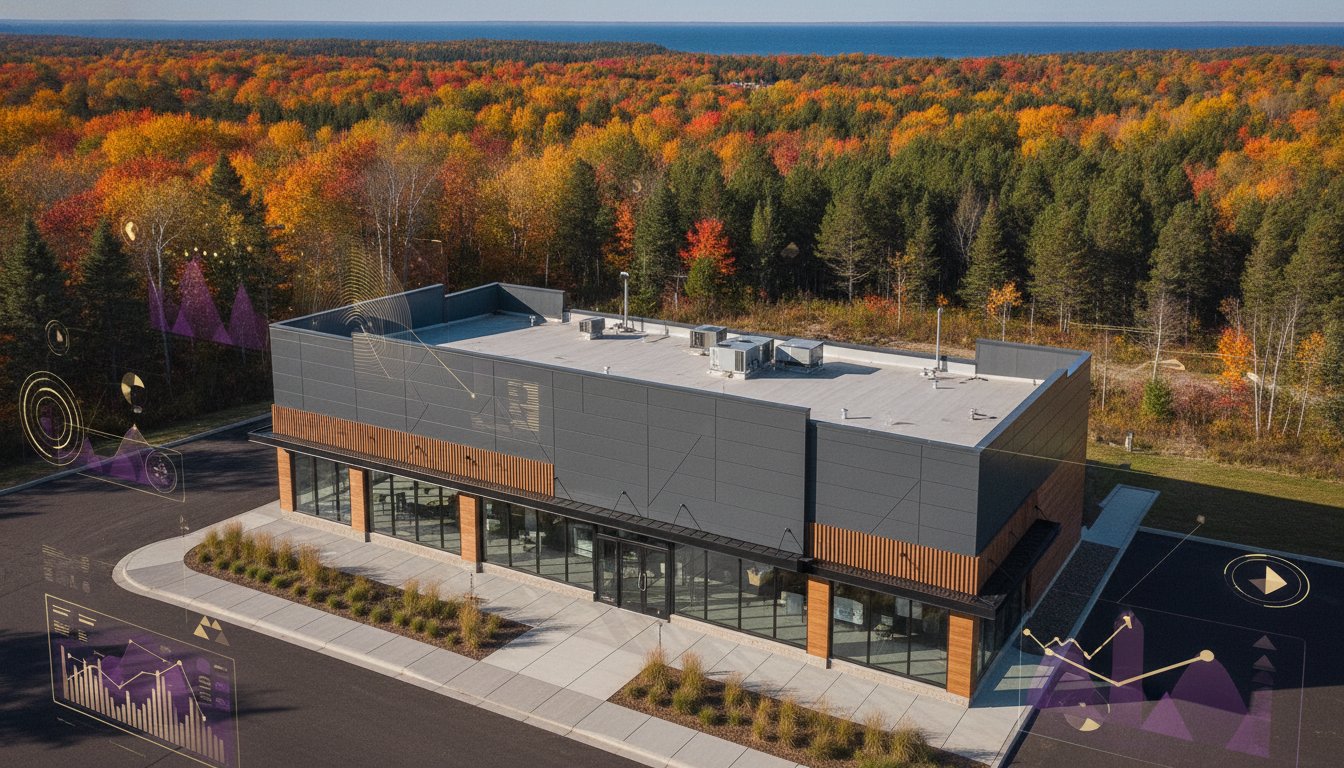
The "set-and-forget" reputation of triple-net leases is a significant misconception that often leads to structural neglect and unmonitored tax liabilities. While these agreements are designed for stability, the reality of the 2026 market requires a more disciplined approach to oversight. You likely pursued these assets to secure passive income, yet the challenges of verifying tenant maintenance compliance and managing the 2.7% inflationary tax cap in Michigan often create heavy administrative burdens. Without precise NNN lease management Northern Michigan, even high-performing retail or industrial assets risk devaluation due to deferred repairs or missed recovery opportunities.
We believe that protecting your capital requires more than just a signed contract; it demands a structured system of verification and reporting. This guide provides a technical roadmap to maximizing your ROI through professional oversight tailored to the local landscape. We'll analyze the impact of the "pop-up" tax on new acquisitions, the necessity of standardized reporting for tax season, and the strategic implementation of vendor coordination to ensure your property remains a high-yielding, low-risk asset throughout the 2026 fiscal year.
Key Takeaways
- Learn how specialized NNN lease management Northern Michigan ensures that tenants remain compliant with specific local tax assessments and the 2.7% inflationary cap for 2026.
- Understand why "passive" income still requires proactive oversight to prevent deferred maintenance from devaluing your commercial real estate assets over the long term.
- Discover technical strategies for verifying that tenant insurance policies provide sufficient coverage against the unique structural risks posed by Northern Michigan winters.
- Gain insights into developing capital improvement plans that align with the high demand for resilient retail and industrial sectors in the Traverse City and Petoskey markets.
- Explore how standardized financial reporting and professional maintenance coordination streamline asset protection while maintaining high-quality tenant relationships.
Understanding NNN Leases in the Northern Michigan Commercial Market
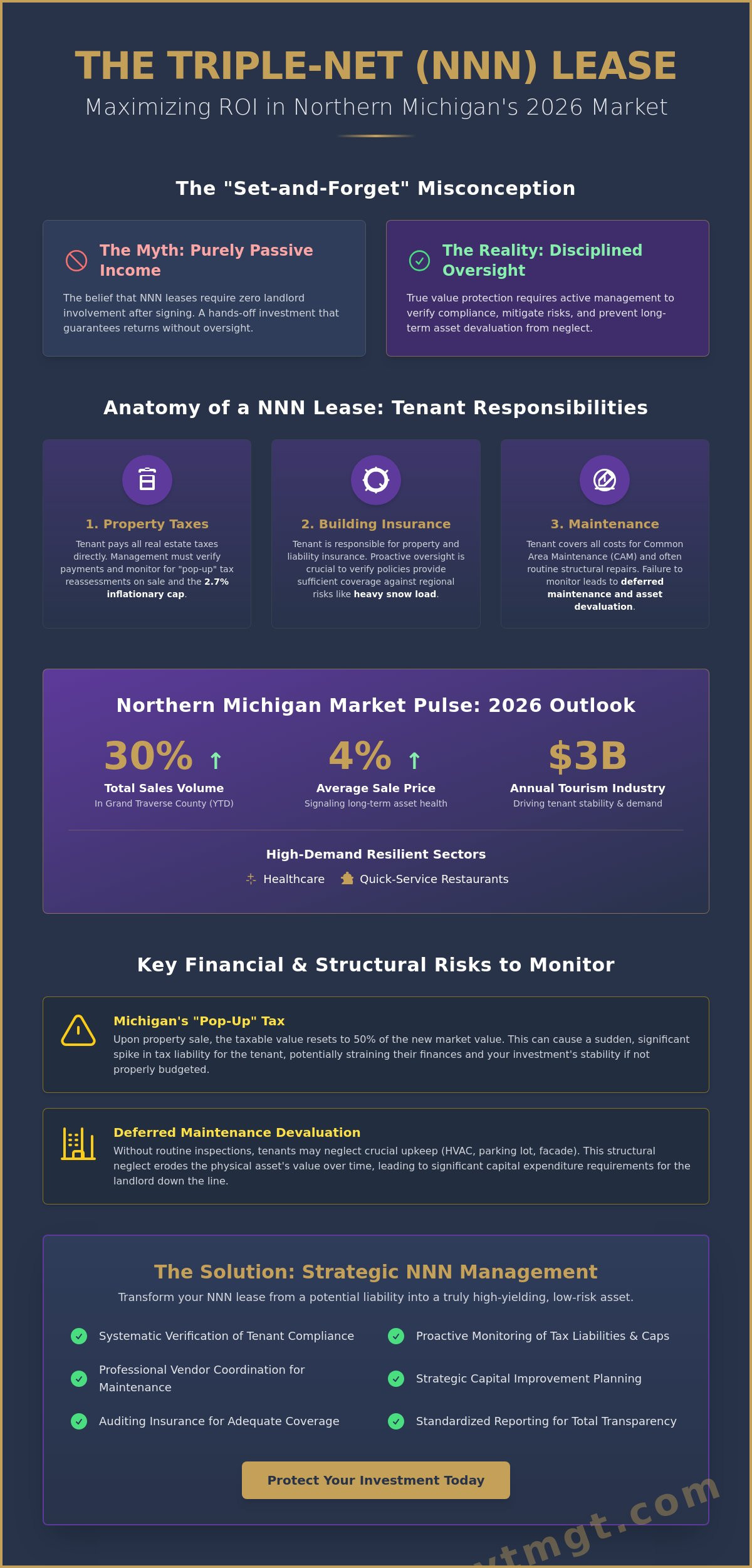
A Triple Net (NNN) lease serves as a technical framework where the tenant assumes the financial burden of the "three nets": property taxes, insurance, and maintenance. This arrangement is the standard for investors seeking a passive income stream, but it requires a disciplined approach to oversight. For those Understanding Net Leases, the distinction between an Absolute NNN and a modified version is critical. In Michigan, modified leases often require the landlord to retain responsibility for the roof and structure; Absolute NNN leases shift every conceivable expense to the tenant. Effective NNN lease management Northern Michigan involves verifying that these contractual obligations are met with technical precision, particularly regarding the region's unique environmental demands.
The 2026 outlook for commercial real estate in Traverse City and Petoskey remains robust. Data from the first half of the year indicates a 30% increase in total sales volume for Grand Traverse County. This growth is paired with a 4% rise in average sale prices, signaling a market that values stability and long-term asset health. Investors favor the NNN structure in these corridors because it mitigates the impact of rising operational costs, shifting the risk of inflation-driven maintenance spikes directly to the commercial tenant.
Key Characteristics of NNN Agreements
Stability is the hallmark of the NNN model. Lease durations in Northern Michigan retail and industrial sectors typically range from 10 to 25 years. This longevity provides a predictable internal rate of return, provided the underlying asset is protected. The financial structure consists of a base rent, which is the landlord's profit, and "additional rent," which covers the three nets. In multi-tenant properties, such as shopping centers in Gaylord or Grand Rapids, Common Area Maintenance (CAM) fees are distributed among tenants based on their pro-rata share of the total square footage. We ensure these calculations are transparent and audited to maintain tenant compliance and owner protection.
Local Market Dynamics in 2026
Northern Michigan's economy is heavily influenced by a $3 billion annual tourism industry, which dictates tenant stability and property demand. Emmet and Charlevoix counties have seen sustained interest in NNN assets, particularly within resilient sectors like healthcare and quick-service restaurants. While the market is moving toward a more balanced state, the scarcity of prime commercial inventory continues to support high property values. Investors must account for Michigan's 2026 inflationary cap of 2.7% on taxable value, a metric that becomes essential when auditing tenant tax payments. The integration of high-level technical oversight ensures that these regional variables don't compromise the asset's performance.
Breaking Down the Three Nets: Taxes, Insurance, and Maintenance
The legal definition of a triple net lease dictates that the tenant assumes responsibility for the three primary operating expenses associated with a property. While this structure is designed to preserve the landlord's net income, the financial risks don't vanish upon signing. If a tenant neglects these obligations, the legal and financial liability eventually reverts to the property owner. Professional NNN lease management Northern Michigan serves as a critical verification layer. It ensures that every dollar allocated to taxes, insurance, and maintenance is actually deployed according to the lease terms. We implement standardized auditing systems to track these payments; this provides owners with the certainty that their asset remains unencumbered and physically sound.
Property Taxes in Northern Michigan Counties
Navigating property taxes in 2026 requires a precise understanding of Michigan's "pop-up" tax and the current 2.7% inflationary cap on taxable value. In Emmet County, the effective property tax rate stands at 0.97%, while Charlevoix County sits slightly higher at 1.02%. Investors must remain vigilant during ownership transfers, as the taxable value resets to 50% of the market value, often resulting in a significant expense spike for the tenant. Landlords must verify that tenants have reconciled all property tax payments against the 2026 taxable value assessments to prevent municipal liens from attaching to the title. We provide rigorous oversight of these payments to ensure that local assessments are challenged when necessary and paid on schedule. For investors seeking to offload this administrative burden, our commercial property management services offer a structured approach to tax verification and compliance.
Maintenance and the 'Northern MI Factor'
The climate in Northern Michigan introduces specific structural risks that generic NNN agreements often fail to address. Maintenance is not merely a tenant's right to save money; it's an owner's requirement for asset protection. Winter snow loads can exceed the design capacity of older commercial roofs, making snow removal a non-negotiable safety item. We insist on strict service schedules for HVAC systems, as the extreme temperature fluctuations of 2026 can lead to premature mechanical failure if units aren't properly winterized. Pipe protection and insulation checks are equally vital to prevent catastrophic water damage during deep freezes. When maintenance is entirely tenant-led, there's a natural incentive for the tenant to choose the cheapest repair over the most durable one. Our oversight ensures that 'tenant-led' maintenance still meets professional engineering standards, protecting the building's structural integrity for the duration of the 10 to 25-year lease term.
The Management Myth: Why NNN Properties Still Need Professional Oversight
The perception that a Triple net lease (NNN) is a zero-effort investment often leads to the gradual erosion of capital. Many investors enter the Northern Michigan market expecting a "set and forget" experience; however, the reality of 2026 asset management requires active verification. Without specialized NNN lease management Northern Michigan, the landlord effectively abdicates control over the building's physical and financial health to the tenant. This creates a fundamental conflict of interest. A tenant's primary goal is to minimize current operating expenses, while the owner's goal is to preserve long-term residual value. When oversight is absent, a tenant's "savings" on deferred maintenance inevitably become the landlord's capital expense at the end of the lease term.
Lease compliance auditing is another critical component of modern oversight. In 2026, verifying that a tenant isn't cutting corners on insurance coverage or property tax payments is non-negotiable. If a tenant fails to maintain the required liability limits or neglects the 2.7% inflationary tax cap adjustments, the property owner remains the ultimate party of responsibility. The 2026 market demands a level of precision found in our guide to commercial property management Northern Michigan, where we detail how local expertise prevents these administrative lapses from becoming legal liabilities.
Protecting Your Asset's Residual Value
The true cost of an NNN investment isn't found in the monthly management fee but in the potential cost of "re-tenanting" a neglected building. Maintenance performed today prevents the catastrophic vacancies of tomorrow. We implement standardized, technical inspections to catch structural issues long before a lease expires. This includes auditing Common Area Maintenance (CAM) charges, which in 2026 typically see a negotiated management fee of 5% of total CAM costs. Precise tracking and annual reconciliation ensure that the owner is not inadvertently subsidizing the tenant's contractual obligations.
Administrative and Financial Reporting
For multi-state investors, the lack of standardized reporting is a significant pain point during tax season. We provide structured financial statements that integrate seamlessly with modern accounting requirements. This professional layer is especially vital when managing the transition if a tenant defaults or vacates. Given that Northern Michigan lenders often require a 30% to 40% down payment for NNN assets, the financial stakes of a default are high. We coordinate with local vendors for emergency oversight; this ensures that your property remains protected and compliant even during periods of tenant turnover or economic shifts.
Strategic NNN Management for Northern Michigan Investors
Effective NNN lease management Northern Michigan transitions from passive observation to proactive asset strategy through the development of a 2026 capital improvement plan. Even when tenants are contractually obligated for repairs, the landlord must maintain a technical roadmap for structural renewals. This prevents the "deferred maintenance trap" where a building's systems reach the end of their lifecycle simultaneously. In the competitive corridors of Petoskey and Traverse City, we ensure that every agreement is reinforced by a deep understanding of Michigan landlord laws. Aligning commercial lease structures with current state regulations provides a firm legal foundation for handling complex net reconciliations and annual rent escalations.
Tenant Placement and Vetting
Securing a high-yield asset begins with a disciplined approach to tenant screening and placement. In the 2026 economic climate, a credit score is merely a baseline metric. Our technical vetting process involves a comprehensive analysis of the tenant's business stability and their sector's resilience against market shifts. We utilize standardized background checks for all commercial lease signers to verify financial history and operational experience. In multi-tenant environments, such as shopping centers, the tenant-mix is a critical factor in long-term viability. We strategically select tenants whose services complement one another; this creates a robust ecosystem that drives consistent foot traffic and minimizes the risk of a single-sector downturn affecting the entire property.
Lease Execution and Renewals
The technical precision of lease agreement preparation dictates the ease of future management. We focus on clearly defined performance standards for maintenance and detailed protocols for CAM reconciliations. Rent escalations must be calculated with accuracy to reflect the 2.7% inflationary cap and other 2026 market benchmarks. Comprehensive lease clarity significantly reduces the probability of protracted litigation by defining technical performance standards for each party. This level of detail ensures that both the landlord and tenant understand their financial and operational boundaries from the first day of the term. For owners looking to optimize their current portfolio, our commercial property management services provide the structured oversight necessary to handle complex renewals and market-rate adjustments with confidence.
Optimizing Your NNN Portfolio with Van Treese Management
Van Treese Management integrates technological innovation with specialized human expertise to redefine the standard for NNN lease management Northern Michigan. We recognize that a commercial asset in the 2026 market is a complex mechanical and financial system that requires constant calibration. Our approach moves beyond the passive nature of traditional net leases by implementing a rigorous framework of operational control. By maintaining a disciplined local presence in Petoskey, Gaylord, and Traverse City, we bridge the gap between high-level investment strategy and the ground-level realities of Northern Michigan property ownership. We focus on the long-term stability of the asset; this ensures that your commercial investment contributes to thriving local communities while delivering predictable financial performance.
Innovation in Commercial Oversight
Precision in reporting is the cornerstone of our management philosophy. We provide owners with 24/7 access to property data; this ensures that every maintenance log, tax reconciliation, and financial statement is available for immediate review. This transparency is supported by our established network of vetted local contractors who specialize in the structural demands of the Michigan climate. Our systems are designed to detect irregularities before they escalate into structural failures. For example, our systematic oversight protocols recently identified a critical drainage misalignment in a Traverse City retail center during a routine inspection. By intervening with a technical solution, we prevented a foundation compromise that would have resulted in significant capital loss, thereby protecting the owner's residual value and the tenant's operational continuity.
Getting Started with Professional NNN Management
The transition to professional oversight begins with a comprehensive analysis of your asset's current performance and market position. Our team conducts detailed property valuations and market research to align your portfolio with 2026 benchmarks, such as the current retail cap rates of 5.5% to 7.2% and industrial rates of 6.8% to 8.5%. We develop customized management plans that address the specific engineering and financial requirements of your commercial holdings. This structured approach ensures that every aspect of the "three nets" is handled with professional humility and technical accuracy. We invite you to experience a partnership where stability and modernization intersect. Secure your Northern Michigan investment with Van Treese Management today.
Securing Long-Term Performance for Your Commercial Portfolio
Maintaining the integrity of a triple-net asset in 2026 requires a technical approach to oversight that accounts for Michigan's specific tax regulations and structural maintenance requirements. We've established that while the financial burden shifts to the tenant, the ultimate responsibility for the building's health remains with the owner. Expert NNN lease management Northern Michigan ensures these contractual responsibilities are met with precision; it prevents the gradual erosion of your property's residual value through disciplined verification. By utilizing our standardized management systems and local expertise in Petoskey and Traverse City, you can protect your capital against deferred maintenance and administrative lapses. Our team provides 24/7 emergency response coordination to handle unforeseen structural risks before they impact your ROI. We invite you to Optimize Your Commercial Asset Performance with Van Treese. Your commercial holdings deserve the stability and technical discipline of a partner committed to professional excellence.
Frequently Asked Questions
Is an NNN lease really management-free for the landlord?
No, an NNN lease is not truly management-free because the landlord retains ultimate legal and financial liability for the asset. You must verify that the tenant is fulfilling their contractual obligations regarding insurance renewals and tax payments. Professional NNN lease management Northern Michigan provides the necessary oversight to ensure that a tenant's desire to reduce their operating costs doesn't lead to structural neglect or title encumbrances.
What happens if a tenant fails to pay property taxes in Northern Michigan?
If a tenant defaults on property taxes, the local municipality will eventually place a tax lien on the property, which can lead to foreclosure regardless of the lease terms. The property owner is the party legally responsible to the county for these payments. We monitor tax portals in Emmet and Grand Traverse counties to confirm that all assessments are settled before interest accrues or legal action begins.
How often should I inspect an NNN commercial property in Petoskey?
We recommend a minimum of two comprehensive site inspections per year to ensure the tenant's maintenance standards align with the lease's technical requirements. These evaluations should occur before and after the winter season to assess the building's structural response to environmental stress. Regular site visits allow you to catch minor issues, such as roof membrane wear or HVAC neglect, before they require major capital expenditures from the landlord.
Can NNN lease management fees be passed through to the tenant?
Most modern NNN agreements allow for a management fee to be passed through to the tenant as a percentage of the Common Area Maintenance (CAM) costs. In 2026, a negotiated fee of 5% of CAM expenses is a common industry benchmark for retail and industrial properties. You must ensure that the specific language in your lease agreement explicitly permits this recovery to avoid disputes during the annual reconciliation process.
What are typical CAM charges for retail spaces in Traverse City in 2026?
Typical CAM charges for retail properties in Traverse City generally range from $3.00 to $8.00 per square foot annually. These costs fluctuate based on the property's age, the complexity of its shared systems, and the level of service required for grounds maintenance. Standardized NNN lease management Northern Michigan involves auditing these expenses to ensure they're reasonable and that the tenant is receiving the services they're funding.
How does the Northern Michigan climate affect NNN lease maintenance requirements?
The Northern Michigan climate necessitates specific maintenance protocols for snow load management and structural winterization. Extreme temperature fluctuations can cause rapid degradation of roofing materials and mechanical systems if they aren't serviced according to a strict schedule. Landlords must verify that tenants are performing preventative tasks, such as clearing roof drains and insulating exposed piping, to mitigate the risk of catastrophic water damage during the spring thaw.
What is the difference between NNN and a Gross Lease for a landlord?
An NNN lease requires the tenant to pay a base rent plus their pro-rata share of taxes, insurance, and maintenance; a Gross Lease is an all-inclusive payment where the landlord covers these costs. NNN leases offer more protection against inflationary spikes in operating expenses, as the tenant absorbs the risk of rising tax rates or repair costs. This structure is generally preferred by institutional investors seeking a predictable net operating income.
Why should out-of-state investors hire a local manager for NNN assets?
Local managers provide the rapid response and regional knowledge that out-of-state investors cannot maintain from a distance. We possess an established network of vetted Northern Michigan vendors who understand the specific engineering requirements of the region. A local presence ensures that property inspections are performed with technical precision and that any emergency issues are addressed immediately, protecting the asset's residual value and maintaining tenant compliance.