
What if the true cost of a commercial vacancy isn't just the lost rent, but the risk of securing a tenant who won't survive their first 24 months? In the stable yet methodical West Michigan market, finding commercial tenants Grand Rapids requires more than a simple listing; it demands a precision engineering approach to tenant placement. You've likely felt the pressure of rising property taxes, currently averaged at 54.14 mills in Michigan, and the urgent need to offset these fixed costs with reliable, long-term occupants who can withstand shifting economic cycles.
We recognize that the complexity of NNN and CAM negotiations often creates unnecessary friction for property owners. This guide provides a professional framework to master the identification, screening, and securing of high-value commercial tenants in our competitive local landscape. You'll gain the technical insights needed to leverage the "flight to quality" trend and navigate the 2026 regulatory environment effectively. We will examine rigorous screening protocols, the impact of new downtown developments like the Acrisure Amphitheater, and the structural nuances of sustainable lease agreements to ensure your property remains a high-performing, stable asset.
Key Takeaways
- Identify high-growth opportunities by analyzing the impact of the Medical Mile expansion and upcoming downtown infrastructure on local vacancy rates.
- Refine your approach to finding commercial tenants Grand Rapids by positioning assets to meet the increasing demand for modern, high-quality office and industrial spaces.
- Execute a rigorous screening protocol that moves beyond basic credit checks to evaluate three years of financial statements and overall corporate health.
- Structure Triple Net (NNN) leases and Tenant Improvement allowances using a precision-focused ROI framework to ensure long-term asset stability.
- Utilize standardized management systems to eliminate vacancy friction and leverage local market expertise for superior tenant placement.
The Grand Rapids Commercial Landscape: Market Dynamics in 2026
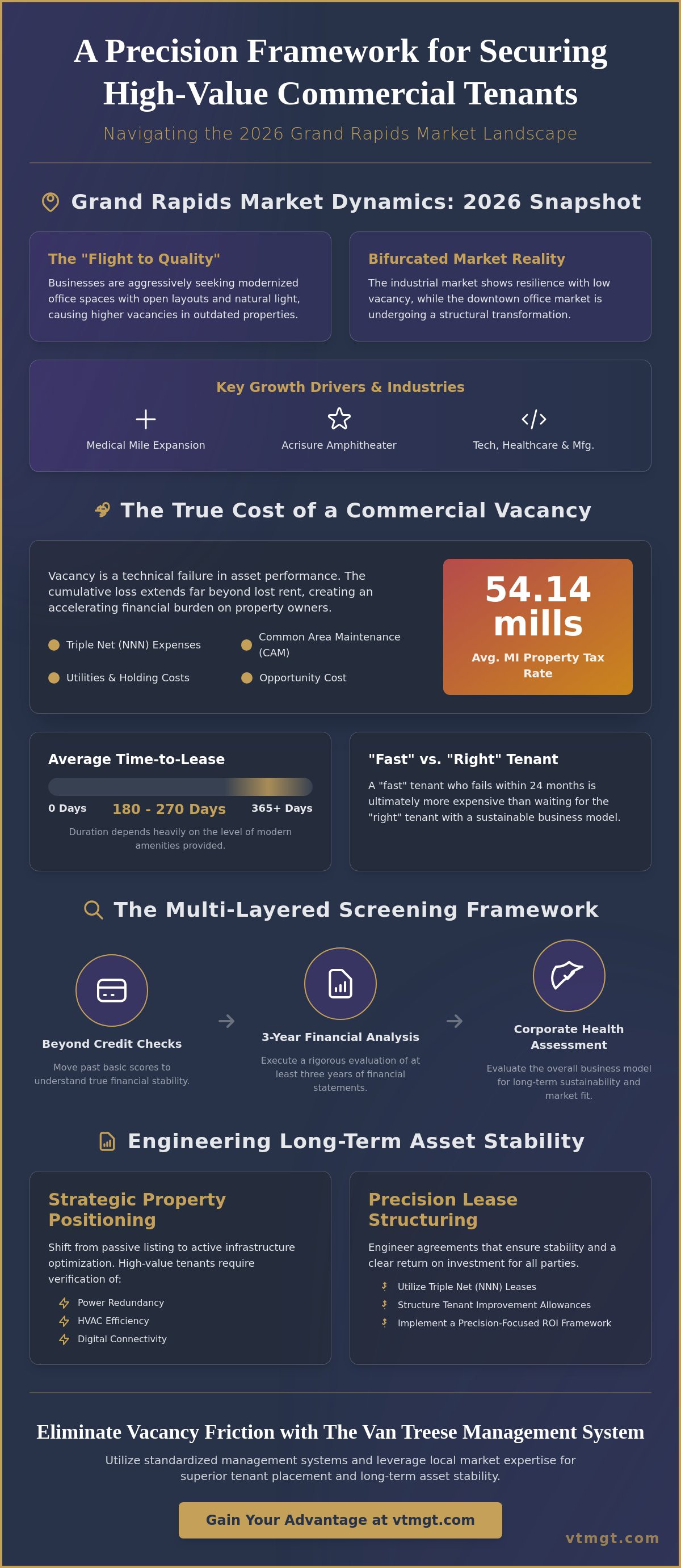
The Grand Rapids commercial sector in 2026 reflects a bifurcated reality that requires a precision-based approach to asset management. While the West Michigan industrial market continues to demonstrate resilience with low vacancy rates and stable rent growth, the downtown office market is undergoing a structural transformation. This shift isn't driven by a lack of demand for a downtown presence, but rather by a "flight to quality." Businesses are aggressively seeking modernized spaces with open layouts and natural light, leaving outdated inventories with higher vacancy levels. Strategic positioning is essential when finding commercial tenants Grand Rapids property owners can rely on for multi-year stability.
A foundational step for any owner involves understanding commercial property classifications to align their asset with the correct market segment. The expansion of the "Medical Mile" has catalyzed peripheral demand, creating a surge in requirements for specialized professional services and medical-adjacent office spaces. Simultaneously, the 2026 opening of the Acrisure Amphitheater has revitalized the retail and entertainment sectors, increasing foot traffic and investor confidence. With Michigan's corporate income tax rate holding steady at 6.00%, the economic climate encourages expansion for high-growth industries, particularly in the healthcare, advanced manufacturing, and technology sectors.
Micro-Market Analysis: From Heartside to the West Side
Your property’s specific zone dictates the ideal tenant profile and the necessary infrastructure required to support their operations. In the Heartside district, the focus remains on foot traffic and entertainment-driven retail, whereas the West Side has seen a significant shift toward mixed-use commercial spaces that prioritize logistical accessibility. Engineering a match between your property's limitations and a tenant's business model is critical. For instance, a tech startup may prioritize high-speed data infrastructure over street-level visibility, while a retail entity will demand the opposite. Evaluating these parameters early prevents the friction of mismatched expectations during the lease term.
The Cost of Vacancy: A Quantitative Assessment
Vacancy is a technical failure in asset performance that extends far beyond lost rent. Owners must calculate the cumulative loss, which includes Triple Net (NNN) expenses, Common Area Maintenance (CAM), utilities, and the opportunity cost of uninvested capital. With the 2026 Michigan property tax rate averaged at 54.14 mills, the financial burden of an empty building accelerates quickly. A "fast" tenant often becomes more expensive than the "right" tenant if their business model lacks the sustainability to survive the initial 24 months of the lease. Market data for 2026 indicates that the average time-to-lease for Grand Rapids commercial assets ranges from 180 to 270 days depending on the level of modern amenities provided.
Strategic Property Positioning: Attracting High-Value Applicants
Positioning a commercial asset in the 2026 Grand Rapids market requires a shift from passive listing to active infrastructure optimization. High-value tenants, particularly those in the expanding medical and technology sectors, view a lease as a strategic partnership rather than a mere overhead expense. To succeed in finding commercial tenants Grand Rapids property owners must ensure their physical assets meet the rigorous standards of modern business operations. This involves more than aesthetic "curb appeal"; it requires verifying that the building's technical parameters, such as power redundancy, HVAC efficiency, and digital connectivity, align with the specific needs of professional industries.
Developing a targeted value proposition for your square footage involves a detailed analysis of how your space facilitates a tenant's growth. If your property is located near the West Side, your marketing should emphasize logistical accessibility and the recent influx of mixed-use developments. Conversely, assets near the Medical Mile must highlight their proximity to regional healthcare hubs. Precision in digital marketing is equally vital in the 2026 B2B space. Utilizing data-driven campaigns on platforms like LinkedIn and specialized commercial real estate networks allows you to reach decision-makers who are actively planning for expansion or consolidation.
Creating a Professional Offering Memorandum
A comprehensive Offering Memorandum (OM) serves as the technical blueprint for your property. It must include precise floor plans, confirmed zoning classifications, and detailed utility capacities to eliminate uncertainty for prospective applicants. In an era of high property taxes, currently averaged at 54.14 mills in Michigan, highlighting Common Area Maintenance (CAM) efficiencies is a powerful incentive for cost-conscious businesses. For out-of-state investors and national franchises looking at the Grand Rapids metro area, providing high-resolution 3D walkthroughs and professional photography is no longer optional; it's a standard requirement for serious consideration.
Networking Within the Grand Rapids Chamber of Commerce
Local business relationships remain a primary driver of off-market tenant leads in West Michigan. Engaging with the Grand Rapids Chamber of Commerce provides a direct line to established companies and emerging startups that may be outgrowing their current facilities. Collaborating with experienced commercial brokers through a structured incentive system can also accelerate the placement process. By positioning your property as a catalyst for local community growth and economic stability, you attract tenants who are invested in the long-term vitality of the region. Implementing a professional property marketing and advertising strategy ensures your asset remains visible to these high-value networks throughout the fiscal year.
The Multi-Layered Screening Framework: Beyond the Credit Score
Screening a commercial applicant requires the same rigor as a technical feasibility study. A standard credit score provides a snapshot of past behavior, but it fails to predict the structural endurance of a business entity over a multi-year lease. When finding commercial tenants Grand Rapids property owners must implement a multi-layered framework that prioritizes "Corporate Health" over surface-level metrics. This process starts with a comprehensive audit of three years of Profit and Loss (P&L) statements and balance sheets to identify patterns of growth, stagnation, or unsustainable debt levels that could jeopardize the lease agreement.
Evaluating a tenant’s business plan through a "stress test" is equally critical. You aren't just checking if they can pay today; you're assessing if their revenue model can withstand the 2026 economic climate, including the 2.7% inflationary cap on taxable value and the 6.00% corporate tax environment. Verifying industry-specific references and previous landlord history provides a qualitative layer to this quantitative data. This reveals how the business manages its operational obligations during periods of market volatility. It's a necessary step to ensure the tenant's business model is compatible with the long-term stability of your asset.
Financial Ratio Analysis for Commercial Applicants
Small to mid-sized businesses often carry different risk profiles than national franchises. Analyzing the Debt-to-Income (DTI) ratio helps determine if the business is over-leveraged, while liquidity checks ensure they maintain a sufficient "runway" to cover the lease term even during lean quarters. The Liquidity Coverage Ratio in commercial leasing represents the proportion of a tenant's highly liquid assets to their total rent and CAM obligations over a specific period, typically twelve months. High-precision screening protocols ensure that the tenant’s cash flow remains robust enough to handle their financial commitments without disruption.
Assessing Business Synergy and Use Clauses
A tenant's impact on your property extends beyond their monthly check. You must evaluate how a new business complements or conflicts with existing occupants to maintain a cohesive environment. "Exclusive Use" clauses are vital in retail and office settings to prevent internal competition that could undermine a tenant's viability. Conversely, strict "Permitted Use" definitions protect the owner from unauthorized activities that could increase insurance premiums or violate local zoning laws. By matching a tenant's business model with the specific asset limitations discussed in previous sections, you mitigate long-term risk and ensure the property remains a high-performing instrument within the Grand Rapids metro area.
Negotiating Leases for Long-Term Asset Stability
Negotiation in the 2026 Grand Rapids market is less about aggressive bargaining and more about engineering a sustainable financial framework. Once you've completed the process of finding commercial tenants Grand Rapids, the focus shifts to the technical structure of the lease agreement. Tenant Improvement (TI) allowances should be viewed through a strict ROI lens. While modern office spaces require investment to attract high-quality occupants, these concessions must be balanced against the tenant’s corporate health. High construction costs in 2026 make precision in these calculations mandatory to avoid over-leveraging the asset.
Structuring Triple Net (NNN) leases remains the standard for achieving predictable owner cash flow after successfully finding commercial tenants Grand Rapids. By passing through taxes, insurance, and maintenance costs, owners mitigate the impact of the Michigan state average tax rate of 54.14 mills. Escalation clauses are equally vital; they must balance the 2.7% inflationary cap on taxable value with the tenant's ability to absorb cost increases. For mid-market businesses, personal guarantees provide a necessary layer of protection, ensuring that individual stakeholders remain committed to the long-term success of the business model throughout the lease term.
Understanding CAM and Operating Expenses
Transparency in Common Area Maintenance (CAM) reporting serves as a critical trust-building mechanism between the owner and occupant. Detailed accounting prevents the friction that often arises from unexpected end-of-year reconciliations. Utilizing professional commercial property management in Northern Michigan can significantly reduce overhead through standardized maintenance coordination and vendor management. To further protect tenant stability, many owners now define "caps" on controllable operating expense increases, providing the tenant with a predictable budget while maintaining the property’s fiscal performance.
Early Termination and Default Protection
Protecting an asset from market volatility requires sophisticated contractual safeguards. Recapture clauses allow an owner to take back the space if a tenant requests a sublease or assignment that doesn't align with the building's synergy. In the 2026 landscape, owners are increasingly evaluating the use of Letters of Credit as an alternative to traditional security deposits for high-value deals. All contracts must maintain strict legal compliance with Michigan landlord laws to ensure they're enforceable in the event of a default. If you need assistance in crafting these complex documents, our team provides expert lease agreement preparation services to secure your investment's future.
Professional Tenant Placement: The Van Treese Management System
The Van Treese Management System operates as a structured protocol designed to eliminate the friction typically associated with commercial vacancy. Finding commercial tenants Grand Rapids requires a localized strategy, but the long-term management of those assets benefits from a philosophy rooted in Northern Michigan values: reliability, precision, and a commitment to long-term partnership. Our approach integrates rigorous maintenance coordination with transparent financial reporting and accounting, ensuring that property owners maintain full control over their investment’s performance. By applying engineering-grade standards to property oversight, we ensure that the asset remains a stable, high-performing instrument in any economic climate. This system allows for the seamless transition of occupants while maintaining the structural and financial integrity of the building.
We provide owners with detailed financial reporting that tracks every mill of the 54.14 average tax rate and every dollar of CAM expenses. This level of transparency is essential for professional owners who require precise data for tax appeals or portfolio audits. Our maintenance coordination protocols are equally rigorous, utilizing a vetted network of contractors to ensure that mechanical systems operate at peak efficiency. This proactive stance prevents the costly emergency repairs that often disrupt a tenant's business operations and strain the owner-tenant relationship. It's a disciplined approach that prioritizes asset health over short-term fixes.
A Human-Centric Approach to Commercial Management
Technical excellence must be balanced with relationship management to prevent tenant default and maintain high occupancy levels. We transform the traditional landlord-tenant dynamic into a partner-partner relationship by prioritizing clear communication and rapid response. Our 24/7 emergency response system isn't just a convenience; it's a critical tool for preserving asset value and demonstrating commitment to the tenant’s operational success. When a business feels supported by its facility’s infrastructure, it's more likely to renew its lease, even when faced with the complexities of the 2026 market. This human-centric focus serves as a primary defense against the high costs of commercial turnover.
Getting Started with a Property Valuation
The first steps in our standardized process involve a detailed property valuation based on comprehensive market research across Kent, Emmet, and Charlevoix counties. We analyze local vacancy rates, comparable lease structures, and neighborhood-specific growth drivers to establish a realistic and competitive positioning for your asset. Our team evaluates the specific technical capabilities of your square footage to ensure it aligns with the "flight to quality" trend currently dominating the downtown office and industrial sectors. This data-driven foundation allows us to execute a strategy for finding commercial tenants Grand Rapids property owners can trust for years to come. To begin the process of stabilizing your portfolio, you can optimize your Grand Rapids commercial asset with Van Treese Management through a consultation with our professional team.
Securing Sustainable Asset Performance in West Michigan
The 2026 commercial landscape demands a shift from traditional landlord roles to a partnership model rooted in technical precision. Success in finding commercial tenants Grand Rapids property owners can rely on requires a multi-layered approach that prioritizes corporate health and structural lease integrity. By moving beyond surface-level credit checks and implementing rigorous financial ratio analysis, you mitigate the risks of early default and preserve the long-term value of your asset. Mastering the nuances of NNN structures and TI allowances ensures that your property remains a high-performing instrument rather than a financial liability.
Van Treese Management, founded in 2018, utilizes standardized management systems to ensure your property operates with engineering-grade efficiency. Our deep expertise in both Northern and West Michigan markets allows us to bridge the gap between asset limitations and specific tenant requirements. We provide the stability and professional oversight necessary to navigate complex negotiations and inflationary tax caps effectively. Secure your next high-quality commercial tenant with Van Treese Management and establish a disciplined framework for your portfolio's growth. Your investment deserves the clarity and control that only expert local management can provide.
Frequently Asked Questions
How long does it typically take to find a commercial tenant in Grand Rapids?
Market data for 2026 indicates that it typically takes between 180 and 270 days to secure a commercial tenant in the Grand Rapids area. This duration depends heavily on the property's technical specifications and whether it meets the current "flight to quality" standards demanded by modern businesses.
What is the difference between a Gross Lease and a Triple Net (NNN) Lease in Michigan?
A Gross Lease requires the owner to pay all operating expenses from the base rent, while a Triple Net (NNN) Lease passes property taxes, insurance, and maintenance costs directly to the tenant. Given the Michigan state average tax rate of 54.14 mills, most owners prefer NNN structures to maintain predictable cash flow.
Should I offer a Tenant Improvement (TI) allowance to attract better businesses?
Offering a TI allowance is a strategic necessity for attracting high-value tenants seeking modernized office or retail environments. You must balance this allowance against a strict ROI framework; ensuring the cost of improvements is fully amortized over the initial lease term without compromising asset liquidity.
How do I verify the financial stability of a startup business applicant?
Verifying a startup requires a technical audit of their business plan and a "stress test" of their revenue model against current economic projections. This is a critical step when finding commercial tenants Grand Rapids property owners can rely on for the duration of a multi-year lease agreement.
What are Common Area Maintenance (CAM) charges, and how are they calculated?
CAM charges represent the tenant's pro-rata share of the costs required to operate shared building infrastructure such as lobbies, parking facilities, and HVAC systems. These are calculated by dividing the total annual operating expenses by the building's total rentable square footage and then multiplying by the tenant’s specific footprint.
Can I require a personal guarantee for a corporate commercial lease in Grand Rapids?
Yes, requiring a personal guarantee is a standard risk-mitigation practice for corporate leases involving small to mid-sized enterprises. This contractually binds the individual stakeholders to the financial obligations of the lease; providing a secondary layer of protection if the corporate entity faces insolvency.
What are the most sought-after commercial amenities in Grand Rapids in 2026?
High-speed digital connectivity, open layouts with natural light, and energy-efficient HVAC systems are the primary amenities sought by professional tenants. Properties located near major downtown developments, such as the Acrisure Amphitheater, also command higher demand due to increased regional foot traffic and investor confidence.
How does hiring a property manager reduce my liability as a commercial owner?
Professional management reduces liability by ensuring all operations comply with Michigan landlord laws and standardized screening protocols. When finding commercial tenants Grand Rapids, a structured management system provides the documentation and legal rigor necessary to defend against potential default or contract disputes.