
Property Management Agreement Checklist: Essential Clauses for 2026

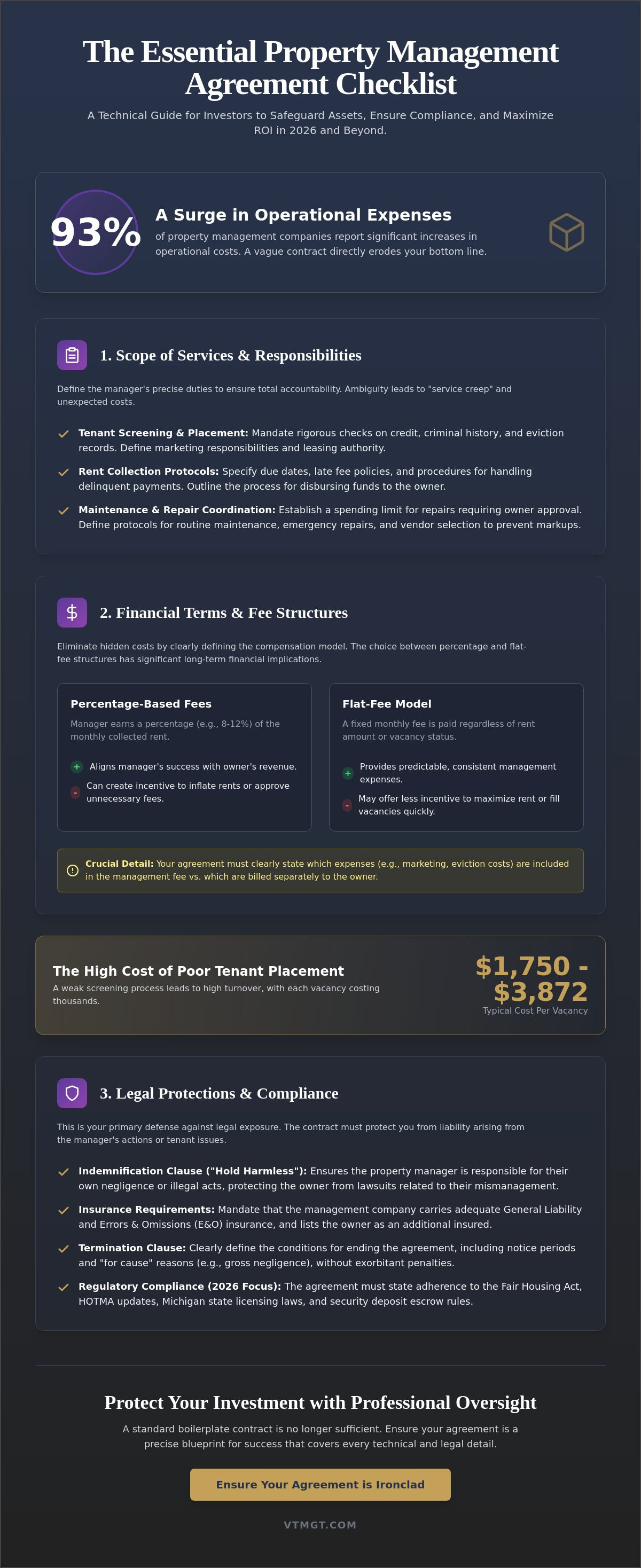
Ninety-three percent of property management companies reported a significant increase in operational expenses over the last year, which means any ambiguity in your contract could directly erode your bottom line. As we move into 2026, a standard boilerplate contract is no longer sufficient to mitigate the risks of maintenance markups or shifting legal liabilities. Utilizing a precise property management agreement checklist has become an essential technical requirement for any serious investor who wants to maintain control over their asset and ensure long-term stability.
We recognize that the complexity of new regulations, such as the 2026 HOTMA updates and evolving state licensing requirements, can create significant anxiety regarding your legal exposure. You deserve a partnership built on transparency and structured processes rather than hidden fees and vague terms. This guide provides a comprehensive checklist of essential clauses to ensure your investment remains protected and your management costs stay predictable. We'll examine everything from precise maintenance coordination protocols to the specific financial reporting standards required for modern portfolio stability.
Key Takeaways
- Define the precise scope of management responsibilities to ensure total accountability in tenant placement and rent collection protocols.
- Identify the technical differences between percentage-based and flat-fee models to eliminate the risk of hidden operational costs.
- Utilize our comprehensive property management agreement checklist to verify essential legal protections, including indemnification and insurance requirements for 2026.
- Establish a structured framework for maintenance coordination to prevent unauthorized markups and maintain long-term asset integrity.
- Understand how standardized operational systems provide a blueprint for consistent ROI across Northern Michigan markets like Traverse City and Petoskey.
Understanding the Property Management Agreement Framework
A property management agreement functions as a technical blueprint for the operational lifecycle of your real estate asset. It's not merely a legal document; it's a fiduciary roadmap that defines how the Professional Property Manager will execute tasks on behalf of the Owner. In the competitive Northern Michigan markets of Petoskey and Traverse City, relying on "handshake" agreements is an operational risk that disciplined investors must avoid. A formal contract provides the structural integrity necessary to resolve disputes and manage expectations with precision. When reviewing your property management agreement checklist, you must first verify the clear legal definitions of the parties involved to ensure accountability is correctly assigned.
In our region, the shift toward professionalized asset management means that informal arrangements lead to unnecessary legal exposure. Whether you're managing a commercial portfolio or residential units, your contract must align with specific state statutes. Using a comprehensive property management agreement checklist ensures that no technical detail, from marketing rights to emergency repair limits, is overlooked during the initial onboarding phase. This structured approach creates a stable foundation for a long-term partnership built on transparency and professional humbleness.
The Legal Nature of the Relationship
The core of this document is the concept of "Agency." By signing, you're granting the manager the authority to act as your agent in specific capacities, such as signing leases or ordering repairs. Most professional Management Contract structures utilize an "Exclusive Right to Rent" clause. This ensures the manager has the sole authority to market and lease the property, which prevents the logistical chaos that occurs when multiple parties attempt to fill the same vacancy. While residential frameworks focus heavily on tenant protections, commercial management structures often involve more complex maintenance and financial reporting requirements that must be explicitly defined.
Regulatory Compliance in 2026
Compliance isn't optional in the modern regulatory environment. Your agreement must explicitly reference adherence to the Fair Housing Act and local Michigan ordinances to mitigate liability for tenant actions. As of 2026, Michigan's licensing requirements demand a high level of professional oversight. Every contract should verify that the provider holds the necessary credentials to perform real estate activities for compensation. Additionally, the document must outline strict protocols for handling security deposit escrow accounts in strict alignment with Michigan landlord laws. This ensures that funds are managed with the same precision applied to engineering processes, protecting both the owner and the tenant from financial mismanagement.
Checklist: Scope of Services and Management Responsibilities
The scope of services section acts as the technical manual for your asset's daily operation. It defines exactly what the manager does and, more importantly, what they are held accountable for. Using a property management agreement checklist ensures that every administrative and operational task is documented. This prevents the "service creep" often found in generic contracts that lack specific performance metrics. A disciplined approach to defining these responsibilities is what separates a passive investment from a high-performing asset.
Operational excellence requires more than just collecting rent. It involves a systematic approach to tenant relations and physical asset preservation. When the roles are clearly defined, the relationship between the owner and the manager functions with the precision of a well-engineered machine. This section of your contract should serve as the definitive guide for every scenario, from routine inspections to emergency plumbing failures.
Tenant Screening and Placement Systems
A professional agreement must mandate a rigorous screening process. This includes verifying credit scores, criminal records, and eviction histories through standardized databases. The manager should also be responsible for manual income verification and calling previous landlord references. These steps are critical because tenant turnover costs typically range between $1,750 and $3,872 per vacancy. Ensuring the contract covers lease preparation and detailed move-in inspections with photo documentation protects your property from the outset. A thorough vetting process is the first line of defense against future legal and financial complications.
Operational Maintenance and Repair Oversight
Maintenance is the most significant variable in property performance. Your agreement should specify how rental property maintenance in Northern Michigan is handled, particularly regarding seasonal challenges like snow removal or pipe insulation. It's essential to define "Emergency Repairs" clearly. This clause gives the manager the authority to act without your immediate approval for life safety issues or active property damage. We recommend requiring the use of vetted, insured local contractors to maintain the quality of the work and mitigate liability. If you're looking for a partner who prioritizes asset preservation, you can explore our management solutions.
Standardized Communication and Reporting
Transparency is maintained through structured reporting. Demand a clause that guarantees regular property performance reviews and access to an online owner portal. In 2026, real-time data access is a standard expectation. The agreement should define the exact timeline for monthly financial disbursements and provide profit/loss statements that offer a granular view of your investment's health. This level of detail ensures you're never surprised by maintenance markups or administrative costs. A robust property management agreement checklist will always prioritize these communication protocols to foster a stable, professional partnership.
Financial Terms: Fee Structures and Expense Management
Financial transparency serves as the structural foundation for any successful asset management strategy. Without a clearly defined fee structure, the technical efficiency of your investment is compromised by unpredictable overhead. A professional property management agreement checklist must categorize every potential cost to eliminate the ambiguity that often leads to friction between owners and managers. In 2026, the rising complexity of operating costs requires a granular approach to expense management that prioritizes precision over general estimates. We emphasize a disciplined disclosure of all financial interactions to ensure your capital is utilized effectively.
The stability of your portfolio depends on how well you manage the divergence between professional and self-managed metrics. While professional management often yields better tenant quality, the associated costs must be structured to prevent margin erosion. Your contract should act as a definitive ledger that outlines not just the base service costs, but the specialized charges that may arise during the property's lifecycle. This level of detail is essential for maintaining long-term partner trust and operational control.
The Management Fee Breakdown
Monthly management fees are the primary cost of professional oversight. In the current market, these fees typically range between 8% and 12% of the monthly rent collected. You must verify if the fee is based on "rent collected" or "rent scheduled," as the latter requires you to pay even when a unit is vacant. Beyond the base fee, your property management agreement checklist should account for several specialized charges:
- Leasing and Tenant Placement: Industry standards for these one-time charges often equal 50% to 100% of the first month's rent. This should cover marketing, showings, and the rigorous screening protocols discussed previously.
- Lease Renewal Fees: These typically range from $100 to $300 and cover the administrative labor of market analysis and document execution.
- Maintenance Markups: Many managers apply a 10% to 20% markup on contractor invoices to cover the coordination of specialized trades.
- Specialized Service Charges: Ensure the contract defines costs for eviction proceedings or court appearances, which can range from $400 to $800 depending on the complexity of the case.
Handling Property Expenses and Reserves
A structured approach to repairs requires the establishment of a reserve fund. This fund, often held in a dedicated escrow account, provides the liquidity necessary for immediate maintenance without disrupting your monthly disbursements. The agreement must define a specific "Owner Approval" threshold for non-emergency repairs. Setting this limit between $300 and $500 allows the manager to maintain the property's integrity while ensuring you retain control over significant capital expenditures. Additionally, the contract should specify if the manager is responsible for recurring financial obligations like property taxes or insurance premiums. Managing these variables with engineering-like precision ensures your asset remains a stable, high-performing component of your portfolio.
Legal Protections: Liability, Indemnification, and Termination
Legal clauses function as the safety systems within your asset management framework. Just as an industrial process requires pressure relief valves, a property contract needs clear protocols to manage risk and provide a structured exit strategy. A robust property management agreement checklist must prioritize these legal protections to ensure that both the Owner and the Professional Property Manager operate within a defined risk envelope. Without these safeguards, a single legal dispute or tenant action could jeopardize the stability of your entire portfolio. We believe that a disciplined approach to liability is the only way to foster a partnership built on long-term trust and operational security.
Asset preservation extends beyond physical maintenance; it involves protecting the owner from the financial consequences of operational errors. In 2026, the regulatory environment is more complex than ever, making indemnification and insurance requirements non-negotiable components of your contract. These terms shouldn't be viewed as mere legal jargon. Instead, they are the technical specifications that define how the partnership handles unforeseen variables and performance failures.
Risk Management and Liability
The "Hold Harmless" or indemnification clause is designed to protect the manager from liability arising from lawful actions taken on your behalf. However, this protection shouldn't extend to cases of gross negligence or willful misconduct. It's essential to verify that the agreement requires the manager to strictly adhere to all Fair Housing laws and local ordinances. To add a layer of redundancy to your risk management strategy, ensure the contract mandates "Wrongful Eviction" insurance coverage. This protects you from significant legal expenses if a tenant disputes a removal action. If you require a partner who prioritizes these high-level legal standards, you can view our professional management services to see how we handle risk coordination.
The Exit Strategy: Notice and Transition
Every professional partnership requires a clear decommissioning plan. Your agreement should define two types of severance: termination "for cause" and "without cause." Termination for cause occurs when there's a documented breach of contract or a failure to meet specific performance metrics. Conversely, termination without cause allows either party to end the relationship with a standard notice period, which typically ranges from 30, 60, to 90 days in Northern Michigan markets. The transition protocol is the most critical technical detail in this section. It must outline the "Successor Manager" handover process, ensuring that keys, digital tenant files, and security deposit escrow accounts are transferred with zero operational downtime. Post-termination obligations must also be clearly defined to ensure active leases remain stable during the transition of authority. Including these details in your property management agreement checklist prevents the logistical friction that often occurs when a partnership concludes.
The Van Treese Standard: Beyond the Basic Checklist
Van Treese Management operates on the principle that property management is a complex engineering challenge. While a property management agreement checklist provides the necessary legal boundaries, the actual performance of the asset depends on the quality of the underlying operational systems. We utilize standardized protocols to ensure that every property in our portfolio achieves consistent ROI. This systematic approach eliminates the variability often associated with smaller, less structured management firms. By treating property management as a series of integrated technical processes, we provide Northern Michigan owners with a level of stability that mirrors industrial-grade reliability.
Local market research is the primary data source that powers our management systems. Our team monitors real-time trends in Petoskey, Boyne City, and Traverse City to adjust pricing and marketing strategies with surgical precision. We don't rely on national averages; we rely on granular data from our specific region. This commitment to local intelligence allows us to anticipate market shifts before they impact your cash flow. We also view 24/7 emergency response as a standard operational parameter rather than an optional add-on. Asset preservation requires constant vigilance, and our systems are designed to handle technical failures at any hour without operational delay.
Innovation in Northern Michigan Management
Our methodology incorporates advanced property valuations and market data to optimize rental rates and minimize vacancy intervals. By leveraging a vetted maintenance network, we reduce long-term repair costs through preventative technical oversight and quality control. We're committed to transforming the industry by applying professional ethics and engineering-level precision to every lease agreement. Our focus remains on creating thriving local communities through disciplined asset management and the perfect balance of technology and human expertise.
Next Steps for Property Owners
The transition from a basic contract to a high-performance management strategy begins with a thorough audit of your current documents. Review your existing contract against this property management agreement checklist to identify potential vulnerabilities in your liability protections or fee structures. If your current provider lacks the technical depth required for the 2026 regulatory environment, it's time to consult with a partner who understands the unique Northern Michigan landscape. You can contact Van Treese Management for a comprehensive property analysis to evaluate the operational health of your investment and develop a roadmap for long-term portfolio growth.
Future-Proofing Your Real Estate Portfolio
Transitioning from a passive investment to a high-performing real estate asset requires a disciplined approach to contractual oversight. We've examined how precise definitions of agency, fee transparency, and structured exit strategies mitigate the operational risks inherent in the 2026 regulatory landscape. A standard contract is no longer sufficient to protect your capital against rising maintenance costs and evolving liability standards. You must treat your management agreement as a technical specification that governs every aspect of property performance and asset preservation.
Utilizing a comprehensive property management agreement checklist ensures that every technical parameter of your asset's lifecycle is documented and controlled. Our team provides the stability your portfolio needs through 24/7 emergency response coordination, standardized maintenance systems, and expert local market research tailored specifically for Emmet and Charlevoix Counties. We invite you to Secure Your Investment with Van Treese Management to ensure your property operates with the precision and reliability it deserves. We're ready to help you build a more resilient and profitable future for your Northern Michigan real estate investments.
Frequently Asked Questions
What is the most important clause in a property management agreement?
The Scope of Authority and Indemnification clauses are the most critical components of any contract. These sections define the legal boundaries of the manager's power and establish the risk envelope for the owner. Without clear definitions here, you risk unauthorized expenditures or legal exposure for the manager's actions. A disciplined property management agreement checklist ensures these clauses are technically sound and compliant with 2026 standards.
How much notice is typically required to terminate a management contract in Michigan?
Termination notice periods in Northern Michigan typically range between 30 and 90 days. This interval allows for a structured decommissioning of management services and the orderly transfer of tenant files, keys, and security deposit escrow accounts. Shorter notice periods may be negotiated for "for cause" terminations involving a material breach of contract. Longer periods are standard for "without cause" transitions to ensure operational stability.
Should I pay a management fee when my property is vacant?
Fee structures vary based on the specific management model defined in your agreement. Some firms charge a flat monthly fee or a percentage of "scheduled rent" regardless of occupancy status. However, many professional managers only collect fees on "rent collected." It's essential to verify this technical detail in your property management agreement checklist to prevent paying for services when the unit isn't generating cash flow.
Does a property management agreement cover legal fees for evictions?
Base management fees typically don't cover external legal expenses or court filing costs associated with evictions. While the manager coordinates the process and may charge an administrative fee for court appearances, the owner remains responsible for attorney fees. You should verify if your manager offers an eviction protection program or if these specialized costs are strictly billable as extra-contractual expenses during the legal process.
What is a maintenance reserve fund and how much should it be?
A maintenance reserve fund is a dedicated escrow account used for immediate property repairs. For residential assets in Northern Michigan, this amount is typically set between $300 and $500 per unit. This fund provides the liquidity necessary for the manager to handle routine maintenance without disrupting your monthly disbursements. The agreement must explicitly define the threshold for when owner approval is required for larger expenditures.
Can I still use my own contractors if I hire a property manager?
Owners can typically use their own contractors if the agreement includes a specific provision for preferred vendors. However, many professional managers prefer utilizing their own vetted network of insured tradespeople to maintain quality control and mitigate liability. If you insist on using external contractors, ensure they meet the manager's insurance requirements and technical standards to avoid operational friction or delays in maintenance coordination.
Are property management fees tax-deductible in Michigan?
Property management fees are generally considered a necessary business expense and are tax-deductible under federal and Michigan state tax laws. These costs directly relate to the production of rental income and the maintenance of the investment property. You should consult with a qualified tax professional to ensure all management-related expenditures, including leasing fees and maintenance markups, are correctly categorized on your financial statements for maximum tax efficiency.
How often should I receive financial reports from my manager?
Monthly financial reporting is the industry standard for professional asset management. These reports should provide a granular view of your profit and loss statements, including rent rolls and detailed maintenance invoices. In 2026, most managers provide real-time data access through an online owner portal. This transparency ensures you can monitor the technical performance of your investment and verify that all financial disbursements align with the agreed budget.