
How to Vet a Property Management Company: The 2026 Landlord’s Guide

Is your rental portfolio a self-sustaining asset or a source of constant operational friction? Many landlords realize too late that a charming interview doesn't guarantee a disciplined management system. When you're learning how to vet a property management company, you must look past the sales pitch to the underlying technical processes. You've likely experienced the frustration of unresponsive communication, hidden maintenance markups, or the high costs of tenant turnover caused by inadequate screening. These aren't just inconveniences; they're structural leaks in your ROI that require a systematic solution.
We believe that property management is a game of standardized systems where precision and stability are paramount. This 2026 guide provides the professional vetting framework you need to secure a partner who protects your peace of mind through transparency and accountability. We'll examine the specific red flags, mandatory Michigan licensing requirements, and performance metrics that separate high-tier firms from the rest. This article outlines a rigorous protocol to ensure your property remains a solid, long-term partner in your financial growth.
Key Takeaways
- Verify that any potential partner holds a valid Michigan real estate broker’s license and utilizes a robust software stack for transparent, real-time financial reporting.
- Learn to identify hidden operational costs, such as setup and lease renewal fees, that can significantly impact your portfolio’s net yield beyond the base management percentage.
- Master how to vet a property management company by auditing their specific tenant screening protocols and maintenance coordination systems to ensure asset stability.
- Evaluate a firm’s localized expertise in Northern Michigan markets like Petoskey and Traverse City to navigate regional regulatory requirements and seasonal demand shifts.
- Conduct a final audit of management agreements to secure favorable termination clauses and verified owner references, ensuring a high-performance partnership.
The Foundation of Vetting: Auditing Credentials and Management Systems
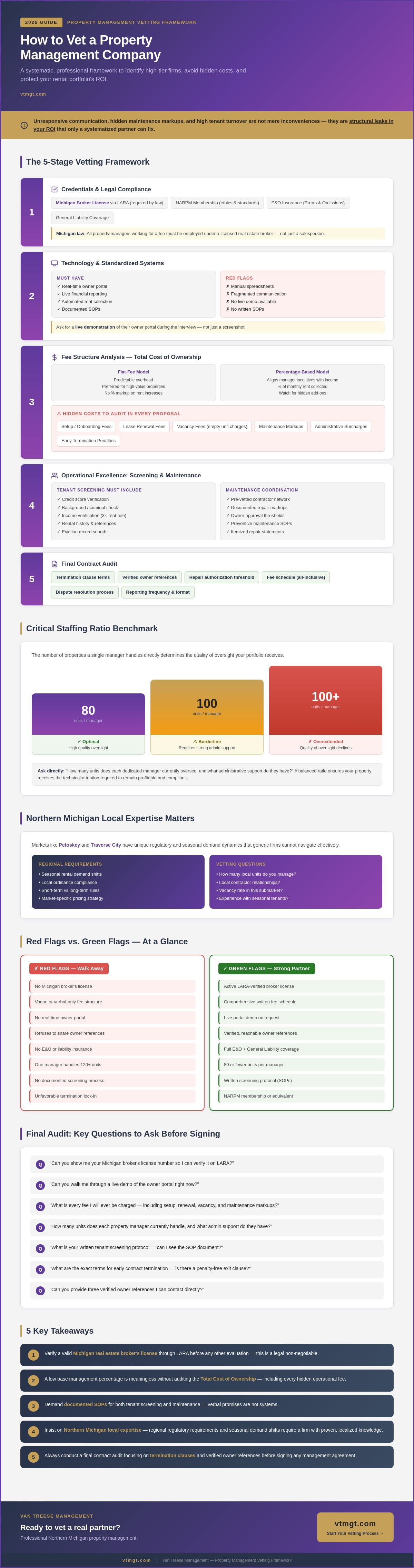
Vetting a management firm requires a shift in perspective. You aren't just hiring a person; you're auditing a technical framework. When you learn how to vet a property management company, the first step is verifying their structural integrity. This process begins with legal compliance and professional accreditation. Without a solid regulatory foundation, even the most advanced management strategies will eventually fail under the weight of legal or financial liabilities.
Professional Accreditations and Local Compliance
In Michigan, property management is legally classified as a real estate activity. This means any firm managing properties for a fee must hold a valid real estate broker's license. You should verify this license through the Michigan Department of Licensing and Regulatory Affairs (LARA). A real estate salesperson may handle daily operations, but they must be employed by a licensed broker. Beyond state mandates, look for memberships in professional bodies like the National Association of Residential Property Managers (NARPM). These memberships indicate a commitment to ethical standards and continuous process improvement. You must also ensure the firm maintains robust insurance coverage, specifically Errors and Omissions (E&O) and General Liability, to mitigate operational risks.
Technology and Standardized Systems
Professional Property management relies on a sophisticated software stack to maintain transparency and precision. A firm's technology should offer more than just digital rent collection; it must provide a real-time owner portal for financial reporting and accounting. Ask for a live demonstration of these systems during your interview. You want to see how data flows from a tenant's payment to your monthly statement. If the firm relies on manual spreadsheets or fragmented communication, they lack the scalability needed to protect your assets.
Evaluate their documented Standard Operating Procedures (SOPs). A high-performance firm operates like a precision engineering facility. Every task, from lease agreement preparation to maintenance coordination, should follow a strictly defined protocol. This consistency prevents human error and ensures your ROI isn't dependent on the mood or memory of a single staff member. A "Standardized Management System" is what allows a company to provide the same high level of service regardless of which team member is assigned to your account.
Finally, analyze the firm's staffing scale. A common industry pitfall is overextension. Ask about the ratio of properties managed per dedicated staff member. If a single manager handles more than 80 to 100 units without significant administrative support, the quality of oversight inevitably declines. A balanced ratio ensures your residential or commercial property receives the technical attention it requires to remain profitable and compliant.
Decoding Fee Structures: Beyond the Monthly Management Percentage
A disciplined approach to asset management requires a shift from looking at base costs to analyzing the Total Cost of Ownership (TCO). When determining how to vet a property management company, you'll encounter two primary revenue models: flat-fee and percentage-based structures. A flat-fee model provides predictable monthly overhead, which is often preferred for high-value properties where a percentage might exceed the actual labor cost. Conversely, percentage-based fees align the manager's incentives with your rental income. However, a low percentage isn't always a bargain. If a firm offers a minimal management fee but integrates aggressive markups into every operational task, your net yield will suffer from structural revenue leakage.
You must identify secondary costs that aren't always featured in the initial proposal. Common "hidden" expenses include setup fees for onboarding the property, lease renewal fees for existing tenants, and vacancy fees charged even when the unit isn't generating cash flow. Industry experts often suggest that hiring a property management company requires a deep dive into the fine print of the management agreement to uncover these administrative surcharges. A transparent firm will provide a comprehensive fee schedule that accounts for every phase of the property lifecycle.
Leasing and Tenant Placement Fees
Tenant placement is a distinct technical process from ongoing management. Most firms charge a one-time fee to cover property marketing, lead vetting, and lease execution. You should clarify exactly what this fee covers. Does it include professional photography and multi-platform advertising? You should also inquire about "lease-up" guarantees. If a tenant is placed but leaves within the first few months, a high-quality firm will often offer to find a replacement at no additional cost. This demonstrates confidence in their screening protocols and protects your stability. Utilizing professional residential property management services can help standardize these costs and ensure that your marketing budget is utilized efficiently.
Maintenance Markups and Vendor Management
Maintenance coordination is a critical operational pillar, but it can also be a source of hidden profit for management firms. You must ask if the company adds a percentage surcharge on top of contractor invoices. While some firms justify this as an administrative fee for oversight, others offer pass-through pricing to maintain transparency. Inquire about their vendor vetting process. A professional firm maintains a pre-vetted network of licensed and insured contractors who provide competitive rates due to the volume of work. Your audit should also cover how they handle emergency response. Effective coordination prevents small mechanical failures from escalating into expensive structural repairs, ensuring that 24/7 coverage doesn't result in inflated, unverified invoices.
Operational Excellence: Vetting Tenant Screening and Maintenance
Operational efficiency is the engine of asset preservation. When you evaluate how to vet a property management company, you must look for a rigorous, data-driven approach to tenant selection and maintenance coordination. Surface-level promises of quality are insufficient. You require a detailed breakdown of the firm’s decision-making matrix. A failure in screening or a delay in mechanical repairs directly correlates with revenue loss and structural depreciation. High-performance management requires a fegyelmezett, system-oriented mindset that treats your property as a precision asset.
The Tenant Screening Framework
A professional screening process must go beyond basic credit scores to mitigate the risk of high turnover and delinquency. Demand a breakdown of their multi-tier verification system. This should include employment verification, a review of rental history for at least the past three years, and a comprehensive criminal background check. You should also ask how the firm ensures strict compliance with the Fair Housing Act and Michigan’s "Truth in Renting Act" to avoid legal liabilities.
Inquire about their historical eviction rates and how they handle security deposits. In Michigan, the security deposit is capped at 1.5 times the monthly rent; a professional manager must have a structured protocol for returning these funds or providing itemized deductions within the 30-day legal deadline. Their ability to manage these parameters effectively is a clear indicator of their organizational stability. Ask for their specific strategy for reducing vacancy rates in Northern Michigan, where seasonal shifts require proactive property marketing and lead management.
Proactive Maintenance Coordination
Maintenance shouldn't be a reactive cycle of emergency repairs. You must evaluate the firm’s system for rental property maintenance Northern Michigan to ensure long-term habitability. Ask how often they perform physical property inspections. A structured firm typically conducts move-in and move-out inspections with photographic documentation, along with periodic mid-lease checkups to identify minor issues before they become structural failures.
The communication protocol for maintenance requests is equally critical. You need to know how tenants submit requests and what the internal approval hierarchy looks like for repairs. A firm with high operational standards will have a pre-defined threshold for automated repairs and a clear system for notifying owners of large-scale capital improvements. This level of transparency ensures you maintain control over your investment without being burdened by daily mechanical decisions. When you understand how to vet a property management company through the lens of maintenance, you secure a partner that values precision as much as you do.
Local Expertise: Navigating Northern Michigan’s Unique Challenges
Northern Michigan operates under a distinct set of geographical and regulatory parameters that require specialized technical oversight. When you are determining how to vet a property management company, their familiarity with regional nuances is as critical as their overall management software. A firm that understands the specific demands of Emmet and Charlevoix Counties can mitigate risks that a remote or non-local entity might overlook. This expertise ensures that your asset remains compliant with local ordinances while maximizing revenue in a highly seasonal market.
Market Knowledge in Emmet and Charlevoix Counties
Setting competitive rental rates in Petoskey, Boyne City, or Traverse City requires more than a cursory glance at online listings. It demands a structured analysis of localized market data. Professional managers must evaluate the balance between high-demand summer months and the quieter winter season. They should provide a clear strategy for maintaining occupancy throughout the year, especially as local short-term rental ordinances continue to evolve. Ask potential partners how they differentiate between long-term residential needs and the shifting regulatory landscape of waterfront communities. Their involvement in the Northern Michigan community often provides early insights into upcoming zoning changes or infrastructure projects that could affect property values.
Legal Compliance and Risk Mitigation
Michigan’s legal framework for landlords is precise and leaves no room for administrative error. A core component of your vetting process should be an audit of their knowledge regarding Michigan landlord laws. For instance, Michigan law strictly limits security deposits to 1.5 times the monthly rent and requires these funds to be held in regulated escrow accounts. Failure to adhere to the 30-day return deadline or the itemization requirements can lead to significant financial penalties.
Your management partner must also be proficient in the eviction process in Michigan, specifically the 7-day "Notice to Quit" for non-payment of rent. They should demonstrate a clear understanding of the 2026 legislative updates to ensure your lease agreements remain enforceable. Precision in these legal matters is what separates a stable investment from a liability. If you require a partner who understands these local complexities, consider our residential property management services to ensure your portfolio is managed with technical accuracy.
Seasonal Maintenance and Environmental Stressors
The climate in Northern Michigan introduces specific structural risks that require proactive management. Winter maintenance is not a routine task; it is a critical preservation strategy. Inquire about their protocols for heating system failures, snow removal coordination, and pipe burst prevention during sub-zero temperatures. A manager with local expertise will have a pre-vetted network of contractors ready for 24/7 emergency response. This level of preparedness prevents minor environmental stressors from becoming catastrophic mechanical failures, ultimately protecting your long-term ROI.
The Final Audit: Questions to Ask Before Signing the Contract
The final phase of how to vet a property management company involves a technical audit of the management agreement itself. This document serves as the operational blueprint for your partnership, defining the boundaries of authority and financial responsibility. A verbal promise is irrelevant if it isn't reflected in the written contract. You must approach this review with the same precision you would apply to a major industrial procurement. The goal is to ensure that the firm's internal systems align with your long-term investment objectives without creating restrictive legal bottlenecks.
Contractual Transparency
Request a sample management agreement early in your evaluation. You should specifically look for "handcuff" clauses, which are restrictive termination penalties designed to trap owners in sub-optimal relationships. A professional firm relies on performance rather than litigation to retain clients; therefore, the contract should include a clear, reasonable termination clause, typically requiring 30 to 60 days of notice.
You must also verify the firm's protocol for the transition of existing tenants. A structured firm will have a documented Standard Operating Procedure (SOP) for taking over current leases, auditing security deposit ledgers, and notifying tenants of the change in management. Ensure that every fee discussed during your vetting process is explicitly itemized in the agreement. This includes administrative surcharges, lease-up fees, and any maintenance coordination percentages. If a cost is not documented in the written contract, it should not appear in your financial reporting.
Human Interaction and Portfolio Matching
While technology drives efficiency, human accountability ensures stability. Evaluate the accessibility of the actual manager who will be assigned to your portfolio. If your primary point of contact is a salesperson who disappears after the contract is signed, you may face communication friction later. Ask for references from current owners who hold similar property portfolios. A manager's ability to handle a single-family home in Petoskey is different from their capacity to manage a multi-unit complex in Traverse City.
If your portfolio includes a mix of residential and business assets, determine if the firm offers commercial property management Northern Michigan. Commercial assets require different technical parameters, such as NNN lease administration and specialized facility maintenance, which a residential-only firm may not be equipped to handle. A partner with multi-sector expertise provides the structural flexibility needed as your portfolio expands.
The Van Treese Difference
Van Treese Management is committed to transforming the property management sector through professional humility and technological innovation. We view ourselves as long-term partners in your financial growth, focusing on the stability of local Northern Michigan communities. Our systems are designed to provide the precision of an engineering firm with the personalized attention of a local expert. We invite you to contact Van Treese Management for a professional consultation to discuss how our standardized management systems can protect your ROI and provide the peace of mind you require.
Securing Your Portfolio’s Future through Professional Oversight
Mastering how to vet a property management company transforms your real estate assets from a source of operational friction into a stable, high-performance portfolio. Success in this sector requires a shift from reactive problem-solving to the implementation of Standardized Management Systems. By prioritizing technical credentials, transparent fee structures, and localized expertise, you ensure your investment is protected by a partner who values precision as much as you do. Effective management isn't a luxury; it's a structural requirement for long-term ROI and asset preservation.
Van Treese Management provides the stability and technological readiness necessary to navigate the complexities of the Northern Michigan market. Serving Petoskey, Boyne City, and Traverse City, we deliver 24/7 emergency maintenance coordination and rigorous tenant screening protocols to ensure your properties remain fit for use. We invite you to take the next step in optimizing your asset's performance. Request a Comprehensive Property Analysis from Van Treese Management to see how our disciplined approach can enhance your operations. Your properties deserve the highest level of professional care and technical accuracy.
Frequently Asked Questions
What is the average property management fee in Northern Michigan?
The typical fee for full-service management in 2026 ranges from 8% to 12% of collected monthly rent. For single-family homes, some firms offer a flat monthly fee between $100 and $300 as an alternative. You should also account for one-time costs like setup fees or leasing fees, which often equal 50% to 100% of one month's rent. Understanding these market averages is a key part of learning how to vet a property management company effectively.
How do I know if a property management company is licensed in Michigan?
You can verify a firm's credentials through the Michigan Department of Licensing and Regulatory Affairs (LARA) website. In Michigan, anyone performing property management for a fee must hold a real estate broker's license. A salesperson may act as a manager but only under the employment of a licensed broker. Confirming this legal compliance is a non-negotiable step in the vetting process to ensure your asset is managed within state regulations.
Should I choose a large national firm or a local property manager?
Choosing a local manager often provides superior results in Northern Michigan due to their understanding of regional environmental stressors and seasonal market shifts. While national firms may offer broader software tools, they often lack the technical network of pre-vetted local contractors needed for winter maintenance. A local partner provides the specialized oversight required for properties in communities like Petoskey or Traverse City, where local ordinances and weather patterns dictate operational success.
What happens if a tenant doesn't pay rent under professional management?
Professional managers initiate a structured legal process starting with a 7-day "Notice to Quit" for non-payment of rent. This standardized protocol ensures compliance with Michigan's landlord-tenant laws while minimizing revenue loss. The manager handles all documentation, communication with the tenant, and coordination with legal professionals if an eviction becomes necessary. This disciplined approach prevents the legal errors often associated with "self-help" evictions, which are illegal in Michigan.
How does a property manager handle emergency repairs in the middle of the night?
High-performance firms utilize a 24/7 emergency coordination system backed by a network of pre-vetted, licensed contractors. When a critical mechanical failure occurs, the manager follows a documented Standard Operating Procedure (SOP) to stabilize the situation and prevent further structural depreciation. This proactive response is essential in Northern Michigan, where heating emergencies or pipe bursts during sub-zero temperatures require immediate technical intervention to preserve the asset's integrity.
Can I still be involved in the decision-making process for my property?
Yes, you can maintain a high level of involvement through real-time owner portals and pre-defined approval thresholds for maintenance. Standardized systems allow you to set specific monetary limits for repairs, ensuring you're only contacted for significant capital improvements or strategic decisions. This framework provides the transparency you need to monitor your portfolio's performance without the burden of managing daily operational tasks. It's a balance of professional delegation and informed oversight.
What are the red flags to watch out for in a management contract?
Critical red flags include restrictive "handcuff" clauses that penalize you for terminating the contract and a lack of itemized fee schedules. You should also be cautious of agreements that don't clearly define the manager's liability or those that lack transparency regarding maintenance markups. When you analyze how to vet a property management company, ensure the contract explicitly outlines the transition process for existing tenants and provides a clear exit strategy for both parties.
How long does it typically take to find a tenant in Petoskey or Traverse City?
Finding a qualified tenant in high-demand markets like Petoskey or Traverse City typically takes between two and four weeks, depending on the season and property condition. Professional managers accelerate this timeline through multi-platform marketing and proactive lead vetting. In Northern Michigan, properties listed during the spring and early summer often see faster placement due to increased regional demand, though a disciplined screening process remains essential to ensure long-term stability.