
While the allure of the 40-license short-term rental market in Petoskey remains strong, the most resilient wealth in 2026 isn't found in seasonal turnover. You've likely realized that the high management overhead of remote ownership and the 6% state use tax on vacation income can quickly erode your margins. Transitioning your focus toward investing in commercial real estate Petoskey offers a more stable path to capital appreciation in Emmet and Charlevoix counties. Northern Michigan's harsh winters and complex landlord-tenant laws demand a disciplined, systems-based approach rather than a reactive one.
We understand that managing properties from a distance feels like a constant battle against maintenance risks and regulatory shifts. It's frustrating to watch your passive income disappear into emergency repairs or legal compliance hurdles. This guide promises to show you how to build a high-yield, low-volatility property portfolio by moving away from volatile seasonal rentals. From navigating the 1.5-month security deposit limit to leveraging mixed-use redevelopments like the $5.3 million Leo's Tavern project, we will examine the standardized systems and professional placement strategies required for professional-grade investment in 2026.
Key Takeaways
- Identify the shift from seasonal tourism demand toward year-round professional and healthcare-driven housing needs that provides regional market resilience in 2026.
- Understand why investing in commercial real estate Petoskey offers superior long-term stability compared to the volatile and increasingly regulated short-term rental market.
- Discover strategic growth opportunities across Emmet and Charlevoix counties, focusing on prestige areas in Harbor Springs and emerging micro-markets along the I-75 corridor.
- Master Michigan's 2026 landlord-tenant regulations, including security deposit limits and eviction protocols, while implementing standardized winter maintenance systems.
- Learn how to scale a Northern Michigan portfolio from one property to many by utilizing professional systems for tenant screening and data-driven financial reporting.
2026 Investment Outlook: The Northern Michigan Rental Market
The real estate landscape in Northern Michigan has undergone a structural transformation. While tourism historically dictated market cycles, 2026 data indicates a pivot toward professional and clinical housing requirements. This shift provides a hedge against the volatility often seen in short-term rental markets. Investors are increasingly moving away from seasonal assets and toward standardized, year-round management systems that serve the local workforce. We've observed that regional demand remains resilient even when national economic fluctuations occur, primarily due to a diversified employment base and shifting demographic trends.
Key Economic Drivers in Petoskey and Traverse City
The expansion of McLaren Northern Michigan serves as a primary catalyst for regional rental demand. This facility attracts specialized healthcare professionals who require long-term, high-quality residential options. Simultaneously, the rise of remote professionals seeking a higher quality of life has transformed Petoskey, Michigan into a year-round hub. These residents prioritize stability and infrastructure over seasonal proximity. Consequently, investing in commercial real estate Petoskey hasn't just become a trend; it's a strategic move for those looking to capture demand in burgeoning downtown corridors. The housing shortage is evident; developments like "The Block at Petoskey" currently maintain waiting lists of over 500 people, signaling a clear opportunity for multi-family and mixed-use investments.
Market Resilience and the Climate Migration Effect
Regional demand remains high despite broader economic shifts. This resilience is partly due to the "Climate Migration" effect. Northern Michigan is increasingly viewed as a long-term refuge for residents from more volatile climates. This influx of population supports diverse asset classes across the region. While single-family residential properties remain stable, multi-family units and commercial spaces are seeing the highest occupancy gains. Early 2026 reports show a 14% year-over-year increase in occupancy for high-quality commercial spaces in Emmet and Grand Traverse counties. This growth isn't limited to retail; it extends to professional office spaces and healthcare-adjacent facilities.
Projected ROI and Appreciation Rates for 2026
Historical data from Emmet and Charlevoix counties shows consistent appreciation, even during broader market corrections. In the 2026 market, cap rates for boutique retail spaces in high-traffic areas like the Gaslight District range between 6.5% and 7.5%. For residential assets, the focus has shifted to long-term leases that minimize the turnover costs associated with vacation rentals. Investing in commercial real estate Petoskey represents a strategic entry point for portfolio holders. The current inventory levels, combined with state-level support for mixed-use redevelopment, create a favorable environment for capital appreciation. We view this as a period of professionalization where structured management systems replace the ad-hoc approaches of the past.
Long-Term Stability vs. Vacation Rental Volatility
The allure of high nightly rates often masks the structural risks associated with the short-term rental (STR) market. In 2026, Northern Michigan has reached a saturation point where municipalities are prioritizing community stability over tourism turnover. According to Northern Michigan housing data, the demand for long-term workforce housing significantly outpaces the available supply; this creates a massive opportunity for investors who prioritize consistent occupancy over seasonal peaks. Shifting your strategy toward long-term management ensures a predictable revenue stream that isn't dependent on the whims of the travel industry.
Navigating Local Short-Term Rental (STR) Ordinances
On July 20, 2026, the Petoskey City Council adopted strict amendments to Chapter 15 of the city code. These rules tightened licensing and transfer regulations; most notably, the city maintains a hard cap of 40 total short-term rental licenses. New permits are now exclusively restricted to the Central Business District (CBD). This regulatory environment makes residential STRs a high-risk gamble with limited upside for new entries. Conversely, investing in commercial real estate Petoskey allows for more predictable portfolio growth without the threat of sudden permit revocations or zoning shifts that currently plague the residential sector. By focusing on commercial models, you future-proof your assets against the local government's efforts to reclaim housing stock for permanent residents.
Financial Analysis: Stability Over Seasonal Hype
A financial comparison between a $400,000 vacation rental and a long-term lease reveals a stark reality in the 2026 market. While the vacation rental might command high rates in July, it faces a 6% state use tax and extreme cleaning overhead that can reach 25% of gross revenue. Long-term leases provide 12 months of uninterrupted cash flow without the "valley" periods common in Northern Michigan winters. Standardized systems for residential property management reduce turnover expenses and ensure that maintenance coordination is proactive rather than reactive. Building a predictable annual budget becomes significantly easier when you aren't fighting the seasonal cycles of the tourism economy.
Asset Preservation and Risk Mitigation
Long-term residents generally maintain property value better than transient guests. Tourists don't have a vested interest in the property's mechanical integrity; they're often unaware of small issues like minor leaks that can lead to major damage in harsh climates. A professional tenant placement strategy ensures that your asset is occupied by individuals who treat the space as a home. This approach preserves the physical structure and supports long-term capital appreciation in Emmet and Charlevoix counties. When investing in commercial real estate Petoskey or long-term residential units, the goal is to minimize wear and tear while maximizing the net operating income through standardized management protocols.
Strategic Micro-Markets: From Petoskey to the I-75 Corridor
Success in Northern Michigan real estate requires a granular understanding of regional micro-markets. While many investors fixate on Traverse City's high-profile waterfront, the 2026 market shows that the highest stability is often found in Emmet and Charlevoix counties. These areas provide a balanced mix of professional demand and manageable entry costs. Emmet County remains the regional anchor for prestige and reliability. Harbor Springs and Petoskey continue to attract high-net-worth residents, but the real growth is in the year-round professional sector. Identifying value pockets requires looking past the luxury listings that often exceed $1 million; instead, savvy investors focus on assets that serve the permanent workforce.
Spotlight on Petoskey and Boyne City
Petoskey's median home sale price settled at $472,000 in June 2026. This 10.4% year-over-year decrease represents a calculated entry point for long-term holders. The city's infrastructure supports a permanent population that demands high-quality residential management. Boyne City has similarly evolved. It's no longer just a seasonal town but a year-round hub for professionals who value the "Lake Charlevoix" effect without the extreme price tags of Charlevoix proper. When investing in commercial real estate Petoskey, the Gaslight District remains the focal point. Cap rates for boutique retail in this high-traffic area are holding steady between 6.5% and 7.5%, providing a reliable yield for those who prioritize location and foot traffic.
Emerging Markets: Gaylord and Indian River
Investors seeking lower barriers to entry should look toward Otsego and Cheboygan counties. Gaylord and Indian River serve as critical service and transportation hubs along the I-75 corridor. The demand for workforce housing here is acute. Regional logistics and light industrial sectors rely on this corridor, creating a "multiplier effect" for commercial rentals. While Grand Traverse County has seen a 4% population increase since 2020, the resulting housing shortage has pushed workers inland. This migration makes Gaylord a prime location for multi-family developments. Those investing in commercial real estate Petoskey and its surrounding inland hubs benefit from this regional displacement, as businesses seek more affordable operational bases near major transit routes.
By diversifying across these micro-markets, you insulate your portfolio from the fluctuations of any single township's zoning changes. We recommend utilizing standardized management systems to maintain operational efficiency across multiple counties. This structured approach ensures that whether your asset is in the heart of Petoskey or along the I-75 corridor, the quality of tenant placement and maintenance remains consistent. The goal is to move away from the "short-term" mindset and build a portfolio based on regional economic fundamentals.
Navigating Michigan Landlord Laws and Winter Maintenance
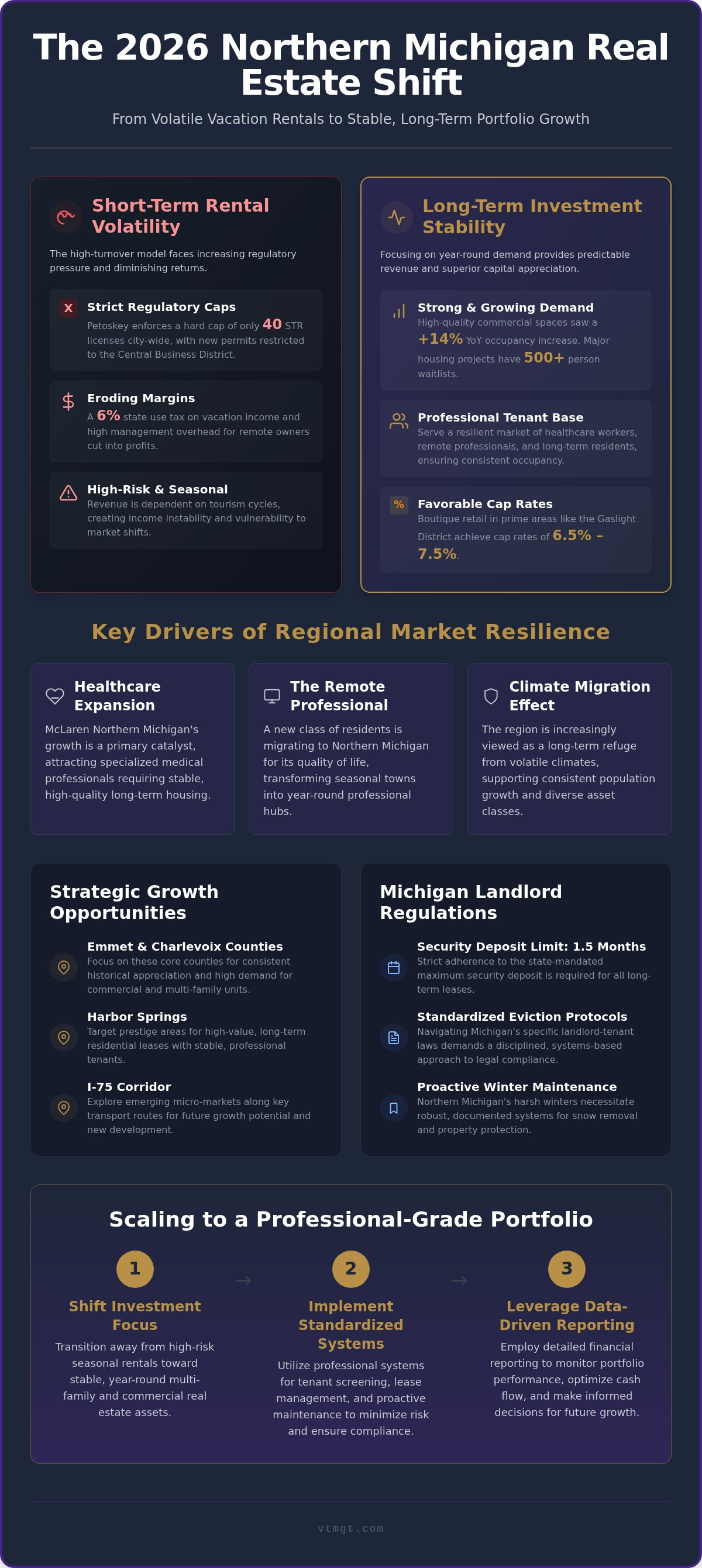
Operational excellence in property management is defined by the quality of its systems. In 2026, the legal landscape for Northern Michigan owners is characterized by precise timelines and financial thresholds. Landlords can charge a maximum of one and one-half months' rent as a security deposit, which must be returned within 30 days of a tenant moving out. For non-payment of rent, a seven-day written notice to quit is a mandatory prerequisite before filing for eviction. These aren't suggestions; they're rigid statutory requirements. We ensure that every lease agreement prepared for our clients adheres to these Michigan landlord laws, effectively insulating owners from the risks of non-compliance and Fair Housing disputes.
Staying Compliant with Regional Regulations
Proper lease agreement preparation is the foundation of any successful investment in Emmet County. In 2026, landlords must navigate updated Fair Housing Act considerations that emphasize objective screening criteria. We recommend a data-driven approach to tenant placement that removes emotional bias and focuses on financial stability. This structured methodology protects the owner from potential litigation while ensuring that the property is occupied by qualified residents. Every document we prepare is designed to withstand legal scrutiny and provide clear protocols for security deposit handling and property inspections. Maintaining this level of professional oversight is essential for remote owners who cannot manage these complexities in person.
Winter-Proofing Your Investment Portfolio
The technical demands of a Northern Michigan winter require more than a local handyman on call. Effective asset protection involves coordinated snow removal, preventative roof raking, and the installation of monitoring systems for temperature and moisture. When investing in commercial real estate Petoskey, these systems aren't optional. They're essential components of a standardized management plan. By integrating these processes into your annual budget, you convert unpredictable repair costs into manageable, fixed operational expenses. This shift from reactive to proactive maintenance is what separates high-yield portfolios from those plagued by seasonal volatility. For a comprehensive list of seasonal requirements, investors can refer to our rental property maintenance Northern Michigan checklist.
Risk mitigation also extends to tenant selection and liability protection. In a competitive 2026 market, standardized tenant screening is the only way to ensure long-term stability. This process involves verifying income, credit history, and previous rental performance to find residents who value the property as much as the owner does. For commercial owners, specialized liability protection and insurance requirements are equally vital to protect against winter-related accidents. Our team provides the professional maintenance coordination and administrative oversight needed to keep your investment secure throughout the harshest months of the year while investing in commercial real estate Petoskey.
Scaling Your Portfolio with Standardized Management Systems
Transitioning from a reactive landlord to a strategic investor requires the implementation of scalable frameworks. While individual property oversight may suffice for a single asset, investing in commercial real estate Petoskey at scale is only possible through the application of standardized management systems. These protocols remove the variability of human error and replace it with a structured approach to asset management. We believe that true passive income isn't a byproduct of luck; it's the result of technical precision and rigorous operational continuity. By treating your portfolio as a series of integrated processes, you ensure that geographic distance doesn't compromise the quality of your oversight.
Our approach to tenant placement and leasing relies on a data-driven methodology rather than intuition. In the competitive 2026 market, reducing vacancy rates depends on identifying high-quality residents through objective parameters. This systematic screening process ensures that every lease agreement is backed by financial stability and verified history. Once a tenant is placed, our financial reporting and accounting systems provide transparent ROI tracking. We provide property owners with detailed ledgers and performance metrics that allow for informed decision-making. This level of administrative clarity is what enables you to move away from the daily minutiae of property maintenance and focus on high-level portfolio growth.
The Van Treese Standardized Management System
We've engineered our management platform to provide seamless communication and efficiency. Technology streamlines rent collection and maintenance requests, ensuring that no technical failure goes unaddressed. This is particularly vital for out-of-state owners who require a boots-on-the-ground partner to maintain their assets. Utilizing professional property management Petoskey MI means your investment is governed by the same standards regardless of its location. Our maintenance coordination system relies on a network of vetted local contractors who understand the specific structural demands of Northern Michigan's climate. This ensures that every repair meets our quality benchmarks and protects your property's long-term value.
Next Steps: Your Northern Michigan Strategy
Building a resilient portfolio starts with a clear understanding of your asset's current and potential performance. We offer comprehensive property valuations and rental analyses for investors considering a new acquisition. If you're investing in commercial real estate Petoskey, having a partner who understands the nuances of Emmet and Charlevoix counties is a significant advantage. Our expertise in commercial property management Northern Michigan allows us to guide you through complex redevelopments and high-traffic retail placements. We invite you to Contact Van Treese Management today to discuss how our standardized systems can help you achieve your 2026 investment goals and scale your Northern Michigan holdings with confidence.
Securing Your Future in the Northern Michigan Market
The 2026 real estate landscape in Northern Michigan clearly favors those who prioritize long-term stability over the diminishing returns of seasonal rentals. By aligning your strategy with professional healthcare and workforce housing needs, you insulate your assets from the regulatory volatility currently impacting short-term markets. Successfully investing in commercial real estate Petoskey requires a disciplined approach to maintenance and a thorough understanding of Michigan's evolving landlord-tenant laws. Transitioning from a reactive management style to a systems-based investment model is the only way to achieve true scalability in Emmet and Charlevoix counties.
Van Treese Management provides the technical infrastructure and 24/7 maintenance coordination network required to protect your property throughout the year. Our standardized management systems ensure operational efficiency and transparent financial reporting for out-of-state owners. Don't let seasonal turnover or harsh winters compromise your portfolio's performance. Take the next step toward professional-grade oversight and Maximize your ROI with Van Treese Management. The Northern Michigan market is ready for investors who value precision and long-term growth.
Frequently Asked Questions
Is Northern Michigan a good place to invest in real estate in 2026?
Yes, the region has transitioned into a year-round economic hub driven by healthcare expansions and professional remote work. Market resilience is supported by a 14% increase in high-quality commercial occupancy and a steady influx of residents seeking climate stability. These factors create a reliable environment for long-term capital appreciation. Investors who move away from seasonal models find a robust market with high demand for professional-grade housing.
What are the typical property management fees in Northern Michigan?
Management fees vary based on the asset type, property volume, and the specific scope of technical services required. Professional firms typically provide a comprehensive suite that includes tenant screening, lease preparation, and financial reporting. Owners should prioritize firms that offer a detailed fee structure rather than relying on industry averages. This ensures that all operational costs, from administrative oversight to maintenance coordination, are clearly defined within your annual budget.
Which county has the best rental ROI, Emmet or Charlevoix?
Both counties offer competitive returns, though they serve different strategic goals. Emmet County provides exceptional stability through prestige markets like Petoskey and Harbor Springs. Charlevoix County, particularly Boyne City, attracts a growing demographic of young professionals who value year-round amenities. ROI is increasingly driven by a property's proximity to regional employment centers and the implementation of standardized management systems rather than simple geographic boundaries.
How do winter maintenance costs affect rental property profitability?
Winter maintenance is a mandatory operational expense that must be integrated into a standardized budget to protect profitability. Proactive measures like coordinated snow removal and roof raking prevent structural failures that lead to high-cost emergency repairs. When handled through a professional coordination network, these costs become predictable. This systematic approach ensures that harsh Northern Michigan weather doesn't compromise your net operating income or the property's long-term value.
Can I manage a Northern Michigan rental property if I live out of state?
Remote ownership is highly effective when supported by a professional management firm that utilizes standardized technology. These systems allow out-of-state owners to track financial performance, oversee tenant placement, and manage maintenance requests in real time. Having a local partner with a 24/7 emergency response network is essential for handling technical issues. This structured oversight allows you to scale a portfolio without the need for a physical presence in the region.
What is the difference between long-term and short-term rental regulations in Petoskey?
Short-term rentals face strict limitations, including a 40-license cap and restricted zoning within the Central Business District as of July 2026. Long-term rentals are not subject to these caps and operate under standard Michigan landlord-tenant laws. This regulatory distinction makes investing in commercial real estate Petoskey or long-term residential units a more predictable path. Investors benefit from consistent 12-month cash flow without the risk of sudden permit revocations or seasonal turnover.
Are commercial rental properties better than residential in Northern Michigan?
Commercial assets often provide higher cap rates, with boutique retail in Petoskey ranging between 6.5% and 7.5% in 2026. Residential properties, however, benefit from an acute housing shortage and a large pool of qualified tenants. The choice depends on your specific financial objectives and risk tolerance. Investing in commercial real estate Petoskey is particularly advantageous for those seeking professional-grade leases and high-traffic locations that support long-term capital growth and portfolio diversification.
How does Van Treese Management handle emergency repairs during a snowstorm?
We utilize a 24/7 emergency response coordination network that is specifically engineered for Northern Michigan's climate. Our vetted contractors are equipped to manage critical technical failures, such as burst pipes or heating outages, even during extreme weather events. This protocol ensures that both the physical asset and the tenant are protected at all times. By maintaining a disciplined, structured response system, we minimize potential damage and ensure operational continuity regardless of external conditions.