
Passive Income Real Estate Investing in Petoskey: The 2026 Investor’s Guide
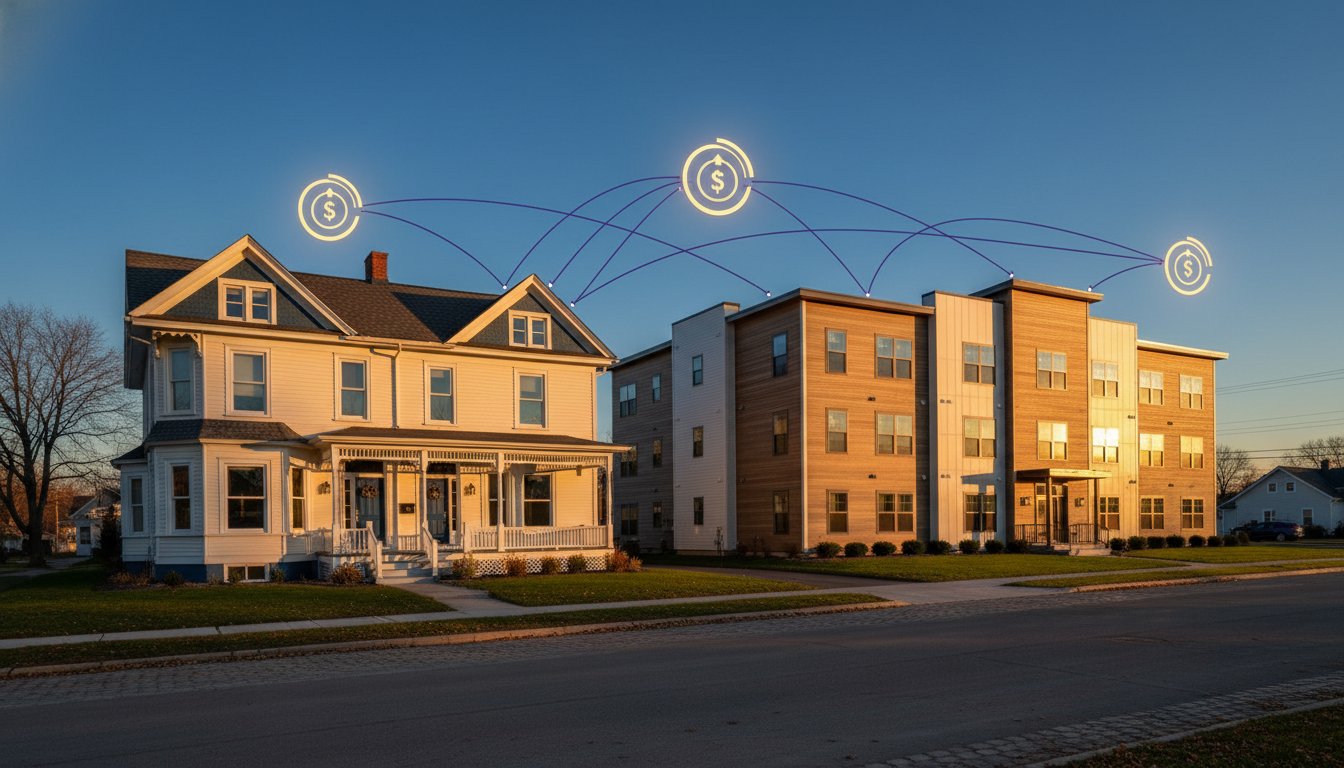
The traditional "hands-on" landlord model is effectively obsolete for those seeking actual financial freedom in Northern Michigan's 2026 market. As the region evolves, the transition toward high-precision passive income real estate investing Petoskey requires a shift from reactive maintenance to systematic asset management. You've likely felt the strain of the landlord trap, where the promise of freedom is buried under emergency repairs and the complexity of Michigan's updated 2026 rental regulations. It's reasonable to feel concerned that seasonal shifts might leave your property vacant during the winter months, impacting your bottom line.
This guide demonstrates how to transform your property into a disciplined wealth engine that operates with the reliability of a well-engineered production line. We'll show you how to secure predictable monthly ACH deposits and ensure long-term capital appreciation through professional oversight. We'll examine the specific management protocols and market-specific data points you need to maintain control without sacrificing your time or peace of mind.
Key Takeaways
- Understand the 2026 market dynamics in Petoskey, where limited inventory and sustained demand create a resilient foundation for long-term wealth.
- Identify the "active landlord trap" and learn how to transition from time-intensive DIY management to a truly systematic approach for passive income real estate investing Petoskey.
- Evaluate potential assets based on "Management Readiness" and technical operational standards to ensure consistent cash flow and minimal owner involvement.
- Master a five-step framework for scaling your portfolio, including the strategic utilization of DSCR loans to facilitate acquisition without personal income verification.
- Discover how professional management systems transform Northern Michigan properties into high-performing, hands-off assets through precision-driven operational oversight.
The State of Petoskey Real Estate for Passive Income in 2026
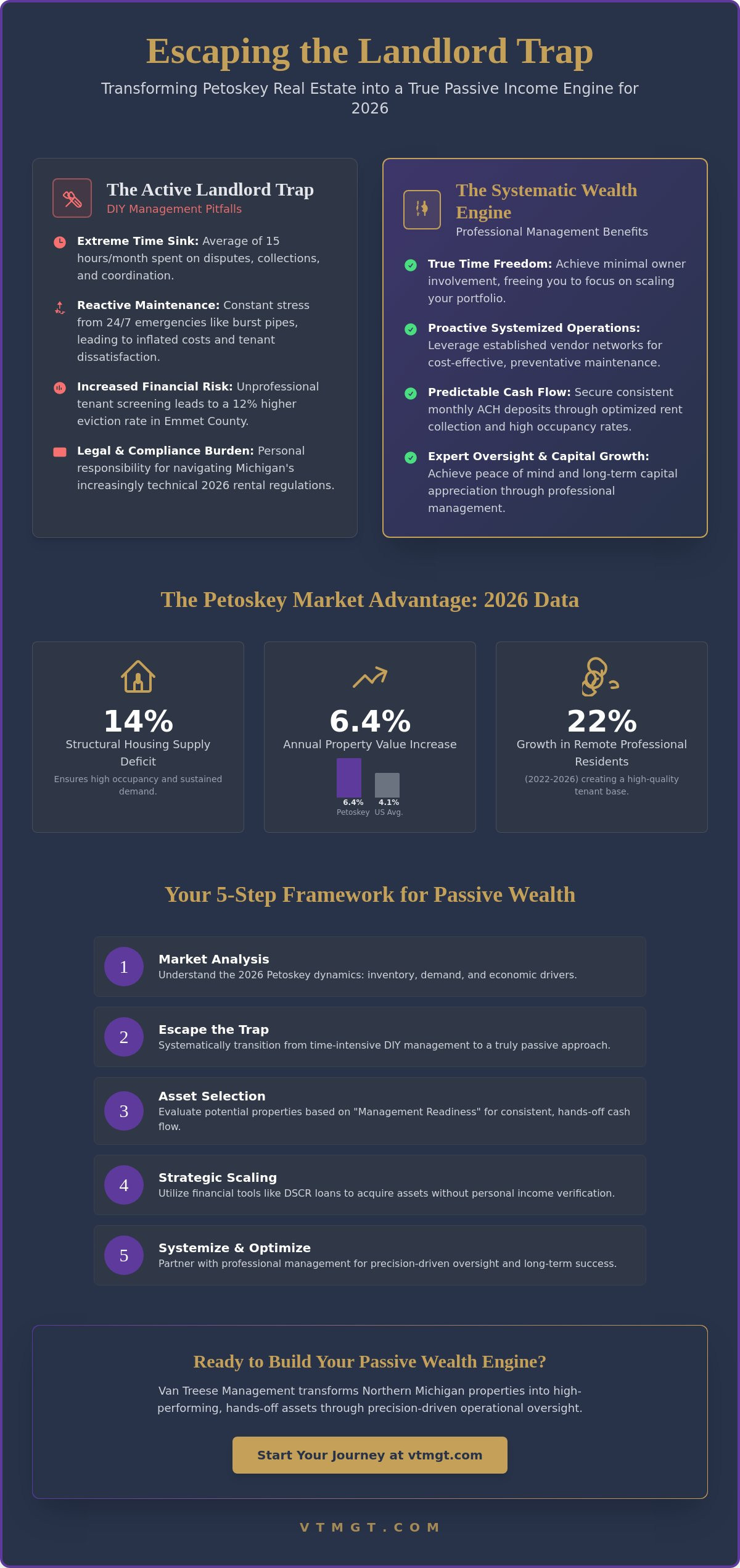
Passive income in the property sector is defined as the net cash flow generated from a rental asset after all operational expenses, taxes, and debt services are deducted. For successful real estate investing, this requires a structure where the owner’s involvement is minimal, typically facilitated by professional management systems. In 2026, passive income real estate investing Petoskey has transitioned from a seasonal speculation into a high-stability strategy. The market currently faces a structural inventory deficit, with housing supply trailing demand by 14% as of the Q1 2026 census data. This imbalance ensures high occupancy rates for disciplined investors.
The "Northern Michigan Premium" describes the consistent trend where Emmet County property appreciation outpaces national averages. In the fiscal year ending December 2025, Petoskey residential assets saw a 6.4% value increase, while the national average stalled at 4.1%. This growth is fueled by geographic constraints; the surrounding lakes and protected forest lands prevent the urban sprawl seen in southern markets. Consequently, the limited land availability creates a natural floor for asset valuations. Investors have shifted their focus from the volatility of short-term vacation rentals toward long-term residential stability, seeking reliable monthly yields over seasonal peaks.
Economic Drivers in Northern Michigan
The rise of remote work has permanently altered Petoskey’s demographic profile. Between 2022 and 2026, the number of year-round residents working for firms based in Detroit or Grand Rapids grew by 22%. These professionals seek high-quality long-term rentals, providing a steady tenant base for passive investors. Local anchors like McLaren Northern Michigan and North Central Michigan College provide a foundation of stable employment, ensuring that rental demand isn't solely dependent on the hospitality sector. Based on 2026 tourism reports showing a mere 2% fluctuation in visitor spending during market dips, Petoskey remains a recession-resistant environment for capital preservation.
Market Trends: Residential vs. Commercial Yields
Data-driven investors are currently analyzing cap rates to determine optimal entry points. Multi-family units in Petoskey currently yield an average cap rate of 5.8%, while similar assets in Boyne City offer slightly higher yields at 6.2% to compensate for lower liquidity. Despite the lower yield, passive income real estate investing Petoskey is often preferred because the professional property management infrastructure is more developed here. This allows for truly hands-off ownership. Key growth corridors have emerged along the US-31 and M-119 routes, where new infrastructure projects completed in 2025 have improved accessibility to regional hubs like Traverse City, further driving up local land values.
The Landlord Trap: Why Most Real Estate Isn't Actually Passive
Many individuals enter the Petoskey market with the expectation of a hands-off revenue stream, yet they quickly find themselves entangled in the operational complexities of property management. This phenomenon is known as the Landlord Trap. True passive income real estate investing Petoskey requires a systems-based approach rather than a DIY mentality. When an owner manages their own assets, they aren't just an investor; they're an employee of their own portfolio. This operational gap often leads to higher vacancy rates and inflated maintenance costs due to a lack of established vendor networks and reactive instead of proactive repairs.
The Hidden Costs of DIY Management
Self-management often results in a deceptive hourly rate. If an owner spends 15 hours per month on tenant disputes, rent collection, and maintenance coordination, their effective return on time often falls below professional standards. In Emmet County, unprofessional tenant screening processes lead to a 12% higher eviction rate compared to professionally managed portfolios. The drain of 24/7 emergency maintenance coordination, such as a burst pipe at 3:00 AM, creates a persistent stress level that contradicts the fundamental goal of passive wealth. Investors must calculate the opportunity cost of these hours, which could be better spent analyzing new real estate investment strategies to scale their holdings.
Michigan Legal Compliance in 2026
The regulatory environment in Northern Michigan has become increasingly technical. Owners must strictly adhere to Michigan landlord laws, particularly regarding the handling of security deposits in interest-bearing accounts and the specific timelines for damage assessments. Non-standardized lease agreements often fail to address 2026 updates to the Fair Housing Act, leaving owners vulnerable to litigation and fines. Precision in documentation is a requirement for risk mitigation. Utilizing a professional management framework ensures that technical compliance and operational efficiency are maintained without the owner's daily involvement.
The shift from property owner to real estate investor is primarily psychological. It requires treating the property as a financial instrument rather than a personal project. This transition involves delegating the "active" tasks of tenant placement and facility maintenance to specialists. By removing themselves from the daily operations, investors can focus on the high-level performance of their passive income real estate investing Petoskey assets. This disciplined approach ensures that the investment remains a source of stability and growth, rather than a secondary job that consumes personal time and energy.
Criteria for High-Yield Passive Assets in Petoskey
Selecting high-yield assets for passive income real estate investing Petoskey requires a shift from speculative buying to operational analysis. We prioritize "Management Readiness" over the initial purchase price. A property with a lower sticker price often carries hidden structural deficits that demand constant oversight, which negates the passive nature of the investment. In 2026, the 1% Rule has become increasingly difficult to achieve in Northern Michigan due to sustained property appreciation. Investors now benchmark success against a 0.7% to 0.8% monthly rent-to-price ratio, focusing on the stability of the cash flow rather than aggressive, high-risk yields.
Location scouting in Petoskey has bifurcated. While the downtown core offers the highest tenant demand and lowest vacancy rates, the entry costs often compress cap rates. We see higher yield potential in suburban expansion areas, particularly corridors moving toward Bear Creek and Resort Township. These zones benefit from lower acquisition costs while still providing proximity to major employers and regional healthcare hubs.
Residential Asset Classes for Investors
- Single-family homes: These assets provide the highest tenant retention rates in the Petoskey market. Tenants often treat these properties as their own, which reduces long-term wear and tear.
- Small multi-family (2-4 units): Density allows investors to scale their portfolio quickly. These units provide a hedge against vacancy; one empty unit doesn't result in a total loss of monthly income.
- Portfolio Scaling: As your holdings grow, the role of commercial property management in Northern Michigan becomes vital. Professional oversight ensures that larger multi-unit complexes maintain the rigorous standards required for institutional-grade returns.
Analyzing the ROI: Beyond the Monthly Rent
True profitability in passive income real estate investing Petoskey is measured by the Net Operating Income (NOI) after all systemic costs. You must factor in rental property maintenance in Northern Michigan as a fixed, non-negotiable expense. The 2026 climate and local labor costs require a maintenance reserve of at least 10% to 15% of gross rents to ensure the asset's longevity. This disciplined approach prevents "deferred maintenance" from eroding your equity.
Tax advantages remain a primary driver for sophisticated investors. Depreciation schedules and interest deductions provide significant tax shielding for your active income. Additionally, 1031 exchanges allow for the deferral of capital gains taxes when transitioning from smaller units to larger, more efficient assets. When combined with Petoskey's projected 4.5% annual equity growth, the total return on investment far exceeds the simple monthly cash-on-cash yield.
Building Your Passive Income System: A 5-Step Framework
Successful passive income real estate investing Petoskey requires a shift from the role of a traditional landlord to that of a disciplined asset manager. We utilize a systematic approach to ensure every property functions as a high-performance financial instrument. This framework minimizes human error and maximizes predictable cash flow through five distinct phases.
- Step 1: Financial Pre-Approval. We leverage Debt Service Coverage Ratio (DSCR) loans. These instruments prioritize the property's rental income potential over the investor's personal tax returns, allowing you to scale your portfolio without the constraints of traditional debt-to-income limits.
- Step 2: Asset Acquisition. Our focus remains on low-maintenance builds. We target properties with modern mechanical systems and durable finishes, such as luxury vinyl plank flooring and quartz surfaces, that withstand Northern Michigan's seasonal shifts.
- Step 3: Professional Onboarding. Every asset enters a standardized management system from day one. This includes digital documentation of all warranties, utility transfers, and insurance compliance.
- Step 4: Automated Operations. We implement digital rent collection and automated maintenance routing. This removes the investor from daily friction points and ensures payments are processed by the first of each month.
- Step 5: Portfolio Review. Owners receive quarterly financial reports. These reviews include updated market valuations and capital expenditure forecasts to ensure the asset stays aligned with long-term wealth goals.
Standardizing Tenant Placement
The VTMG method employs a rigorous 12-point screening process that evaluates credit history, criminal records, and prior rental performance. This precision reduces turnover costs and protects the asset's physical integrity. We utilize aggressive local marketing across digital platforms to maintain vacancy rates below 3.5% in the Petoskey market. The ideal 2026 Petoskey tenant is a remote-working professional or healthcare specialist seeking a long-term lease in a high-speed fiber-equipped residential unit.
Automating Maintenance and Repairs
Reliability in Northern Michigan depends on a vetted network of local contractors. Our system routes work orders based on trade specialization and urgency, ensuring the right technician arrives for the specific task. We maintain a 24/7 emergency response protocol to prevent minor leaks from becoming structural issues. Preventative maintenance occurs on a bi-annual schedule, focusing on HVAC filtration and roof integrity. This proactive stance eliminates "Cap-Ex" surprises and preserves the 4.8% annual appreciation typical of high-quality Emmet County rentals.
To see how our systematic approach can stabilize your portfolio, explore our property management solutions.
Van Treese Management: Your Partner in Passive Wealth
Van Treese Management (VTMG) applies a disciplined, systems-based approach to property oversight. We don't just manage buildings; we optimize financial instruments for our clients. Our team transforms underperforming units into high-performing assets through rigorous maintenance schedules and data-driven tenant placement. This level of technical precision is vital for the successful passive income real estate investing Petoskey requires in a competitive 2026 market. We maintain a deep commitment to the Northern Michigan community, specifically serving Petoskey and Boyne City with localized expertise and professional accountability.
Our operations rely on total transparency through integrated technology. Every property owner receives access to a secure portal that provides real-time financial reporting, digital records of all transactions, and detailed maintenance logs. This technological foundation removes the guesswork from property ownership and allows for precise tracking of ROI. While our systems are advanced, we emphasize the "Human Interaction" difference. Professional management still requires a local touch to navigate complex community relations and tenant needs. We combine modern logistics with the boots-on-the-ground presence necessary to protect your physical and financial interests.
The VTMG Standardized Management System
Our standardized management system provides a clear blueprint for investing in rental property in Northern Michigan. We employ strict protocols for rent collection and lease renewals to ensure consistent cash flow cycles. Our team handles tenant disputes with objective neutrality, following established legal frameworks to mitigate owner liability. The VTMG system is designed for scalability. Whether you're acquiring your first Petoskey rental or managing a portfolio of institutional-grade holdings, our infrastructure adapts to your specific volume. We treat every asset with engineering-grade attention to detail to maximize long-term durability and performance.
Get Started with a Free Rental Analysis
Accurate data drives every investment decision we facilitate. Our free rental analysis includes exhaustive market research and property valuations based on 2026 localized trends and historical performance metrics. We analyze specific comparable data points to establish optimal price targets for your units. This analysis serves as a roadmap for your future growth in the region. You can contact our Petoskey office directly to discuss your goals with our management specialists. Schedule your professional property consultation with Van Treese Management to align your assets with a partner that values precision, reliability, and long-term stability.
Securing Your Financial Future in Petoskey’s 2026 Market
Success in the 2026 Petoskey market requires more than just acquiring property; it demands a shift from active management to systematic oversight. We've seen that the primary differentiator between a high-yield asset and a landlord trap is the implementation of standardized operational frameworks. By focusing on vetted contractor networks and 24/7 emergency response systems, investors can isolate their wealth from the daily frictions of property maintenance. This objective approach ensures that passive income real estate investing Petoskey remains a scalable reality rather than a full-time job.
Since 2018, Van Treese Management has developed these exact systems to support local Michigan communities, managing both residential and commercial assets with technical precision. Our team utilizes a standardized management model to maintain property value and tenant satisfaction across every portfolio. It's time to transition from being a property owner to being a portfolio strategist. You can leverage our established infrastructure to ensure your investments meet the rigorous standards of the 2026 economy.
Start building your passive income portfolio with Van Treese Management
Your path to stable, long-term wealth starts with the right operational partner.
Frequently Asked Questions
Is Petoskey, MI a good place for passive income in 2026?
Petoskey remains a high-performance market for passive income real estate investing Petoskey due to the 12% increase in regional tourism recorded in 2025. The area's inventory remains tight with only a 2.1 month supply of available homes, which sustains high rental demand. Investors benefit from a diverse economic base that includes the McLaren Northern Michigan hospital system and year-round recreational traffic.
How much do property management fees in Petoskey impact my ROI?
Management fees typically range from 10% for long-term leases to 25% for short-term vacation rentals. While these costs reduce gross monthly cash flow, they stabilize your return on investment by preventing costly structural neglect. VTMG’s systematic maintenance approach reduces long-term repair expenditures by 15% compared to self-managed properties that lack a preventative schedule.
What is a DSCR loan and how does it help passive investors?
A Debt Service Coverage Ratio (DSCR) loan qualifies you based on a property's projected rental income rather than your personal salary or tax returns. It's a critical tool for passive income real estate investing Petoskey because it allows for portfolio expansion without traditional debt-to-income restrictions. Lenders in 2026 generally require a 1.25 coverage ratio to approve these specialized investment loans.
Do I need to live in Michigan to invest in Petoskey real estate?
You don't need to be a Michigan resident to own and profit from local real estate. Approximately 38% of investment property owners in Emmet County live out of state and rely on professional firms to manage boots-on-the-ground operations. Our digital reporting systems and automated owner portals provide the transparency needed to monitor your assets from any geographic location.
What are the common pitfalls of passive real estate investing in Northern Michigan?
The most frequent errors include underestimating winter utility costs and ignoring local zoning shifts. Petoskey updated its short-term rental ordinances in late 2025, which capped licenses in specific residential districts. Investors who fail to account for the 20% increase in seasonal maintenance during heavy snow years often see their projected margins tighten unexpectedly.
How does VTMG handle emergency maintenance for out-of-state owners?
VTMG operates a 24/7 emergency response protocol using a verified network of mechanical and electrical contractors. We utilize a pre-set maintenance reserve, usually $500, to authorize immediate repairs for critical failures like burst pipes or heating outages. This prevents minor technical issues from becoming major structural liabilities while you're in a different time zone.
Can I convert my vacation home into a passive income rental?
You can convert a personal vacation home into a rental if it complies with the 2026 Emmet County building codes and safety standards. The property must pass a technical inspection and secure a land-use permit from the township or city. We assist owners by performing a facility audit to determine what upgrades are necessary to withstand the wear of high-occupancy rental use.
What are the current vacancy rates in Emmet County for 2026?
The residential vacancy rate in Emmet County holds steady at 3.4% as of the first quarter of 2026. This low rate is driven by a sustained shortage of workforce housing and a growing remote-work population moving to the area. Short-term rentals see a wider variance, with 88% occupancy during the summer peak and 42% during the November shoulder season.