
Online Rent Collection for Landlords in Michigan: The 2026 Efficiency Guide

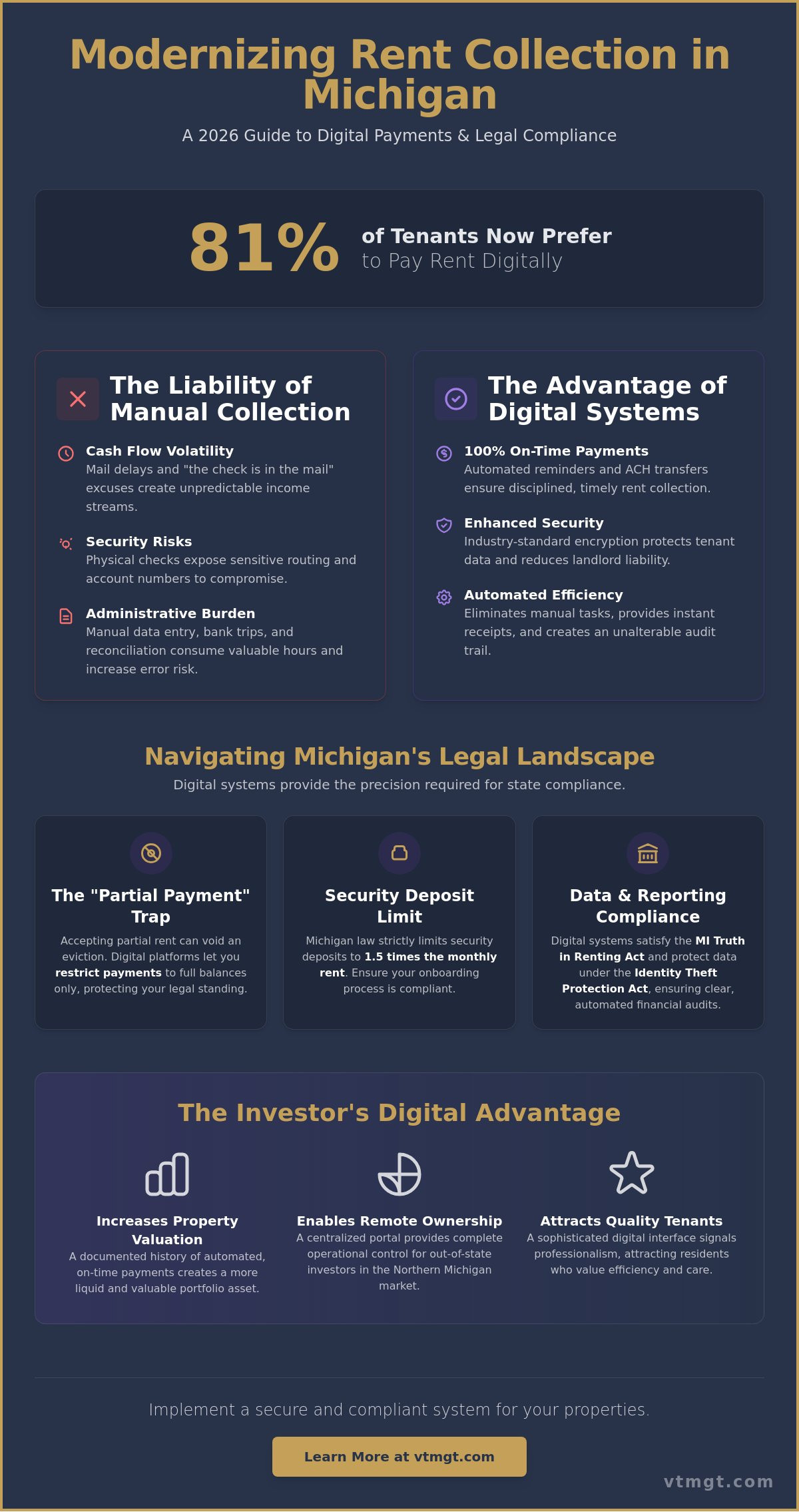
Recent data confirms that 81% of tenants now prefer to settle their obligations through digital channels. For property owners, adopting a structured system for online rent collection for landlords Michigan is no longer a matter of simple convenience; it is a technical requirement for maintaining a disciplined and legally sound financial operation. Inconsistent record-keeping and the manual pursuit of late payments introduce unnecessary variables into what should be a precise, professional process.
We recognize that navigating Michigan's specific regulations, such as the 1.5 times security deposit limit and the 2025 source of income protections, requires a high level of professional oversight. You require a system that ensures 100% on-time payments and absolute clarity for your annual financial audits. This guide provides the framework to implement a secure, compliant system that eliminates payment disputes and automates your reporting. We'll analyze the current 2026 landscape, including electronic communication standards and the latest legislative trends, to ensure your property management remains efficient and stable.
Key Takeaways
- Mitigate legal risks by understanding Michigan’s "partial payment" regulations and how digital systems provide automated receipt compliance for every transaction.
- Evaluate the transition from manual check processing to high-efficiency ACH and cloud-based portals to ensure financial stability and 100% on-time payments.
- Identify the most effective platform for your specific portfolio by analyzing transaction fee structures and platform scalability from Petoskey to Grand Rapids.
- Implementing online rent collection for landlords Michigan allows for the seamless integration of real-time data into professional financial reporting and accounting systems.
- Discover how to align your existing lease agreements with modern digital payment standards to ensure an enforceable, transparent, and legally sound collection process.
The Evolution of Rent Collection for Michigan Landlords
Online rent collection for landlords Michigan represents a fundamental shift from manual, error-prone tasks to a standardized, cloud-based financial management system. In 2026, the industry has moved beyond the physical transport of currency in favor of robust e-commerce payment systems that utilize ACH transfers and dedicated tenant portals. This transition isn't merely about speed. It's about establishing a rigorous, unalterable audit trail that provides real-time transparency for both owners and residents. For investors, this digital precision directly impacts property valuation. A portfolio with documented, automated cash flows and a history of on-time payments is a more liquid and valuable asset. It demonstrates a level of operational maturity that traditional ledger books cannot match.
Why Paper Checks are a Liability in 2026
Physical checks introduce unacceptable variables into a professional property management operation. Mail delays and the classic "check is in the mail" excuse create cash flow volatility that complicates maintenance scheduling and tax planning. Beyond simple logistics, handling paper checks exposes both parties to security vulnerabilities. Physical documents contain sensitive routing and account numbers that are easily compromised during transport or storage. The administrative burden is also significant. Manual data entry, physical bank trips, and the reconciliation of disparate payment dates consume hours of productive time. In a high-precision environment, these manual steps are seen as failure points that increase the risk of accounting errors.
The Digital Advantage for Northern Michigan Investors
Automation serves as the essential infrastructure for remote ownership, particularly for out-of-state investors targeting the Northern Michigan market. A centralized portal ensures that distance doesn't compromise operational control. These systems integrate payment data directly with Michigan landlord laws, ensuring that every transaction meets state-mandated receipt requirements and documentation standards. Providing a sophisticated digital interface also signals professionalism to high-quality tenants. It establishes a disciplined framework for the landlord-tenant relationship from day one. This approach attracts residents who value efficiency, which typically results in better property care and longer lease durations. By implementing online rent collection for landlords Michigan, owners can maintain a fegyelmezett (disciplined) and growth-oriented portfolio regardless of their physical location.
Michigan Legal Compliance and Digital Payments
Compliance in the Michigan rental market requires a disciplined approach to documentation and financial record-keeping. While state law traditionally focused on mandates for cash payment receipts, modern online rent collection for landlords Michigan provides a superior technological solution by generating an immutable digital record for every transaction. This level of precision satisfies the legal burden of proof during potential disputes. It also ensures adherence to the Michigan Truth in Renting Act, which requires that all payment terms and digital disclosures are presented clearly without deceptive clauses. Establishing this transparent framework is a prerequisite for any professional property operation.
Landlords must remain vigilant regarding the "partial payment" trap during eviction proceedings. In Michigan, accepting a fraction of the total rent owed can inadvertently stay or void an eviction case for non-payment. Professional digital systems allow owners to restrict payment amounts, ensuring that only full balances are accepted once a legal notice has been served. When evaluating digital rent payment services, the ability to toggle payment limits is a critical security feature for risk mitigation. This technical control prevents tenants from resetting the legal clock through unauthorized minor payments.
Managing tenant financial data involves significant responsibility under the Michigan Identity Theft Protection Act. Online platforms must utilize industry-standard encryption to protect routing numbers and personal identifiers. A structured digital ecosystem ensures that this sensitive data is never stored on unsecured local hardware, reducing the owner's liability in the event of a data breach. Maintaining these high standards of data integrity is essential for long-term operational stability.
Managing Late Fees under Michigan Law
Michigan courts typically uphold late fees that are deemed "reasonable" and compensatory rather than punitive. Automated systems eliminate the subjectivity of manual enforcement, applying fees with mathematical consistency across the entire portfolio. This uniformity is essential for defending against potential discrimination claims. Michigan law requires that all late fee structures are clearly defined and transparently disclosed within the written lease agreement.
The Intersection of Rent and Security Deposits
Legal compliance requires the strict separation of rent payments and security deposit funds. According to Michigan law, deposit funds must be held in a regulated financial institution and accounted for in a distinct ledger. Mixing these funds is a common regulatory failure that online rent collection for landlords Michigan helps avoid through automated sub-ledgering. Accurate record-keeping is particularly vital when reconciling rental property maintenance in Northern Michigan against deposit returns at the end of a tenancy. Maintaining this level of financial discipline protects the owner’s capital and professional reputation. Owners seeking to institutionalize these processes often benefit from professional lease agreement preparation to ensure all digital payment clauses are fully enforceable.
Evaluating Online Rent Collection Platforms
Selecting the technical infrastructure for online rent collection for landlords Michigan requires a comparative analysis of payment methods and data integrity. Automated Clearing House (ACH) transfers remain the industry standard for their low transaction overhead and direct bank-to-bank reliability. While credit and debit card options provide tenants with flexibility, they often introduce processing fees that typically range from 2.95% to 3.5%. Landlords must determine whether to absorb these operational costs or configure the system to pass them to the tenant as a convenience fee. A professional platform doesn't just move money; it categorizes every dollar to ensure 1099-K compliance and streamlined year-end tax preparation. This level of accounting precision is vital for maintaining a clean audit trail across a diverse property portfolio.
Tenant-facing features significantly influence collection rates. Systems that support "Auto-pay" configurations reduce the risk of human error and late payments. Additionally, current 2026 trends and proposed Michigan legislation, such as SB 795, highlight the value of reporting positive rent history to credit bureaus. This feature incentivizes on-time payments by helping tenants build their credit profiles, creating a mutually beneficial ecosystem. When these technical components work in unison, the result is a stabilized cash flow and reduced administrative friction.
Security Features You Cannot Overlook
Data protection is a non-negotiable requirement for any digital financial system. Professional platforms must adhere to PCI DSS compliance standards and utilize bank-level 256-bit encryption to safeguard sensitive financial identifiers. Implementing Two-Factor Authentication (2FA) for both landlords and tenants adds a critical layer of defense against unauthorized access. These security protocols aren't optional; they're the foundation of a legally defensible operation. In the event of a Michigan legal dispute, a secure, timestamped audit trail serves as objective evidence of payment history and communication.
Integration with Property Management Systems
Fragmented payment applications like Venmo or Zelle lack the structural depth required for professional property oversight. These standalone tools don't link payments to specific lease terms or maintenance work orders, leading to data silos that complicate financial reporting. A unified system ensures that payment data flows directly into your accounting and leasing modules. This integrated approach is a hallmark of professional rental management in Charlevoix, where stability is built on technical precision. By avoiding disconnected apps, owners ensure their financial data remains centralized, accurate, and ready for scaling.
Steps to Transition Your Tenants to Online Payments
Transitioning to a standardized system for online rent collection for landlords Michigan requires a disciplined implementation strategy. This process is not merely a technical migration; it is a recalibration of your operational workflow that demands clear communication and a logical rollout. Successful adoption hinges on removing variables that cause friction between the landlord and the resident. By following a structured transition plan, owners ensure that their digital systems are fully integrated with their long-term financial goals without disrupting monthly cash flows.
The first step involves a rigorous review of your existing Michigan lease agreements. If your current contracts do not explicitly define digital payment methods, you must prepare a formal lease addendum. This document should specify the selected portal as the primary channel for all future transactions. When selecting a platform, ensure it aligns with your specific portfolio size, whether you are managing a few residential units in Petoskey or a complex commercial asset in Grand Rapids. The technical infrastructure must be scalable and capable of handling the specific demands of your property type.
Once the platform is selected, draft a formal "Notice of Change in Payment Method" and distribute it to all residents at least 30 days prior to the mandatory start date. During the initial 30-day onboarding phase, we recommend providing a "Grace Period." This allows tenants to familiarize themselves with the new interface without the immediate pressure of late fees, which builds trust and ensures a smoother long-term transition. Standardizing the troubleshooting process for common technical issues ensures that portal setup does not become an excuse for payment delays.
Updating Your Michigan Lease Agreements
For all new tenancies, the online portal should be established as the mandatory payment channel from day one. Your lease must clearly define cut-off times for "on-time" digital timestamps to prevent disputes over late payments. Additionally, specify the consequences of failed ACH transfers, including standardized Non-Sufficient Funds (NSF) fees. This level of detail ensures that your financial processes remain transparent, enforceable, and fully compliant with state regulations.
Onboarding Tenants for Success
Providing a simple, one-page PDF guide for portal setup significantly reduces technical support requests. Emphasize the benefits to the tenant, such as the ability to build credit history through on-time payments, which aligns with modern 2026 reporting trends. Address common concerns regarding automated withdrawals and data privacy by highlighting the bank-level encryption standards of the system. A proactive approach to tenant education minimizes administrative friction and stabilizes your monthly revenue. If you require assistance with Lease Agreement Preparation to facilitate this transition, our team provides the necessary legal and technical framework.
The Van Treese Approach: Integrated Financial Systems
Van Treese Management utilizes a disciplined, engineering-grade framework to manage property assets with technical precision. Our ecosystem for online rent collection for landlords Michigan is not a standalone utility; it's a core component of a broader financial architecture designed for stability and growth. We prioritize the elimination of manual variables, ensuring that every transaction is mapped to the correct sub-ledger without human error. This systematic approach provides Northern Michigan owners with a robust defense against legal liability by maintaining an immutable, timestamped record of all financial interactions. By institutionalizing these processes, we transform property management from a series of reactive tasks into a structured, predictable operation.
We believe that the highest level of efficiency is achieved through the synergy of human expertise and standardized systems. While our software handles the rigorous data processing and collection tasks, our professional team provides the necessary oversight to resolve complex tenant relations and local market challenges. This balance ensures that your portfolio benefits from modern technological innovations without losing the nuanced judgment required for high-stakes property decisions. Transparency remains a fundamental requirement of our partnership. Every owner receives comprehensive monthly financial reporting that provides a hierarchical view of property performance, from gross revenue to net operating income, ensuring you maintain full control over your investment's trajectory.
Beyond Collection: Full-Cycle Financial Management
Our financial oversight extends far beyond simple rent processing. We manage the entire fiscal lifecycle of the asset, including automated utility bill-backs and maintenance deductions that are reconciled in real-time. This level of granularity is essential for those investing in rental property in Northern Michigan, where accurate ROI calculations depend on precise expense tracking. Our team also handles the complexities of 1099 reporting and year-end accounting, providing a "tax-ready" package that simplifies your annual filings. This full-cycle approach ensures that your property's financial health is documented and optimized throughout the year.
Local Expertise from Petoskey to Grand Rapids
Operational success in Northern Michigan requires a physical presence that matches our digital capabilities. With deep roots in Emmet and Charlevoix counties, our team provides localized oversight from Petoskey to Grand Rapids. We understand that payment stability is often linked to property condition, which is why our maintenance coordination and emergency response protocols are integrated into our management model. This localized accountability ensures that your assets are protected and your tenants are supported. We invite property owners to experience a hands-off approach to Michigan landlording, where technical precision and professional management converge to create long-term stability.
Advancing Your Property Management Infrastructure
Modernizing your financial infrastructure is a technical requirement for ensuring long-term operational stability. By shifting away from manual check processing, you eliminate security vulnerabilities and administrative delays that impede growth. A disciplined approach to online rent collection for landlords Michigan ensures that every transaction is documented, compliant with state law, and integrated into a rigorous audit trail. This transition protects your capital while establishing the professional transparency required for a mature property portfolio.
Since 2018, we've implemented standardized management systems that maximize ROI for owners across Petoskey, Charlevoix, and the broader Northern Michigan region. Our framework combines technical precision with 24/7 emergency response coordination to ensure your assets are protected and maintained to the highest standards. Transform your rental business with Van Treese Management’s professional systems. Establishing these rigorous standards today creates a foundation for a scalable, resilient investment portfolio that is prepared for future market shifts and regulatory developments.
Frequently Asked Questions
Is it legal to require online rent payments in Michigan?
Michigan law permits landlords to accept any form of rent they deem appropriate, including online payments. No state statute prohibits a landlord from requiring digital payments as the primary method of collection. To ensure this requirement is enforceable, the specific payment method must be clearly defined within the written lease agreement.
How do I handle tenants who do not have a bank account or internet access?
Professional systems for online rent collection for landlords Michigan often include electronic cash payment (ECP) options to accommodate unbanked residents. These services allow tenants to pay rent in cash at participating retail locations, which then generates a digital receipt and updates the landlord's ledger automatically. This approach ensures compliance with the 2025 source of income protections while maintaining a standardized digital record.
What are the typical fees for online rent collection in 2026?
ACH transfers typically involve a flat convenience fee of approximately $2.50 per transaction, which is often paid by the tenant. Credit and debit card payments generally incur processing fees ranging from 2.95% to 3.5%. Landlords must decide during the system configuration whether to absorb these costs as an operational expense or pass them to the resident.
How does online rent collection affect the Michigan eviction process?
Digital systems provide an immutable audit trail that serves as objective evidence in Michigan courts during non-payment cases. These platforms allow landlords to block all payment attempts once a legal notice is served. This technical control is vital for preventing tenants from resetting the eviction timeline by making unauthorized payments after a case has been filed.
Can I stop a tenant from making a partial payment online?
Yes, professional property management portals allow owners to disable partial payment functionality. This ensures that the system only accepts the full balance owed, which is a critical safeguard during legal disputes. By toggling this setting, landlords avoid the "partial payment trap" that can stay or void an eviction proceeding in Michigan.
Are online rent payments more secure than traditional checks?
Online rent collection for landlords Michigan is significantly more secure than handling physical checks. Digital platforms utilize bank-level 256-bit encryption and PCI-compliant protocols to protect sensitive financial data. This eliminates the risk of mail theft and ensures that routing and account numbers aren't exposed on paper documents during transport or storage.
How long does it take for funds to reach my bank account?
Standard ACH transactions generally require 3 to 5 business days to clear and reach the landlord's designated bank account. While some platforms offer accelerated or real-time funding options, the timeline depends on the specific technical architecture of the selected service. Automated systems provide clear status updates so owners can track the progress of every transfer.
Does Van Treese Management provide online portals for all managed properties?
We provide a secure, standardized online portal for every property within our residential and commercial management portfolios. This integrated system centralizes all rent collection, financial reporting, and maintenance coordination into a single transparent ecosystem. Our approach ensures that every owner has real-time access to their property's financial performance through a disciplined digital framework.