
Best Way to Collect Rent from Tenants: A 2026 Guide to Reliable Systems

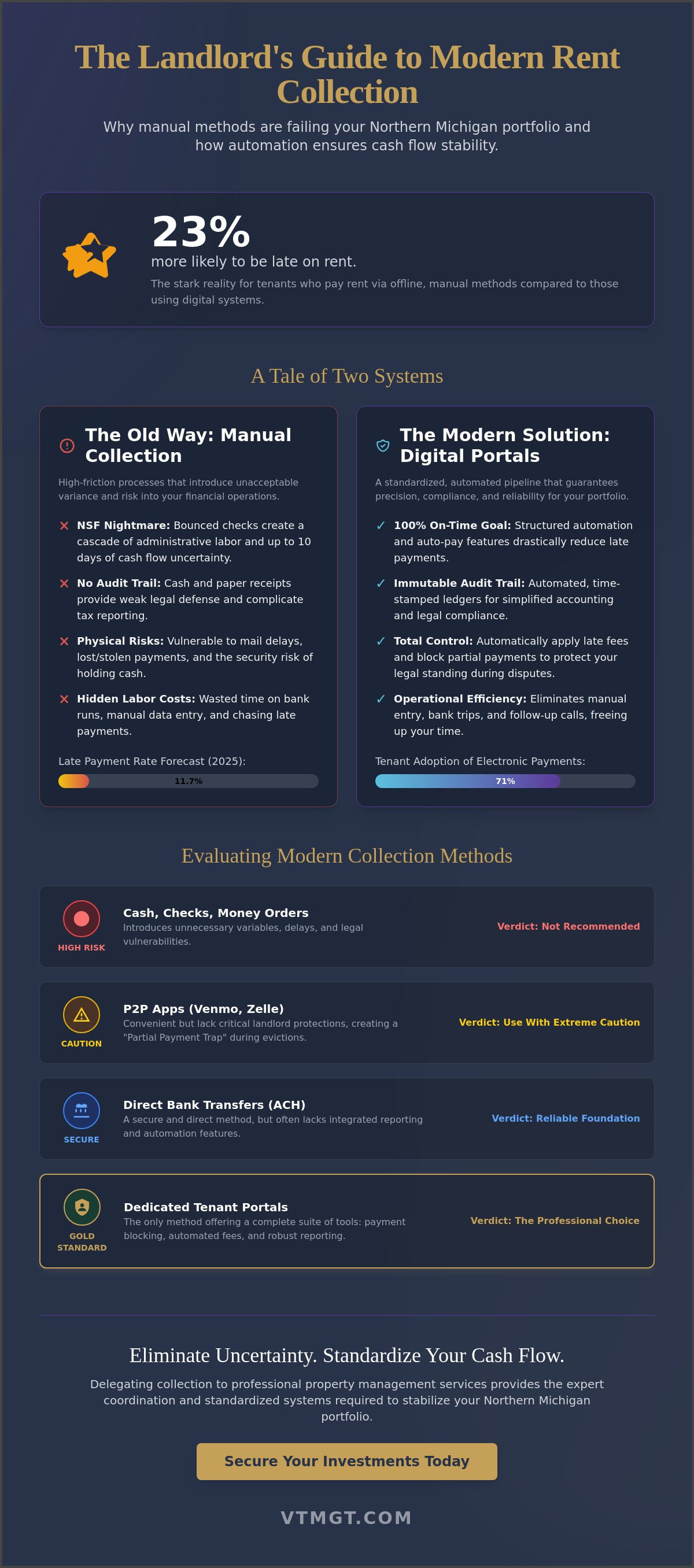
Recent data indicates that tenants who pay rent offline are 23% more likely to be late than those utilizing digital systems. With late payment rates for independent rentals rising to 11.7% in 2025, relying on manual collection methods is no longer a sustainable strategy for property owners. Identifying the best way to collect rent from tenants is not merely a matter of convenience; it is a fundamental requirement for the standardized engineering of your property's cash flow. Ensuring a precise, automated pipeline for your Northern Michigan investments is the only way to maintain the stability your portfolio requires.
We recognize the operational strain caused by chasing late payments and the lack of a clear digital audit trail for tax reporting. You need a system that functions with professional precision, removing the uncertainty of bounced checks and manual entry. This guide outlines the most secure, legally compliant methods to ensure 100% on-time rent collection through structured automation. We will examine specialized platforms that offer automated late fee applications and rigorous financial reporting, providing you with the technical framework necessary for modern residential and commercial property management.
Key Takeaways
- Transition from outdated manual processes to automated digital portals to achieve the precision and reliability required for modern cash flow management.
- Identify why implementing a centralized electronic system is the best way to collect rent from tenants while ensuring a robust audit trail for tax and accounting purposes.
- Eliminate the operational instability of bounced checks and "non-sufficient funds" cycles by adopting secure, time-stamped payment technologies.
- Establish a standardized onboarding protocol to train tenants on your collection system, reinforcing lease compliance and reducing the need for manual follow-up.
- Explore how delegating to professional property management services can stabilize your Northern Michigan portfolio through expert coordination and standardized systems.
Evaluating Modern Rent Collection Methods: From Cash to Portals
The transition toward automated financial systems in 2026 isn't a matter of preference but a requirement for operational stability. For Northern Michigan property owners, determining the best way to collect rent from tenants requires an objective analysis of system reliability and precision. Manual collection methods, once the industry standard, now represent a significant point of failure in the cash flow pipeline. Modern systems must pass a "Precision Test," ensuring every transaction generates an immutable audit trail that satisfies both tax requirements and legal standards established in the lease agreement. When you calculate the time-cost of manual deposit runs, including fuel and administrative labor, the inefficiency of physical collection becomes clear.
Reliable systems are built on four pillars: physical payments, P2P applications, bank transfers, and dedicated tenant portals. While 71% of tenants now utilize electronic methods, many owners still struggle with fragmented processes that lack structural integrity. The best way to collect rent from tenants involves moving away from high-friction manual tasks toward a standardized digital infrastructure that guarantees transparency for both parties.
The Reality of Physical Payments
Physical currency and checks introduce unnecessary variables into your financial reporting. In Northern Michigan, rural mail routes and seasonal weather patterns create unpredictable delays that disrupt the consistency of your cash flow. Relying on the postal service means accepting the risk of lost or stolen payments, which can take weeks to rectify. Processing money orders and cashier's checks adds another layer of hidden labor, requiring physical trips to financial institutions and manual data entry. Cash is a liability; it lacks an inherent digital timestamp and leaves you vulnerable to disputes regarding the exact date and time of receipt.
Digital Platforms and P2P Apps
While P2P apps like Venmo and Zelle offer immediate convenience, they aren't designed for the complexities of professional property management. These platforms often lack robust reporting features, making it difficult to generate a clean audit trail for year-end accounting. A critical risk is the "Partial Payment" trap. Most P2P apps don't allow you to decline a partial payment. If you're in the middle of an eviction process, accepting even a small fraction of the rent can legally reset the timeline, forcing you to start the 7-day notice period over again.
ACH transfers and specialized portals remain the gold standard for secure, direct-to-bank transactions. These systems allow for automated late fee application and the ability to block partial payments during legal disputes. By utilizing a structured digital environment, you ensure that your financial processes are both scalable and legally compliant.
The Risks of Manual Collection: Why Cash and Personal Checks Fail
Manual collection processes introduce an unacceptable level of variance into property financial operations. When owners accept physical payments, they essentially opt into a system defined by high friction and low transparency. Identifying the best way to collect rent from tenants requires a shift toward eliminating variables that lead to human error or administrative instability. Accepting cash or personal checks creates a "Non-Sufficient Funds" (NSF) cycle that can take up to ten days to resolve, leaving your cash flow in a state of uncertainty. This lack of structural integrity forces you to manage by crisis rather than by protocol.
The legal burden of manual collection is equally significant. Without a digital timestamp, proving the exact moment of payment becomes a matter of conflicting testimony. In Emmet County courts, manual receipts are often viewed as a weak defense compared to automated, time-stamped ledgers. Relying on paper trails increases the risk of accounting discrepancies, which can compromise your financial reporting and hinder your ability to secure financing for future acquisitions. The best way to collect rent from tenants involves moving toward a unified digital system that removes the possibility of bookkeeping mistakes.
The NSF Nightmare
A bounced check represents more than just a bank fee. It triggers a cascade of administrative labor, from issuing a 7-day notice to quit to recalculating late fees and adjusting ledgers. These common rent collection challenges disrupt your ability to meet monthly mortgage obligations and maintenance schedules with precision. Standardized response protocols are difficult to maintain when every tenant uses a different payment method, leading to operational chaos that drains your time and resources.
Security and Compliance Concerns
Handling tenant banking information manually introduces unnecessary privacy risks and liability. To maintain a clean rent ledger that complies with Michigan landlord laws, you must have a system that records every transaction with architectural accuracy. Manual bookkeeping is inherently prone to error, which can lead to disputes over security deposit returns or rent increases. Transitioning to professional property management ensures these processes are handled within a disciplined, structured framework that protects your investment from avoidable legal and financial risks.
Top Online Rent Collection Tools and Platforms for 2026
Selecting a platform for financial transactions requires a disciplined evaluation of its structural integrity and reporting capabilities. For Northern Michigan property owners, the best way to collect rent from tenants involves utilizing software that acts as a centralized command center for all property operations. We evaluate these tools based on three primary criteria: the precision of their automation, the depth of their financial reporting, and the friction-level of the tenant interface. A system that fails to provide an immutable audit trail is an operational liability that your portfolio cannot afford.
Generalist tools such as Zillow and Apartments.com offer basic functionality that may suffice for single-unit DIY landlords, but they often lack the technical depth required for scaling a portfolio. These platforms typically prioritize listing visibility over robust accounting. In contrast, specialized landlord software like Buildium, AppFolio, and Hemlane provides a structured environment where rent collection is integrated into a broader ecosystem of property oversight. While transaction fees vary across these platforms, the cost is offset by the significant reduction in administrative labor and the elimination of manual bookkeeping errors.
Enterprise-Grade vs. DIY Software
Enterprise-grade systems provide superior protection through features like the "partial payment block," which is essential during legal disputes or eviction proceedings. These platforms allow for automated late fee calculations that synchronize precisely with the specific terms outlined in your lease. Furthermore, these systems offer seamless integration with rental property maintenance Northern Michigan coordination. When rent collection and maintenance requests exist within the same digital framework, you gain a comprehensive view of your property’s net operating income without the need for fragmented data entry.
Tenant Adoption Strategies
The best way to collect rent from tenants is to ensure the system is as accessible as it is secure. Technology barriers can be a concern for non-digital-native tenants, so we recommend selecting platforms with mobile-first interfaces that allow for payments via smartphone apps. Standardization is key to successful adoption. By making digital payment a non-negotiable requirement in the lease agreement, you establish a professional expectation from day one. To facilitate a smooth transition, provide tenants with a structured onboarding guide that details how to set up recurring ACH transfers. This proactive approach reduces the likelihood of "forgotten" payments and ensures your cash flow remains predictable throughout the year.
Setting Up Your Collection System for 100% On-Time Payments
A high-performance rent collection system is built on the rigorous application of standardized protocols. Determining the best way to collect rent from tenants involves more than just selecting a digital tool; it requires the integration of legal compliance with technological precision. Establishing a "No Partial Payments" rule is a critical component of this framework. In Michigan, accepting even a small fraction of the rent can complicate or reset the eviction timeline, making it essential to use a system that allows you to block incomplete transactions during legal disputes. By removing the possibility of variance, you maintain full control over the financial health of your portfolio.
Michigan law provides landlords with significant flexibility regarding late fees, as there is no state-mandated cap on the amount charged. However, any late fee policy must be explicitly defined in the lease agreement to be enforceable. Research indicates that properties with a clear late fee policy achieve a 91% on-time collection rate, compared to 89% for those without one. To ensure compliance and maximize efficiency, your system must automate these assessments based on the specific terms you have established. For owners seeking to implement these rigorous standards without managing the daily administrative burden, our Residential Property Management services provide a turnkey solution.
Drafting the Rent Clause
The rent clause in your lease must be architecturally sound to prevent disputes. You must clearly define what constitutes "received" payment. In a digital environment, this typically refers to the date the transaction is initiated in the portal, rather than the date the funds settle in your bank account. Specifying a single, preferred payment portal eliminates ambiguity and prevents tenants from attempting to use non-standardized methods like cash or P2P apps. Your clause should outline the exact timeline for late fee triggers, including any grace periods you choose to offer, though Michigan law does not mandate a specific grace period.
The Automation Workflow
Precision timing is the core of effective collection. We recommend an automated reminder sequence that triggers five days, three days, and one day before the due date. These nudges reduce the likelihood of "forgotten" payments and reinforce the professional nature of the relationship. Syncing your collection portal with your financial reporting system ensures that every payment is recorded with a digital timestamp, providing the audit trail necessary for tax compliance and legal protection. A standardized collection system serves as the foundational architecture for maximizing property ROI.
Professional Management: The Ultimate Solution for Northern Michigan Landlords
Transitioning from a self-managed approach to professional oversight marks the evolution from being a landlord to becoming a disciplined investor. While digital tools provide the necessary infrastructure, the best way to collect rent from tenants at scale is through the implementation of a comprehensive management system. Professional delegation removes the individual from the high-friction environment of manual follow-ups and late-fee disputes. By placing a structured organization between the owner and the tenant, you ensure that every transaction is handled with technical precision and professional distance. This shift allows you to focus on portfolio growth while we manage the granular details of operational stability.
Professional oversight eliminates the emotional friction that often complicates rent collection. When an owner manages their own assets, personal relationships can sometimes lead to inconsistencies in lease enforcement. A standardized system, however, operates without bias. It ensures that every tenant is subject to the same rigorous protocols for payment deadlines and late fee applications. This level of consistency is vital for maintaining the structural integrity of your cash flow and ensuring that your Northern Michigan properties remain compliant with evolving state regulations. Our approach combines these high-efficiency digital systems with local expertise to provide a balanced, reliable framework for your assets.
The Van Treese Advantage
Our commitment to professional property management is rooted in the belief that stability in rent collection builds thriving local communities. In Petoskey and the surrounding areas, we implement standardized systems that synchronize maintenance coordination with financial oversight. This integration provides you with precision financial reporting and monthly statements that simplify tax season. You no longer have to reconcile fragmented data from multiple apps or bank accounts. Instead, you receive a consolidated, audit-ready report that reflects the actual performance of your investment. We treat the engineering of your cash flow with the same rigor found in high-precision manufacturing processes.
Next Steps for Your Portfolio
The best way to collect rent from tenants starts with a thorough gap analysis of your current processes. We recommend evaluating your existing collection methods for points of failure, such as manual entry errors or lack of "partial payment" blocks. If your current system requires more than a few minutes of oversight per month, it is likely an inefficient use of your labor. The transition to our professional systems is a structured migration process. We handle the onboarding of your tenants, the preparation of compliant lease agreements, and the setup of automated digital portals. Contact Van Treese Management to discuss how we can stabilize your Northern Michigan assets through professional Residential Property Management and expert financial reporting.
Optimizing Your Property's Financial Infrastructure
Successful property management requires a transition from reactive habits to structured, high-precision systems. We've examined how digital automation and rigid lease enforcement create the predictable cash flow necessary for sustained asset growth. By removing the volatility of manual collection, you protect your legal standing and ensure that your financial reporting remains audit-ready. Implementing a standardized digital pipeline is the best way to collect rent from tenants while maintaining the professional boundaries required for long-term stability.
Since 2018, our team has applied these disciplined management principles to properties throughout Emmet and Charlevoix counties. We provide the technical framework, maintenance coordination, and precision accounting required to transform your rental business into a high-performing investment. You don't have to manage the complexities of evolving Michigan regulations alone. Streamline your portfolio with Van Treese Management to secure your property's future with the region's most reliable oversight.
Frequently Asked Questions
Is Venmo a safe way to collect rent from tenants in 2026?
Venmo remains an unsuitable platform for professional rent collection due to its lack of landlord-specific protections. Using personal accounts for business transactions violates their terms of service and risks immediate account suspension. These apps don't allow you to block partial payments, which is a critical failure if you need to initiate legal proceedings or maintain a clean audit trail.
What are the legal limits for late fees in Michigan?
Michigan law does not currently impose a state-mandated cap on late fees. Any fee policy you implement must be explicitly stated in the signed lease agreement to be legally enforceable. While there is no specific dollar limit, fees should remain reasonable to withstand potential judicial review in local courts and maintain the structural integrity of your tenant relations.
Can I require my tenants to pay rent online only?
You can require online payments as long as the requirement is clearly defined in the lease and doesn't violate fair housing accessibility standards. Providing a digital-only option is often the best way to collect rent from tenants while ensuring operational consistency across your portfolio. Owners should ensure the selected platform is accessible via standard web browsers for those without mobile devices.
What should I do if a tenant only sends a partial rent payment?
You should immediately return or refuse any partial payment if you intend to proceed with an eviction. Accepting even a small portion of the rent can legally invalidate a 7-day notice to quit in Michigan, forcing you to restart the legal timeline. Utilizing enterprise-grade software allows you to programmatically block anything less than the full balance due to protect your legal standing.
How do I handle rent collection for tenants who don't use smartphones?
Tenants who don't utilize smartphones can still participate in digital systems through traditional web portals or automated ACH transfers initiated through their bank. Many professional platforms also offer retail-based payment solutions where tenants pay at a participating location, which then syncs a digital receipt to your ledger. This ensures you maintain a digital audit trail regardless of the tenant's hardware preferences.
What is the best way to track rent payments for tax purposes?
Utilizing integrated property management software is the most effective method for tracking payments for tax purposes. These systems generate an immutable audit trail and produce monthly financial statements that simplify year-end accounting processes. This structured approach is the best way to collect rent from tenants while maintaining the technical precision required for professional financial reporting.
Does Michigan law require a grace period for rent payments?
Michigan law does not require landlords to provide a grace period for rent payments. Rent is legally due on the date specified in the lease agreement. If a tenant fails to pay by that date, you're permitted to issue a 7-day notice to quit immediately, provided your lease doesn't specify a voluntary grace period.
How does professional property management handle non-payment and evictions?
Professional property management companies handle non-payment through a disciplined, multi-step protocol that removes emotional bias from the process. This includes automated reminders, the immediate issuance of 7-day notices upon default, and direct coordination with legal counsel for eviction filings. This structured oversight ensures your assets remain protected and compliant with all evolving Michigan rental regulations.